
.svg)
.svg)
.svg)
.svg)


.svg)
Journey Foods' neural network used for recipe generation.

.svg)
Journey Foods’ AI-driven software is an industry leader when it comes to helping CPG companies find the best ingredients and materials to both make and package their product. However, a secondary expertise we also excel in is generating recipes based on neural networks - a relatively new technology that helps businesses and consumers come up with innovative food ideas.
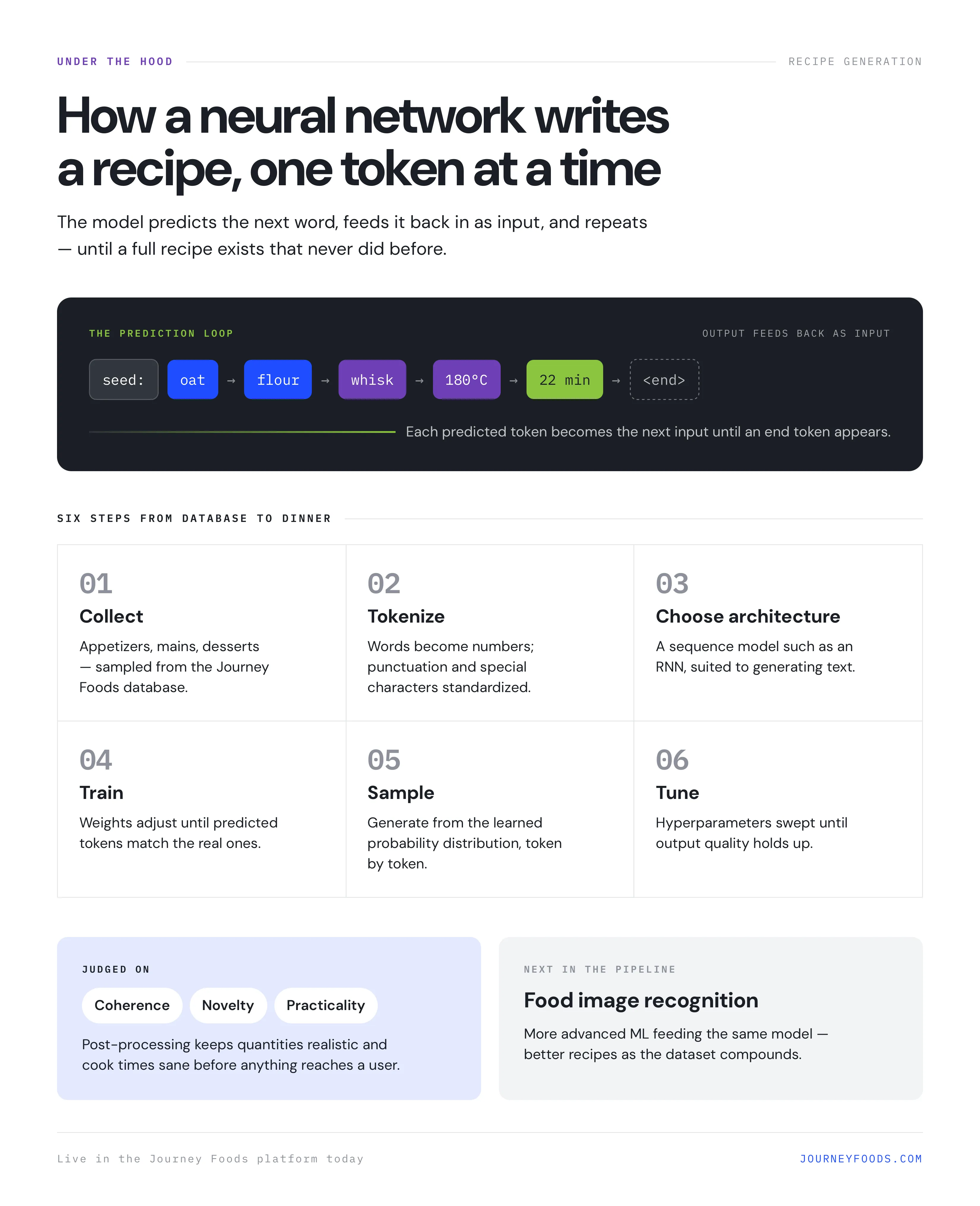
Generating recipes using neural networks involves training a model on a dataset of existing recipes and then sampling from the trained model to generate new recipes. Because our Journey Foods database is so extensive, there is a wealth of data to sample from in this regard, making data collection a cinch. These datasets range from all kinds of recipes: appetizers, main courses, desserts, and many more.
After the data is collected, the preprocess begins; the text is tokenized by converting words into numerical representations. This also involves standardizing the text, removing punctuation, and handling any special characters. Once this is done, a suitable neural network architecture is selected for generating text sequences, such as an RNN.
With the data ready and neural network model chosen, the model is then trained. This entails the model learning to predict the next token (word) in a sequence given the previous tokens. This process also involves adjusting the model's parameters (weights) to minimize the difference between the predicted tokens and the actual tokens in the dataset.
Once the model is trained, we use it to generate new recipes by sampling from the learned probability distribution of tokens. Starting from a seed text (e.g., a list of ingredients or a cooking instruction), the model predicts the next token, which is then fed back into the model as input to predict the subsequent token. This process continues until a predefined length is reached or an end token is generated. After generating a recipe, it is usually necessary to post-process the text to make it more readable or to ensure that it follows certain constraints (e.g., ensuring ingredient quantities are realistic, adjusting cooking times, etc.). Evaluating the generated recipes based on criteria such as coherence, novelty, and practicality is also important. The model is then fine-tuned by experimenting with different hyperparameters to improve the quality of the generated recipes.
Our model, which was perfected to meet our high level of standards, has now been deployed through our software that is available through our website. This novel technology is ripe and ready for users to start generating their own recipes. As Journey Foods continues to implement more advanced machine learning and AI into this process - such as food image recognition - our software is only predicted to improve further and deliver you the most delicious recipes available!
Scientist. Nutrition Leader. Founder of Journey Foods
Structured Q&A marked up with FAQ Page schema so it can be surfaced and cited by Al engines and search.
In Journey Al's 12 month dataset, the median plant protein reformulation came in -6.5% on raw material cost versus an animal protein control the first year that line went negative, driven by Tier 1 isolate suppliers reaching spec parity.
In Journey Al's 12 month dataset, the median plant protein reformulation came in -6.5% on raw material cost versus an animal protein control the first year that line went negative, driven by Tier 1 isolate suppliers reaching spec parity.
In Journey Al's 12 month dataset, the median plant protein reformulation came in -6.5% on raw material cost versus an animal protein control the first year that line went negative, driven by Tier 1 isolate suppliers reaching spec parity.