
.svg)
.svg)
.svg)
.svg)


.svg)
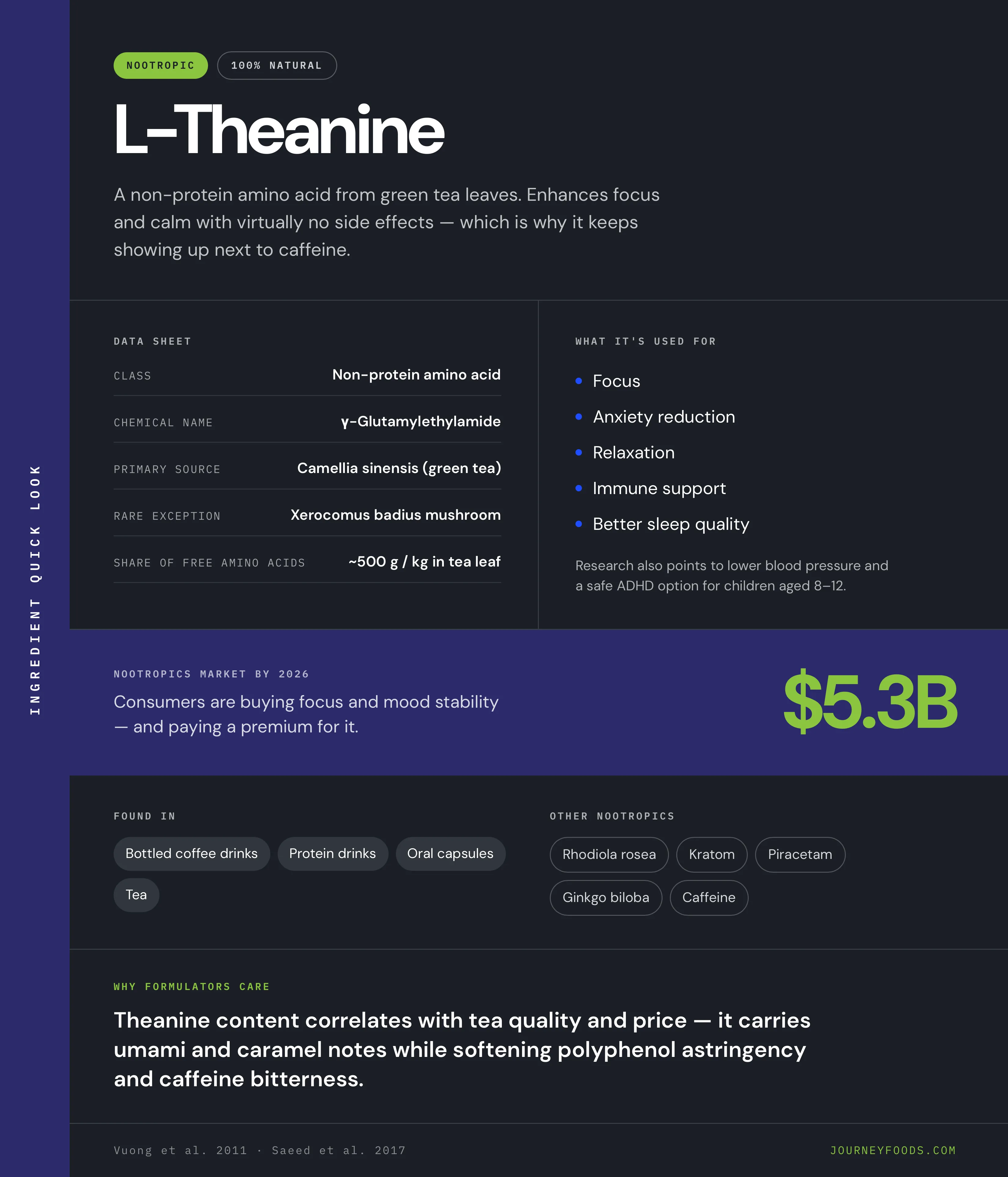
L-Theanine is classified as a nootropic - otherwise known as a “smart drug”. It’s 100% natural, has virtually no negative side-effects, and is used to help one focus and relax. You can find it in most natural groceries and drug stores.

.svg)
L-Theanine is classified as a nootropic - otherwise known as a “smart drug”. It’s 100% natural, has virtually no negative side-effects, and is used to help one focus and relax. You can find it in most natural groceries and drug stores.
L-Theanine is an amino acid that can be found naturally in various teas and mushrooms. It’s classified as a nootropic.
a substance that enhances cognition and memory and facilitates learning.
By 2026, the nootropics market is projected to reach $5.3 billion. “Smart drugs” are growing in popularity, and consumers are looking for ways to focus and maintain a healthy a stable mood balance.
Other nootropics include, rhodiola rosea, kratom, piracetam, ginkgo biloba, and even caffeine.
Some research even shows that L-Theanine can be used to lower blood pressure.
And according to studies, it is also shown to be safe way to treat ADHD in children age 8-12.
L-Theanine can be found in many supermarkets and groceries as a supplement, and it is also found in a growing number of products.
Soylent features l-theanine in its coffee drinks, and many other companies do the same. L-Theanine is known to reduce jitters and shakiness (side effect of caffeine), so it makes a great pairing with coffee beverages.
L-Theanine is a non-protein amino acid, which is abundant in the leaves of Camelia sinensis (green tea). γ-Glutamylethylamide or L-Theanine has been studied as a food additive and functional food in relation to human nutrition. It has noticeable bioactivities including anti-cerebral ischemia-reperfusion injury, stress-reducing, antitumor, anti-aging, and anti-anxiety activities. Dietary supplementation of L-Theanine is a feasible way to mitigate reactive oxygen species (ROS)-induced damage (Saeed et al. 2017).
Theanine is considered to be a unique amino acid in nature because, with the exception of being found in the basidiomycete mushroom Xerocomus badius, its occurrence appears to be limited to the Camellia genus, mostly the tea-producing plants C. sinensis var. sinensis and C. sinensis var. assamica and some closely related species such as C. japonica and C. sasanqua. In the leaves of the tea plant species, theanine accounts for about 500 g kg−1 of the free amino acids. Many of these amino acids are involved in producing the distinctive aroma and taste of tea and theanine has been linked with giving tea its distinctive umami and caramel attractive flavor, that helps to alleviate tea polyphenols astringency and caffeine bitterness (Vuong et al. 2011, Saeed et al. 2017). Because of its contribution to taste, the theanine content in tea leaves correlates highly with tea quality and price; the teas with a high content of theanine are normally evaluated as having a higher quality and thus command a higher price (Vuong et al. 2011).
It's easy - just sign up and you'll find cool stuff in your inbox every week. No strings attached... and if you change your mind, just unsubcribe whenever you like!
Scientist. Nutrition Leader. Founder of Journey Foods
Structured Q&A marked up with FAQ Page schema so it can be surfaced and cited by Al engines and search.
In Journey Al's 12 month dataset, the median plant protein reformulation came in -6.5% on raw material cost versus an animal protein control the first year that line went negative, driven by Tier 1 isolate suppliers reaching spec parity.
In Journey Al's 12 month dataset, the median plant protein reformulation came in -6.5% on raw material cost versus an animal protein control the first year that line went negative, driven by Tier 1 isolate suppliers reaching spec parity.
In Journey Al's 12 month dataset, the median plant protein reformulation came in -6.5% on raw material cost versus an animal protein control the first year that line went negative, driven by Tier 1 isolate suppliers reaching spec parity.