Case Study: How a CPG Brand Cut Ingredient Research Time by 64% Using Journey Foods


Quick answer
Ingredient research is one of the most time-consuming parts of product development — and one of the least talked about. R&D teams spend hours cross-referencing supplier specs, nutritional databases, cost data, and sustainability profiles before they can even begin formulating. That's not a process problem. That's a data problem.
Ingredient research is one of the most time-consuming parts of product development — and one of the least talked about. R&D teams spend hours cross-referencing supplier specs, nutritional databases, cost data, and sustainability profiles before they can even begin formulating. That's not a process problem. That's a data problem.
Journey Foods clients have cut ingredient research time by 64%. That's not a rounding error. That's the difference between a product that launches this quarter and one that gets stuck in review limbo for another six months.
Let me walk you through what that actually looks like on the ground.
The Problem: Fragmented Data Slows Every Decision
Most CPG R&D teams are working with ingredient data scattered across spreadsheets, supplier PDFs, internal wikis, and email chains. When a formulation question comes up — "Can we swap this fiber source for something with a cleaner label and lower cost?" — someone has to manually pull from four or five different places before they can even frame an answer.
This is the operating reality for product developers in 2026. The data exists. It's just not organized in a way that supports fast decisions.
The downstream effects compound quickly:
None of this is unique to one company. It's a structural issue across the CPG industry — and it's solvable.
What the Journey Foods Platform Actually Does
Journey Foods built its platform specifically for this problem. The core idea: give R&D and procurement teams a single place to search, score, and monitor ingredients across the dimensions that actually drive decisions.
Those dimensions include:
The AI-powered ingredient intelligence behind the platform doesn't just surface data — it generates recommendations. When you're evaluating a protein source, the system suggests alternatives ranked by your specific objectives, whether that's cost reduction, clean-label positioning, or nutritional equivalence.
That changes the workflow entirely. Instead of spending hours researching before you can make a decision, you're evaluating options the platform has already surfaced for you.
Where the 64% Time Savings Comes From
The efficiency gains aren't concentrated in one place. They compound across the research and formulation process.
Centralized Ingredient Search
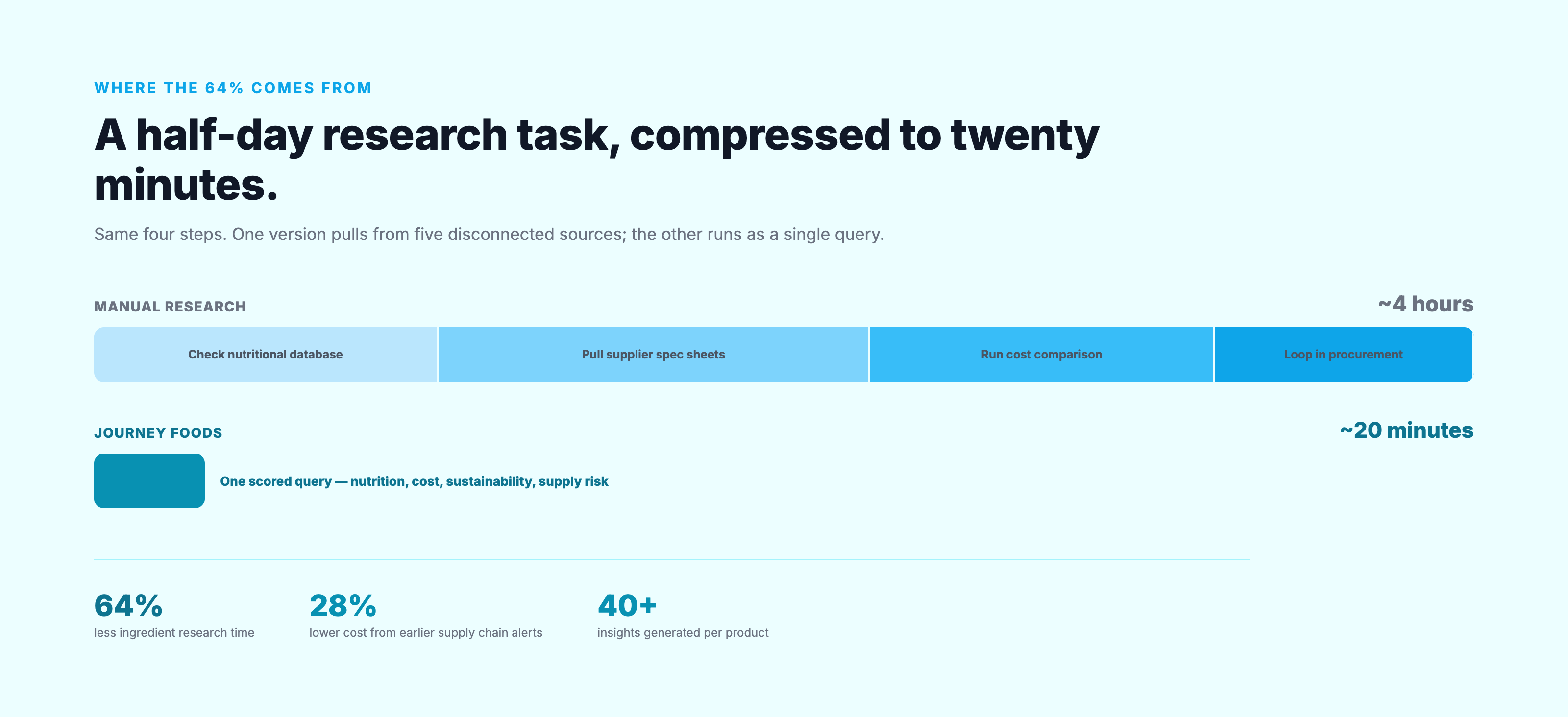
Before Journey Foods, a typical research session for a mid-size CPG team might involve checking a nutritional database, pulling supplier spec sheets, running a cost comparison in a spreadsheet, and looping in procurement to verify availability. That's a half-day task for something that should take 20 minutes.
With centralized ingredient search and scoring, all of that happens in one query. Filter by ingredient type, nutritional targets, cost range, or sustainability criteria — and you get a scored list of options with supporting data attached. The research phase that used to eat hours now takes minutes.
Version Control and Formulation History
One underappreciated time sink in CPG product development is the question: "Why did we change this ingredient three versions ago?" Without version control, someone has to dig through emails or meeting notes to reconstruct the decision history.
Journey Foods tracks formulation changes automatically. Every version is logged, every change is traceable, and the reasoning behind past decisions stays accessible. This matters especially when a product gets handed off between team members or when regulatory review requires documentation.
Supply Chain Alerts That Surface Problems Early
28% cost savings is the other headline number from Journey Foods clients — and a significant portion of that comes from catching supply chain issues before they force expensive emergency sourcing decisions.
The platform monitors supplier and market signals continuously and flags risks proactively. If a key ingredient faces a supply disruption or a price spike, the team sees it in the dashboard before it becomes a crisis. That gives procurement time to identify alternatives, negotiate better terms, or adjust formulations before costs escalate.
This kind of supply chain visibility is increasingly non-negotiable for CPG brands operating in volatile sourcing environments.
Real-World Impact: What Changes When Research Gets Faster
The 64% time reduction isn't just an efficiency metric. It changes what's possible for a product development team.
When research takes less time, R&D teams can evaluate more ingredient options before committing to a formulation — which means better products, not just faster ones. Teams that previously had bandwidth to test three or four ingredient variations before a deadline can now evaluate eight or ten. The quality of the final formulation improves because the decision came from a broader evidence base.
Faster research also compresses the feedback loop between concept and prototype. When a product developer can answer a formulation question in 20 minutes instead of half a day, the entire iteration cycle speeds up. More cycles in the same timeframe means more learning, faster product maturation, and a shorter path from concept to shelf.
For teams working toward sustainability goals, the speed improvement also frees up time to evaluate sourcing alternatives that align with company commitments. The platform's sustainability scoring makes it practical to factor environmental impact into every ingredient decision — not just the high-priority ones. That connects directly to the broader CPG push toward better sustainability practices across key suppliers.
Collaboration and Traceability: The Organizational Layer
Individual efficiency gains matter. But the bigger organizational win is what happens when the whole team works from the same data.
Journey Foods' centralized dashboard gives R&D, procurement, regulatory, and marketing teams a shared view of the product portfolio. Everyone sees the same ingredient data, the same formulation history, the same supply chain alerts. That eliminates the version control problems and miscommunications that slow cross-functional review.
40+ insights generated per product is the platform benchmark. That's not just data volume — it's structured, actionable information that makes cross-functional alignment faster. When procurement asks why R&D chose a particular ingredient, the answer is in the platform, not buried in someone's inbox.
This matters especially for CPG brands managing multiple product lines simultaneously. Portfolio management at scale requires organizational visibility that spreadsheets and shared drives simply can't provide. And as packaging and sustainability requirements tighten — including pressure to reduce single-use plastics in food packaging — traceable, documented ingredient decisions become a compliance asset, not just an operational convenience.
The Numbers Tell the Story
To put it plainly:
These aren't projections. They reflect what teams using the platform have actually achieved on the ground.
The underlying driver is straightforward: when ingredient data is organized, scored, and continuously monitored in one place, every decision that depends on that data gets faster and more confident. Research time drops. Sourcing risks surface earlier. Formulations improve because teams have the bandwidth to evaluate more options.
This isn't manual research with a better spreadsheet. This is AI-powered ingredient intelligence operating at the speed product development actually requires in 2026.
If you're evaluating whether Journey Foods fits your team's workflow, the right question isn't "can we afford this?" It's "what does six months of slow ingredient research cost us in delayed launches, missed windows, and emergency sourcing decisions?" For most CPG teams, that number is larger than they think.
Learn more and book a demo at JourneyFoods.io.
We'd love to hear from you! If you have questions about how the platform works — or want to share how your team handles ingredient research today — throw them in the comments below.
Find us on Instagram, LinkedIn, and X.
FAQs
What is the Journey Foods platform and who is it built for?
Journey Foods is an AI-powered software platform designed for CPG product development, R&D, and procurement teams. It centralizes ingredient search, scoring, supply chain monitoring, and formulation management in one place — so teams can make faster, more confident sourcing and development decisions.
How does Journey Foods reduce ingredient research time by 64%?
The platform consolidates ingredient data across nutrition, cost, sustainability, and supply chain risk into a single searchable interface. Instead of pulling from multiple sources manually, teams get scored ingredient options and AI-generated recommendations in a single query — compressing what used to take hours into minutes.
What kind of supply chain alerts does the platform provide?
Journey Foods monitors supplier and market signals continuously and flags disruptions, price changes, or availability risks before they affect production. That gives procurement teams time to identify alternatives or adjust formulations proactively, rather than reacting after costs have already escalated.
How does Journey Foods support sustainability goals in product development?
The platform includes sustainability scoring for ingredients, giving teams visibility into sourcing transparency and environmental impact alongside cost and nutritional data. That makes it practical to factor sustainability into every ingredient decision — not just the compliance-driven ones.
Does Journey Foods support team collaboration across R&D, procurement, and regulatory functions?
Yes. The centralized dashboard gives all functions a shared view of the product portfolio, formulation history, and supply chain data. Version control and traceable development workflows eliminate the miscommunications and documentation gaps that typically slow cross-functional review.
What's the difference between Journey Foods and traditional nutritional database tools?
Traditional tools like Genesis R&D or ESHA focus primarily on nutritional labeling and compliance. Journey Foods adds AI-powered ingredient recommendations, supply chain monitoring, cost modeling, sustainability scoring, and portfolio management in one integrated platform — built for the full product development workflow, not just label generation.
How quickly can a CPG team expect to see results after adopting Journey Foods?
The efficiency gains are structural, so they apply to every ingredient research task from day one. Teams managing multiple product lines or high-frequency formulation changes typically see the most immediate impact — particularly in research time and supply chain risk visibility.