.svg)
.svg)
.svg)
.svg)


.svg)
Your product development team spends weeks sourcing ingredients, months tracking formulation changes in spreadsheets, and countless hours in meetings trying to align on what version is current. Meanwhile, supply chain disruptions catch you off guard, and your launch dates keep slipping.
The right food product development platform fixes these problems. The wrong one creates new headaches while draining your budget.
This guide walks you through evaluating platforms in 2026, focusing on what matters for R&D directors, product development managers, and food scientists who need to ship better products faster.
A food product development platform should solve three core problems: slow ingredient discovery, fragmented team communication, and reactive supply chain management.
Your current process probably looks like this: someone manually researches ingredients across multiple databases, emails spreadsheets back and forth with version confusion, and discovers supply issues only when suppliers call with bad news.
The right platform changes this workflow entirely. You search ingredients with AI-powered scoring across nutrition, cost, and sustainability. Your team works from one centralized dashboard with automatic version control. Supply chain alerts reach you before disruptions become delays.
But not every platform delivers on these promises. Many focus on single dimensions like nutrition calculation or trend prediction without addressing the full development workflow.
Your platform needs comprehensive ingredient data with multi-criteria scoring. Look for systems that evaluate ingredients across nutrition, cost, and sustainability in one search rather than forcing you to use separate tools.
The best platforms include AI-powered recommendations that suggest alternatives based on your specific formulation goals. This means finding plant-based protein alternatives that match your cost targets, or identifying sustainable packaging materials that meet regulatory requirements.
Avoid platforms with limited ingredient databases or those that require manual data entry for basic nutritional information. Your team should spend time developing products, not maintaining ingredient spreadsheets.
Version control prevents the chaos of multiple team members working on different formulation versions. Your platform should track every change, show who made updates, and allow easy rollbacks to previous versions.
Look for systems that handle complex formulations with sub-recipes and scaling calculations. If you develop products with multiple SKUs or size variations, the platform should automatically adjust ingredient quantities and costs.
The interface should make it easy to compare formulation versions side by side, highlighting changes in nutrition profiles, costs, or sustainability scores.
Real-time supply chain monitoring prevents launch delays and cost overruns. Your platform should connect with supplier data to track ingredient availability, price changes, and potential disruptions.
The best systems provide proactive alerts about supply issues before they impact your timeline. This includes notifications about ingredient shortages, price volatility, or regulatory changes affecting your formulations.
Integration with your existing procurement systems streamlines the handoff from development to production, reducing communication gaps between R&D and supply chain teams.
Your entire product development team needs to work from the same data. The platform should eliminate email chains and spreadsheet confusion with centralized project management and communication tools.
Look for features like comment threads on specific formulations, task assignment for development milestones, and approval workflows for formulation changes. Your food scientists, regulatory specialists, and procurement managers should all have appropriate access levels.
The system should generate reports and dashboards that keep stakeholders informed without requiring manual updates from your team.
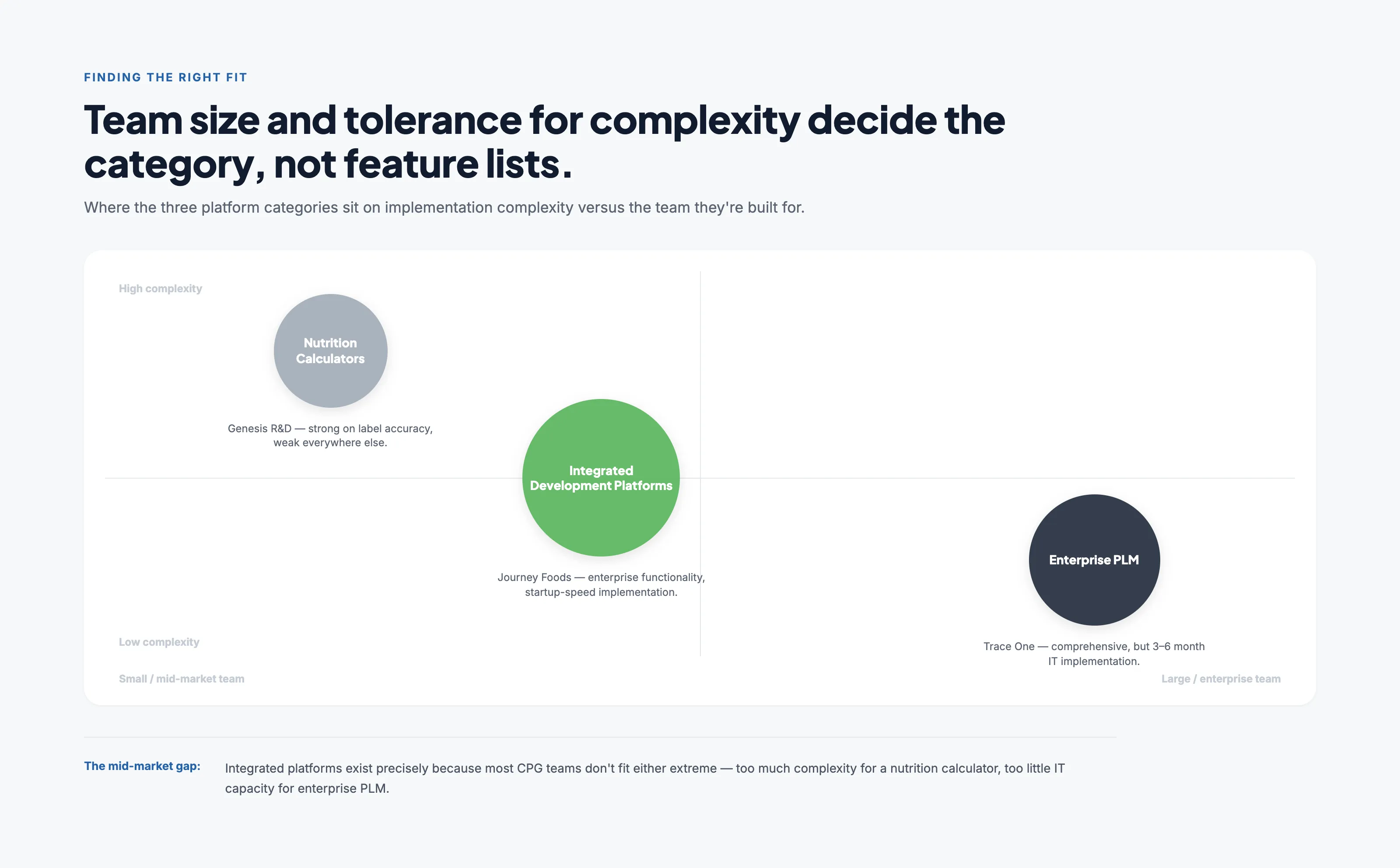
Enterprise Product Lifecycle Management systems like Trace One offer comprehensive functionality but come with complexity and high costs. These platforms handle everything from initial concept through manufacturing but often require extensive IT implementation and training.
Consider enterprise PLM if you're a large CPG company with dedicated IT resources and complex regulatory requirements. The learning curve is steep, but the functionality is extensive.
Skip enterprise PLM if you're a smaller company or startup that needs to move quickly. The implementation timeline and costs often outweigh the benefits for teams under 50 people.
Platforms like Genesis R&D excel at nutrition calculation and label generation but offer limited supply chain integration or collaborative features. These tools work well for regulatory compliance but don't address broader development workflow challenges.
Choose nutrition-focused platforms if label accuracy is your primary concern and you have other systems handling ingredient sourcing and team collaboration.
Avoid these platforms if you need comprehensive product development support beyond nutrition calculation. You'll end up using multiple disconnected tools.
Integrated platforms combine ingredient intelligence, formulation management, supply chain monitoring, and team collaboration in one system. These solutions fill the gap between simple calculators and complex enterprise systems.
Platforms like Journey Foods provide AI-powered ingredient scoring, real-time supply chain alerts, and collaborative development workflows without requiring extensive IT implementation. Teams can start using the system immediately while accessing enterprise-level functionality.
This category works well for mid-market CPG companies and funded startups that need comprehensive functionality without enterprise complexity.
Start your evaluation with a clear understanding of your team's workflow and pain points. Document how you currently handle ingredient research, formulation changes, and supply chain communication.
Request demos that use your actual formulations rather than generic examples. The best platforms will walk you through your specific use cases and show how the system handles your ingredient requirements and development process.
Test the platform with a small project before committing to a full implementation. Many vendors offer trial periods or pilot programs that let you evaluate the system with real work.
Pay attention to user adoption during trials. If your food scientists and product managers don't embrace the platform during testing, they won't use it after you purchase.
Evaluate integration capabilities with your existing systems. The platform should connect with your ERP, procurement software, and regulatory databases without requiring custom development.
Avoid platforms that require extensive customization to match your workflow. The best systems adapt to common food industry processes without major configuration.
Skip vendors who can't demonstrate the platform during sales calls or only show pre-recorded demos. You need to see how the system handles real-time questions and edge cases.
Be wary of platforms with limited ingredient databases or those that charge extra for basic functionality like team collaboration or supply chain alerts.
Don't choose systems based solely on price. Cheap platforms often lack critical features or require expensive add-ons that increase total cost of ownership.
Avoid vendors who can't provide references from similar companies in your industry. Food product development has unique requirements that general product management platforms don't address.
Plan for a phased rollout starting with your most engaged team members. Early adopters can help identify workflow improvements and train other team members.
Ensure your platform vendor provides comprehensive training and ongoing support. Your team needs to feel confident using the system before you can expect full adoption.
Migrate your existing formulations and ingredient data systematically. Don't try to move everything at once, which often leads to data quality issues and user frustration.
Set clear expectations about timeline and training requirements. Most teams need 2-4 weeks to become proficient with new product development platforms.
Your food product development platform should solve your biggest workflow problems while fitting your team size and technical capabilities. Enterprise systems work for large companies with IT resources. Integrated platforms serve mid-market companies that need comprehensive functionality without complexity.
Consider Journey Foods if you need AI-powered ingredient intelligence, real-time supply chain alerts, and collaborative development workflows in one platform. The system provides enterprise functionality with startup agility, helping teams find ingredients faster and launch products without delays.
The right platform eliminates spreadsheet chaos, prevents supply chain surprises, and keeps your entire team aligned on formulation changes. Your product launches happen on schedule, and your team focuses on innovation instead of administrative tasks.
Learn more at Journeyfoods.io to see how AI-powered ingredient intelligence accelerates your product development timeline.
What's the difference between a food product development platform and PLM software?
Food product development platforms focus specifically on ingredient intelligence, formulation management, and supply chain integration for food companies. PLM software covers broader product lifecycle management across industries but often lacks food-specific features like nutrition calculation and ingredient sourcing.
How long does it typically take to implement a new product development platform?
Implementation timelines vary by platform complexity and team size. Simple platforms can be operational within days, while enterprise systems may require 3-6 months. Most mid-market solutions like integrated development platforms take 2-4 weeks for full team adoption.
Should we choose a platform based on our current team size or planned growth?
Consider both current needs and 12-18 month growth projections. Many platforms offer scalable pricing tiers, but switching systems later disrupts workflows. Choose a platform that handles your current volume while supporting reasonable growth without major upgrades.
What integration capabilities should we prioritize?
Focus on integrations with your ERP system, existing supplier databases, and regulatory compliance tools. API availability ensures future integration flexibility as your tech stack evolves. Avoid platforms that require manual data entry for information you already maintain elsewhere.
How do we measure ROI on a product development platform investment?
Track metrics like ingredient sourcing time, formulation cycle duration, supply chain disruption frequency, and team communication efficiency. Most companies see ROI through faster product launches, reduced ingredient costs, and fewer supply chain surprises rather than direct cost savings.
What level of training should we expect for team adoption?
Plan for 1-2 weeks of initial training plus ongoing support during the first month. The best platforms provide role-specific training for food scientists, product managers, and procurement specialists. User-friendly interfaces reduce training requirements but don't eliminate the need for proper onboarding.
Can these platforms handle complex formulations with sub-recipes and scaling?
Quality food product development platforms support complex formulations including sub-recipes, ingredient alternatives, and automatic scaling calculations. Test this functionality during demos using your actual formulations to ensure the platform handles your specific complexity requirements.
The right food product development platform transforms your team's workflow from reactive to proactive. You find ingredients faster, prevent supply chain disruptions, and launch products on schedule.
Focus your evaluation on platforms that solve your specific pain points rather than offering the most features. Test with real formulations, ensure team adoption, and choose systems that integrate with your existing workflow.
Your next product launch timeline depends on the platform decision you make today. Choose wisely, implement systematically, and watch your development cycles accelerate.
Journey Foods Team News