
.svg)
.svg)
.svg)
.svg)


.svg)
Ingredient discovery used to mean spreadsheets, supplier calls, and a lot of waiting. Your food scientist would shortlist candidates, procurement would chase down pricing, and R&D would circle back weeks later with a formulation that may or may not survive a supply chain reality check.
In 2026, that cycle is compressing fast. AI-powered ingredient discovery is changing how CPG brands find, evaluate, and act on ingredient decisions — not by replacing food scientists, but by giving them better information, faster.
This article breaks down how AI ingredient discovery actually works, where it saves the most time, and where your team's expertise still does the heavy lifting.
If you've worked in R&D or product development at a CPG company, you know the friction. A brief comes in. You need a plant-based protein that hits a specific amino acid profile, stays under a cost threshold, and doesn't blow up your sustainability targets. So you start digging.
You search supplier databases. You email contacts. You wait for spec sheets. You cross-reference nutrition data in one tool, cost estimates in a spreadsheet, and sustainability claims in a third document that someone emailed you six weeks ago.
By the time you have a shortlist, two weeks have passed. And that's before you've run a single formulation.
The problem isn't effort. It's that ingredient intelligence is scattered across too many sources, and pulling it together manually is slow by design. AI ingredient discovery solves exactly that bottleneck.
AI ingredient discovery platforms don't just search a database. They score, rank, and recommend ingredients based on multiple criteria simultaneously — nutrition, cost, sustainability, supply availability — so your team can evaluate options in minutes instead of weeks.
The best systems work as a continuous intelligence layer, not a one-time lookup tool. They monitor ingredient data in real time, flag supply chain risks before they become delays, and surface alternatives when a primary ingredient becomes unavailable or too expensive.
A scoring engine takes your target criteria — say, a protein with a PDCAAS above 0.9, a cost under $4/kg, and a low carbon footprint — and runs those against a structured ingredient database to generate ranked results.
The AI component goes further than a filter. Machine learning models can identify patterns across ingredient attributes, flag trade-offs you might not have considered, and weight criteria based on your product goals. If you're optimizing for a clean label, the engine surfaces ingredients with shorter INCI names. If cost is the primary driver, it adjusts the ranking accordingly.
What makes this useful in practice is speed and consistency. Every team member runs the same query against the same data. No one is working from a supplier spec sheet that's six months out of date.
The quality of AI ingredient discovery depends entirely on the data behind it. Strong platforms pull from structured ingredient databases that include:
The more dimensions the data covers, the more useful the AI recommendations become. A system that only scores on nutrition can't tell you whether your preferred ingredient is facing a supply shortage or whether a cheaper alternative performs equally well on your sustainability KPIs.
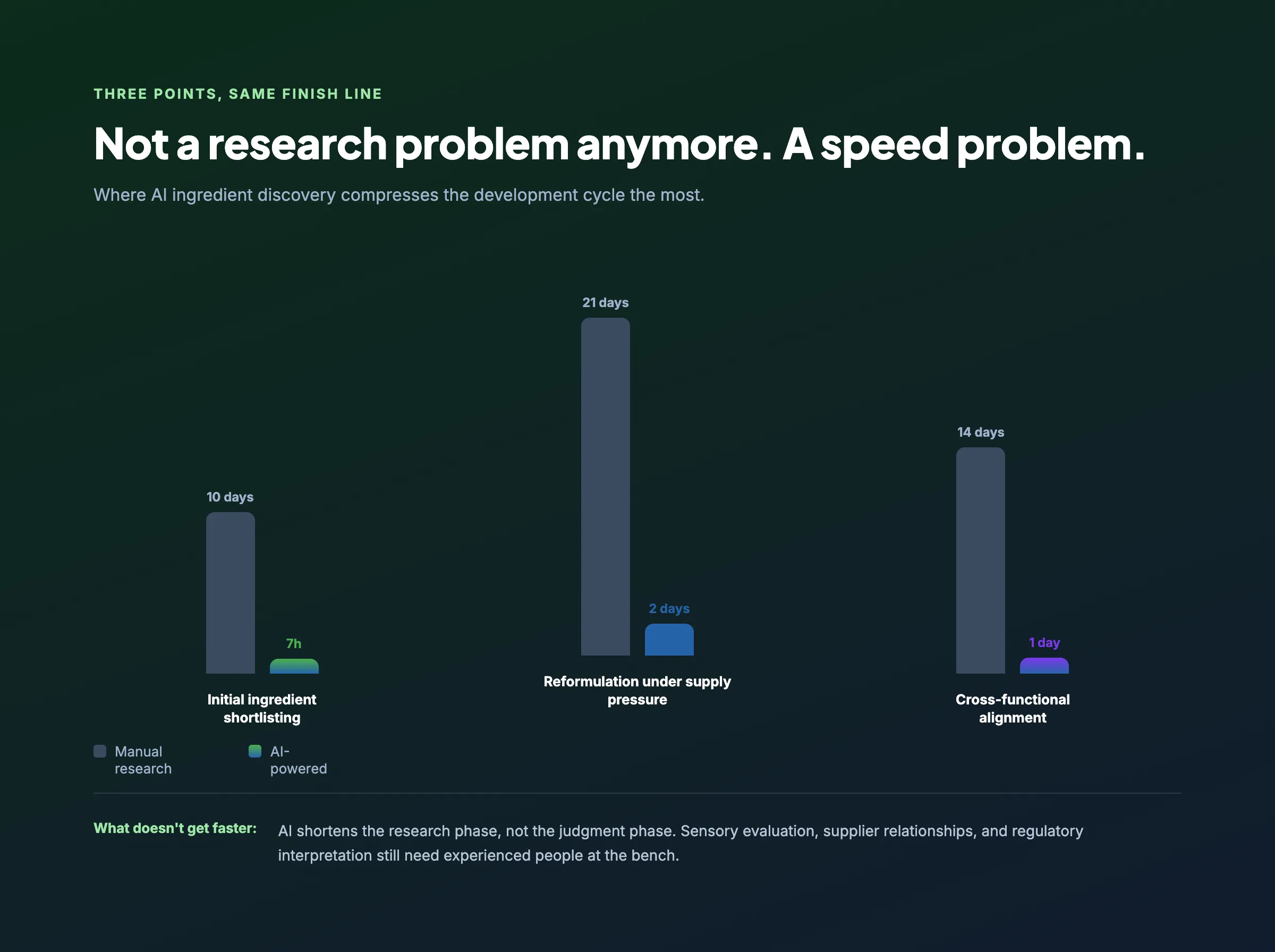
The biggest time savings in AI-powered food product development happen at three specific points.
1. Initial ingredient shortlisting
Manual shortlisting takes days to weeks depending on how obscure the ingredient category is. AI scoring engines compress this to hours or less. Your food scientist sets the parameters, reviews the ranked output, and moves straight to formulation evaluation — skipping the research rabbit hole entirely.
2. Reformulation under pressure
When a supplier discontinues an ingredient or a cost spike forces a reformulation, speed matters. AI systems that monitor supply chain signals in real time can alert your team before the disruption hits and surface pre-scored alternatives immediately. Instead of scrambling for three weeks, you're evaluating options in a structured way from day one.
3. Cross-functional alignment
One of the quieter time costs in CPG product development is internal communication. R&D has one version of a formulation. Procurement has different cost assumptions. Regulatory is working from last month's spec sheet. AI platforms that centralize ingredient data and formulation tracking in a shared dashboard eliminate the back-and-forth. Everyone works from the same current version.
This is where tools like Journey Foods make a practical difference. The platform's Operations Scientist AI engine scores ingredients across nutrition, cost, and sustainability in a unified workflow, and the centralized dashboard keeps R&D, procurement, and product development aligned without version confusion. You can learn more at Journeyfoods.io.
Most ingredient tools in the market solve one problem well. Nutrition calculators are good at nutrition. Sustainability databases are good at sustainability. Cost benchmarking tools give you pricing context. But none of them talk to each other.
That creates a familiar problem: you find an ingredient that scores perfectly on nutrition, only to discover it's 40% over budget. Or you identify a cost-effective option that your sustainability team flags as a liability. You're making decisions sequentially across disconnected tools instead of evaluating trade-offs in one place.
In 2026, the CPG brands moving fastest are the ones treating ingredient discovery as a multi-criteria optimization problem from the start. That means scoring nutrition, cost, and sustainability simultaneously — not in sequence.
Here's how the major tool categories stack up:
Tool TypeNutritionCostSustainabilitySupply ChainCollaborationNutrition calculators (e.g., Genesis R&D)StrongWeakNoneNoneLimitedSustainability databases (e.g., HowGood)LimitedNoneStrongNoneLimitedEnterprise PLM (e.g., Trace One)ModerateModerateModerateModerateStrongAI ingredient platforms (e.g., Journey Foods)StrongStrongStrongStrongStrong
The gap between point solutions and a unified AI platform isn't just about features. It's about how many decisions your team can make confidently in a single session versus how many require another tool, another email, or another meeting.
AI ingredient discovery is fast and data-rich, but it doesn't replace food science expertise. It replaces the time your food scientists spend doing research, not the judgment they apply to the results.
A few areas where your team's expertise remains irreplaceable:
Sensory and functional performance. No scoring engine can tell you how an ingredient behaves in a specific formulation under specific processing conditions. Texture, mouthfeel, flavor interactions, emulsification behavior — these require bench work and experienced evaluation.
Supplier relationship context. AI systems score ingredients based on available data. Your procurement team knows which suppliers are reliable, which have quality consistency issues, and which are worth paying a premium for. That institutional knowledge doesn't live in a database.
Consumer and market fit. Trend data and consumer research inform which ingredients will resonate with your target buyer. AI can surface what's nutritionally optimal or cost-efficient, but positioning and market timing require human judgment.
Regulatory interpretation. Ingredient compliance varies by market, application, and claim. Your regulatory team needs to interpret AI-flagged data in context, not just accept it at face value.
The best use of AI ingredient discovery is to get your team to the starting line faster — with better candidates, cleaner data, and fewer surprises — so the human work that follows is more focused and more effective.
If you're evaluating AI food product development tools for your team, these are the capabilities that actually move the needle:
Multi-criteria scoring. The platform should score ingredients across nutrition, cost, and sustainability simultaneously — not force you to run separate queries and reconcile the results yourself.
Real-time supply chain monitoring. Ingredient availability changes. A platform that only shows you static data is a liability when a supply disruption hits. Look for real-time alerts tied to your active formulations.
Formulation version control. If your team is still managing formulations in spreadsheets or email threads, you're losing time to version confusion. A platform with built-in version control keeps everyone on the same page.
Collaborative workflows. R&D, procurement, and product development need to work from the same data. A platform that siloes information by department recreates the problem you're trying to solve.
AI-driven recommendations. Beyond search and scoring, the best platforms proactively surface ingredient alternatives and optimization opportunities — so your team is acting on intelligence, not just searching for it.
Accessible implementation. Enterprise PLM systems can take months to implement and require dedicated IT resources. For mid-market CPG companies and funded startups, a platform that's ready to use without a long onboarding runway is a real advantage.
Journey Foods is built around exactly these capabilities. The Operations Scientist AI engine handles multi-criteria scoring, real-time supply chain alerts keep your team ahead of disruptions, and the centralized dashboard gives R&D and procurement a shared view of every formulation. Pricing starts at $199/month for individual users and scales to $1,999/month for teams of up to 50, with enterprise options available. See the full platform at Journeyfoods.io.
What is AI ingredient discovery in CPG?
AI ingredient discovery uses machine learning and structured ingredient databases to help CPG brands find, evaluate, and compare ingredients across multiple criteria — nutrition, cost, sustainability, and supply availability — faster than manual research methods allow.
How does an AI scoring engine evaluate ingredients?
A scoring engine takes your defined product criteria and runs them against a structured ingredient database to generate ranked results. Advanced systems weight criteria based on your goals, identify trade-offs, and surface alternatives you might not have considered.
Can AI replace food scientists in product development?
No. AI ingredient discovery accelerates the research and shortlisting phase, but sensory evaluation, functional performance testing, supplier relationship management, and regulatory interpretation still require experienced food scientists and procurement professionals.
What data does an AI ingredient platform use?
Strong platforms use nutritional profiles, cost data by region and volume, sustainability metrics, supply chain availability, and regulatory information. The breadth and freshness of this data directly determines how useful the AI recommendations are.
How does AI help with supply chain disruptions in food manufacturing?
AI platforms that monitor supply chain signals in real time can alert your team when an ingredient faces availability issues or price spikes, and immediately surface pre-scored alternatives — reducing the time it takes to respond to a disruption from weeks to days.
What's the difference between an AI ingredient platform and a PLM system?
PLM systems like Trace One offer strong product lifecycle management but typically require significant IT implementation and enterprise-level investment. AI ingredient platforms are designed for faster deployment and focus specifically on ingredient intelligence, scoring, and collaborative formulation management.
How does machine learning ingredient sourcing differ from traditional supplier databases?
Traditional supplier databases are static — you search and filter manually. Machine learning systems learn from patterns across ingredient attributes, generate ranked recommendations based on your specific criteria, and improve over time as more data is processed.
Ingredient discovery is no longer a research problem. It's a data and speed problem. The CPG brands shortening their development cycles in 2026 are the ones treating ingredient decisions as a multi-criteria optimization challenge — not a series of sequential lookups across disconnected tools.
AI doesn't make the formulation decisions for you. It gets your team to better decisions faster, with less back-and-forth and fewer surprises from supply chain or cost data that surfaces too late.
If your team is still spending weeks on ingredient shortlisting or managing formulations across spreadsheets and email threads, that's the bottleneck worth fixing first.
Learn more about how Journey Foods approaches AI ingredient discovery at Journeyfoods.io.
Journey Foods Team News