How to Build a Sustainable Ingredient Strategy: A Framework for CPG Teams in 2026


Quick answer
We're at an inflection point in how CPG companies think about ingredients. Sustainability used to be a marketing layer — a "clean-label" callout on the front of pack, a paragraph in the annual report. In 2026, it's a supply chain discipline. And the teams that treat it that way are outperforming the ones that don't.
How to Build a Sustainable Ingredient Strategy: A Framework for CPG Teams in 2026
We're at an inflection point in how CPG companies think about ingredients. Sustainability used to be a marketing layer — a "clean-label" callout on the front of pack, a paragraph in the annual report. In 2026, it's a supply chain discipline. And the teams that treat it that way are outperforming the ones that don't.
The pressure is coming from multiple directions simultaneously: retailer sustainability mandates, tightening regulatory frameworks in the EU and increasingly in the US, consumer demand for transparency, and the raw financial risk of sourcing from climatically vulnerable regions. If your ingredient strategy isn't built around sustainability criteria, you're not just behind on values — you're carrying unpriced risk.
Let me walk you through a practical framework for building sustainable ingredient sourcing into your R&D and procurement process — not as an add-on, but as a core decision layer.
Start With a Sustainability Audit of Your Current Portfolio
Before you can build a better strategy, you need an honest picture of where you stand. Most CPG teams are surprised by what they find when they map their ingredient portfolio against sustainability criteria for the first time.
A useful audit covers four dimensions:
This isn't a one-time exercise. The audit becomes a living baseline — updated as formulations change and suppliers shift. Teams that run this process quarterly catch problems before they become crises.
Define What "Sustainable" Actually Means for Your Brand
"Sustainable" is not one thing. A regenerative agriculture claim means something very different from a low-carbon-footprint claim or a fair-wage certification. Before you can source sustainably, your team needs to agree on which dimensions matter most for your products and your customers.
This is a strategic decision, not a procurement one. It should involve R&D, marketing, and leadership — because the criteria you set will shape your supplier relationships, your formulation choices, and eventually your product claims.
A few questions worth answering explicitly:
Getting these answers on paper turns "we care about sustainability" into an actual sourcing framework your team can use.
Build Sustainability Into Ingredient Selection, Not After It
This is where most CPG teams lose time. They select an ingredient based on function, cost, and availability — then try to retrofit a sustainability assessment afterward. By that point, the formulation is half-built and switching costs are high.
The better approach integrates sustainability criteria into the ingredient discovery phase. When you're evaluating a new ingredient, you want to see its environmental profile alongside its nutritional profile and cost data — not in a separate workflow three weeks later.
AI-powered ingredient intelligence tools are making this genuinely feasible at scale. Platforms that score ingredients across nutrition, cost, and sustainability dimensions simultaneously give your R&D team the ability to make better trade-offs earlier in the development cycle. The decision doesn't get easier later — it gets more expensive.
At Journey Foods, the ingredient search and scoring engine does exactly this: evaluate candidates across all three dimensions before a formulation decision is made. That means sustainability isn't a veto at the end of the process — it's a filter at the beginning.
Map Your Supplier Relationships Against Sustainability Risk
Knowing your ingredients is only half the picture. You also need to know your suppliers — not just the distributors you buy from, but the farms, processors, and co-manufacturers further up the chain.
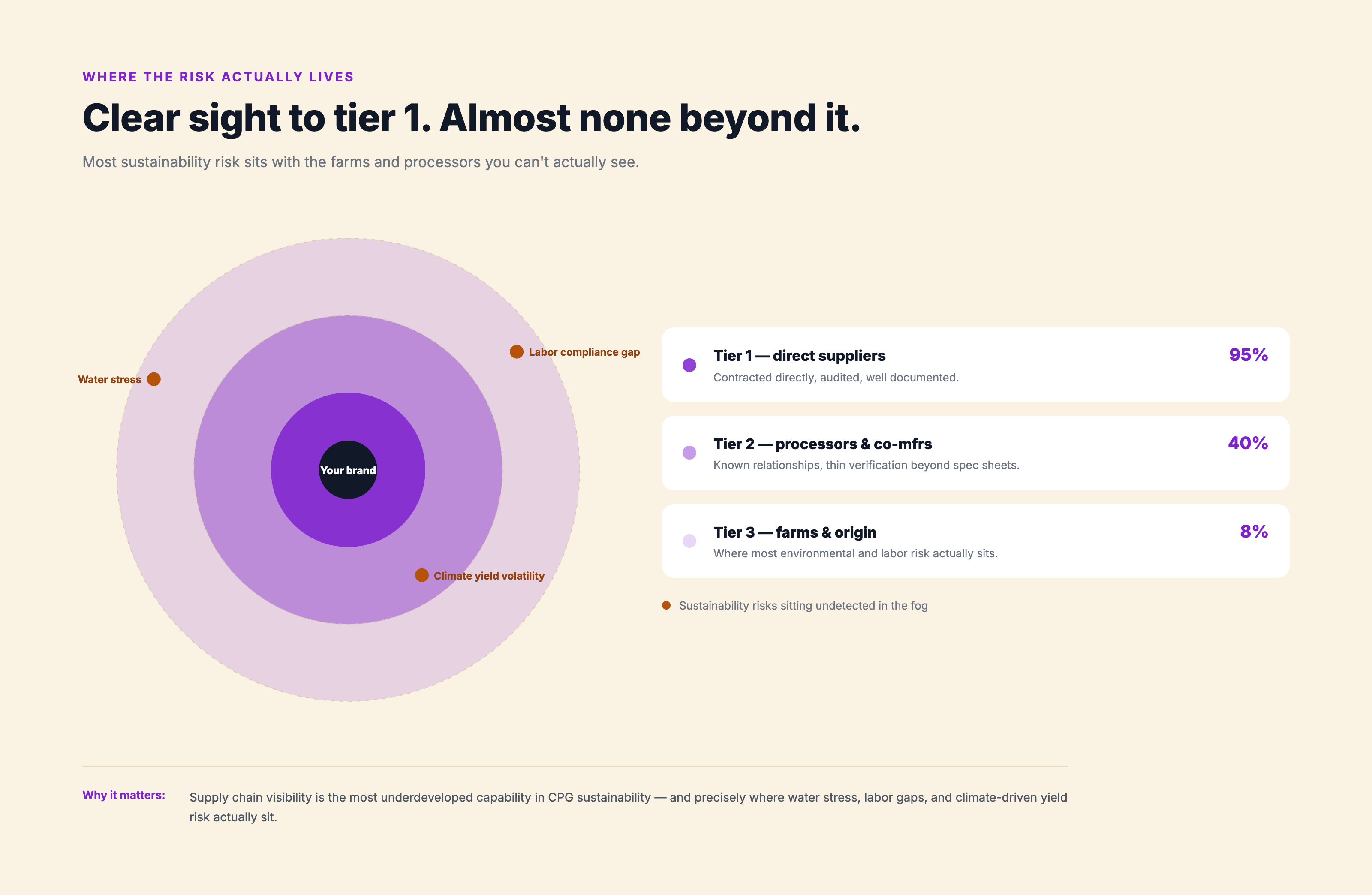
Supply chain visibility is one of the most underdeveloped capabilities in CPG. Most brands have strong visibility to tier-1 suppliers and almost none beyond that. That's precisely where the sustainability risk lives: farms dealing with water stress, processing facilities with labor compliance gaps, regions facing climate-driven yield volatility.
A few practical steps for improving supplier-level sustainability visibility:
For a deeper look at evaluating and selecting sustainability-forward partners, the Journey Foods guide to key sustainability suppliers and services is worth bookmarking.
Factor Packaging Into Your Ingredient Strategy
Ingredient sustainability and packaging sustainability are usually managed by different teams. That's a structural problem. The environmental footprint of a product includes both — and consumers see them as one thing.
If your R&D team is sourcing regenerative oats but your product ships in non-recyclable multilayer packaging, the sustainability story has a gap in it. Retailers and consumers will notice. The CPG industry's ongoing work to reduce single-use plastics in food packaging is directly relevant here: the same rigor you apply to ingredient sourcing needs to extend to packaging material decisions.
This doesn't mean solving everything at once. It means making sure your ingredient strategy and your packaging strategy are at least in conversation with each other.
Use Data to Track Progress — and Communicate It
A sustainable ingredient strategy you can't measure is just a set of intentions. The teams making real progress in 2026 are tracking sustainability KPIs with the same discipline they apply to cost and margin.
Useful metrics to track at the portfolio level:
These numbers matter internally for accountability. They also matter externally — retailers are increasingly asking for them, and brands with clean data will have a real advantage in shelf placement conversations.
Supply chain intelligence platforms are making it faster to generate and maintain this kind of portfolio-level data, which used to require significant manual effort from procurement and R&D teams.
The Framework in Practice: A Quick Summary
If you're building or rebuilding your sustainable ingredient strategy, here's the sequence that works:
This isn't a one-quarter project. It's an operating capability you build over time. But teams that start now — with clear criteria and the right tools — will be significantly ahead of those still treating sustainability as a communications exercise.
Ready to put this framework into practice? Journey Foods helps CPG teams move from intention to execution — from ingredient scoring and supply chain monitoring to portfolio-level analytics. Explore the platform at Journeyfoods.io or book a demo to see it in action.
We'd love to hear from you! If your team is working through any of these challenges, throw your questions or thoughts in the comments below. You can also find us on Instagram, LinkedIn, and X.
FAQs
What is sustainable ingredient sourcing in CPG?
Sustainable ingredient sourcing means selecting and procuring ingredients based on their environmental, social, and supply chain impact — not just cost and function. It includes evaluating carbon footprint, water use, land impact, supplier labor practices, and geographic sourcing risk alongside traditional formulation criteria.
How do CPG companies measure the sustainability of an ingredient?
Common methods include third-party certifications (organic, Rainforest Alliance, Fair Trade, regenerative), life cycle assessments (LCAs) that quantify carbon and water impact, supplier questionnaires, and AI-powered scoring tools that aggregate multiple sustainability dimensions into a single comparable metric.
What is the biggest barrier to sustainable ingredient sourcing for food brands?
Supply chain visibility. Most CPG brands have clear sight lines to their tier-1 suppliers but limited insight into tier-2 and tier-3 — where the majority of environmental and social risk actually sits. Without that visibility, it's difficult to make verified sustainability claims or catch sourcing problems early.
How does AI help with sustainable ingredient sourcing?
AI tools can score ingredients across nutrition, cost, and sustainability dimensions simultaneously, surface alternative ingredients with better environmental profiles, monitor supply chain conditions for risk signals, and generate portfolio-level sustainability analytics that would take procurement teams weeks to compile manually.
Should sustainability criteria override cost and performance in ingredient decisions?
Not automatically — but they should be part of the same decision, not a separate review. The most effective CPG teams define explicit trade-off rules in advance: for example, accepting a 5–8% cost premium for a certified sustainable ingredient that meets functional requirements. That kind of pre-agreed framework removes the friction from individual formulation decisions.
How often should a CPG team review its sustainable ingredient strategy?
At minimum, annually — but quarterly reviews are more effective for teams actively improving their sustainability profile. Supplier certifications expire, climate events shift sourcing risk, and formulations change. A living strategy that updates with your portfolio is more useful than a static document.
What's the difference between clean-label and sustainable sourcing?
Clean-label refers to ingredient transparency for consumers — short ingredient lists, recognizable names, no artificial additives. Sustainable sourcing is about the environmental and social conditions behind those ingredients. A product can be clean-label without being sustainably sourced, and vice versa. The strongest brands in 2026 are building both into their formulation strategy.
Journey Ingredient Intelligence
Oats
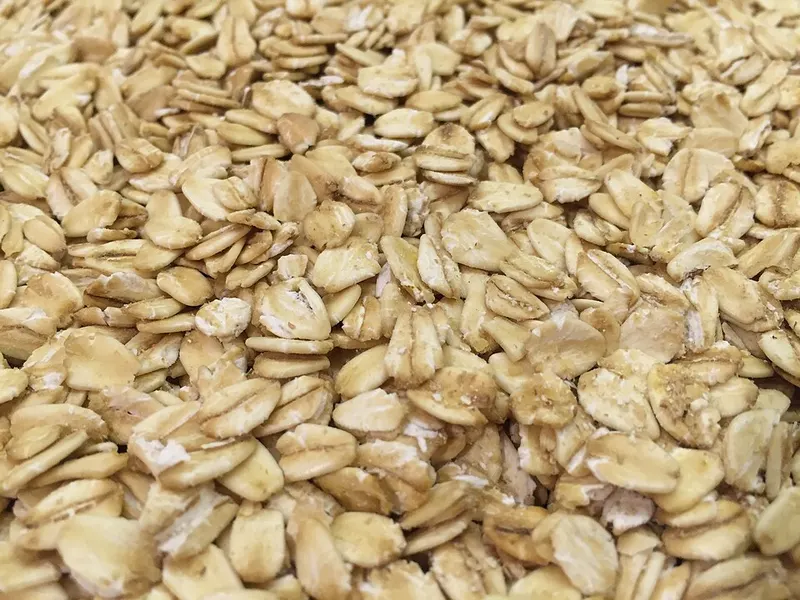
If your R&D team is sourcing regenerative oats but your product ships in non-recyclable multilayer packaging, the sustainability story has a gap in it.
Oats: 379 kcal and 13.2 g protein per 100 g; top producer Canada (15%, 2024); 2.48 kg CO2e per kg.
Explore Oats dataAs published
8%
Data from this story
Shareable Journey Intelligence
How to Build a Sustainable Ingredient Strategy: A Framework for CPG Teams in 2026
Sustainability
8%
The most effective CPG teams define explicit trade-off rules in advance: for example, accepting a 5–8% cost premium for a certified sustainable ingredient that meets functional requirements.