

.svg)
.svg)
.svg)
.svg)


.svg)
Food scientists and product developers face an impossible choice: optimize for nutrition, cost, or sustainability. Pick one, sacrifice the others. Your protein powder needs clean label ingredients, but the sustainable options cost 40% more. Your snack bar reformulation improves the nutrition profile but doubles ingredient costs.
This trade-off thinking slows product development and creates suboptimal formulations. The solution isn't choosing one criterion over others. It's scoring ingredients across all three dimensions simultaneously to find the best overall match for your product goals.
Single-dimension ingredient evaluation creates blind spots. You might select the most sustainable palm oil alternative only to discover it fails your cost targets. Or choose the cheapest protein source that tanks your nutrition score.
Multi-criteria ingredient evaluation lets you see the full picture before making sourcing decisions. You can identify ingredients that perform well across nutrition, cost, and sustainability rather than excelling in just one area.
This approach speeds up R&D cycles by eliminating back-and-forth between teams. Your food scientist doesn't need to restart formulation work because procurement flagged cost issues. Your sustainability team doesn't discover ingredient choices after product launch.
Teams that score ingredients across multiple criteria report 30% faster product development cycles and fewer reformulation surprises during commercialization.
Nutrition scoring evaluates how ingredients contribute to your product's health profile. Key metrics include:
Macronutrient density: Protein, fiber, healthy fats per serving
Micronutrient content: Vitamins, minerals, antioxidants
Functional benefits: Prebiotics, omega-3s, plant compounds
Negative factors: Added sugars, sodium, saturated fats
Clean label status: Natural vs artificial, processing level
Your nutrition score should align with your target consumer's health priorities. A sports nutrition product weights protein density higher than a children's snack focused on reduced sugar.
Cost scoring goes beyond ingredient price per pound. Comprehensive cost evaluation includes:
Raw material cost: Current spot price and 12-month averages
Supply chain expenses: Transportation, storage, handling
Processing requirements: Special equipment, additional steps
Yield factors: How much finished product each ingredient produces
Price volatility: Historical price swings and seasonal patterns
Smart cost scoring considers total formulation impact, not just individual ingredient prices. A premium ingredient that improves yield or reduces processing steps might score higher than cheaper alternatives.
Sustainability scoring measures environmental and social impact across the supply chain:
Carbon footprint: Greenhouse gas emissions from production to delivery
Water usage: Irrigation, processing, cleaning requirements
Land use efficiency: Acres required per unit of ingredient
Biodiversity impact: Effect on ecosystems and wildlife
Social responsibility: Fair trade, labor practices, community impact
Packaging considerations: Recyclability, material sourcing
Sustainability scoring helps you meet corporate ESG goals while appealing to environmentally conscious consumers.
Use a consistent 1-100 scale across all three criteria. This makes comparison and weighting calculations straightforward.
90-100: Exceptional performance, best-in-class
70-89: Good performance, meets most requirements
50-69: Average performance, acceptable with trade-offs
30-49: Below average, requires significant compromises
Below 30: Poor performance, avoid unless critical need
Create reference points for each scoring dimension:
Nutrition benchmarks: Compare against category leaders, regulatory standards, and consumer expectations
Cost benchmarks: Use current market prices, budget targets, and competitive product costs
Sustainability benchmarks: Reference industry standards, certification requirements, and corporate goals
Document these benchmarks so your entire team uses consistent evaluation criteria.
Develop specific criteria for each score range. For nutrition scoring:
Apply similar detailed rubrics to cost and sustainability dimensions.
Not all criteria carry equal weight in every product decision. Your weighting should reflect business priorities, consumer expectations, and market positioning.
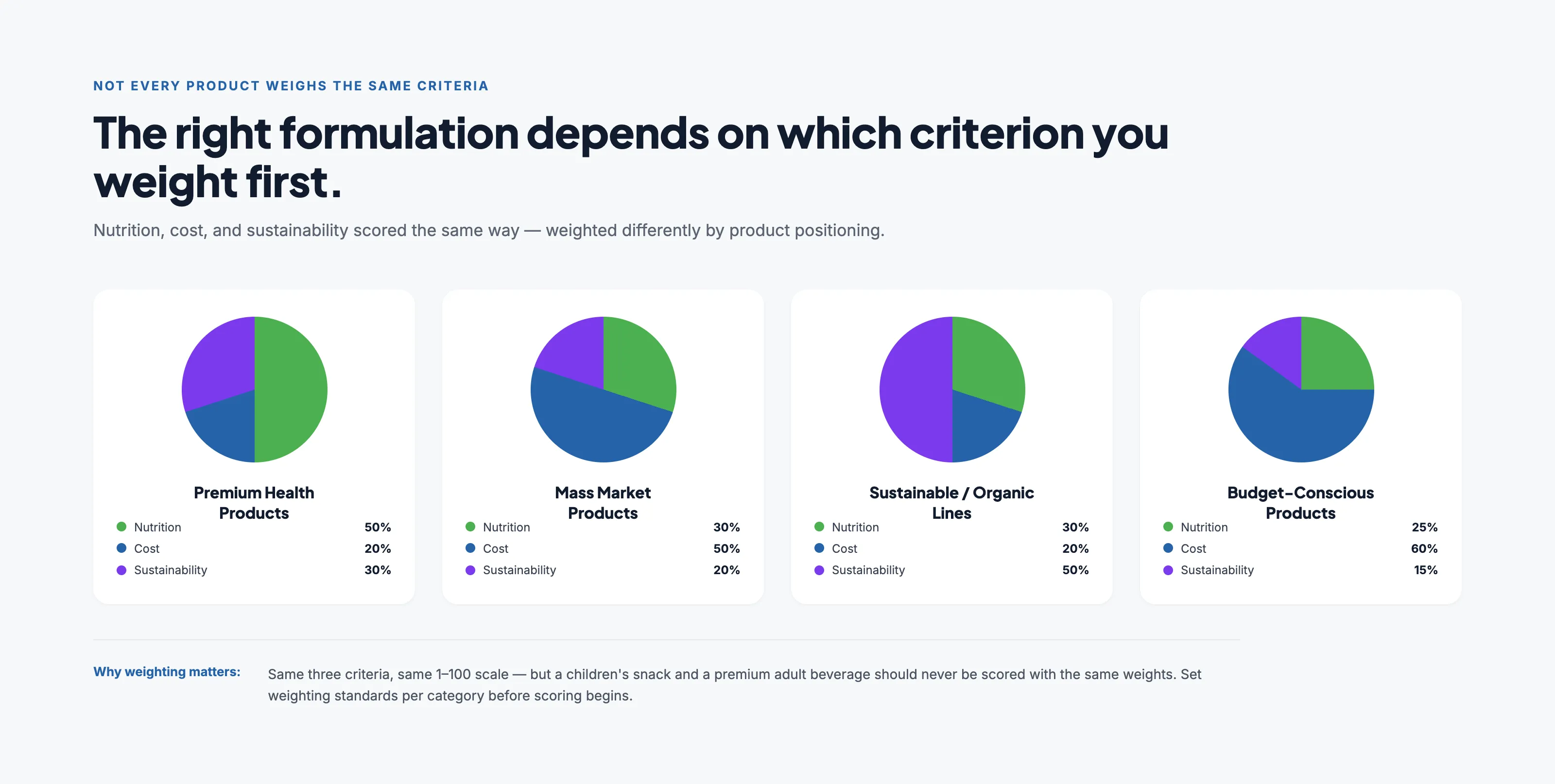
Adjust these weights based on your specific product goals and target market. A children's product might weight nutrition higher than sustainability, while a premium adult beverage could prioritize sustainability and nutrition equally.
Start with a spreadsheet-based approach for small ingredient sets:
This manual process works for 10-20 ingredients but becomes unwieldy for larger evaluations.
For regular ingredient evaluation, build a database with:
Database approaches scale better but require significant setup time and data management.
Advanced teams use AI systems that automatically score ingredients across all three dimensions. These platforms maintain current ingredient databases, apply complex scoring algorithms, and provide real-time recommendations.
AI-powered systems like Journey Foods' Operations Scientist engine can evaluate thousands of ingredients simultaneously, updating scores as market conditions change and new sustainability data becomes available.
Incomplete or outdated ingredient data skews scoring results. Sustainability data especially varies widely between sources.
Solution: Use multiple data sources and clearly document data quality levels. Mark scores with confidence ratings based on data completeness.
Scoring apple juice concentrate against whey protein creates apples-to-oranges comparisons.
Solution: Score ingredients within functional categories first, then compare category winners. Or adjust scoring rubrics to account for ingredient type differences.
Ingredient costs and availability change rapidly, making static scores obsolete.
Solution: Update scores regularly and flag significant changes. Set up alerts for major price movements or supply disruptions.
Different departments weight criteria differently, creating scoring conflicts.
Solution: Establish clear weighting standards for each product category and get cross-functional buy-in before scoring begins.
Manual multi-criteria scoring works for simple evaluations but breaks down with complex formulations. AI-powered platforms automate the entire process while maintaining accuracy and consistency.
AI systems excel at:
Processing vast ingredient databases: Evaluating thousands of options simultaneously
Real-time data integration: Updating scores as market conditions change
Complex weighting calculations: Applying sophisticated algorithms beyond simple averages
Scenario modeling: Testing different weighting schemes and constraints
Supply chain integration: Factoring in supplier reliability and logistics
Modern ingredient intelligence platforms combine nutrition databases, cost tracking, and sustainability assessments in unified scoring systems. These tools eliminate manual data gathering and calculation errors while providing deeper insights than spreadsheet-based approaches.
Teams using AI-powered ingredient scoring report finding better ingredient alternatives they never would have discovered through manual research. The systems surface unexpected options that score well across all criteria.
Multi-criteria scoring transforms ingredient selection from gut feeling to data-driven decision making. You can confidently explain why you chose specific ingredients and how they support overall product goals.
Document your scoring methodology and share results with stakeholders. When procurement questions ingredient costs, show how the higher-priced option scores better overall. When marketing asks about sustainability claims, point to concrete scoring data.
Use scoring results to guide supplier negotiations. If an ingredient scores well on nutrition and sustainability but poorly on cost, work with suppliers to improve pricing. If cost can't improve, consider adjusting formulation percentages to maintain budget targets.
Track scoring accuracy over time. Compare predicted performance with actual results after product launch. This feedback improves your scoring rubrics and builds confidence in the methodology.
For teams ready to move beyond manual scoring processes, platforms like Journey Foods provide comprehensive ingredient intelligence that scores options across nutrition, cost, and sustainability dimensions automatically. Learn more at Journeyfoods.io.
Update scores monthly for cost data and quarterly for nutrition and sustainability data. Set up alerts for major market changes that require immediate score updates.
Consider the ingredient if it meets minimum thresholds in the poor-performing category. Sometimes a slight weakness in one area is acceptable for exceptional performance elsewhere.
Score based on available data but flag the uncertainty. Consider investing in additional research for ingredients that could significantly impact your product.
No. Adjust weighting based on product positioning, target market, and business priorities. Premium products might weight sustainability higher than value products.
Score them as separate ingredients. The organic version typically scores higher on sustainability but may score lower on cost. Let the weighted scores determine the better choice.
Start with nutrition and cost as minimum criteria. Add sustainability when it becomes important for your brand or consumers. Three criteria provide good balance without over-complexity.
Start with a pilot project on a single product. Demonstrate how scoring improves decision speed and reduces reformulation work. Share success stories and gradually expand to more products.
Multi-criteria ingredient scoring eliminates the false choice between nutrition, cost, and sustainability. By evaluating ingredients across all three dimensions simultaneously, you make better sourcing decisions that support your product goals and business objectives.
Start with manual scoring for immediate results, then consider AI-powered platforms as your ingredient evaluation needs grow. The key is consistent methodology and clear weighting that reflects your product priorities.
Stop choosing between good nutrition, reasonable costs, and sustainable sourcing. Score ingredients across all criteria and find options that deliver on every dimension.
Journey Foods Team News