
Quick answer
Most CPG product launches don't fail because of bad ideas. They fail because of bad data.
How to Use Ingredient Data to Reduce Product Launch Risk in CPG
Most CPG product launches don't fail because of bad ideas. They fail because of bad data.
The formulation looked right on paper. The market research checked out. Then a supplier changed specs mid-development, a key ingredient hit a regulatory flag in a new market, or the cost model collapsed when commodity prices shifted. By the time the team caught it, months of R&D work were already sunk.
This is the operating reality of 2026. And the teams winning at launch are the ones treating ingredient data as a risk management tool — not just a development input.
Let me walk you through exactly how ingredient data reduces CPG product launch risk at each stage of development, and where most teams are still leaving exposure on the table.
Why CPG Product Launch Risk Is an Ingredient Data Problem
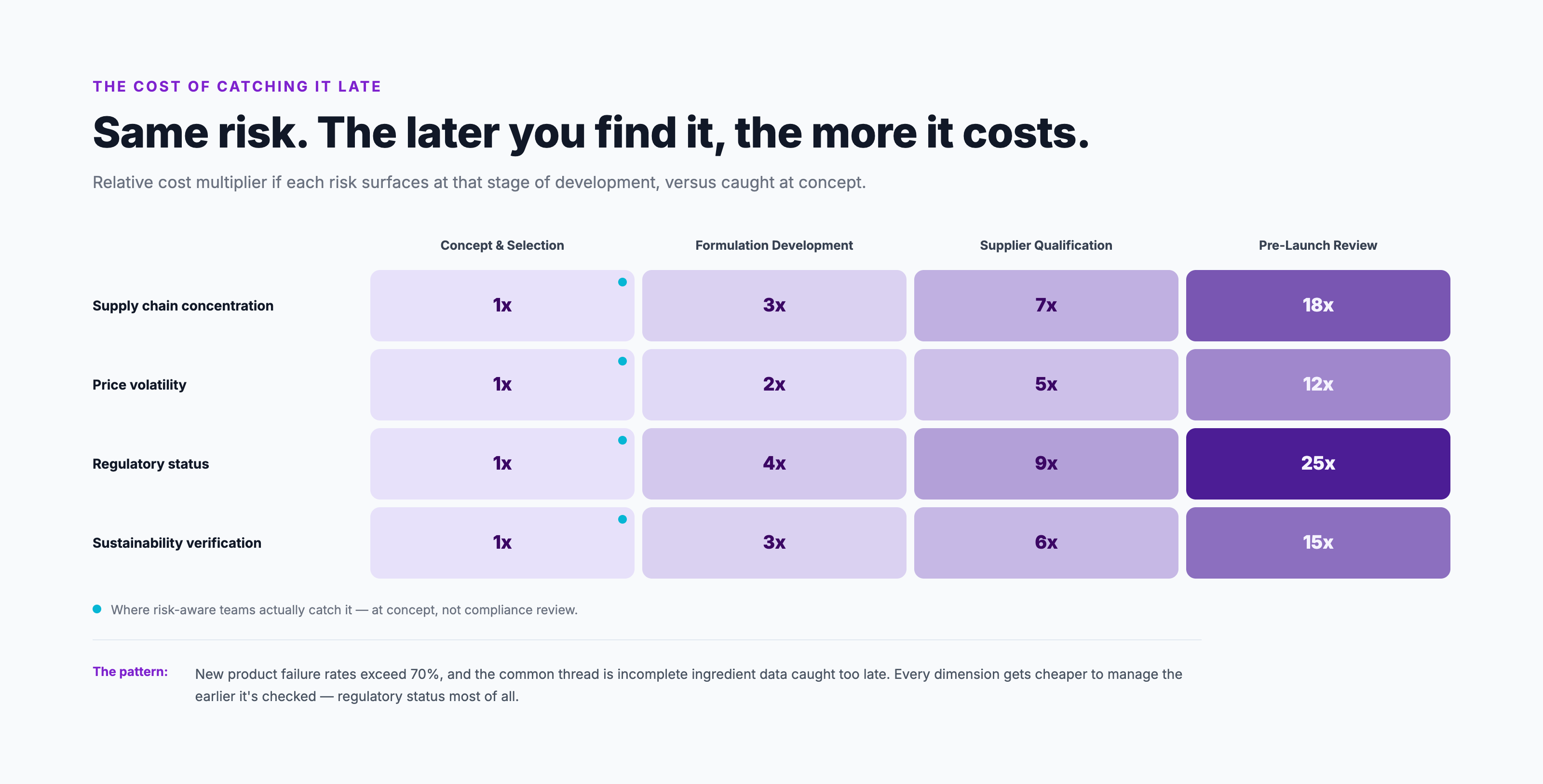
The food industry's launch failure rate is well-documented. New product failure rates consistently exceed 70%, with formulation issues, supply chain disruptions, and regulatory non-compliance among the most common culprits. These aren't random failures — they're predictable ones.
The common thread: most R&D and procurement teams make critical decisions on incomplete ingredient information. They know what an ingredient does functionally. They rarely know its full risk profile — price volatility history, supplier concentration, regulatory status across target markets, sustainability credentials, or how it interacts with label claims at scale.
Ingredient data gaps don't just slow launches. They kill them.
The shift happening now is that leading CPG teams are building ingredient intelligence into the front end of development, not the back end. They're asking risk questions before committing to a formulation — not after a supplier audit flags a problem six weeks before launch.
The Four Dimensions of Ingredient Risk
Not all ingredient risk looks the same. Before you can manage it, you need to know where to look. The four dimensions that matter most in CPG product development:
Each dimension requires specific data. That's exactly where most teams are underinvested.
How Ingredient Data Reduces Risk at Each Development Stage
Stage 1: Concept and Ingredient Selection
This is where the most consequential risk decisions get made — and where teams most often skip the data work. Choosing an ingredient because it performed well in a bench test is necessary, but it's not sufficient. You also need to know its supply chain depth, cost trajectory, and regulatory footprint before you build a formulation around it.
AI-powered ingredient search tools now score ingredients across nutrition, cost, and sustainability dimensions simultaneously, so you're not triangulating between three separate research streams. The goal at this stage is to identify ingredients with strong functional profiles and acceptable risk profiles before development investment accumulates.
Supply chain intelligence has moved well beyond recipe testing. Teams using it at the concept stage catch single-source dependency issues and regulatory flags before they're baked into a formulation.
Stage 2: Formulation Development
Once you've selected ingredients, the risk calculus shifts to formulation stability and substitution readiness. What happens if Ingredient A becomes unavailable or spikes in price? Do you have a pre-qualified alternative that maintains your label claims and nutritional targets?
This is where version control for formulations becomes operationally important. Teams that maintain a documented development history with ingredient-level data can run substitution scenarios quickly — without starting from scratch. They can also demonstrate compliance traceability if a regulatory question surfaces later.
The teams that launch fastest are the ones who built substitution options into the formulation from the start — not the ones scrambling for alternatives when a supplier goes dark.
Stage 3: Supplier Qualification and Supply Chain Monitoring
Supplier qualification is where ingredient data meets procurement reality. A supplier who looks qualified on paper may have quality inconsistencies, capacity constraints, or sustainability gaps that only surface with deeper data.
Proactive supply chain monitoring — with alerts for price changes, supplier disruptions, or regulatory updates — shifts your team from reactive to anticipatory. You're not reading about a supply disruption in a trade publication after it's already hit your launch timeline. You're seeing early signals and adjusting before they become crises.
For teams working on sustainability commitments in packaging and sourcing, this visibility also supports the supplier-level verification that backs up clean-label claims. Unverified claims are a growing liability, and ingredient-level data is how you close that gap.
Stage 4: Pre-Launch Compliance Review
Regulatory compliance is the final gate before launch — but it shouldn't be the first time you're checking it. By the time you're in pre-launch review, any compliance issue is expensive to fix.
The right approach is continuous compliance monitoring throughout development. That means knowing the regulatory status of every ingredient in your formulation across your target markets from the moment you select it, and tracking any changes that could affect your launch timeline.
AI-driven transparency tools are making real-time regulatory visibility more accessible, even for teams without dedicated regulatory affairs staff. The data infrastructure exists. The question is whether your team is using it.
What "Good" Ingredient Data Actually Looks Like
There's a real difference between having ingredient data and having useful ingredient data. For CPG risk management, useful means:
This is what separates ingredient data as a risk tool from ingredient data as a reference library. The reference library tells you what an ingredient is. The risk tool tells you what could go wrong — and what to do about it.
Building a Risk-Aware Development Culture
Data tools only work if the team uses them at the right moments. The cultural shift that matters is moving ingredient risk assessment from a late-stage compliance exercise to an early-stage development input.
That means R&D leads asking supply chain questions at the concept stage. It means procurement and product development working from shared ingredient data rather than separate systems. It means building substitution readiness into every formulation — not treating it as a contingency plan you'll figure out later.
Stronger supplier relationships and cleaner sourcing data also matter here. Teams with deeper supplier networks have more options when disruptions hit, and they can verify their claims with confidence rather than hoping nothing gets scrutinized.
The teams at the front of the pack in 2026 aren't just faster at development. They're making better risk decisions earlier, with better data. That's the actual competitive advantage.
Want to see how ingredient data works in practice for your formulation and supply chain decisions? Explore the platform at Journeyfoods.io or book a demo to walk through it with the team.
We'd love to hear from you! If you have questions or want to share how your team is managing ingredient risk, throw them in the comments below. You can also find us on Instagram, LinkedIn, and X.
FAQs
What is CPG product launch risk, and why does ingredient data affect it?
CPG product launch risk is the probability that a new product fails to reach market successfully — or underperforms after launch — due to formulation, supply chain, regulatory, or cost issues. Ingredient data affects it directly because most launch failures trace back to incomplete information about the ingredients in the formulation: supplier concentration, price volatility, regulatory status, and sustainability verification.
At what stage of development should CPG teams start assessing ingredient risk?
The earlier the better. The highest-leverage point is the concept and ingredient selection stage, before significant R&D investment accumulates. Teams that wait until pre-launch compliance review to identify ingredient risks face expensive reformulations and delayed timelines. Embedding ingredient risk assessment at the front end of development reduces both cost and time-to-market.
What does supply chain concentration risk mean for a CPG formulation?
It means a key ingredient in your formulation has a limited number of qualified suppliers — sometimes just one or two globally. If that supplier faces a disruption from capacity issues, geopolitical factors, or quality failures, your launch timeline and cost model are both exposed. Identifying high-concentration ingredients early lets teams pre-qualify alternative suppliers or reformulate before the risk becomes a crisis.
How do AI-powered ingredient tools reduce product launch risk compared to manual research?
Manual ingredient research is slow, siloed, and often incomplete. AI-powered tools score ingredients across multiple risk dimensions simultaneously — nutrition, cost, sustainability, and supply chain depth — and provide real-time monitoring for changes that affect your formulation. They also generate substitution recommendations, so teams can respond to disruptions quickly without restarting development from scratch.
What ingredient data should CPG teams prioritize when evaluating launch risk?
The most important data points are supplier depth (number of qualified sources), price volatility history, regulatory status across target markets, sustainability and sourcing verification, and formulation substitution options. Teams that have this data at the ingredient selection stage make significantly better risk decisions than those who discover gaps during supplier qualification or pre-launch review.
How does ingredient data support clean-label and sustainability claims?
Clean-label and sustainability claims require supplier-level verification — not just ingredient-level assertions. Ingredient data platforms that track sourcing provenance, supplier certifications, and supply chain transparency give CPG teams the documentation they need to back up label claims with evidence, reducing both regulatory and reputational exposure.
Can smaller CPG teams use ingredient data tools, or are they built for enterprise R&D?
Ingredient data platforms have become more accessible across team sizes. The core value — faster ingredient research, supply chain monitoring, and formulation version control — applies whether you're a startup launching your first product or a multi-brand enterprise managing a large portfolio. The key is integrating the tool into the development workflow early, not treating it as a reporting layer at the end.
As published
70%
Data from this story
Shareable Journey Intelligence
How to Use Ingredient Data to Reduce Product Launch Risk in CPG
Supply Chain
70%
New product failure rates consistently exceed 70%, with formulation issues, supply chain disruptions, and regulatory non-compliance among the most common culprits.