.svg)
.svg)
.svg)
.svg)


.svg)
The ingredient management software category has matured significantly, but most platforms still solve only part of the problem. Nutrition tools don't cover supply chain. Sustainability platforms don't touch cost optimization. Enterprise PLM systems are too complex for most mid-market teams to implement and maintain.
Most food teams are still managing ingredient decisions in spreadsheets, shared drives, and long email threads. That setup worked when product cycles were slow and supply chains were predictable. Neither of those things is true anymore.
If you're evaluating ingredient management software in 2026, you're probably dealing with at least one of these: a delayed launch, a supply disruption you didn't see coming, or a reformulation project where nobody can agree on which version is current. This guide breaks down what modern ingredient management software needs to do, what the market offers, and how to evaluate your options without wasting months on the wrong tool.
The problem isn't that food teams lack data. It's that the data lives in too many places.
Your nutrition specs are in one system. Supplier contacts are in another. Sustainability certifications are in a shared folder that hasn't been updated since last year. When a supply disruption hits or a reformulation is needed, your team spends days just pulling information together before any actual decision-making can happen.
This fragmentation creates three specific problems:
Ingredient tracking software solves these problems by centralizing the data and automating the intelligence layer on top of it.
At its core, ingredient management software gives your R&D and product development team a single place to search, evaluate, track, and act on ingredient data.
The best platforms in 2026 go well beyond a simple ingredient database. They score ingredients across multiple criteria simultaneously, monitor supply chain conditions in real time, and keep your entire team working from the same data. That last part matters more than most teams realize until they've experienced a launch delay caused by a miscommunication between R&D and procurement.
Good food R&D software connects three workflows that are usually siloed:
When those three workflows live in one platform, decisions get faster and mistakes get fewer.
Single-dimension scoring is no longer enough. Evaluating an ingredient only on nutrition, or only on sustainability, gives you an incomplete picture. Your product has to hit cost targets, meet nutritional goals, and satisfy sustainability commitments at the same time.
Look for a platform that scores ingredients across nutrition, cost, and sustainability simultaneously so your team can compare options without running three separate analyses. This is the difference between a decision that takes days and one that takes minutes.
This is where most ingredient tracking software still falls short. Knowing your current ingredient specs is useful. Knowing that one of your key ingredients is at supply risk before it becomes a production problem is what actually protects your launch timeline.
Real-time supply chain monitoring means the platform surfaces alerts and flags potential disruptions proactively, not after the fact. For procurement and R&D teams, this shifts the work from reactive firefighting to proactive planning.
If your team is still emailing formulation files back and forth, you're introducing version risk on every iteration. A proper CPG ingredient platform gives your whole team access to the same formulation data, with a clear record of who made what change and when.
This matters especially when R&D, procurement, and regulatory teams all need to weigh in on the same product. Centralized, traceable workflows cut down on miscommunication and keep projects moving.
Related to collaboration but distinct: version control means every iteration of a formulation is saved, documented, and retrievable. When a product needs to be reformulated six months after launch, your team should be able to pull up the full development history without hunting through email archives.
This also protects you during audits and regulatory reviews. A clean record of formulation decisions is not optional for most CPG companies.
Individual product management is table stakes. The more valuable capability is visibility across your entire portfolio. Which products are underperforming against nutrition targets? Where are your highest supply chain risk concentrations? What's the cost profile of your top-selling SKUs?
Portfolio analytics give leadership and R&D leads the data to set priorities and allocate resources based on actual performance, not gut feel.
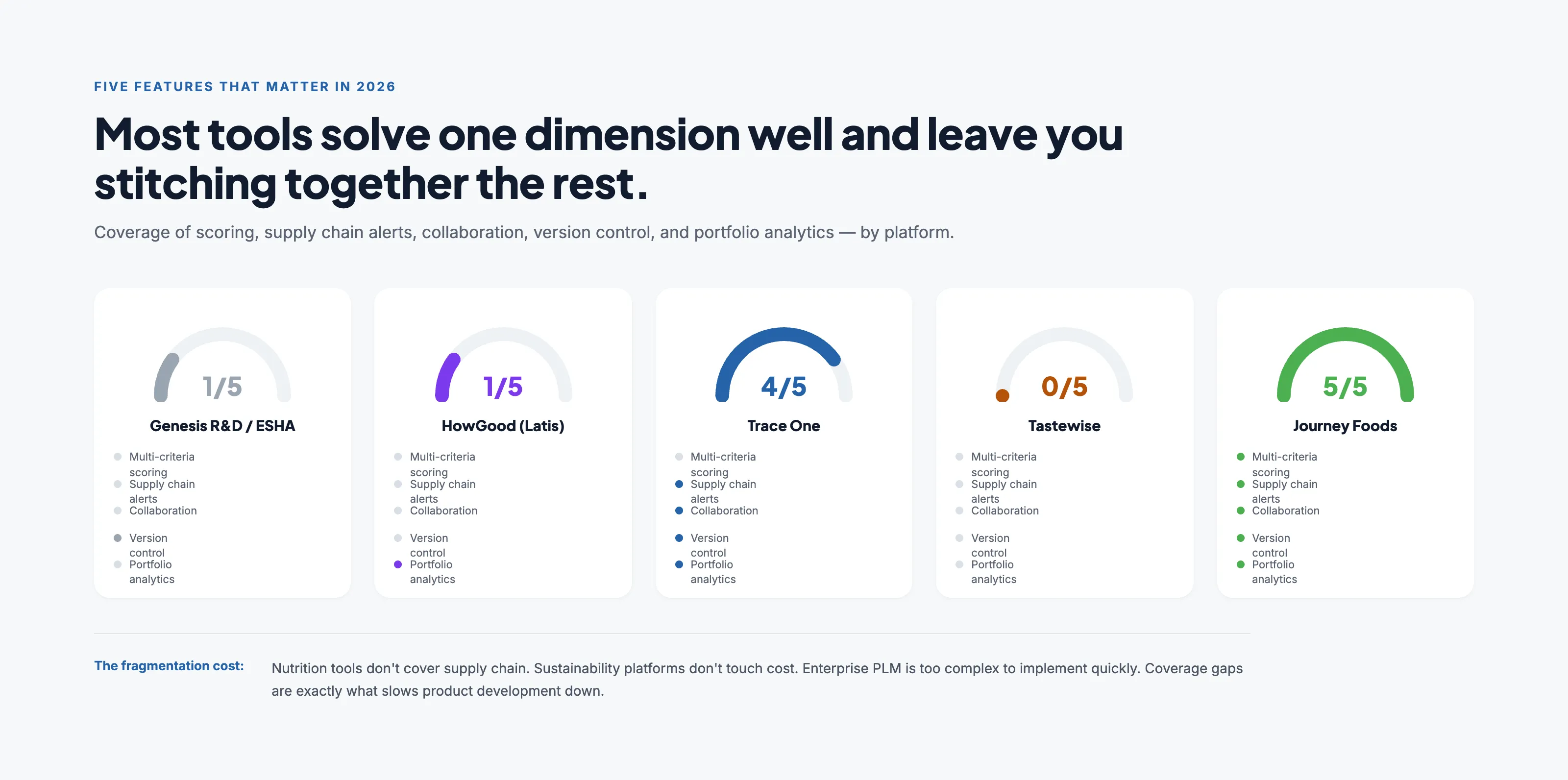
The ingredient management software market in 2026 includes a range of tools, but most solve only part of the problem.
Genesis R&D and ESHA are strong on nutrition analysis and regulatory compliance. If your primary need is nutrition labeling, they're established options. Where they fall short is supply chain integration and ingredient sourcing intelligence. They're built for compliance, not for speed.
HowGood (Latis) has the most comprehensive sustainability data available, with a database covering 33,000+ ingredients. If sustainability reporting is your primary driver, it's worth evaluating. But it doesn't address cost optimization or nutrition scoring in the same workflow, so you'll still need additional tools.
Trace One offers enterprise-grade PLM with deep compliance management. It's a serious platform for large CPG companies with complex regulatory requirements across multiple markets. The tradeoff is implementation complexity and pricing that doesn't fit most mid-market teams.
Tastewise is excellent for consumer trend intelligence but isn't an ingredient management tool. It's useful for innovation teams identifying market opportunities, not for R&D teams managing formulations.
The gap across most of these options is the same: they solve one dimension well but leave your team stitching together multiple tools to cover the full workflow. That fragmentation is exactly what slows product development down.
Journey Foods is built to close that gap. The platform connects ingredient discovery, multi-criteria scoring, supply chain monitoring, and collaborative formulation management in one workflow. It's designed for mid-market CPG brands and food startups that need the capability of an enterprise platform without the implementation overhead. Pricing starts at $199/month for individual contributors and scales to $1,999/month for teams of up to 50 users, with custom enterprise options available.
You can explore the full platform at journeyfoods.io.
When you're comparing ingredient management software options, these are the questions worth asking before you commit:
Does it score across multiple criteria at once? Nutrition-only or sustainability-only scoring means you're still doing manual reconciliation. You need a platform that evaluates ingredients across all the dimensions your team cares about simultaneously.
How does it handle supply chain monitoring? Ask specifically whether alerts are proactive or reactive. A platform that shows you current supplier data is useful. One that flags emerging risks before they hit your production schedule is significantly more valuable.
Can your whole team work in it without IT support? Enterprise PLM tools often require months of implementation and dedicated IT resources. If you're a team of 5 to 50, you need a platform your R&D and procurement teams can actually use without a long onboarding process.
Does it maintain formulation history? Version control isn't a nice-to-have. It's essential for audit trails, reformulation projects, and regulatory compliance.
What does the pricing model look like at your scale? Some platforms are priced for Fortune 500 companies. If you're a mid-market brand or a funded startup, make sure the pricing makes sense for your team size and usage before you get deep into an evaluation.
What is ingredient management software?
Ingredient management software is a platform that helps food and CPG product teams search, evaluate, track, and manage ingredients across their product portfolio. Modern platforms include ingredient scoring, supply chain monitoring, formulation version control, and collaborative workflows for R&D and procurement teams.
How is ingredient management software different from a nutrition analysis tool?
Nutrition analysis tools focus specifically on calculating and labeling nutritional content. Ingredient management software covers a broader workflow, including ingredient sourcing, multi-criteria scoring (nutrition, cost, and sustainability), supply chain risk monitoring, and team collaboration on formulations.
What features should I prioritize when choosing ingredient tracking software?
The most important features for most teams in 2026 are multi-criteria ingredient scoring, real-time supply chain alerts, collaborative formulation workflows, version control, and portfolio-level analytics. The right priority depends on your team's biggest bottleneck.
Is ingredient management software only for large CPG companies?
No. While enterprise PLM tools like Trace One are built for large organizations, platforms like Journey Foods are designed for mid-market CPG brands and food startups. Pricing tiers starting at $199/month make it accessible for smaller teams.
How does ingredient management software help with supply chain disruptions?
Platforms with real-time supply chain monitoring send alerts when ingredient availability changes or risk levels increase. This gives your team time to identify alternatives and adjust formulations before a disruption affects production, rather than responding after the fact.
Can ingredient management software support sustainability reporting?
Yes. Platforms that include sustainability scoring as part of ingredient evaluation can support sustainability reporting by tracking the environmental profile of ingredients across your portfolio. This is particularly useful for teams with carbon reduction commitments or retailer sustainability requirements.
What's the difference between ingredient management software and a PLM system?
Product lifecycle management (PLM) systems handle the full lifecycle of a product from concept to discontinuation, with strong compliance and regulatory management features. Ingredient management software focuses specifically on the ingredient intelligence and formulation workflow layer. Some platforms, like Journey Foods, bridge both by combining ingredient scoring, supply chain monitoring, and collaborative development without the implementation complexity of a full enterprise PLM.
The ingredient management software category has matured significantly, but most platforms still solve only part of the problem. Nutrition tools don't cover supply chain. Sustainability platforms don't touch cost optimization. Enterprise PLM systems are too complex for most mid-market teams to implement and maintain.
What food teams actually need in 2026 is a platform that connects ingredient discovery, scoring, supply chain monitoring, and team collaboration in one place. That's the workflow that shortens development cycles and reduces the risk of launch delays.
If your team is still managing ingredient decisions across spreadsheets and email threads, the cost of that fragmentation shows up in every delayed launch and every supply disruption you didn't see coming.
Learn more at journeyfoods.io or book a demo to see how the platform handles your specific workflow.
Journey Foods Team News