.svg)
.svg)
.svg)
.svg)


.svg)
Nutrient density has always mattered. What's changed in 2026 is that food scientists can now measure it with enough precision to drive real formulation decisions — not just directional ones.

.svg)
For years, "nutrient-dense" functioned more as marketing language than a technical specification. A product could carry the claim with minimal accountability. Now, scoring frameworks and AI-assisted ingredient databases give R&D teams a structured, defensible way to quantify what's actually in their formulations — and compare it across hundreds of ingredient options at once.
Here's how nutrient density scoring works, which frameworks are gaining traction, and how food scientists and CPG product developers are using these scores to move faster and make better calls.
Nutrient density is not the same as calorie density. It describes the concentration of beneficial nutrients — vitamins, minerals, fiber, protein, phytonutrients — relative to a reference unit, typically 100 calories or 100 grams of a food or ingredient.
A high-calorie ingredient isn't automatically low in nutrient density. Nuts are calorie-dense but also rich in healthy fats, magnesium, and vitamin E. The scoring challenge is building a model that captures this complexity without collapsing it into a single misleading number.
Most nutrient density scoring systems are trying to solve three problems:
The answers vary by framework — and that variation matters enormously when you're comparing ingredients for a specific application.
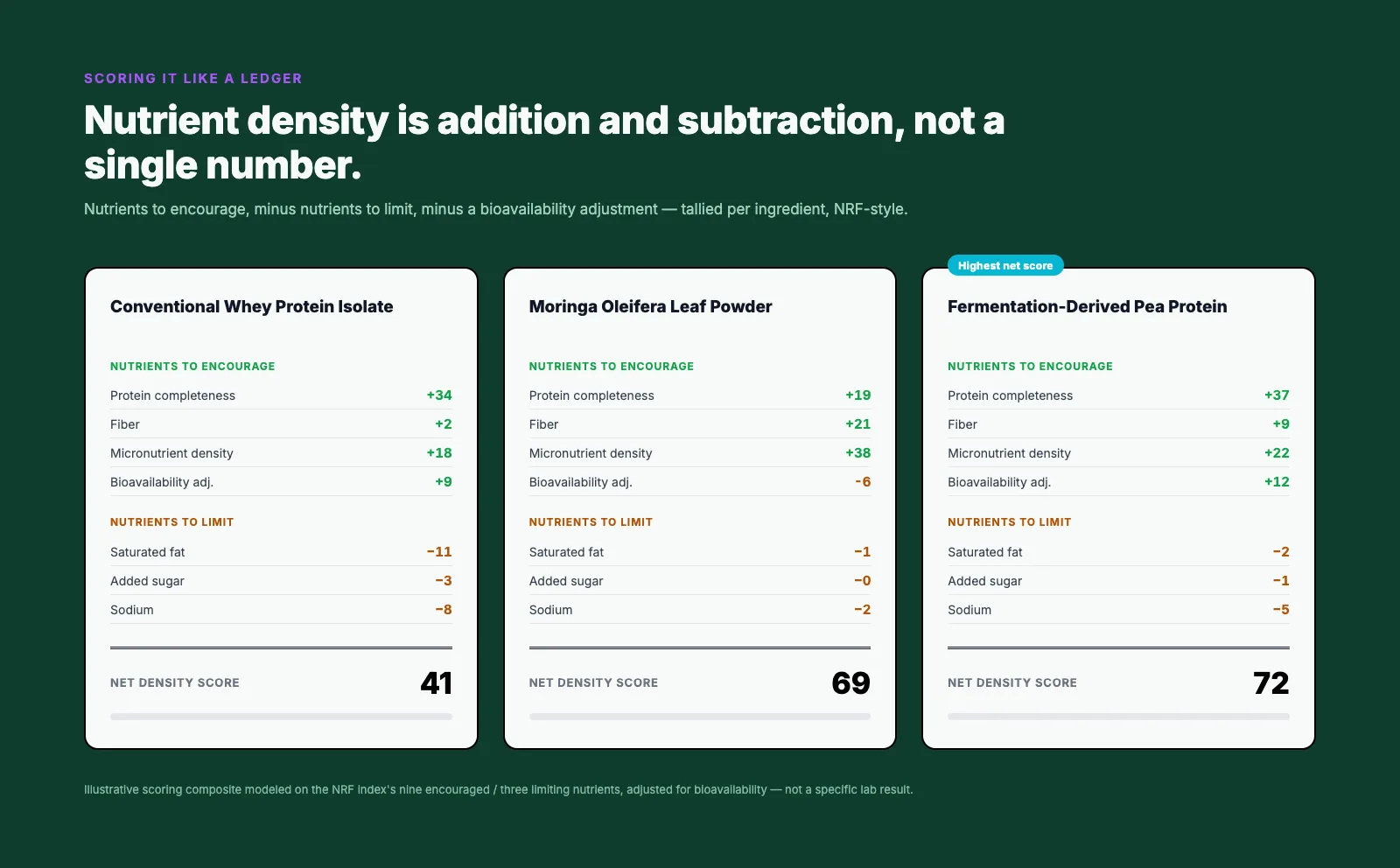
The NRF index is one of the most widely cited academic frameworks for nutrient density scoring. It calculates a score based on nine beneficial nutrients — protein, fiber, vitamins A, C, and E, calcium, iron, magnesium, and potassium — minus three nutrients to limit: saturated fat, added sugar, and sodium. All expressed per 100 calories.
The NRF model works well for comparing whole foods and single ingredients. Its limitation is that it was designed for consumer-facing dietary guidance, not the nuanced demands of food formulation — where you might be evaluating a functional ingredient like Moringa oleifera against a conventional protein source on a cost-per-nutrient basis.
Indices like the Healthy Eating Index (HEI) and the Diet Quality Score (DQS) take a pattern-based approach, scoring diets rather than individual ingredients. Less directly applicable to ingredient-level formulation decisions, but relevant when your product team is positioning a SKU against dietary guidelines or making claims tied to federal nutrition standards.
This is where 2026 looks meaningfully different from five years ago. Software platforms now build proprietary scoring models that layer nutrient density data with cost, sustainability, and supply chain variables — producing a composite ingredient score a food scientist can actually use during formulation, not just cite in a white paper.
Journey Foods assigns ingredient scores that factor in nutritional profile alongside cost and sustainability dimensions. That kind of multi-variable scoring is increasingly what R&D teams expect from their ingredient intelligence tools, because optimizing for nutrition alone rarely reflects real-world formulation constraints.
One of the most persistent problems in ingredient selection is optimizing for one variable while ignoring everything else. A team selects a high-protein isolate because it scores well on amino acid completeness — then discovers it performs poorly on taste, has a fragile supply chain, or conflicts with a clean-label positioning strategy.
Nutrient density scoring done well integrates multiple dimensions. The score on any single ingredient should reflect:
These aren't hypothetical edge cases. They're the daily questions that slow down product development cycles. A scoring system that ignores them produces numbers that look clean in a spreadsheet and fail in the lab.
The practical bottleneck in nutrient density scoring has always been data. Calculating a meaningful score for one ingredient means pulling from multiple sources — USDA FoodData Central, supplier spec sheets, peer-reviewed bioavailability studies — and reconciling inconsistencies between them. Doing that for 50 candidate ingredients is a multi-week research project.
AI compresses that timeline by automating data aggregation and applying consistent scoring logic across large ingredient sets simultaneously. Instead of days of manual comparison, the platform surfaces ranked options in minutes — with the scoring methodology visible and auditable.
This is part of a broader shift in how AI is being applied across food supply chains. How AI and transparency are reshaping ingredient safety and supply chains in 2026 covers this in more detail, but the core dynamic is consistent: AI doesn't replace the food scientist's judgment — it gives them better inputs to work with, faster.
The Journey Foods platform is built around this principle. Its ingredient search and scoring tools let R&D teams evaluate ingredients across nutrition, cost, and sustainability in one place — with AI-powered recommendations that account for product improvement goals and supply chain conditions at the same time.
There's a growing recognition in 2026 that nutrient density scoring and sustainability scoring can't live in separate silos. A highly nutrient-dense ingredient that requires water-intensive cultivation, generates significant carbon in transport, or depends on a single-origin supply chain carries real risk — both operational and reputational.
The most forward-looking formulation teams are already treating these as joint optimization problems. When you're choosing between two protein sources with comparable amino acid profiles, the sustainability footprint of each becomes a meaningful differentiator.
Better sustainability through key suppliers and services explores how supplier relationships factor into this equation. The short version: the data you need to make this joint optimization work has to come from your supply chain partners. That means your ingredient intelligence platform needs to connect to that network — not just pull from a static database.
If your team is moving from informal ingredient evaluation to a structured scoring approach, here's a practical starting point.
1. Define your scoring objectives before choosing a framework.
Are you optimizing for regulatory compliance, consumer-facing nutrition claims, internal formulation quality, or all three? Each objective may favor a different framework or weighting scheme.
2. Standardize your reference unit.
Decide whether you're scoring per 100g, per serving, or per 100 calories — and apply it consistently across all ingredient comparisons. Mixing reference units is the most common source of misleading scores.
3. Include bioavailability adjustments where data exists.
For key nutrients like iron, calcium, and zinc, raw content numbers overstate actual nutritional impact. Use bioavailability correction factors from peer-reviewed sources when they're available.
4. Build in processing stability flags.
Tag ingredients where heat, pH, or mechanical processing significantly degrades key nutrients. This prevents formulations that look strong on paper but underperform in finished product testing.
5. Connect your nutrient scores to cost and supply chain data.
A score that lives only in a nutrition database is useful for research. A score connected to real-time ingredient cost and supplier availability is useful for decisions.
6. Document your methodology.
If you're making label claims or positioning your product against dietary guidelines, you need a defensible, documented scoring methodology — not just an internal spreadsheet.
Nutrient density scoring is increasingly tied to a broader demand for ingredient transparency — from regulators, retailers, and consumers. Brands that can show their work, not just their claims, are building a real competitive advantage.
Digital tools that strengthen transparency, traceability, and trust in food covers how traceability infrastructure supports this. The connection to scoring is direct: a nutrient density score is only as credible as the ingredient data behind it. If you can't trace your ingredient to its source and verify the spec sheet against actual testing, the score is an estimate at best.
This is why the most rigorous food scientists in 2026 are pairing nutrient density scoring with supply chain traceability — not treating them as separate functions.
A mature nutrient density scoring workflow in 2026 has several components working together:
Platforms built for this kind of integrated workflow — like Journey Foods — are where serious CPG R&D teams are moving. The alternative is a patchwork of spreadsheets, static databases, and manual supplier outreach that creates bottlenecks at every stage of development.
What is nutrient density scoring in food science?
Nutrient density scoring quantifies the concentration of beneficial nutrients in a food or ingredient relative to a reference unit — typically 100 calories or 100 grams. Frameworks like the NRF index calculate a composite score based on beneficial nutrients (protein, fiber, vitamins, minerals) minus nutrients to limit (sodium, saturated fat, added sugar). In formulation contexts, these scores are used to compare ingredient options and support product development decisions.
Which nutrient density scoring framework is most widely used?
The Nutrient Rich Foods (NRF) index is one of the most cited academic frameworks. It scores foods per 100 calories across nine beneficial nutrients minus three limiting nutrients. In commercial and CPG contexts, proprietary platform-based scoring models are increasingly common because they integrate cost, sustainability, and supply chain data alongside nutritional metrics.
How does bioavailability affect nutrient density scores?
Raw nutrient content and bioavailable nutrient content are not the same thing. Iron from plant sources, for example, is absorbed at significantly lower rates than iron from animal sources. A nutrient density score that doesn't account for bioavailability will overstate the practical nutritional value of certain ingredients. Rigorous scoring systems apply bioavailability correction factors where peer-reviewed data supports them.
Can nutrient density scoring be automated with AI?
Yes. AI platforms can aggregate data from multiple sources — nutritional databases, supplier spec sheets, research literature — and apply consistent scoring logic across large ingredient sets simultaneously. This compresses what was previously a multi-week manual research process into minutes, while keeping the scoring methodology transparent and auditable.
How do food scientists use nutrient density scores in product formulation?
Scores are used to compare candidate ingredients, identify high-performing substitutions, support clean-label positioning, and document the nutritional rationale behind formulation decisions. In integrated platforms, nutrient scores are evaluated alongside cost and sustainability data so formulation choices reflect the full set of constraints a product team is working within.
What's the difference between nutrient density scoring and dietary quality indices?
Nutrient density scoring applies to individual ingredients or foods. Dietary quality indices like the Healthy Eating Index assess overall dietary patterns. For food scientists and R&D teams, ingredient-level scoring is more directly actionable during formulation. Dietary quality indices become relevant when positioning a product against federal nutrition guidelines or making dietary pattern claims.
How does nutrient density scoring connect to supply chain transparency?
A nutrient density score is only as reliable as the data behind it. If ingredient specs can't be traced and verified against actual supplier data, the score is built on assumptions. Connecting nutrient scoring to supply chain traceability — knowing where an ingredient comes from and what the verified spec looks like — is what makes scores defensible for both internal decisions and external claims.
Nutrient density scoring is no longer a research exercise. In 2026, it's an operational capability — one that separates teams making fast, confident formulation decisions from teams stuck in manual research loops.
If you want to see how integrated ingredient scoring works in practice, book a demo with Journey Foods or explore the platform at Journeyfoods.io.

Structured Q&A marked up with FAQ Page schema so it can be surfaced and cited by Al engines and search.
In Journey Al's 12 month dataset, the median plant protein reformulation came in -6.5% on raw material cost versus an animal protein control the first year that line went negative, driven by Tier 1 isolate suppliers reaching spec parity.
In Journey Al's 12 month dataset, the median plant protein reformulation came in -6.5% on raw material cost versus an animal protein control the first year that line went negative, driven by Tier 1 isolate suppliers reaching spec parity.
In Journey Al's 12 month dataset, the median plant protein reformulation came in -6.5% on raw material cost versus an animal protein control the first year that line went negative, driven by Tier 1 isolate suppliers reaching spec parity.