Store-bought versus homemade Pop-Tarts represents a classic tradeoff between convenience and quality. Let's dive into the differences by comparing their nutritional values, ingredients, and now with a complete homemade recipe.
Nutrition Comparison
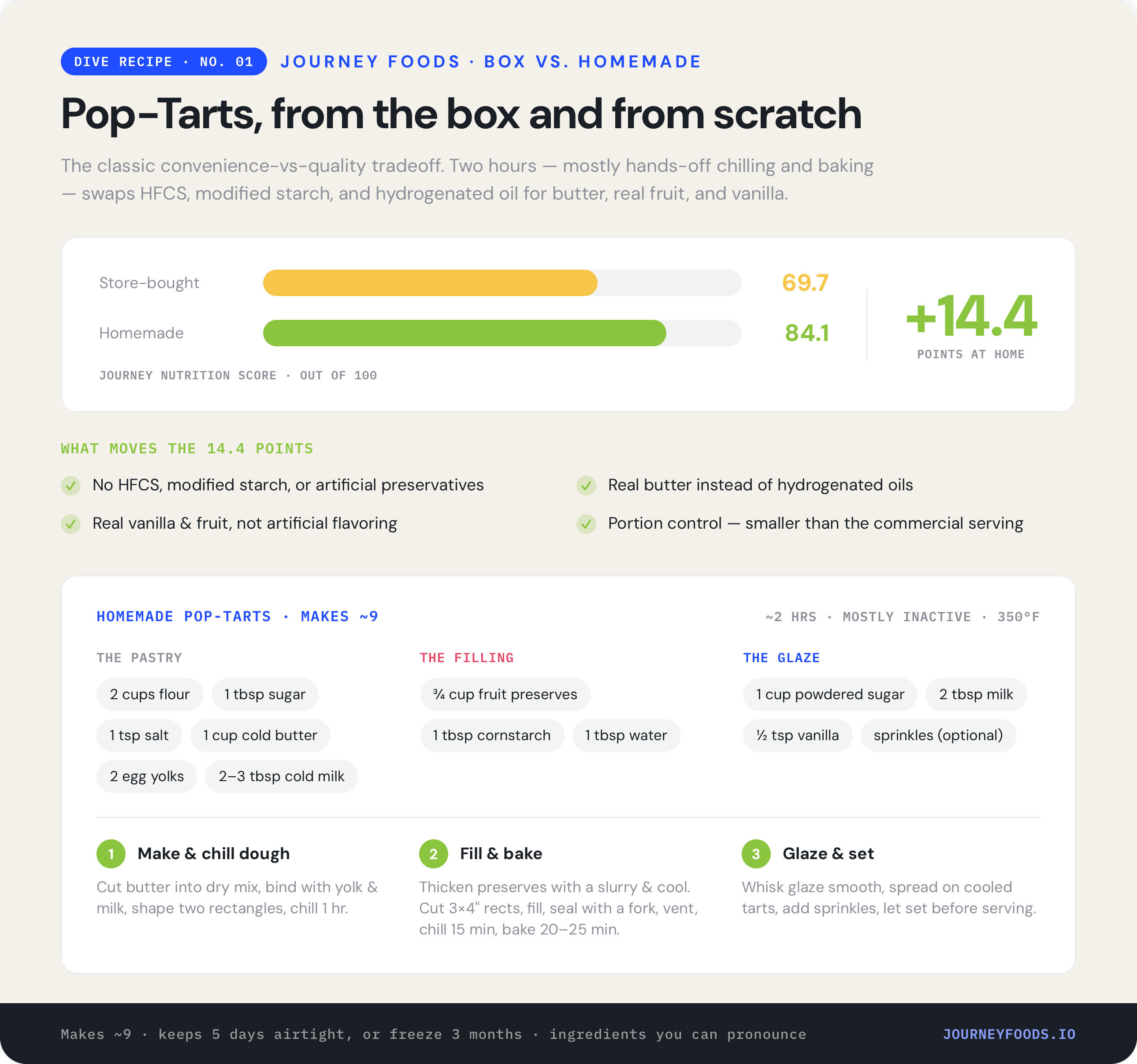
Based on Journey Foods data, the nutrition scores tell a compelling story:
Store-bought Pop-Tarts: 69.7/100
Homemade Pop-Tarts: 84.1/100
That's a significant 14.4 point improvement when you make them at home!
What Makes the Difference?
The homemade version scores higher primarily due to:
Fewer processed ingredients: No high fructose corn syrup, modified starches, or artificial preservatives
Higher quality fats: Real butter instead of hydrogenated oils
Natural flavoring: Real vanilla and fruit instead of artificial alternatives
Portion control: Typically smaller serving sizes than commercial products
Why This Matters
The nutrition score gap highlights how food processing impacts overall quality. While store-bought versions offer convenience, homemade alternatives provide better nutritional value and fewer additives.
The recipe above takes about 2 hours total (including chilling and baking time), but most of that is inactive time. The result is a fresher, more wholesome alternative to the packaged version with ingredients you can pronounce.
This is the first in our "Dive Recipe" series where we'll compare common packaged foods with their homemade counterparts.
Homemade Pop-Tarts Recipe
Ingredients
For the Pastry
2 cups (250g) all-purpose flour
1 tablespoon granulated sugar
1 teaspoon salt
1 cup (226g) cold unsalted butter, cubed
2 large egg yolks
2-3 tablespoons cold milk
For the Filling
3/4 cup (240g) fruit preserves (strawberry, blueberry, or your preference)
1 tablespoon cornstarch
1 tablespoon water
For the Glaze
1 cup (120g) powdered sugar
2 tablespoons milk
1/2 teaspoon vanilla extract
Food coloring (optional)
Sprinkles (optional)
Directions
Make the Dough
In a large bowl, whisk together flour, sugar, and salt.
Add cold cubed butter and work it into the flour using a pastry cutter or your fingertips until the mixture resembles coarse crumbs with some pea-sized butter pieces remaining.
Mix egg yolks with 2 tablespoons of cold milk. Drizzle over flour mixture and stir until the dough just comes together. Add the remaining tablespoon of milk if needed.
Divide the dough in half, shape each half into a rectangle, wrap in plastic wrap, and refrigerate for at least 1 hour.
Prepare the Filling
In a small bowl, mix cornstarch with water to create a slurry.
In a small saucepan, heat preserves over medium heat until bubbling.
Add cornstarch slurry and cook, stirring constantly until mixture thickens (about 1-2 minutes).
Remove from heat and let cool completely.
Assemble and Bake
Preheat oven to 350°F (175°C) and line baking sheets with parchment paper.
On a lightly floured surface, roll out one portion of dough to about 1/8 inch thickness.
Cut into 3×4 inch rectangles.
Place 1 tablespoon of cooled filling in the center of half of the rectangles, leaving a 1/2-inch border.
Brush the borders with beaten egg.
Top with remaining rectangles and seal the edges with a fork.
Prick the tops with a fork to create steam vents.
Place on prepared baking sheets and refrigerate for 15 minutes.
Bake for 20-25 minutes until golden brown.
Cool completely on a wire rack.
Make the Glaze
Whisk together powdered sugar, milk, and vanilla extract until smooth.
Add food coloring if desired.
Spread glaze over cooled pastries and top with sprinkles if using.
Allow glaze to set before serving.
Yield
Makes approximately 9 Pop-Tarts.
Storage
Store in an airtight container at room temperature for up to 5 days or freeze for up to 3 months.
About the Author
Julia Froese
Research and Content Fellow. Biology and Farming Researcher