.svg)
.svg)
.svg)
.svg)


.svg)
Story time and real insights

.svg)
It started with a typhoon. Typhoon Mei-Ling, to be specific, which stalled over the South China Sea for eleven days in August 2025, creating what supply chain professionals now refer to as "The Great Port Gridlock."
Over 2,400 container ships were delayed. Port congestion cascaded from Shanghai to Singapore to Los Angeles. Food manufacturers watched helplessly as critical ingredient shipments sat offshore, their production lines grinding to a halt, their fulfillment commitments evaporating.
The visibility tools everyone had invested in—the track-and-trace systems, the GPS monitoring, the predictive ETA platforms—all worked perfectly. Companies could see exactly where their shipments were. They could watch, in real-time, as their carefully planned production schedules became impossible.
Visibility without action turned out to be worse than no visibility at all. At least ignorance came with plausible deniability.
The Great Port Gridlock taught the food industry a brutal lesson: knowing your shipment is stuck is worthless if you can't do anything about it.
That's the problem Journey AI set out to solve. And by 2026, we haven't just solved it—we've fundamentally transformed what "supply chain management" means.
Let's be clear about what happened before Journey AI's Predictive Logistics Loop.
A food manufacturer sources specialized organic pea protein from Northern Europe. It's a critical ingredient for their flagship plant-based burger, comprising 18% of the formulation and providing the exact protein-to-texture ratio that took R&D eighteen months to perfect.
The shipment departs Rotterdam on schedule. It should arrive in New Jersey in 14 days. Production is scheduled to start in 16 days, providing a comfortable two-day buffer.
But three days into the voyage, severe weather in the North Atlantic forces the vessel to reduce speed. The ETA slips to 17 days. Then to 19 days. The visibility platform sends alert after alert.
Now what?
In the old world, here's what happened:
This cycle repeated, with variations, at nearly every food company we spoke with. Delays happened. Visibility tools reported them faithfully. Companies reacted frantically, expensively, and too late.
Journey AI's integrations changes this equation fundamentally. We've moved from reactive crisis management to proactive, automated contingency execution.
Here's the same scenario, but in 2026, with the Predictive Logistics Loop active:
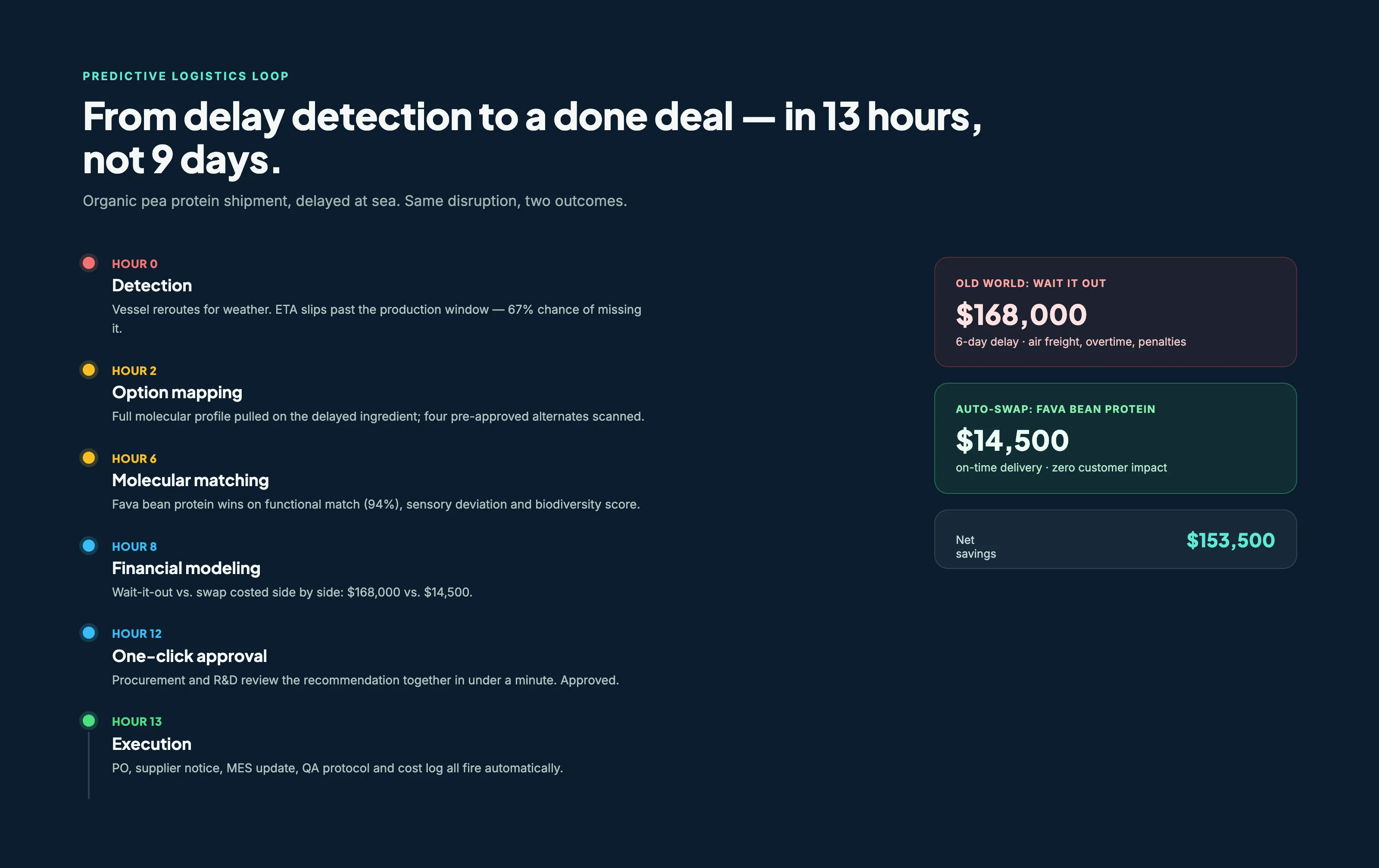
Our partners detects that the vessel carrying your organic pea protein has altered course due to weather. Current ETA: 17 days, which pushes past your critical production window by one day.
Most companies would file this under "monitor closely" and wait. Journey AI's Predictive Logistics Loop doesn't wait.
The system immediately:
While your team sleeps, Journey AI's Operations Science engine goes to work.
It pulls up the complete molecular and functional profile of the delayed ingredient:
Then it scans your pre-approved alternate supplier network—not just any supplier who could ship pea protein, but suppliers who have already been vetted and approved through your GFSI audits, sustainability screens, and quality protocols.
The AI identifies four potential alternates:
Here's where Journey AI's Operations Science architecture shows its power.
The system doesn't just match on basic specs ("it's a protein"). It runs functional equivalence modeling using:
The fava bean protein emerges as the optimal candidate:
But Journey AI doesn't stop at "this ingredient works." It immediately models the complete financial cascade:
Scenario A: Wait for Delayed Shipment
Scenario B: Use Fava Bean Auto-Swap
Net savings: $153,500
At 8:47 AM, your Procurement Lead, Sarah, opens her Journey AI dashboard and sees a notification:
ALERT: Auto-Swap Recommendation Ready
Your organic pea protein shipment (PO #45782) is delayed with 73% probability of missing production window.
Recommended Action: Ingredient Swap
Estimated savings vs. delay scenario: $153,500
[Approve Swap] [Request More Options] [Monitor and Defer]
Sarah clicks into the recommendation. She sees:
She consults with R&D Lead Marcus for thirty seconds: "The AI says fava bean works. You comfortable?"
Marcus pulls up the sensory prediction models, sees the confidence intervals, checks the amino acid profile. "Yeah, this actually looks better than the pea protein for our new burger formula. Let's do it."
Sarah clicks "Approve Swap."
The moment Sarah approves, Journey AI executes a coordinated sequence:
All of this happens while the delayed pea protein shipment is still somewhere in the North Atlantic.
The fava bean protein arrives. Production runs as scheduled. Customers receive their orders on time.
The following week, the delayed pea protein shipment finally arrives. It doesn't go to waste—it enters inventory as backup stock for the next production run.
Total disruption to operations: zero.
Total manual intervention required: one approval click and a thirty-second consultation.
Total cost of the "crisis": $14,500 instead of $168,000.
Let's get technical about what's happening under the hood, because this isn't magic—it's Operations Science.
The Predictive Logistics Loop requires seamless data flow from multiple systems:
Visibility Platform:
Journey AI Product Intelligence Database:
Your ERP and Production Systems:
Formula and Sensory Databases:
Journey AI employs several specialized ML models that power the Auto-Swap intelligence:
Delay Probability Forecasting: A gradient boosted model trained on 8 years of global shipping data that predicts not just if a delay will occur, but how long it's likely to be. This model factors in:
Functional Equivalence Matching: A neural network trained on ingredient performance data from 100,000+ formulation trials. It learns complex, non-linear relationships between ingredient properties and finished product characteristics. For proteins specifically, it models:
Sensory Deviation Prediction: This model takes two ingredients and a formula, and predicts consumer-detectable differences in:
It's been validated against blind consumer taste tests and achieves 89% accuracy in predicting whether a substitution will be detected by consumers.
Cost Optimization Engine: A multi-objective optimization model that balances:
It doesn't just find the cheapest alternate—it finds the optimal trade-off across all dimensions.
Here's a critical insight that many companies miss: the Auto-Swap doesn't work without groundwork.
You can't have an AI automatically swapping ingredients from random suppliers you've never vetted. That's a recipe for quality disasters, compliance failures, and food safety incidents.
Journey AI's approach requires companies to build a Pre-Approved Alternate Network:
Supplier Qualification: Before any supplier can appear in an Auto-Swap recommendation, they must complete:
Ingredient Validation: For each ingredient category, R&D teams work with Journey AI to:
Risk Tiering: Not all swaps are created equal. Journey AI categorizes potential swaps into risk tiers:
The pea-to-fava protein swap in our example is Tier 2. The AI did the heavy analytical lifting, but a human R&D expert reviewed and approved it before execution.
Every Auto-Swap becomes training data for the next one. The system tracks:
This data continuously refines the models, making future recommendations more accurate and building institutional knowledge that persists even as individual employees turn over.
While we've focused on shipment delays, the Predictive Logistics Loop handles a much broader range of supply chain disruptions:
A shipment of cocoa powder fails microbial testing at your receiving dock. In the old world, you scramble to find replacement inventory. With Journey AI, the moment the quality team enters the rejection in your QMS, the Auto-Swap protocols activate, identifying available cocoa powder from alternate suppliers with compatible specifications.
Your bakery flour supplier experiences a mill equipment failure. They can only fulfill 60% of your order. Journey AI immediately models:
Vanilla prices spike 40% due to a poor Madagascar harvest. Journey AI doesn't just alert you to the price increase—it evaluates:
New tariffs are announced on ingredients from a specific country. The Predictive Logistics Loop:
An upcoming regulation will restrict ingredients from regions with deforestation. Journey AI:
Here's what separates leaders from laggards in 2026:
Average response time to supply chain disruptions:
Average cost of supply chain disruptions:
That's not incremental improvement. That's category transformation.
A critical point that gets lost in automation discussions: the Auto-Swap doesn't eliminate human judgment. It empowers it.
Sarah, the Procurement Lead in our earlier example, didn't become obsolete. She became more strategic. Instead of spending her week frantically calling suppliers and negotiating emergency pricing, she spent thirty seconds reviewing an AI-generated recommendation backed by comprehensive analysis.
Marcus, the R&D Lead, didn't lose control over formulation quality. He gained the ability to make faster, better-informed decisions. The AI gave him predictive sensory modeling that would have taken his team days to generate manually.
The CFO didn't lose visibility into costs. She gained real-time, scenario-based financial modeling that showed the complete P&L impact of supply chain decisions before they were made.
This is the promise of Operations Science: augmenting human expertise with computational power so that teams can focus on strategy, creativity, and relationship-building rather than administrative firefighting.
Let's be honest about what it takes to make this work, because we've seen implementations succeed and fail.
Success factors:
Common failure modes:
The sweet spot is what we call "supervised automation": the AI does the heavy analytical lifting and generates recommendations, but domain experts review and approve before execution, especially for Tier 2 and Tier 3 swaps.
The Auto-Swap is just the beginning. Journey AI is currently piloting Auto-Optimize—a more ambitious system that doesn't just react to disruptions but proactively improves supply chains.
Imagine this: The AI continuously monitors your supply network and identifies improvement opportunities:
"Supplier A has a score of 45. Supplier B, who provides nearly identical functionality, has a score of 78 and actually costs 3% less due to more efficient logistics. Would you like to transition 40% of your sourcing from A to B over the next six months?"
Or: "Your formula for Product X uses imported organic cane sugar. We've identified a domestic beet sugar that would reduce your carbon footprint by 32%, improve your JBRIJ_{BRI}JBRI score by 12 points, and reduce ingredient cost by 8%. Predicted sensory impact: undetectable. Would you like to run a plant trial?"
This is the future of Operations Science: supply chains that don't just respond to problems but continuously evolve toward better outcomes across cost, quality, sustainability, and resilience.
The Great Port Gridlock was painful, but it clarified something essential: visibility is useless without agency.
Knowing your ingredients are stuck at sea doesn't help if you can't do anything about it.
The food companies thriving in 2026 aren't those with the best visibility tools. They're the ones who've built systems that transform visibility into action—and action into advantage.
Because in the end, your customers don't care that there was a typhoon. They care that their order arrived on time, tasted great, and aligned with their values.
Contact sales@journeyfoods.com today for a trial.
Journey Foods Team News
Structured Q&A marked up with FAQ Page schema so it can be surfaced and cited by Al engines and search.
In Journey Al's 12 month dataset, the median plant protein reformulation came in -6.5% on raw material cost versus an animal protein control the first year that line went negative, driven by Tier 1 isolate suppliers reaching spec parity.
In Journey Al's 12 month dataset, the median plant protein reformulation came in -6.5% on raw material cost versus an animal protein control the first year that line went negative, driven by Tier 1 isolate suppliers reaching spec parity.
In Journey Al's 12 month dataset, the median plant protein reformulation came in -6.5% on raw material cost versus an animal protein control the first year that line went negative, driven by Tier 1 isolate suppliers reaching spec parity.