
.svg)
.svg)
.svg)
.svg)


.svg)
Sustainability reporting used to be a marketing exercise. In 2026, it's an operational requirement with teeth.
Retailers are demanding ingredient-level emissions data before they'll list new products. Investors want Scope 3 breakdowns tied to specific raw materials. Regulatory frameworks in the EU — and increasingly in North America — are moving from voluntary disclosure to mandatory reporting. If your sustainability data still lives in a spreadsheet or a one-off audit report, you're already behind.
This article breaks down exactly what CPG brands need to measure at the ingredient level, why the data requirements are harder than most teams expect, and what a functional reporting workflow actually looks like.
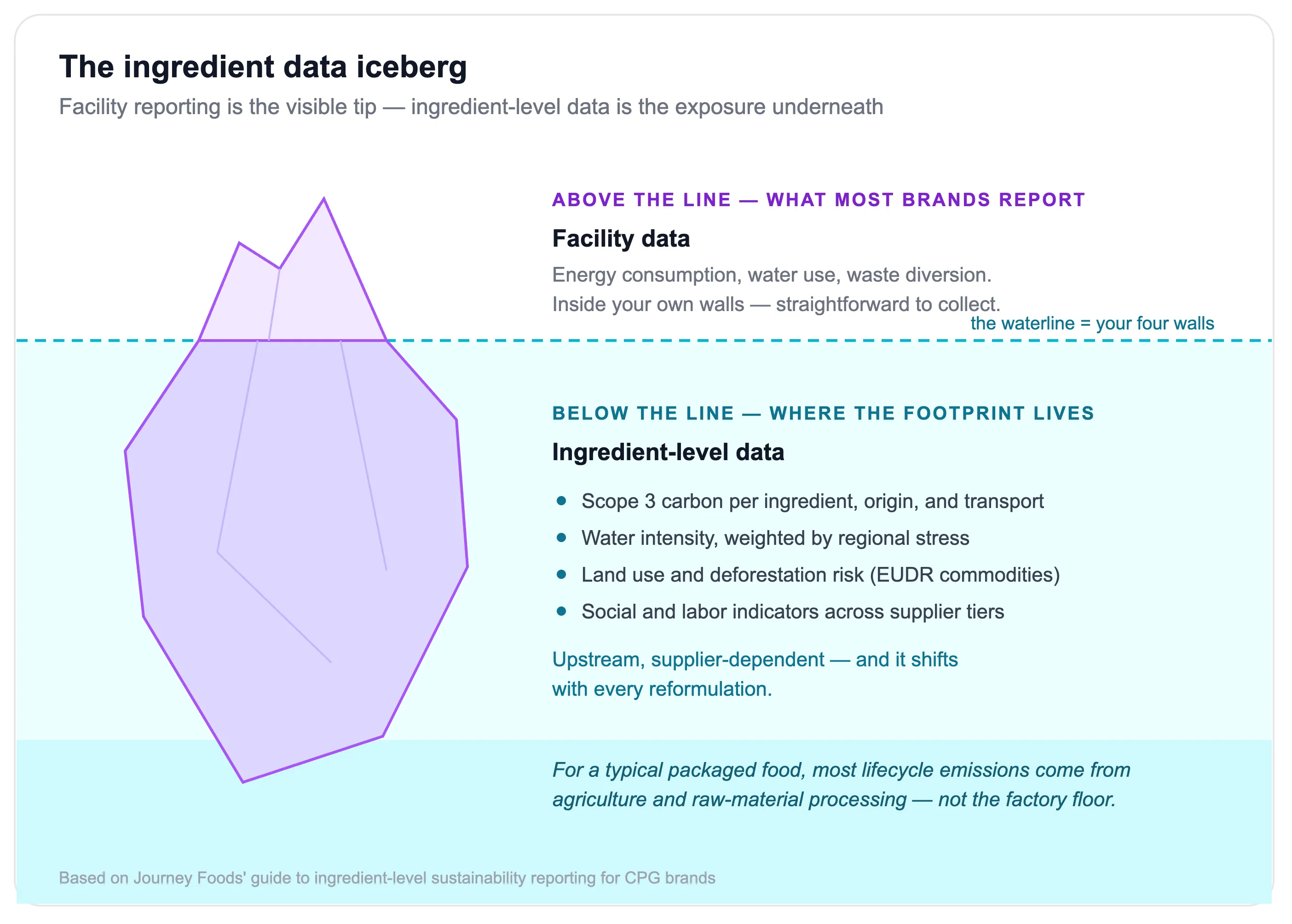
Most CPG brands can report on their facilities. Energy consumption, water use, waste diversion rates — that data sits inside your four walls and is relatively straightforward to collect.
Ingredient-level sustainability data is different. It's upstream. It depends on your suppliers' suppliers. It shifts with geography, growing season, and processing method. And it changes every time you reformulate.
The result: sustainability reports that cover corporate operations in detail but go thin on ingredients — which is exactly where most of a food product's environmental footprint actually lives. For a typical packaged food, the majority of lifecycle emissions come from agricultural production and raw material processing, not the factory floor.
Retailers and investors are catching on. The ingredient-level data gap is now the gap that creates the most exposure.
Scope 3 Category 1 covers purchased goods and services — which means your ingredients. This is the category most CPG brands struggle with because it requires supplier-reported emissions data or credible third-party estimates tied to specific commodities and origins.
What you need at the ingredient level:
Not all suppliers will hand you this data. Many teams use commodity-level emissions databases as proxies and layer in supplier-specific adjustments where available. The key is documenting your methodology clearly enough that auditors and buyers can actually assess it.
Water intensity is increasingly a required disclosure, particularly for ingredients sourced from water-stressed regions. Palm oil, almonds, avocados, and certain grains draw the most scrutiny.
The data points that matter:
Raw volume isn't the whole story. One liter used in a water-rich region carries a very different risk profile than one liter drawn from an aquifer under stress. Context is part of the disclosure.
For ingredients linked to deforestation risk — soy, palm, cocoa, beef derivatives, coffee, certain wood-based additives — traceability data needs to go beyond country of origin.
Specifically:
The EU Deforestation Regulation (EUDR) is the clearest forcing function here. If you sell into the EU or supply brands that do, deforestation-free documentation is no longer optional for covered commodities.
ESG reporting increasingly includes social metrics alongside environmental ones. For ingredients, that means:
This is the least standardized part of ingredient-level reporting, but it's converging. As GRI and SASB frameworks continue to align, expect more defined disclosure requirements here within the next reporting cycle or two.
The Frameworks You're Reporting Into
Which frameworks apply to your business determines what you need to collect. In 2026, the most relevant ones for CPG ingredient reporting are:
GHG Protocol remains the baseline for emissions accounting. Scope 3 Category 1 is where ingredient data lands. If your buyers or investors ask for a carbon footprint, this is the methodology they expect.
Science Based Targets initiative (SBTi) requires emissions reduction targets aligned with 1.5°C pathways. If your company has made an SBTi commitment, you need ingredient-level emissions data to track progress against your Scope 3 baseline.
GRI Standards — particularly GRI 301, 302, 303, and 308 — cover materials, energy, water, and supplier environmental assessment. Widely used for sustainability reports directed at investors and public stakeholders.
SASB Food and Beverage Standard includes specific metrics for ingredient sourcing: GMO disclosure, water management, and supply chain traceability.
EU CSRD (Corporate Sustainability Reporting Directive) applies to large companies operating in the EU and their supply chain partners. Even if you're a mid-market US brand, if you supply into EU retail, your buyers may pass reporting requirements directly down to you.
The practical implication: your ingredient data needs to be flexible enough to feed multiple frameworks, not just one. Building your data collection around a single framework creates rework every time a new requirement lands.
The most common problem is that supplier sustainability data is unavailable, inconsistent, or unverified. Suppliers in different regions use different methodologies. Some provide lifecycle assessment (LCA) data. Others offer only certifications. Many provide nothing.
The workaround most teams use is a tiered approach: primary data from key suppliers, secondary data from commodity databases for the rest, with clear documentation of which is which. The problem is that this is labor-intensive and hard to keep current as formulations change.
When you swap an ingredient, your sustainability profile changes. But most teams don't have a system that automatically updates sustainability metrics when a formulation changes. The data lives in a separate tool from the formulation, so the connection breaks.
This is where ingredient-level scoring built into your development workflow pays off. If sustainability data is attached to each ingredient in your system, a formulation change triggers an updated sustainability calculation automatically — rather than requiring a separate audit cycle.
Sustainability reporting requires you to report on what you actually used, not what you planned to use. If your formulation records and your sustainability records are out of sync, your report is wrong. That's a version control problem as much as a data problem.
Managing multiple SKUs means aggregating ingredient-level data across all active formulations for portfolio-level reporting. Without a centralized system, that's a manual process that takes weeks and introduces errors.
What a Functional Ingredient Sustainability Workflow Looks Like
The teams that handle this well share a few common practices.
Sustainability data is attached to ingredients at the point of sourcing, not added retroactively. When an ingredient enters the system, its carbon footprint, water intensity, and certification status come with it. The data is current and available when formulation decisions are made.
Ingredient scoring happens before formulation decisions are finalized. Sustainability isn't reviewed at the end of the development process — it's a criterion during ingredient selection. This prevents situations where a product is nearly launch-ready and then fails a sustainability review.
Supplier data is tracked with version history. When a supplier updates their emissions data or changes their sourcing region, the system records it. Historical formulations stay accurate to the data that was current when they were built.
Reporting is generated from the same data used in development. There's no separate sustainability database to reconcile with the formulation database. One source of truth feeds both.
This is the workflow that building sustainability into your supplier relationships supports from the supply side. The data you collect from key suppliers feeds directly into your reporting, rather than sitting in a separate audit file.
The manual approach to ingredient sustainability data doesn't scale. A mid-market CPG brand with 50 to 200 active formulations — each containing 10 to 30 ingredients — is managing thousands of data points that need to stay current.
AI-driven ingredient scoring changes this by automating the lookup, scoring, and flagging process. Instead of a food scientist manually researching the carbon footprint of a new ingredient, the system scores it automatically and surfaces alternatives if the score falls below threshold.
Journey Foods' Operations Scientist engine does exactly this: it scores ingredients across nutrition, cost, and sustainability simultaneously, so your team sees the full picture before making a formulation decision. You're not running three separate analyses. You're looking at one score that accounts for all three dimensions.
That matters for sustainability reporting because it means your sustainability data becomes a byproduct of your normal development workflow — not a separate data collection exercise. The formulation record and the sustainability record are the same record.
You can explore how this works at journeyfoods.io.
Ingredient sustainability data doesn't exist in isolation. Retailers and investors evaluate total product footprint, and that includes packaging. The work happening across the industry on reducing single-use plastics in food packaging is part of the same reporting conversation.
Getting ingredient-level data right is the harder, less-discussed half of the problem. Packaging is more visible and easier to audit. But ingredient footprint — particularly for products with complex formulations or high-risk commodities — is where the material exposure sits.
To make this concrete, here's what data requests from retailers and investors typically look like in 2026:
Some large retailers are moving toward requiring this data in machine-readable format — not just a PDF report. That's a signal that the infrastructure expectation is shifting toward real-time data access, not annual disclosure cycles.
The transparency expectations around ingredient sourcing are also rising on the consumer side, as covered in the broader discussion of AI and transparency in food supply chains. What starts as a B2B reporting requirement often becomes a consumer-facing claim within a few years.
If your ingredient sustainability data is currently fragmented or incomplete, don't start with a full sustainability audit. That's expensive and produces a snapshot that's already out of date by the time it's finished.
The better move is building sustainability scoring into your ingredient management system so data is collected and updated continuously as part of your normal workflow. That's the infrastructure that makes annual reporting fast and makes real-time buyer requests answerable.
If you're evaluating how to build that infrastructure, book a demo with Journey Foods to see how ingredient scoring, formulation management, and sustainability tracking work in a single workflow.
What is ingredient-level sustainability reporting in CPG?
Ingredient-level sustainability reporting means documenting the environmental and social impact of each raw material in your formulations — carbon footprint, water use, land use, and sourcing certifications. It goes beyond facility-level reporting to capture the upstream footprint of your supply chain.
Which sustainability frameworks apply to CPG ingredient data?
The most relevant frameworks for CPG brands in 2026 are the GHG Protocol (specifically Scope 3 Category 1), SBTi for companies with emissions targets, GRI Standards (301, 302, 303, 308), the SASB Food and Beverage Standard, and the EU CSRD for companies with EU market exposure.
What data do I need to report Scope 3 Category 1 emissions for ingredients?
You need cradle-to-gate carbon footprint data per kilogram of ingredient, country or region of origin, processing method, and transport details. Primary data from suppliers is preferred; commodity-level database estimates are an acceptable proxy when supplier data is unavailable, provided you document the methodology.
How does reformulation affect sustainability reporting?
Every formulation change potentially changes your product's sustainability profile. If your sustainability data isn't connected to your formulation records, you'll need to run a separate analysis every time you reformulate. Systems that attach sustainability scores to ingredients at the formulation level update automatically when ingredients change.
What is the EU Deforestation Regulation and which ingredients does it cover?
The EUDR requires companies placing certain commodities on the EU market to verify they are deforestation-free. Covered commodities include cattle, cocoa, coffee, palm oil, soy, wood, and derived products. If you sell into EU retail or supply brands that do, deforestation-free documentation is required for these ingredients.
Why is ingredient sustainability data harder to collect than facility data?
Facility data is internal and relatively easy to measure directly. Ingredient data is upstream and depends on supplier reporting, geographic variables, and processing methods outside your direct control. It also changes when suppliers shift their sourcing or when you reformulate — which means continuous updates, not a one-time collection.
How can AI help with CPG sustainability reporting for ingredients?
AI can automate ingredient scoring by pulling and synthesizing sustainability data at the point of ingredient selection, rather than requiring manual research after the fact. This makes sustainability data a continuous output of the development workflow instead of a separate audit exercise — reducing reporting time and keeping data current as formulations evolve.
Journey Foods Team News