
.svg)
.svg)
.svg)
.svg)


.svg)
How Journey AI Healed the R&D and Finance Divide

.svg)
Every food company has the same dirty secret: their most talented departments can't stand each other.
It's not personal. It's structural. And it's killing innovation.
On one side: the Chef. The innovation team. R&D. Product Development. Whatever you call them, they're the dreamers. They obsess over mouthfeel, clean labels, ingredient provenance, sensory experience. They spent six months perfecting a plant-based mozzarella that melts just right. They'll fight you over 0.3% difference in potato starch content because it affects the texture profile.
On the other side: the CFO. Finance. Procurement. Operations. The realists. They obsess over COGS, margin expansion, SKU rationalization, manufacturing efficiency. They've seen too many "innovative" products that looked great in small batches and became margin disasters at scale.
Between them: a chasm of mistrust, incompatible incentives, and fundamentally different languages.
The Chef thinks Finance is soulless and short-sighted, killing beautiful products because they can't see past next quarter's earnings.
Finance thinks R&D is reckless and naive, creating expensive complications that erode profitability and operational efficiency.
They're both right. And both wrong.
And in 2026, Journey AI is finally translating between them.
Let's walk through how this typically plays out. It's a story you've lived if you work in food innovation:
Maria leads the plant-based innovation team at a mid-sized CPG company. She's brilliant—trained at CIA (the Culinary Institute, not the spy agency), worked at Impossible Foods during the early days, holds two patents in protein texturization.
The CEO has given her team a mandate: create a plant-based chicken nugget that kids will actually eat. Not a product that health-conscious parents buy and then throw away when their kids refuse to touch it. A product kids choose.
Maria assembles her team. They start experimenting:
They go through 47 iterations. They conduct taste tests with focus groups. They optimize the breading-to-nugget ratio. They perfect the golden-brown color that signals "delicious" to a seven-year-old's brain.
By month six, they have it: Plant-Based Chicken Nuggets that score 4.2 out of 5 in blind taste tests against the leading conventional nugget brand. Kids ask for seconds. Parents are thrilled by the clean ingredient deck.
Maria's team is euphoric. They've cracked it. They're ready to change the market.
Maria presents the finished formulation to the commercialization committee. She's prepared a beautiful deck with photos of happy kids eating nuggets, the sensory scores, the nutritional profile, the sustainability story.
Seven slides in, David from Finance raises his hand.
"What's the landed cost per pound?"
Maria hesitates. "We've been focused on the product quality first. We'll optimize costs during scale-up."
"Ballpark?"
"Approximately $4.20 per pound."
The room goes silent.
David pulls up a spreadsheet. "The leading conventional nugget retails for $8.99 per pound. With retailer margins, distributor margins, and our margin targets, we need to land at $3.10 per pound maximum. You're 35% over."
"But the product is extraordinary. Consumers will pay a premium for—"
"They won't. Our consumer research shows the premium ceiling for plant-based nuggets is 15%, maybe 20% in premium channels. At your cost structure, we'd have to retail at $11.49 per pound. That's 28% premium. It won't sell."
Maria's six months of work collapses in six minutes.
But Maria doesn't give up. She goes back to the lab, determined to hit the cost target without destroying the product.
She starts cutting:
Four months later, she's at $3.65 per pound. Better, but still not there.
She runs another taste test. The scores drop to 3.4 out of 5. Still acceptable, but no longer exceptional. The magic is gone.
David runs the numbers again: "At $3.65, with required margins, we're at a 22% retail premium. It's borderline. But frankly, at a 3.4 sensory score, I don't think it's differentiated enough to command any premium. We'd be launching a 'me too' product at a price disadvantage."
The Executive Committee reviews the project. The verdict: "Promising concept, but not ready for commercialization. Recommend parking for future consideration."
Translation: killed.
Maria's team is devastated. Twelve months of work. Brilliant innovation. All for nothing.
The CFO is frustrated too: "We can't keep funding R&D projects that don't have commercial viability. We need discipline."
The CEO is caught in the middle: "We need innovation to grow, but we can't launch products that lose money."
Everyone blames everyone else. Nobody learns anything. The cycle repeats with the next project.
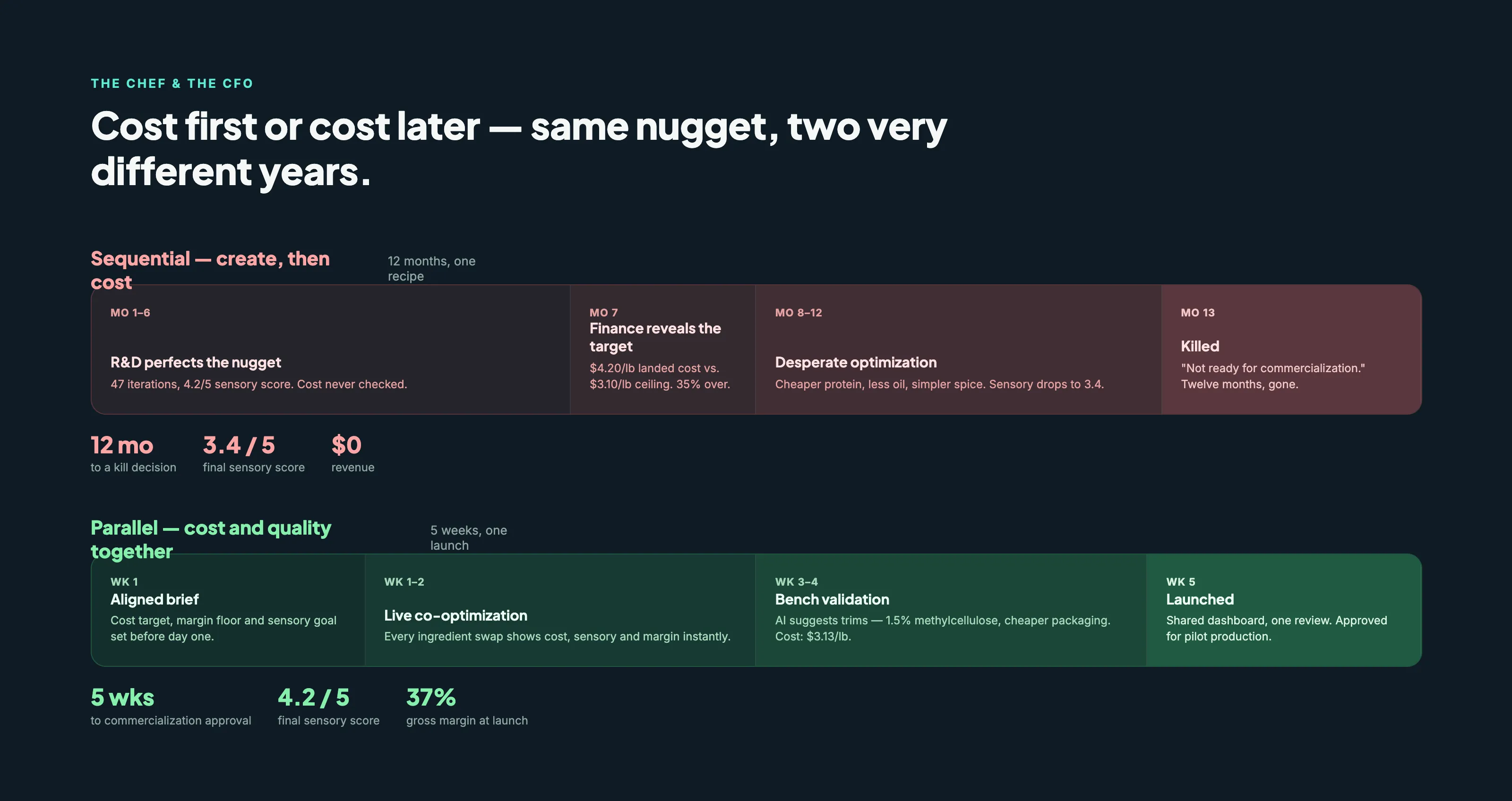
Here's the fundamental problem that Journey AI identified:
Food companies treat product development as a sequential process: Create first, cost later.
This makes intuitive sense. How can you know what something will cost before you know what it is?
But this sequencing creates a fatal flaw: by the time you discover the product is uneconomical, you've invested enormous resources in optimizing the wrong formulation.
Maria spent six months perfecting a $4.20/lb nugget. Then four more months degrading it trying to hit a $3.10/lb target she didn't know existed.
What if she'd known the cost target on Day 1? She would have designed a completely different product—one that was delicious and economical from the start.
But traditional tools don't allow this. You can't know costs until you've specified ingredients. You can't specify ingredients until you've tested formulations. You can't test formulations until you've bought ingredients and run trials.
Sequential. Expensive. Wasteful.
Journey AI makes product development parallel instead of sequential.
Here's the same scenario, but in 2026, with Journey AI as the operating system:
Maria receives the plant-based nugget brief. But now it's different. The brief includes:
Target Product Profile:
Commercial Parameters:
Constraints:
From Day 1, Maria knows what success looks like—both culinarily and commercially. The targets are negotiated and aligned before a single ingredient is purchased.
Maria opens Journey AI's Product Innovation Studio. It's not a spreadsheet. It's not a costing tool. It's an integrated workspace where culinary creativity meets financial reality in real-time.
She starts building the nugget formulation. As she adds each ingredient, Journey AI instantly displays:
For each ingredient:
For the total formulation:
Maria experiments in real-time:
"What if I use pea protein isolate?"
Maria tries the blend. It works. The texture prediction models show good water binding. The cost is closer to target, though still slightly high.
"What if I reduce sunflower oil from 8% to 6%?"
This isn't guesswork. The AI is running thousands of formulation simulations per second, learning from decades of data on how ingredients interact, how processing conditions affect outcomes, how consumers perceive differences.
Maria has three promising formulations, all hitting the cost and sensory targets in the AI models. Now it's time to validate in the real world.
She runs bench trials. The AI monitors the results:
Formulation A:
Formulation B:
Formulation C:
Formulation C is the winner—slightly over cost target, but the sensory performance is exceptional.
But here's where Journey AI shows its power: instead of accepting the overage or compromising sensory, the system generates optimization suggestions:
"Analysis: Your methylcellulose usage is 1.8%, which is at the high end for this application. Trials show acceptable binding at 1.5% when combined with increased mixing time. Predicted savings: $0.06/lb. Sensory impact: minimal."
"Analysis: Your current packaging supplier quotes $0.18 per bag. An alternate pre-approved supplier offers equivalent quality at $0.14 per bag. Potential savings: $0.04/lb equivalent."
"Analysis: Your spice blend includes three premium ingredients. A reformulated blend using more cost-effective flavor compounds scores identically in sensory panels. Savings: $0.05/lb."
Maria implements these suggestions. New landed cost: $3.13/lb. Sensory maintains at 4.2.
Target hit.
Maria presents to the Executive Committee. But this time, the presentation is radically different.
Instead of a beautiful deck followed by a painful cost revelation, Maria shares a live Journey AI dashboard.
Everyone in the room—the CEO, the CFO, the CMO, the Head of Operations—sees the same real-time data:
Product Performance:
Commercial Viability:
Risk Assessment:
Financial Forecast:
David from Finance doesn't raise his hand to kill the project. He raises his hand to ask: "The margin at $9.49 retail is 37%. What happens if we retail at $9.99? And what's our price elasticity model showing?"
Maria clicks into the pricing scenario modeler. "At $9.99, margin increases to 41%, but we forecast 12% volume reduction based on price sensitivity data. Net EBITDA impact: +$87K in Year 2. But it positions us outside the 'value' perception range and could impact trial rates."
The CMO chimes in: "I'd rather build volume at $9.49 and establish the brand, then we can explore premium pricing for line extensions."
The CEO nods: "Agreed. This is excellent work. Let's move to pilot production."
From concept to commercialization approval: five weeks instead of twelve months.
What Journey AI provides isn't just tools—it's a common language for the Chef and the CFO.
Before Journey AI:
With Journey AI:
When Maria wants to add a premium ingredient, she doesn't have to wait for Finance to run a cost analysis. She sees the margin impact instantly. She can make an informed decision: "Is the 0.2 point sensory improvement worth the 4% margin reduction?"
When David wants to challenge an ingredient choice, he doesn't just see cost—he sees the functional impact: "If we switch from ingredient A to ingredient B, we save 0.12/lb but predicted sensory drops by 0.4 points and $J_{BRI} score decreases by 8. Is that trade-off acceptable?"
The conversation shifts from "You're wrong" to "Here are the trade-offs—what do we optimize for?"
Let's get specific about what this shared operating system looks like, because the details matter.
At the center of Journey AI's interface is the Product Canvas—a visual workspace where formulations come to life.
It looks something like a digital recipe card, but with superpowers:
Left Panel: Ingredient DeckEach ingredient is a draggable, modifiable card:
Right Panel: Live Impact Metrics As you modify ingredients, this panel updates in real-time:
Bottom Panel: Scenario Explorer This is where the co-optimization happens:
Because this is a shared operating system, multiple stakeholders interact with the same Product Canvas:
R&D's View:
Finance's View:
Operations' View:
Procurement's View:
Everyone sees the same core data, but the interface adapts to show what's most relevant to each role.
Critically, Journey AI includes built-in collaboration:
Maria (R&D): "I'm proposing to use faba bean protein concentrate as the primary protein source. It scores well on texture and sensory, but it's $0.15/lb more expensive than the pea protein option. Worth it for the functional benefits?"
David (Finance): "At current volume projections, that $0.15/lb adds up to $75K annually. What's the sensory differential?"
Journey AI automatically generates a comparison report: "Pea protein option: predicted sensory 3.8. Faba bean option: predicted sensory 4.1. Consumer blind test models suggest the 0.3 point difference translates to approximately 12% higher purchase intent."
Lisa (Marketing): "12% higher purchase intent could justify a $0.25-0.50 premium at retail, which more than offsets the ingredient cost increase. I vote faba bean."
David: "Agreed, if we can confirm the purchase intent model. Can we run a small consumer test to validate?"
Maria: "Already scheduled for next week with our panel partner. Will have data in 10 days."
This is the conversation that should happen early in development—but traditionally only happens (if at all) during late-stage commercialization reviews when it's too expensive to change course.
Tools alone don't heal organizational rifts. Journey AI's power comes from the cultural shifts it enables:
Before Journey AI, Finance acted as a gatekeeper: "No, you can't use that ingredient, it's too expensive."
With Journey AI, Finance sets guardrails: "Here are the cost targets. Here's the margin threshold. Optimize within these parameters however you see fit."
R&D has creative freedom—but within economically viable bounds. They're not surprised by cost realities late in development because the realities are visible from Day 1.
Before, each department operated in isolation:
Information flowed slowly, through emails and meetings and endless revision cycles.
With Journey AI, expertise flows through a shared system:
When products fail commercially in the old model, blame cascades:
With Journey AI, there's a shared truth: "We all saw the same data. We made decisions together. If the product fails, we learn together and improve the models."
The system tracks:
This data feeds back into the AI, improving future predictions. Failures become training data rather than career-limiting events.
Traditional product development follows an annual cycle:
Journey AI enables continuous development:
Let's talk about what this actually delivers, because theory is useless without results.
Companies using Journey AI as their product development operating system are seeing:
Speed to Market:
Commercial Success Rate:
Financial Performance:
Team Dynamics:
Every transformation has skeptics. Here are the questions we hear most:
"Doesn't AI stifle creativity?"
No—it focuses creativity. Maria isn't less creative because she knows cost targets. She's more creative because she's optimizing for the right constraints from the start. The AI doesn't tell her what to create; it tells her the likely outcomes of her creations, allowing faster iteration.
"What about breakthrough innovations that don't fit in the model?"
Journey AI excels at incremental and line extension innovation—the 80% of product development that drives most revenue. For true breakthrough innovation (new categories, novel ingredients, paradigm-shifting products), companies still need exploratory R&D freedom. But even breakthroughs benefit from understanding cost realities early rather than late.
"Doesn't this make Finance too powerful?"
Actually, it balances power. In the old model, Finance had veto power at the end of development, which was frustrating for everyone. In the new model, Finance sets constraints at the beginning, but R&D has freedom to optimize within those constraints. And critically—Finance's constraints are visible and negotiable. If R&D believes the margin target is too aggressive, they can show the trade-off: "To hit 35% margin, sensory drops to 3.6. To hit 4.0 sensory, margin is 32%. Which matters more for this product?"
"What if the AI predictions are wrong?"
They sometimes are—that's why human expertise remains essential. The AI provides predictions with confidence intervals. Formulation A might show "predicted sensory: 4.1 ± 0.3"—meaning the true sensory could range from 3.8 to 4.4. When confidence is low, the AI flags it: "Limited data for this ingredient combination. Recommend bench trial validation."
And as noted earlier, every real-world outcome feeds back into the models, improving accuracy over time.
"Isn't this just glorified Excel?"
Excel can calculate costs. Excel cannot:
Journey AI is to Excel what a Tesla is to a bicycle. Sure, both can get you from point A to point B, but the experience is radically different.
Journey AI started with individual product development. But the next frontier is portfolio optimization.
Imagine this scenario:
Your company has 47 SKUs across three product lines. Journey AI analyzes the entire portfolio and identifies:
Cannibalization Opportunities:"SKUs 12 and 18 serve similar consumer occasions and have 67% ingredient overlap. Consolidating them would:
Portfolio Gaps:"Consumer trend analysis shows growing demand for high-protein, low-sugar breakfast options. Your portfolio is underweight in this segment. Recommended: Develop a Greek-yogurt-style product line. Projected revenue opportunity: $3.2M Year 2."
Margin Optimization:"SKU 7 has 24% gross margin—lowest in portfolio. Analysis suggests:Option A: Reformulate with alternate protein source → margin increases to 31%, sensory impact minimalOption B: Increase retail price by $0.50 → margin increases to 29%, projected volume loss 8%Option C: Discontinue and reallocate production capacity to SKU 15 (42% margin) → net EBITDA improvement $220K annually"
Sustainability Balancing:"Your portfolio aggregate JBRIJ_{BRI}JBRI score is 58. To reach your public commitment of 65 by 2027:
This is portfolio management transformed from annual strategic reviews to continuous, data-driven optimization.
Here's what we've learned after working with hundreds of food companies:
R&D wants to create products that matter. Products that taste amazing, use clean ingredients, support regenerative agriculture, and delight consumers.
Finance wants to create value. Profitable products that generate cash flow, earn attractive returns, and build shareholder value.
These goals are not in conflict. They never were.
The conflict came from information asymmetry and sequential decision-making.
Journey AI solves both.
When R&D and Finance share the same operating system, see the same data, and collaborate from Day 1, they discover something powerful:
The best products are both delicious AND profitable.
The most sustainable ingredients are often the most resilient.
The cleanest labels frequently command the strongest margins.
Innovation and fiscal discipline are not opposites—they're partners.
Maria and David don't need to fight anymore. They're on the same team, using the same playbook, working toward the same vision.
The Chef and the CFO have been reconciled.
And the food industry is better for it.
"Before Journey AI, our R&D team would spend six months developing a product only for Finance to kill it because the margins didn't work. Now, we know the margin on the first day of ideation."— CPG Brand Director, 2026
Want to see how Journey AI can transform your product development process? We offer customized demonstrations that map to your specific business challenges. Contact our team to schedule your session.
For teams considering implementation, here's the structured approach we recommend:
The companies seeing the greatest success aren't those with the most sophisticated technology stacks—they're the ones with the strongest commitment to collaborative culture and data-driven decision-making.
Because in the end, Journey AI is just a tool.
The real transformation is human.
Journey Foods Team News
Structured Q&A marked up with FAQ Page schema so it can be surfaced and cited by Al engines and search.
In Journey Al's 12 month dataset, the median plant protein reformulation came in -6.5% on raw material cost versus an animal protein control the first year that line went negative, driven by Tier 1 isolate suppliers reaching spec parity.
In Journey Al's 12 month dataset, the median plant protein reformulation came in -6.5% on raw material cost versus an animal protein control the first year that line went negative, driven by Tier 1 isolate suppliers reaching spec parity.
In Journey Al's 12 month dataset, the median plant protein reformulation came in -6.5% on raw material cost versus an animal protein control the first year that line went negative, driven by Tier 1 isolate suppliers reaching spec parity.