The Return of Real Meat: Why Authentic Red Meat and Less-Processed Options Are Gaining in 2026


Quick answer
The return of real meat isn't a rejection of progress. It's an evolution.Consumers still want sustainability. They still want health. But they've recalibrated what those words mean. "Sustainable" doesn't automatically mean plant-based anymore—it can mean regenerative agriculture. "Healthy" doesn't mean ultra-processed alt-meat—it means whole foods, short ingredient lists, and nutrient density.The brands that will thrive in this moment are the ones that meet consumers in their contradictions instead of trying to resolve them. They're the ones that offer both indulgence and values. Taste and transparency. Comfort and consciousness.
If you'd told me five years ago that plant-based meat would plateau while grass-fed beef, organ blends, and "ancestral" CPG brands would be the growth story of 2026, I would have known. After all, my grandfather was a meat-distrutor and even though I've been a leader in different parts of the plant-based movement, I am a flexitarian. AND I look at our data. I am still shocked by the marketing spend, but not surprised.
But here we are.
Plant-based meat—the category that dominated headlines, venture capital, and retail innovation for years—has hit a wall. Meanwhile, "real meat" is having a renaissance, and it's not the factory-farmed, feedlot beef of the past. It's grass-fed. It's regenerative. It's nose-to-tail. And it's being packaged with the same clean-label, health-forward language that plant-based brands pioneered.
This isn't a rejection of sustainability or health. It's a recalibration. Consumers are embracing a health-plus-indulgence mindset, and CPG brands are scrambling to keep up. Let me walk you through what's actually happening—and what it means for the future of protein.
Plant-Based Meat Hits a Plateau
Let's start with the numbers, because they're stark.
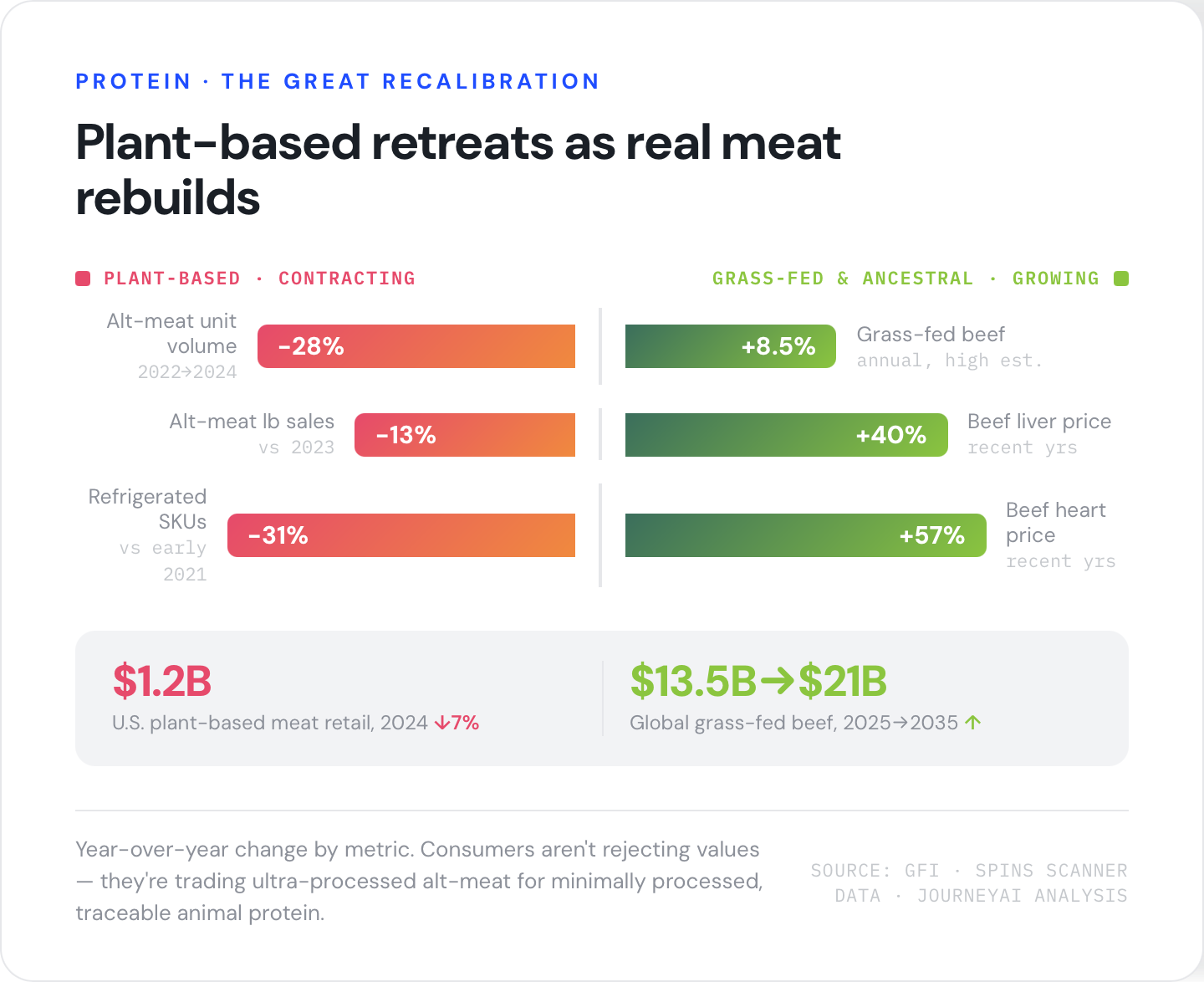
U.S. retail sales of plant-based meat and seafood fell to about $1.2 billion in 2024, down 7% from 2023. Unit volumes dropped 28% from 2022 to 2024. By April 2025, retail plant-based meat sales were down another 7.5% year over year, with unit sales down 10%. Retailers had cut refrigerated alt-meat SKUs by roughly 31% versus early 2021.
Late-2025 scanner data confirms it: meat-alternative pound sales are down more than 13% versus 2023. The category's pandemic boom has given way to contraction and rationalization.
So what happened?
The short answer: artificiality fatigue. Long ingredient lists, ultra-processing, and a growing perception that these products aren't as "natural" or "healthy" as promised have become top barriers to purchase. Consumers wanted plant-based options that felt less processed than conventional meat—but many alt-meat products felt more processed.
That perception gap became a trust problem. And in food, trust is everything.
Grass-Fed and "Real Meat" Growth
While plant-based meat contracts, grass-fed beef is scaling fast.
The global grass-fed beef market is projected at about $13.5 billion in 2025 and forecast to exceed $21 billion by 2035, growing roughly 4.5–8.5% annually depending on region. Analysts expect grass-fed beef to add more than $3.2 billion in value between 2025 and 2029, driven by clean-label claims, no-antibiotics, and animal-welfare certifications.
Both U.S. and U.K. markets are seeing steady mid-single-digit growth as premium butchers, regenerative brands, and specialty retailers expand their assortments. This isn't niche anymore—it's mainstream premium.
Why? Because grass-fed beef checks multiple boxes at once: environmental story, animal welfare, nutrient density, and taste. It's protein that feels less guilty without feeling less indulgent. That's a powerful combination.
Organ Blends and "Ancestral" CPG: Nose-to-Tail Goes Mainstream
Here's where things get interesting—and a little surprising.
Rising interest in nutrient-dense "ancestral" diets has pushed wholesale beef heart prices up nearly 57% and livers over 40% in recent years. But most consumers aren't buying stand-alone organ cuts. They're buying ancestral blends—ground beef mixed with heart and liver—that command premiums over conventional ground beef while still sitting in the everyday meat case.
These blends let shoppers "trade up" to nose-to-tail nutrition without fully committing to cooking liver for dinner. And they give processors more flexibility in carcass utilization, which has supply-chain and sustainability benefits.
This is CPG innovation at its best: meeting consumers where they are (ground beef is comfortable) while giving them what they want (more nutrients, better sourcing). It's not performative wellness—it's practical wellness, packaged for real life.
Consumer Contradictions: Health + Indulgence
Here's the paradox driving this shift: roughly one-third to one-half of consumers say they're trying to reduce meat for health or environmental reasons in 2024–2025. Yet many of those same consumers are migrating away from highly processed alt-meat and toward minimally processed animal protein.
What gives?
Consumers are reconciling two truths:
- They care about sustainability and animal welfare.
- They don't want ultra-processed foods, even if they're plant-based.
The result is what industry forecasters are calling "real food over alt meats." Blended plant-and-animal proteins, regenerative meat, and grass-fed options are filling the gap between vegan aspirations and comfort-food behaviors.
It's not either/or anymore. It's both/and—and the brands that figure out how to straddle that line are winning.
CPG and Supply Chain Implications
This shift is reshaping retail sets and upstream infrastructure in real time.
Retail rebalancing:
By late 2024, meat departments were trimming plant-based offerings (down about 2–3% in sales) and leaning into premium fresh, grass-fed, nitrate-free, and "regenerative" SKUs. The message is clear: retailers are betting on quality over novelty.
Processed meat evolution:
Processed meat is still growing globally (mid-single-digit CAGRs), but investment is skewing toward high-pressure-processed, preservative-free deli, and "clean label" cold cuts that promise both safety and fewer additives. Consumers want convenience, but they want it to feel closer to "real food."
Upstream pressure:
Sustained demand for grass-fed and regenerative beef requires more pasture capacity, verification systems, and chilled-chain logistics. It also concentrates pricing power among producers who can certify origin, welfare, and environmental claims. This is where traceability and transparency become competitive advantages—not nice-to-haves.
At JourneyAI, we're watching this play out in real time across our 60+ billion data points. The brands and retailers that win are the ones investing in supply chain visibility, formulation transparency, and claims verification. Because in this market, you can't fake "real."
What This Means for the Industry
The return of real meat isn't a rejection of progress. It's an evolution.
Consumers still want sustainability. They still want health. But they've recalibrated what those words mean. "Sustainable" doesn't automatically mean plant-based anymore—it can mean regenerative agriculture. "Healthy" doesn't mean ultra-processed alt-meat—it means whole foods, short ingredient lists, and nutrient density.
The brands that will thrive in this moment are the ones that meet consumers in their contradictions instead of trying to resolve them. They're the ones that offer both indulgence and values. Taste and transparency. Comfort and consciousness.
Because at the end of the day, people want to eat food that makes them feel good—physically, emotionally, and ethically. And right now, that's looking a lot more like grass-fed beef than a lab-extruded patty.
What's your take on the plant-based vs. real meat debate? Are you seeing this shift play out in your own shopping habits? Let's talk.