
.svg)
.svg)
.svg)
.svg)


.svg)
If you're a food scientist or R&D lead searching "food formulation software" right now, you're probably dealing with one of two things: a product launch that's moving too slowly, or a supply chain issue that caught you off guard. Either way, you're wondering whether dedicated software would actually fix the problem or just add another tool to manage.
This article gives you a straight answer. No fluff, no feature lists dressed up as benefits.
Food formulation software is a purpose-built platform for managing the full lifecycle of a product's recipe — from ingredient discovery and selection through nutrition profiling, cost modeling, version control, and team collaboration.
At its core, it replaces the patchwork of spreadsheets, shared drives, and email threads that most R&D teams rely on. A good platform keeps every formulation version in one place, tracks ingredient data across nutrition, cost, and sourcing, and makes that information accessible to everyone who needs it — R&D, procurement, regulatory, and operations.
More advanced platforms, like Journey Foods, layer AI on top of that foundation. The Operations Scientist AI engine in Journey Foods scores ingredients across nutrition, cost, and sustainability simultaneously, surfaces substitution recommendations, and sends real-time supply chain alerts when sourcing risks emerge. That's a meaningful step beyond a digital recipe card.
Food formulation software is relevant to any team that develops, iterates on, or manages food or beverage products at scale. In practice, that means:
If you're a solo food scientist at a very early-stage startup, a spreadsheet might still be sufficient. But once you have multiple people touching formulations, multiple active projects, or any real supply chain complexity, the cost of staying manual adds up fast.
Spreadsheets aren't inherently bad. They're flexible, familiar, and free. The problem is what happens when your team grows or your product line expands.
Version control breaks down. Someone updates a formulation locally and doesn't share it. Procurement is working from ingredient costs that are three months old. Your regulatory contact is reviewing a spec that was superseded two weeks ago. Nobody catches it until something goes wrong.
Beyond version chaos, spreadsheets can't tell you that a key ingredient is at risk of a supply disruption. They can't score a potential substitute across nutrition, cost, and sustainability at the same time. They can't flag that your reformulation is pushing a label claim out of compliance.
These aren't edge cases. They're the normal friction that slows down every product launch cycle.
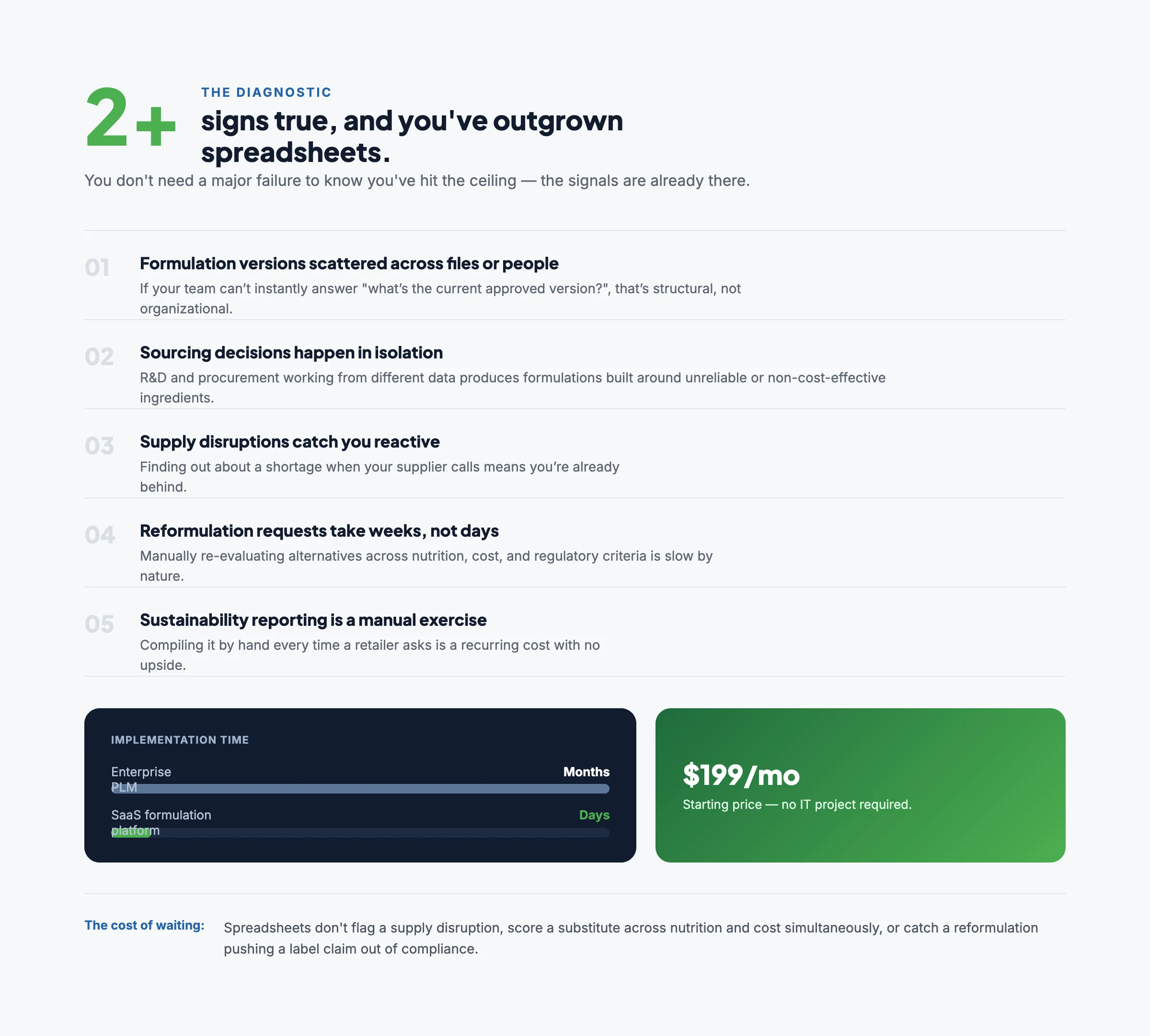
You don't need to wait for a major failure to know you've hit the ceiling. Here are the clearest signals:
1. Formulation versions are scattered across multiple files or people.
If your team can't instantly answer "what's the current approved version of this formula?", that's a structural problem, not an organization problem.
2. Ingredient sourcing decisions happen in isolation.
When R&D and procurement aren't working from the same data, you get formulations built around ingredients that aren't cost-effective or reliably available.
3. Supply disruptions catch you reactive, not proactive.
If you find out about an ingredient shortage when your supplier calls, you're already behind. Real-time monitoring changes that.
4. Reformulation requests take weeks, not days.
Manually re-evaluating ingredient alternatives across nutrition, cost, and regulatory criteria is slow. Software built for this cuts that time significantly.
5. Sustainability reporting is a manual exercise.
More retailers and partners are asking for sustainability data. If you're compiling it by hand every time, that's a recurring cost with no upside.
If two or more of these describe your team right now, formulation management software will pay for itself quickly.
Not all food formulation tools are built the same. Some focus only on nutrition calculation. Others are full enterprise PLM systems that take months to implement and require dedicated IT support. Most teams need something in between.
Here's what actually matters when evaluating options:
You need to evaluate ingredients across nutrition, cost, and sustainability at the same time, not in separate tools. Switching between platforms to cross-reference data wastes time and introduces errors.
Static ingredient databases go stale fast. Look for a platform that monitors supply chain conditions and alerts your team before shortages become delays.
Every change should be tracked, timestamped, and reversible. This protects you during audits, reformulations, and regulatory reviews.
R&D, procurement, and operations need to work from the same data simultaneously. A platform that siloes information by department defeats the purpose.
Enterprise PLM systems like Trace One are powerful but come with enterprise complexity and pricing. If you're a mid-market CPG company or a funded startup, you need something that your team can actually get running without a six-month IT project.
Journey Foods is built specifically for this gap. It covers multi-criteria ingredient intelligence, real-time supply chain monitoring, and collaborative formulation management in a single platform, with pricing starting at $199 per month. No IT implementation required. Learn more at Journeyfoods.io.
One of the biggest concerns R&D teams have about switching to formulation software is the implementation burden. Fair concern. But the reality depends heavily on which platform you choose.
Heavy enterprise systems require data migration projects, IT integration work, and training programs that can stretch across quarters. That's appropriate for a 5,000-person food conglomerate managing hundreds of SKUs across global supply chains. It's overkill for most mid-market teams.
Modern SaaS-based formulation platforms are designed to get you operational quickly. With Journey Foods, your team accesses the platform through a web app at app.journeyfoods.io, with API and plugin support for connecting to tools you already use. You're not starting from zero, and you're not waiting on IT.
The practical steps look like this:
For most mid-market teams, this is measured in days, not months. The bigger time investment is the upfront data work, which you'd need to do eventually anyway.
What is food formulation software used for?
Food formulation software helps R&D and product development teams manage ingredient data, track formulation versions, model nutrition and cost, and collaborate across departments. More advanced platforms also include supply chain monitoring and AI-driven ingredient recommendations.
Is food formulation software only for large CPG companies?
No. While enterprise PLM systems are built for large organizations, platforms like Journey Foods are designed for mid-market CPG companies and funded food startups. Pricing starts at $199 per month for a single user, making it accessible at earlier growth stages.
How is formulation management software different from a nutrition calculator?
A nutrition calculator handles label math. Formulation management software handles the full product development workflow, including ingredient sourcing, version control, team collaboration, supply chain monitoring, and multi-criteria ingredient scoring. Nutrition calculation is one component, not the whole product.
Can food formulation software help with sustainability reporting?
Yes. Platforms that include sustainability scoring at the ingredient level, like Journey Foods, make it significantly easier to pull sustainability data for retailer requests, internal reporting, or reformulation decisions tied to environmental goals.
What's the difference between recipe development software and formulation management software?
Recipe development software is typically consumer-facing or used for culinary applications. Formulation management software is built for commercial food and CPG development, with features like regulatory compliance tracking, supply chain integration, cost modeling, and multi-user collaboration.
How long does it take to implement food formulation software?
It depends on the platform. Enterprise systems can take months. SaaS-based platforms like Journey Foods are designed for faster onboarding, with most teams operational within days once their formulation and ingredient data is migrated.
What should I look for when comparing CPG formulation platforms?
Prioritize multi-criteria ingredient scoring (nutrition, cost, and sustainability together), real-time supply chain alerts, version control, collaborative workflows, and implementation complexity. Avoid tools that only solve one dimension of the problem.
Food formulation software isn't a nice-to-have for teams shipping real products on real timelines. If your team is managing more than a handful of active formulations, working across R&D and procurement, or dealing with any supply chain variability, the manual approach is costing you time you don't have.
The right platform doesn't need to be complex or expensive. It needs to keep your team working from the same data, surface the right ingredient options fast, and flag supply risks before they become launch delays.
Stop managing formulations in spreadsheets. Start shipping better products. Learn more at Journeyfoods.io.
Journey Foods Team News