
.svg)
.svg)
.svg)
.svg)


.svg)
A peer-reviewed study published in 2026 complicates one of the more persistent assumptions in food industry nutrition strategy: that neighbourhood poverty predicts poor diet quality in a consistent, predictable way.

.svg)
The study — Neighbourhood deprivation and diet quality among a nationally representative sample of adults in Canada: an intersectional investigation (PubMed ID 42473825) — found that material deprivation at the neighbourhood level was not consistently associated with worse diet quality across the population. The relationship shifted significantly depending on two other neighbourhood-level factors: immigrant and visible-minority composition, and labour force composition.
Put plainly: a low-income neighbourhood with high immigrant and visible-minority representation did not show the same diet-quality patterns as a low-income neighbourhood with a different demographic or labour profile. The relationship between deprivation and diet is intersectional. It does not move in a straight line.
For CPG product teams, that finding has direct implications for how you build nutrition scoring frameworks, how you position "accessible" or "better-for-you" products, and how you approach formulation for diverse markets.
Most of the food industry's approach to diet equity still runs on a single axis: affordability. The logic is straightforward — lower-income consumers need cheaper products, and improving nutrition access means making healthier options available in underserved areas at lower price points.
That logic is not wrong. It is just incomplete. The 2026 Canadian study shows that socioeconomic deprivation interacts with demographic and labour force context in ways that produce meaningfully different dietary outcomes across communities. Treating "low income" as a monolithic category leads to product and portfolio decisions that miss large portions of the population you are actually trying to serve.
Three areas of CPG strategy feel this most directly.
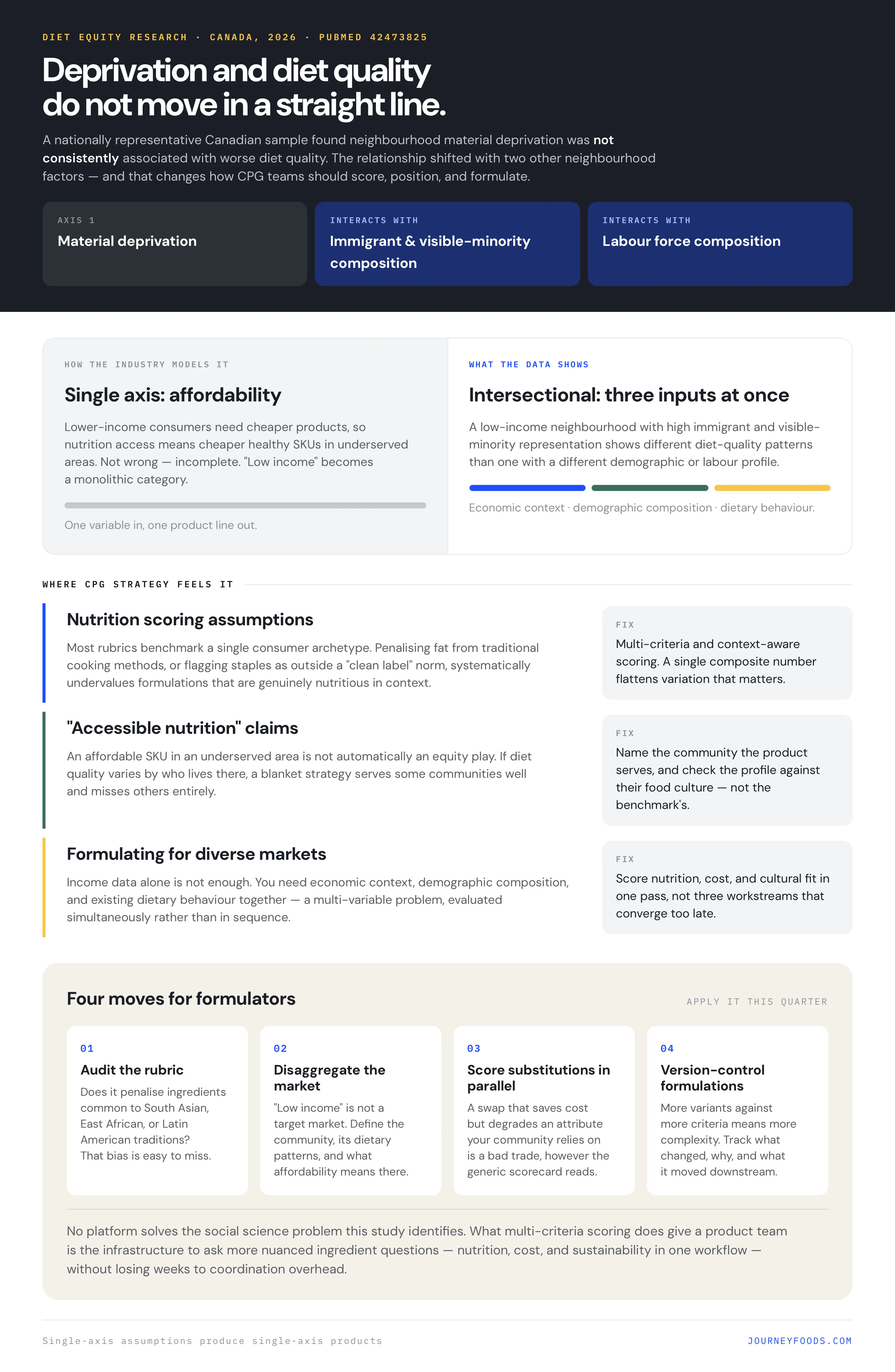
When product teams score formulations against a "healthy" benchmark, they are usually benchmarking against a single consumer archetype. A high-fibre, low-sodium, moderate-calorie profile might score well on a standard rubric — but that rubric was likely built around a dietary pattern that does not reflect the full range of what "nutritious" looks like across different communities.
Immigrant and visible-minority communities often maintain dietary patterns with different macronutrient profiles, different staple ingredients, and different cultural definitions of a balanced meal. A scoring system that penalises higher fat content from traditional cooking methods, or flags certain ingredients as outside a "clean label" norm, can systematically undervalue formulations that are genuinely nutritious within the cultural context they are meant to serve.
Nutrition scoring needs to be multi-criteria and context-aware. A single composite number flattens real variation in ways that matter.
The study also pushes back against the assumption that affordable product lines automatically serve diet equity goals. If diet quality in materially deprived neighbourhoods varies significantly based on who lives there, then a blanket strategy of "affordable SKU in underserved area" is not a coherent equity play. It may serve some communities well and miss others entirely.
For portfolio strategy, that means asking harder questions: Which specific communities does this product actually serve? What dietary patterns and ingredient preferences reflect their existing food culture? Does the product's nutritional profile align with what those communities actually need, or does it align with what a generic "healthy" benchmark says they should eat?
These are not rhetorical questions. They are formulation decisions.
If you are formulating a product for a specific underserved or diverse market, income-level data alone is not enough. You need to understand the intersection of economic context, demographic composition, and existing dietary behaviour in that market.
That is a multi-variable problem — and it requires evaluating ingredients across nutrition, cost, and cultural fit simultaneously, not one after another.
Most product development workflows still treat nutrition, cost, and market positioning as separate workstreams. A nutritionist scores the formulation. Procurement runs cost analysis. Marketing decides on positioning. These tracks often do not converge until late in the development cycle, which is exactly when changing a formulation gets expensive.
The 2026 diet equity research is a useful prompt to reconsider that separation. If the relationship between deprivation and diet is intersectional, then the formulation decisions that respond to it need to be intersectional too — evaluating ingredients simultaneously across nutrition criteria, cost thresholds, and the cultural and demographic context of the intended market, rather than reconciling separate analyses after the fact.
This is the kind of multi-criteria, multi-dimensional decision-making that Journey Foods is built for. The Operations Scientist AI engine scores ingredients across nutrition, cost, and sustainability criteria within a single workflow, so teams are not stitching together outputs from disconnected tools. That does not mean the platform solves the social science problem the study identifies — it does not. But it does mean product teams have the infrastructure to ask more nuanced questions about ingredient trade-offs without losing time to coordination overhead.
For teams formulating for diverse or underserved markets, a centralized ingredient database with multi-criteria scoring makes it possible to test whether a lower-cost ingredient alternative actually maintains the nutritional profile relevant to your target community — not just whether it clears a generic nutrient benchmark.
Here is how to apply the research to your actual workflow.
Audit your nutrition scoring rubric. Does it reflect a single dietary archetype, or does it allow for variation in what "nutritious" looks like across cultural contexts? If your rubric penalises ingredients common in South Asian, East African, Latin American, or other non-Western dietary traditions, it may be systematically biasing your formulation decisions in ways that are easy to miss.
Disaggregate your market assumptions. "Low income" is not a target market. Before formulating for an "accessible" product line, define the specific community context you are working within. What are the dominant dietary patterns? What ingredients carry cultural significance? What does affordability actually mean in that context?
Run multi-criteria ingredient evaluations. When you assess substitutions or cost-reduction options, score them simultaneously against nutrition, cost, and cultural fit — not sequentially. A substitution that saves cost but degrades a nutritional attribute that matters to your target community is not a good trade-off, even if it looks fine on a generic scorecard.
Build version control into your formulation process. Intersectional formulation strategy means testing more variants against more criteria. That increases complexity, and complexity without structure creates errors. Version-controlled formulation workflows help teams track what changed, why, and what the downstream effects were.
To see how multi-criteria ingredient scoring works in practice, you can book a demo and walk through the platform's capabilities against your specific use case.
Diet equity is not a marketing concept. It is a research area with genuine complexity, and the 2026 Canadian intersectional study is a useful reminder that simple narratives about poverty and nutrition do not hold up under rigorous analysis.
The practical takeaway for CPG teams is not that diet equity work is too complicated to act on. It is that the tools and frameworks you use for nutrition scoring and formulation strategy need to match the actual complexity of the markets you serve. Single-axis assumptions produce single-axis products. Multi-dimensional markets need multi-dimensional thinking.
Explore what that looks like for your team at Journeyfoods.io.
What is the main finding of the 2026 neighbourhood diet equity study?
The study (PubMed ID 42473825) found that neighbourhood material deprivation was not uniformly associated with poor diet quality in Canada. The relationship varied significantly depending on the immigrant and visible-minority composition and labour force composition of a neighbourhood — indicating that diet-quality disparities are intersectional, not explained by income alone.
Why does this matter for CPG nutrition scoring?
Standard nutrition scoring rubrics typically benchmark against a single dietary archetype. If diet quality varies across communities in ways that reflect cultural and demographic context, a single-axis score may systematically undervalue formulations that are genuinely nutritious for specific communities but do not match a generic "healthy" profile.
How should CPG brands rethink "accessible nutrition" product lines?
Rather than assuming affordable products in low-income areas automatically serve diet equity goals, brands should define the specific community context they are formulating for, understand existing dietary patterns and ingredient preferences in that community, and evaluate whether the product's nutritional profile aligns with what that community actually needs — not just what a generic benchmark recommends.
What does "intersectional formulation strategy" mean in practice?
It means evaluating ingredients simultaneously across nutrition, cost, and cultural fit, rather than treating these as separate workstreams. It also means disaggregating market assumptions so that "low income" is not treated as a monolithic category with uniform dietary needs.
How does multi-criteria ingredient scoring help with this kind of formulation work?
Platforms that score ingredients across nutrition, cost, and other criteria within a single workflow make it easier to test whether a cost-reduction substitution maintains the nutritional profile relevant to a specific target community, rather than just checking it against a generic benchmark.
Can AI platforms like Journey Foods solve diet equity problems on their own?
No. The social and structural dimensions of diet equity require policy, community engagement, and research expertise that go well beyond any software platform. What AI-powered ingredient management tools can do is give product teams better infrastructure for asking more nuanced questions about ingredient trade-offs without losing time to coordination overhead.
Where can I learn more about multi-criteria ingredient evaluation for diverse markets?
You can explore Journey Foods' approach to ingredient scoring and formulation management at Journeyfoods.io, or book a demo to see how the platform handles multi-dimensional ingredient decisions for your specific product development context.
Journey Foods Team News
Structured Q&A marked up with FAQ Page schema so it can be surfaced and cited by Al engines and search.
In Journey Al's 12 month dataset, the median plant protein reformulation came in -6.5% on raw material cost versus an animal protein control the first year that line went negative, driven by Tier 1 isolate suppliers reaching spec parity.
In Journey Al's 12 month dataset, the median plant protein reformulation came in -6.5% on raw material cost versus an animal protein control the first year that line went negative, driven by Tier 1 isolate suppliers reaching spec parity.
In Journey Al's 12 month dataset, the median plant protein reformulation came in -6.5% on raw material cost versus an animal protein control the first year that line went negative, driven by Tier 1 isolate suppliers reaching spec parity.