
Quick answer
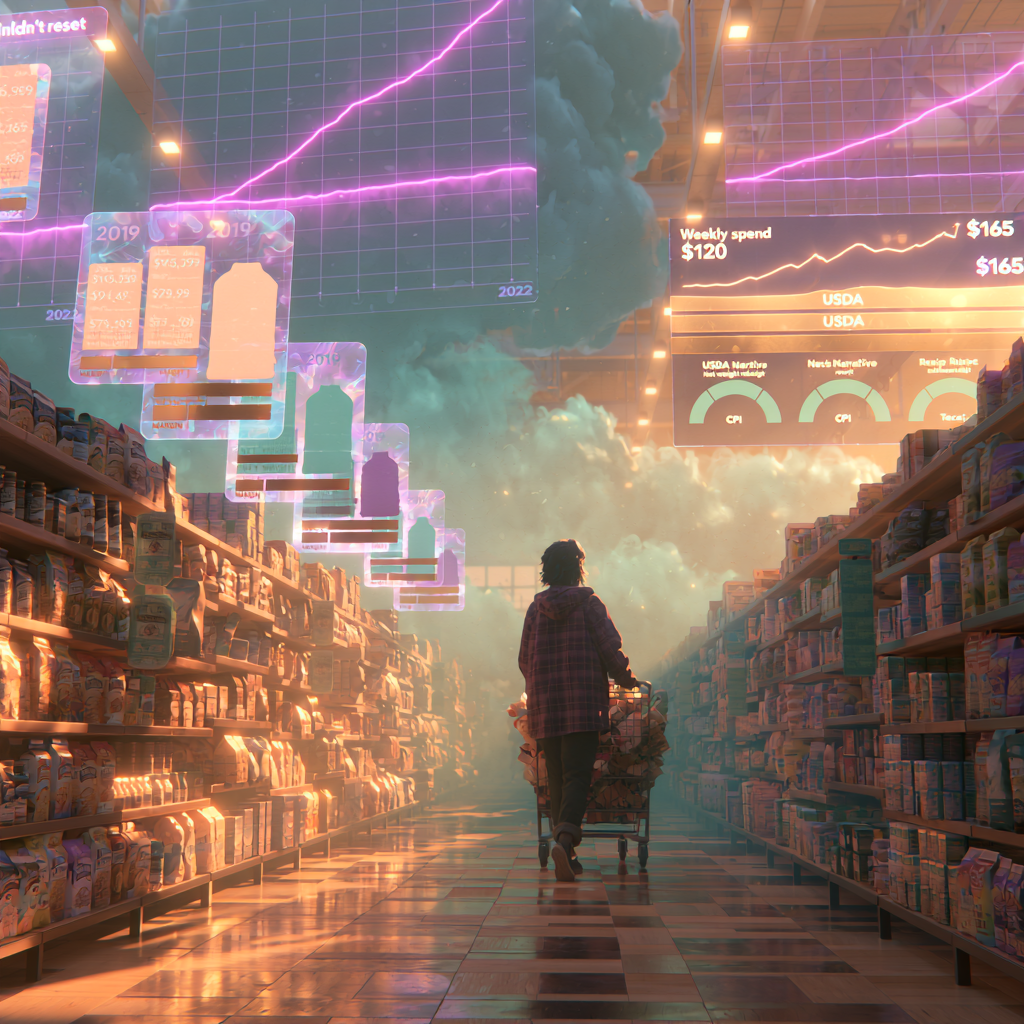
You've heard it: inflation is cooling, the economy is stabilizing. But your grocery cart tells a different story. Food inflation slowed to ~1–2%, yet the average household is paying 25–30% more than 2019. The math isn't mathing—and it's not in your head. Here's what's actually happening: prices plateaued at a higher level, shrinkflation hit ~65% of packaged goods, and retail margins expanded even as input costs normalized. The result? The price per bite you're paying rose faster than official inflation charts suggest.
You've probably heard it by now: inflation is cooling, the economy is stabilizing, prices are "coming down." But if you're like most people, when you walk through the grocery store, your cart tells a very different story.
The disconnect is real—and it's not in your head.
Here's what's actually happening: food inflation has slowed, but grocery prices never went back to their old baseline. Your household is stuck paying "new normal" bills on a permanently higher plateau. And when you factor in shrinkflation and strategic margin moves by retailers and manufacturers, the price per bite you're paying rose faster than the official inflation charts even suggest.
Let me break down the math—and the psychology—behind why your grocery bill still feels painful.
The Inflation Cooldown vs. Your Cart
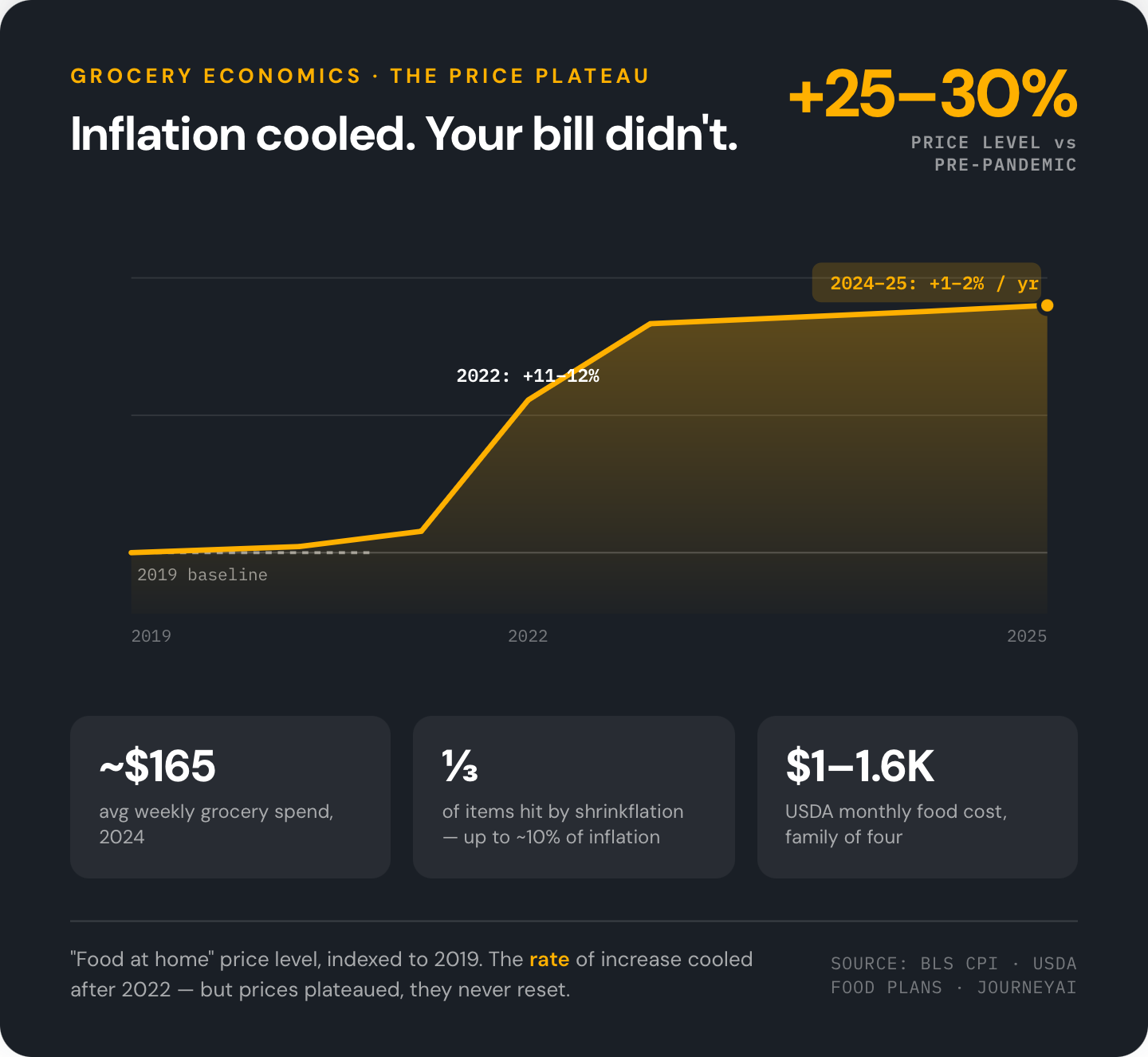
The data is clear: U.S. "food at home" prices (what you buy at the grocery store) jumped about 11–12% in 2022 alone—the fastest annual increase in decades. By 2024–2025, grocery inflation had slowed sharply to roughly 1–2% year over year, close to its long-run average.
So inflation is "down," right? Technically, yes. The rate of increase slowed. But here's the thing: that 1–2% is stacking on top of the 2022 surge. Prices didn't reset. They plateaued at a much higher level.
The result: Inflation rate is down, but the level of prices is locked in 25–30% higher than pre-pandemic.
Why Your Bill Is 25–30% Higher
Let's get specific. By 2024, the average weekly grocery spend climbed to about $165, up dramatically from 2019 levels when pandemic disruptions and inflation first kicked in. USDA food plans now show record monthly costs—roughly $1,000–$1,600 per month for a family of four depending on the plan you're on.
Even when specific items go on sale, you're building your basket in a world where meat, eggs, snacks, and basics all sit on a higher price floor than they did five years ago.
This isn't a blip. It's structural.
Shrinkflation: The Stealth Price Hike
Now let's talk about something that doesn't show up neatly in CPI data but hits your wallet hard: shrinkflation.
Shrinkflation is when brands reduce package sizes while keeping the sticker price the same (or even raising it slightly). The bag of chips you've been buying for years? It's lighter. The cereal box? Fewer ounces. The bottle of juice? Smaller.
Recent analyses estimate that about one-third of grocery items have seen some form of shrinkflation, and it can account for up to roughly 10% of overall grocery price inflation. That means even when the shelf tag looks stable, you're paying more per unit—and most shoppers don't catch it until they're halfway through the bag wondering why it's already empty.
Consumers notice it most in snacks, beverages, and household products—categories where ounces quietly disappear while the branding stays loud and familiar.
Retail Margins and the "Center Store" Profit Play
Here's where things get strategic—and a little uncomfortable.
Center-store packaged items (cereal, snacks, canned goods, etc.) became a critical profit center for retailers as they navigated volatile meat and produce costs. Industry reporting shows that gross margins on many packaged categories widened after 2022 as input costs moderated faster than shelf prices.
In plain language: the cost to make your favorite cereal went down, but the price you pay at checkout didn't. Retailers and manufacturers held onto some of that spread.
That margin creep means the gap between production cost and checkout price is often larger now than it was at the height of the supply-chain crisis. You're not imagining it—the math changed, and not in your favor.
The Perception Gap: CPI vs. Lived Reality
Here's where the frustration compounds. Official CPI (Consumer Price Index) baskets smooth across thousands of items, but households feel price changes most acutely on high-frequency purchases—milk, bread, snacks, kids' favorites.
People anchor to 2019–2020 prices. So when a trip that used to cost $120 now lands near $150–160, it feels like "inflation is still out of control," even if the year-over-year change is only a few percent.
Add in shrinkflation and selective margin expansion, and the real cost of a weekly basket can easily feel closer to 25–30% higher than before the pandemic—despite what the headline CPI is telling you.
This is the lived experience of millions of households. It's valid. It's measurable. And it's why trust in "the data" erodes when people look at their receipts.
What This Means for the Industry
At JourneyAI, we process over 60 billion food data points to help brands and retailers understand exactly these dynamics—ingredient costs, formulation changes, margin structures, and consumer perception gaps. The companies that win in this environment are the ones that acknowledge the reality shoppers are living in and respond with transparency, value, and innovation.
Because here's the truth: consumers aren't confused. They're paying attention. And they're voting with their wallets.
What are you noticing in your grocery spending? Drop a comment or reach out—I'd love to hear your experience.
Riana Lynn is the Founder and CEO of JourneyAI, an AI-powered ingredient intelligence platform processing over 60 billion food data points to help food brands, retailers, and manufacturers make smarter decisions in a rapidly changing market.