

We're at an inflection point in the food industry, and it's being driven by two converging forces: AI-powered innovation and radical transparency demands.
For years, these operated in separate lanes. AI was the domain of tech-forward startups experimenting with formulation tools. Transparency was the rallying cry of clean-label advocates pushing back against Big Food. But in 2026, they've merged into something more powerful: an integrated technology stack that's reshaping how products are developed, traced through supply chains, verified at point of purchase, and trusted by consumers.
The numbers tell the story: AI in food processing is projected to grow from roughly $15 billion in 2025 to about $140 billion by 2034—a compound annual growth rate of 28%. Meanwhile, 64% of Gen Z consumers actively seek clean-label claims, and 58% of global consumers rank honesty and transparency among their top purchasing drivers.
This isn't future-forward thinking anymore. This is the operating reality of 2026. And the brands that get it right—the ones that use AI to accelerate innovation while building unprecedented supply chain visibility—are the ones that will win the next decade.
Let me walk you through what's actually happening on the ground.
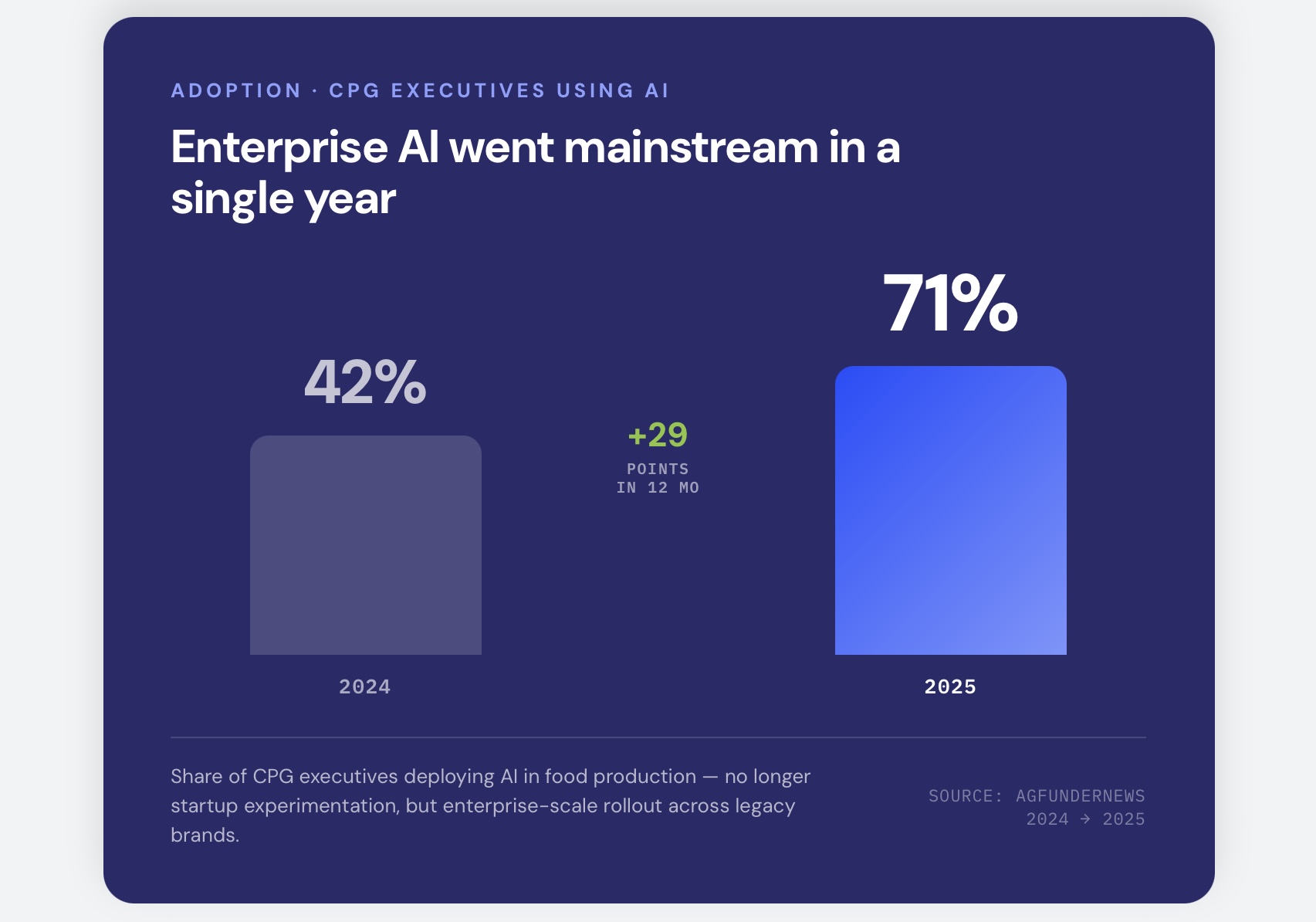
The adoption curve for AI in CPG has gone vertical. 71% of CPG executives now use AI, up from just 42% in 2024. This isn't startup experimentation anymore—this is enterprise-scale deployment across legacy brands and new players alike.
Why? Because AI has proven it can do what traditional R&D couldn't: compress timelines, reduce waste, and unlock formulation possibilities that were previously too complex or expensive to explore.
Leading CPG brands are using AI to generate hundreds of product concepts in weeks instead of months—compressing what once took entire quarters—while simultaneously modeling carbon-footprint targets and wellness goals. That's not just speed. That's the ability to iterate on sustainability and nutrition and taste simultaneously, something that would be prohibitively expensive in a traditional test kitchen.
Generative tools now predict sensory attributes like mouthfeel, melting, crispiness, and gelling behavior, letting formulators swap ingredients for health or sustainability goals without sacrificing eating quality. Virtual simulation eliminates unnecessary ingredient waste and shortens concept-to-shelf timelines.
AI also allows brands to tailor product design to geographic preferences, lifestyle segments, and seasonal demand—improving launch success rates while reducing the costly failures that come from guesswork.
At JourneyAI by Journey Foods, we're processing over 60 billion food data points to help brands navigate this exact challenge. Our platform enables CPG companies to model ingredient swaps, predict sensory outcomes, optimize for nutrition and sustainability simultaneously, and understand supply chain implications—all before a single batch is made.
What used to take months of trial and error now happens in days. And in a market where speed to shelf and formulation precision are competitive advantages, that matters.
If AI is accelerating what happens inside the product, traceability tech is transforming what happens around it—from farm to fork.
The FDA's Food Traceability Final Rule (FSMA Section 204) went into effect in January 2026, mandating enhanced recordkeeping for high-risk foods using Traceability Lot Codes (TLCs) at every critical tracking event—from harvest through retail.
Companies must now record and share Key Data Elements (KDEs) such as lot codes, origin, and handling events so the FDA can trace contaminated products within hours rather than days. This isn't optional. This is compliance infrastructure that every company in the supply chain must build.
GS1 barcodes and RFID tags are the primary physical-to-digital links, enabling interoperable data exchange across complex, multi-tier supply chains. IBM Food Trust, built on Hyperledger Fabric blockchain, allows growers, manufacturers, and retailers to trace products in seconds, standardize data with GS1, and generate immutable audit trails for recalls.
But here's where it gets interesting: AI-powered platforms are now overlaying traceability data to predict disruptions, optimize inventory, and automate quality checks in real time. This is being flagged as a key 2025–2026 innovation theme—not just compliance, but predictive supply chain intelligence.
At JourneyAI, we're seeing clients use traceability data not just for recall response, but for proactive risk management—identifying supplier vulnerabilities before they become contamination events, optimizing sourcing based on real-time quality signals, and building consumer-facing transparency features that turn compliance infrastructure into brand equity.
Food fraud is a massive, underreported problem. Olive oil, honey, tea, and spices remain the most fraud-prone categories, and global food fraud incidents surged in 2025, with adulteration rates highest in bulk-traded commodities.
Honey adulteration alone is one of the most reported issues in scientific literature. Regulators worldwide are struggling to authenticate purity claims at scale.
Enter AI.
Predictive intelligence: AI analyzes historical data to flag high-risk suppliers or pricing anomalies—such as an unexpected drop in ingredient price from a specific region—allowing procurement teams to intervene before the adulterated product enters the supply chain.
Machine learning pattern recognition: Algorithms process supplier history, shipping records, and even social media chatter to identify substitution patterns (e.g., cheaper oils marketed as olive oil), becoming more accurate over time.
Deep learning + sensors: Thermal imaging combined with convolutional neural networks can classify honey adulteration levels with high accuracy, offering a non-invasive, rapid authenticity test. Studies show that combining AI algorithms with sensors yields detection accuracies ranging from 81% to 100% across oils, juices, and spices.
This is the future of quality assurance—moving from reactive testing to predictive fraud prevention, powered by AI that gets smarter with every data point.
All of this backend technology infrastructure only matters if consumers care. And they do—intensely.
The rise of ingredient scanning and nutrition apps has fundamentally changed the retail landscape. Consumers now have the tools to decode ingredient lists, understand nutritional trade-offs, and make informed decisions at the moment of purchase.
This is exactly why we built Guava (withguava.io)—our consumer-facing platform that helps families optimize childhood nutrition using the same AI and data intelligence that powers JourneyAI. Guava enables parents to understand what's actually in their children's food, make better choices based on real nutritional data, and plan meals that support healthy development.
The takeaway: Consumers have the tools to hold brands accountable at the moment of purchase. Ingredient lists are no longer fine print—they're the first thing people check. And platforms like Guava are democratizing access to the kind of nutritional intelligence that used to require a degree in food science.
Transparency isn't just about voluntary clean-label marketing. It's also about regulatory action on safety.
In January 2025, the FDA banned Red 3 (erythrosine) from food and ingested drugs, citing animal carcinogenicity studies under the Delaney Clause. Manufacturers must reformulate by January 2027 (food) or January 2028 (drugs).
But that's just the beginning. In April 2025, the FDA announced plans to phase out six additional synthetic dyes—Red 40, Yellow 5, Yellow 6, Blue 1, Blue 2, and Green 3—before 2027, following stricter state bans in California and West Virginia.
The FDA and NIH are partnering on research into how food additives impact children's health and development, signaling more aggressive scrutiny ahead.
Brands are reformulating with natural alternatives—beet juice, annatto, turmeric, spirulina—anticipating that artificial-dye-free claims will become table stakes in 2026 and beyond.
This is a perfect example of how transparency and safety converge: regulatory pressure + consumer demand + AI-powered reformulation tools = faster, cleaner product innovation. And it's especially critical for childhood nutrition—one of the core focus areas for Guava, where parents are actively seeking foods free from artificial dyes and additives.
Let's zoom out. What do all of these trends tell us about where the industry is headed?
Deloitte's 2026 Consumer Products Outlook flags ingredient transparency, traceability tech, and AI-powered product development as three of seven "significant changes" reshaping food and beverage.
Here's what I'm watching:
1. Data advantages are shrinking.
Legacy brands used to win on decades of proprietary consumer insights. But as preferences shift rapidly, only the most recent six months of data remain strategically valuable. That levels the playing field for smaller, AI-native brands that can move faster.
2. Transparency is infrastructure, not marketing.
Traceability, fraud prevention, and clean labels aren't nice-to-haves anymore. They're the cost of entry. The brands that build this into their operating systems—not just their PR decks—will win.
3. AI is the unlock for sustainable innovation.
You can't optimize for taste, nutrition, sustainability, and cost simultaneously without computational power. AI is how brands will thread that needle at scale.
At JourneyAI, we're building exactly this stack—combining our 60+ billion data points on ingredients, suppliers, and formulations with AI-driven tools that let brands innovate faster, source smarter, and prove their claims in real time. And through Guava (withguava.io), we're putting that same intelligence in the hands of families who want to make better food choices for their children.
Because the future of food isn't just about what you make. It's about how you make it, how you prove it, and how you earn trust in a world where consumers have more information—and more power—than ever before.
What transparency features matter most to you as a consumer? And if you're in the industry, how are you navigating the AI and traceability buildout? Let's talk.