.svg)
.svg)
.svg)
.svg)


.svg)
Brunch gets dismissed as a consumer occasion. It shouldn't be.
Brunch gets dismissed as a consumer occasion. It shouldn't be.
For food scientists and CPG product developers, it's one of the most interesting formulation windows in the day. The consumer is relaxed, present, and open to something new — not grabbing a bar on the way out the door. They're sitting down, paying attention, and genuinely willing to try something that tastes good and does something for them.
That's the functional food sweet spot. And in 2026, the ingredients to fill it are better than ever.
This guide is built for formulators who want real inspiration, not fluff. Every recipe here uses functional ingredients with documented benefits, sound flavor logic, and practical application potential for CPG development. Let's dive in.
Brunch sits at the intersection of indulgence and wellness — and that tension is exactly where functional food wins. Consumers want something satisfying, but they're increasingly asking what their food is actually doing for them beyond calories.
The numbers back this up. The global functional food market is projected to exceed $300 billion by 2028, with breakfast and morning occasions driving a significant share of that growth. Adaptogens, nootropics, and bioactive ingredients are moving fast — out of supplement aisles and into everyday food formats.
Brunch formats are also inherently flexible. Pancakes, frittatas, smoothie bowls, egg dishes — they all tolerate a wide range of additions without major texture or flavor disruption. You can introduce lion's mane, collagen peptides, or turmeric at meaningful doses without wrecking the eating experience.
The challenge is doing it well. That's what this guide is for.
Functional means the ingredient contributes a documented health benefit beyond basic nutrition. Not a marketing claim — a formulation decision grounded in evidence.
For brunch applications, the most relevant categories are:
The key formulation question isn't just "does this ingredient work?" It's: does it work at the dose I can realistically include in this format, and does it survive processing?
That's where most functional food launches fall apart. The benefit is real. The dose in the product is not.
Here's what's performing well in brunch-adjacent formulations right now — based on flavor compatibility, consumer familiarity, and functional evidence:
The protein innovation trend is also reshaping brunch formulations in 2026. If you're tracking where the category is heading on that front, the Q4 trends breakdown on alternative proteins and ingredient innovation is worth reading alongside this.
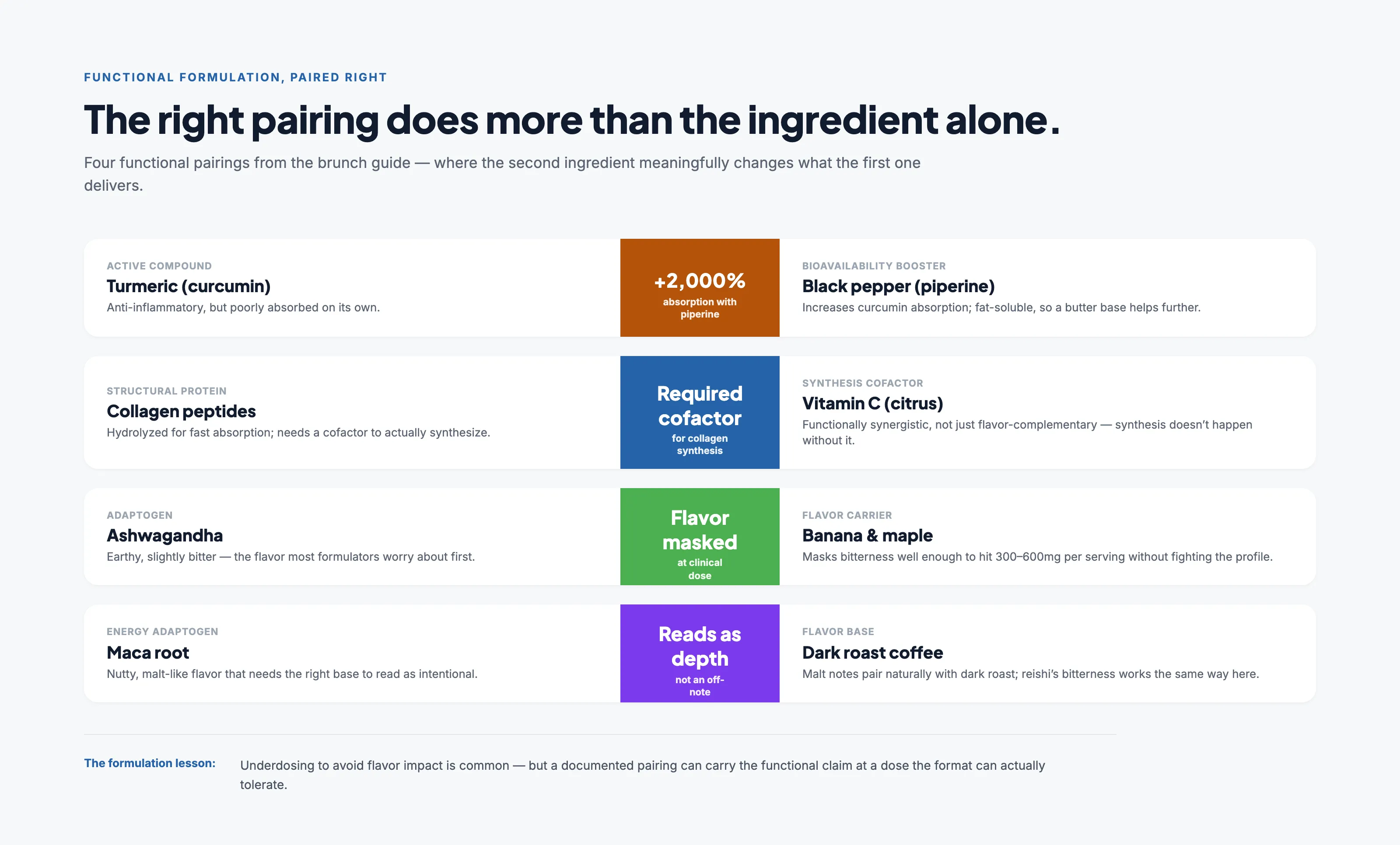
Why this works: Oat flour brings beta-glucan fiber — a documented cholesterol-lowering agent. Ashwagandha at 300–600mg per serving has shown statistically significant reductions in perceived stress in clinical trials. The earthy bitterness gets masked well by banana and maple, so it doesn't fight the flavor profile.
Formulator note: At 1 tsp per batch (roughly 4 pancakes), each serving delivers approximately 300mg ashwagandha — the lower end of the clinically studied range. Scale to 1.5 tsp if you're targeting a higher-dose functional claim.
Why this works: Curcumin, turmeric's active compound, has well-documented anti-inflammatory properties — but bioavailability is the formulation challenge. Black pepper (piperine) increases curcumin absorption by up to 2,000% [1]. This recipe includes both, and the fat base makes it even more effective.
Formulator note: The fat content of hollandaise is actually a feature here — curcumin is fat-soluble, so the butter base meaningfully improves absorption. This is a clean example of a formulation decision that serves both flavor and function at the same time.
Why this works: Lion's mane (Hericium erinaceus) contains hericenones and erinacines — compounds shown to stimulate nerve growth factor (NGF) synthesis. Early research points to cognitive and neuroprotective benefits. Its mild, slightly seafood-adjacent flavor integrates naturally into savory egg dishes without standing out.
Formulator note: Fresh lion's mane delivers a better texture experience, but powder is more practical for CPG applications. If you're developing a retail frittata kit or meal kit product, standardized extract powder gives you consistent, reproducible dosing.
Why this works: Collagen peptides are hydrolyzed for fast absorption and essentially flavorless in cold applications. Vitamin C from citrus is a required cofactor for collagen synthesis — so this combination is functionally synergistic, not just aesthetically appealing.
Formulator note: Texture is everything in a smoothie bowl — get it wrong and you lose the format entirely. If you're developing a retail version, start at a 3:1 frozen fruit to liquid ratio by volume and adjust from there. Too much liquid and it's just a smoothie.
Brunch without coffee isn't really brunch. But the coffee occasion in 2026 has moved well past caffeine delivery.
We've covered the functional coffee trend in depth before — including the sex coffee formulation angle circulating in wellness communities. The core principle holds: coffee is a delivery vehicle, and the right functional additions can meaningfully extend what it does.
Formulator note: Maca's malt-like flavor pairs well with dark roast. Reishi adds a slight bitterness that reads as depth rather than off-note in a dark coffee base. For a retail RTD application, emulsification is your main technical challenge with MCT oil — plan for it early.
These recipes are starting points. The real formulation work begins when you move from kitchen-scale inspiration to commercial reality.
Here's where most functional brunch products run into trouble:
This is exactly the kind of multi-variable problem Journey Foods is built for. The platform scores ingredients across nutrition, cost, and sustainability simultaneously, flags supply chain risks before they become launch problems, and keeps your formulation history organized and traceable across your whole team.
If you're building a functional brunch product and want to pressure-test your ingredient choices before committing to a supplier or formula, that's where the platform adds real value.
Sustainability is also increasingly part of the formulation brief. If you want to understand how packaging and supplier decisions affect your overall footprint, the sustainability and key suppliers guide covers the frameworks worth knowing.
What functional ingredients work best in brunch recipes?
Adaptogens like ashwagandha and maca, anti-inflammatory ingredients like turmeric (paired with black pepper for bioavailability), nootropic mushrooms like lion's mane, and collagen peptides are all well-suited to brunch formats. They integrate into common dishes without major flavor disruption and have meaningful clinical evidence at realistic doses.
How do you dose functional ingredients in food without making health claims?
Structure/function claims — like "supports cognitive function" — require the ingredient to be present at a dose consistent with the evidence base. Work with a regulatory consultant to confirm what's claimable at your specific inclusion level. Underdosing to avoid flavor impact is common, but it makes your functional positioning indefensible.
Does cooking destroy functional ingredients like turmeric or ashwagandha?
It depends on the ingredient and processing conditions. Curcumin is relatively heat-stable at typical cooking temperatures. Ashwagandha extract is also reasonably stable. Probiotics and some enzymes are more heat-sensitive — they need to be added post-processing or encapsulated. Always validate stability at your specific process conditions.
What's the difference between whole functional ingredients and extracts in formulation?
Extracts give you standardized, consistent active compound levels — which matters for label claims and reproducibility. Whole ingredients offer broader nutritional profiles and often perform better in clean-label positioning. The right choice depends on your product's functional goal, target consumer, and regulatory strategy.
How do I find reliable suppliers for functional ingredients like lion's mane or maca?
Look for suppliers who provide certificates of analysis (COAs) with standardized active compound levels, third-party testing, and traceability documentation. Quality varies significantly in the functional mushroom and adaptogen categories. Tools like Journey Foods can help you evaluate and monitor suppliers against your specific requirements.
Are functional brunch products a viable CPG category in 2026?
Yes. The functional food category is growing, and morning occasions are a primary driver. Consumer willingness to pay a premium for food that does something is well-documented. The challenge is execution — dose integrity, flavor, and supply chain consistency are what separate products that build loyalty from ones that get returned.
What's the best brunch format for introducing functional ingredients to new consumers?
Smoothie bowls and lattes are the most forgiving entry points. They tolerate a wide range of additions, mask off-notes well, and already carry strong consumer associations with health and wellness. Pancakes and frittatas work well for savory and adaptogen applications once you've dialed in the flavor balance.
Brunch is a serious formulation opportunity. The consumer is ready. The ingredients are there. The question is whether your product is built well enough to earn a spot on the table.
If you want to build it right, explore what Journey Foods can do for your R&D process.
We'd love to hear from you! If you have questions, ingredient ideas, or formulation challenges you're working through, drop them in the comments below. You can also find us on Instagram, LinkedIn, and Twitter.
The Team at Journey
[1] Shoba G, et al. "Influence of piperine on the pharmacokinetics of curcumin in animals and human volunteers." Planta Medica, 1998.