
.svg)
.svg)
.svg)
.svg)


.svg)
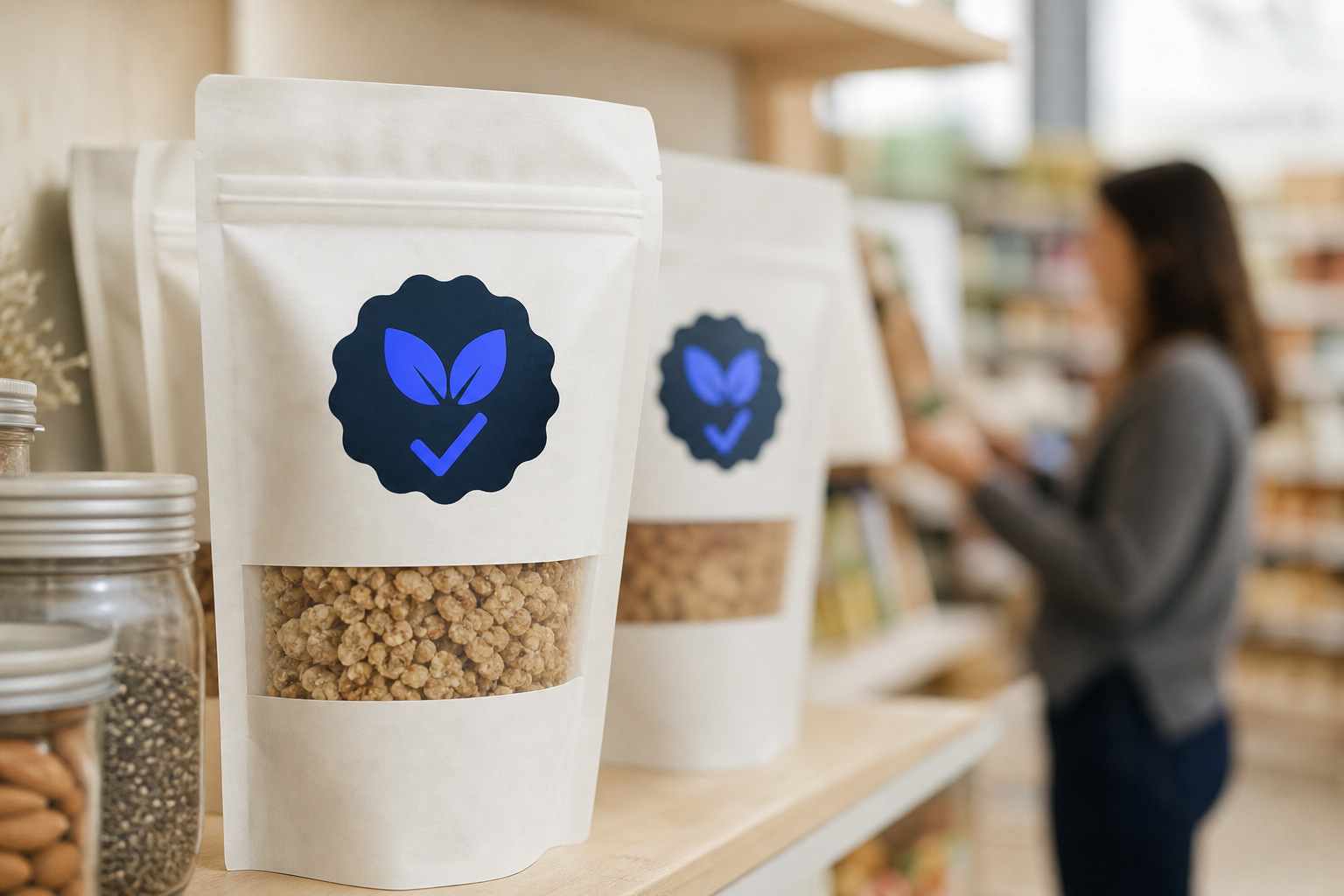
California Governor Gavin Newsom signed AB 2244 on September 28, 2026, creating the nation's first state-level "Non-Ultraprocessed (UPF) Certified" seal program for food products sold in California. Authored by Assemblymember Jesse Gabriel, the bill is now Chapter 721, Statutes of 2026.
The structure is straightforward. CDPH will accredit third-party certification agents who evaluate products and award the Non-Ultraprocessed Certified seal. Those certifying agents must be accredited by June 1, 2029. That date matters: this is a multi-year rollout, not a label appearing on shelves next quarter.
Once the program is live, qualifying grocery stores — those with annual gross sales over $10 million — must give certified products prominent placement at entrances, checkouts, and end-of-aisle displays. That retail placement mandate is what separates this from a voluntary badge. It creates a direct commercial incentive for brands to pursue certification, not just a reputational one.
Enforcement has real teeth. CDPH, the Attorney General, county counsel, city attorneys, and city prosecutors can all seek injunctions against seal misuse. Consumers, businesses, and nonprofits can also sue to stop unauthorized use. Brands that put this seal on non-qualifying products face multi-party exposure.
AB 2244 doesn't stand alone. It builds on AB 1264, signed in 2025, which created California's first statutory definition of "ultraprocessed food" — for school-food purposes. AB 1264 uses a hybrid ingredient-plus-nutrient test that is NOVA-adjacent but not NOVA. It's California's own framework, not a direct import of the French classification system.
Under AB 1264, CDPH must define "ultraprocessed foods of concern" and "restricted school foods" by June 1, 2028. That definition will likely shape how certifying agents interpret AB 2244's criteria, even though the two laws operate in different contexts — school food policy versus retail labeling.
Your legal and regulatory team needs to track both. They are related but distinct, with different effective dates, different enforcement mechanisms, and different scopes. An ingredient that clears the AB 1264 school-food threshold may or may not qualify for AB 2244 certification — the certification criteria will be set by accredited agents, not defined identically to the school-food standard.
At the federal level, no UPF definition exists yet. USDA, HHS, and FDA have a proposed definition under final review, but California is moving ahead of federal action. That gap means California's framework will function as a de facto national reference point for any brand with significant California distribution.
CPG brands selling in California. If you have SKUs in California grocery retail, you need to assess your portfolio against whatever certification criteria emerge. The June 2029 accreditation deadline gives you roughly two and a half years to prepare — but reformulation timelines, supplier qualification, and certification audits compress that window considerably.
Large grocery retailers above $10 million in annual gross sales. The retail placement mandate creates downstream pressure on brands. Retailers will have commercial reasons to stock certified products in premium positions, which means brands without the seal may lose shelf placement to competitors who have it.
Ingredient suppliers. If your customers are CPG brands reformulating for non-UPF certification, your ingredient specifications, processing methods, and documentation will come under scrutiny. Suppliers who can provide clear traceability and processing-level documentation will have a sourcing advantage.
The specific certification criteria will be set by CDPH-accredited agents, so exact ingredient-level requirements aren't published yet. But based on how California's hybrid framework operates and the broader UPF literature, certain ingredient categories will almost certainly determine eligibility.
The ingredients that typically separate a UPF from a non-UPF formulation fall into a few categories:
Categories with the most reformulation headroom include shelf-stable snacks, ready-to-eat cereals, baked goods, and certain beverage categories. Highly processed meat alternatives and products with long additive lists face steeper reformulation challenges.
Most coverage on AB 2244 frames this as a labeling or legal question. It isn't, primarily. It's a formulation and sourcing strategy question.
Before your team invests in reformulation, you need to answer a more basic question: which of your SKUs are even plausible certification candidates? That requires ingredient-level visibility across your portfolio — not just a list of ingredients, but a scored view of each ingredient's processing level, additive classification, supplier sourcing depth, and cost impact of substitution.
That's a multi-criteria evaluation problem. Swapping BHT for a natural antioxidant system changes your cost structure, your shelf-life validation requirements, your supplier relationships, and potentially your nutritional profile — all at once. Evaluating those tradeoffs in sequence, in separate spreadsheets, is how reformulation projects stall.
The Operations Scientist framework at Journey Foods evaluates ingredients simultaneously across nutrition, cost, sustainability, sourcing, risk, and quality criteria. That kind of parallel scoring is what non-UPF reformulation actually requires. You cannot optimize for one axis and ignore the others.
Supplier intelligence matters equally. Finding a qualifying alternative to a flagged ingredient is only useful if you can also verify that alternative's supply security, cost at scale, and documentation quality. A supplier who can't provide processing-level traceability won't survive a certification audit, regardless of how clean the ingredient looks on paper.
The brands that move fastest on AB 2244 certification won't be the ones who start reformulating in 2028. They'll be the ones who use the next 18 months to map their portfolio, identify the SKUs with genuine certification potential, and build supplier relationships around qualifying ingredients now.
What is AB 2244 and when does it take effect?
AB 2244, signed September 28, 2026, creates California's first "Non-Ultraprocessed (UPF) Certified" seal program for retail food products. CDPH must accredit third-party certifying agents by June 1, 2029, so the program isn't operational immediately — brands have a multi-year preparation window.
How is AB 2244 different from AB 1264?
AB 1264 (signed 2025) created California's statutory definition of "ultraprocessed food" for school-food policy purposes. AB 2244 creates a voluntary retail certification seal. Both laws use California's own hybrid framework, but they operate in different contexts with different effective dates and different regulatory requirements.
Does a federal UPF definition exist?
Not yet. USDA, HHS, and FDA have a proposed federal definition under final review, but no final rule has been issued. California's framework is currently the only enacted state-level UPF standard in the country.
Which product categories are most likely to pursue Non-UPF Certified status?
Categories with the most reformulation headroom include shelf-stable snacks, ready-to-eat cereals, baked goods, and certain beverages. Products with high additive loads or heavily fractionated protein ingredients face steeper reformulation challenges.
What happens if a brand misuses the Non-UPF Certified seal?
CDPH, the Attorney General, county counsel, city attorneys, and city prosecutors can all seek injunctions against misuse. Consumers, businesses, and nonprofits also have standing to sue. Unauthorized use of the seal carries meaningful legal exposure.
Do grocery retailers have obligations under AB 2244?
Yes. Qualifying grocery stores with annual gross sales over $10 million must give Non-UPF Certified products prominent retail placement — at entrances, checkouts, and end-of-aisle displays. That creates a direct commercial incentive for brands to pursue certification.
How should CPG brands start preparing now?
Start with portfolio mapping: identify which SKUs have realistic certification potential based on current ingredient profiles. Then build a sourcing strategy around qualifying alternative ingredients before committing to reformulation investment. Ingredient-level scoring across nutrition, cost, and sourcing risk is the foundation of that work.