Clean-Label Formulation: How to Replace Synthetic Additives Without Killing Your Margin


Quick answer
We're at an inflection point in CPG product development. Consumers are reading ingredient labels more carefully than ever, retailers are tightening their "free-from" requirements, and regulatory scrutiny on synthetic additives is intensifying across the US, EU, and MENA markets. The pressure to go clean-label is real. So is the pressure to stay profitable.
Clean-Label Formulation: How to Replace Synthetic Additives Without Killing Your Margin
We're at an inflection point in CPG product development. Consumers are reading ingredient labels more carefully than ever, retailers are tightening their "free-from" requirements, and regulatory scrutiny on synthetic additives is intensifying across the US, EU, and MENA markets. The pressure to go clean-label is real. So is the pressure to stay profitable.
The problem most R&D teams run into isn't identifying what to remove. It's figuring out what to replace it with, at what cost, without blowing up shelf life, texture, or your BOM.
Let me walk you through how to approach clean-label formulation as a practical engineering problem — not a marketing exercise.
What "Clean-Label" Actually Means in 2026
There's no single regulatory definition of clean-label, which is part of what makes it complicated. In practice, it means different things depending on your channel, customer, and geography.
The working definition most CPG teams use: a formulation that uses recognizable, minimally processed ingredients with no synthetic preservatives, artificial colors, or chemical emulsifiers that require consumer explanation. That last part matters. "Citric acid" passes. "TBHQ" does not.
A few things have shifted the goalposts heading into 2026:
This isn't just a positioning play anymore. It's operational risk management.
The Four Hardest Synthetic Additives to Replace (And How to Do It)
Not all synthetic additives are equal in difficulty. Some have well-established natural alternatives. Others require a systems-level rethink of your entire formulation. Here's where most teams spend the most time.
1. Synthetic Preservatives (BHA, BHT, Sodium Benzoate)
These do real work — they extend shelf life and prevent oxidation. Remove them without a replacement strategy and you'll shorten your product's viable window and drive up spoilage rates.
Natural alternatives worth evaluating:
The tradeoff almost always comes down to cost-per-unit versus shelf life target. Run the math against your specific distribution chain. A DTC product with a 60-day shelf life has a very different equation than one sitting in a warehouse for six months.
Journey Ingredient Intelligence
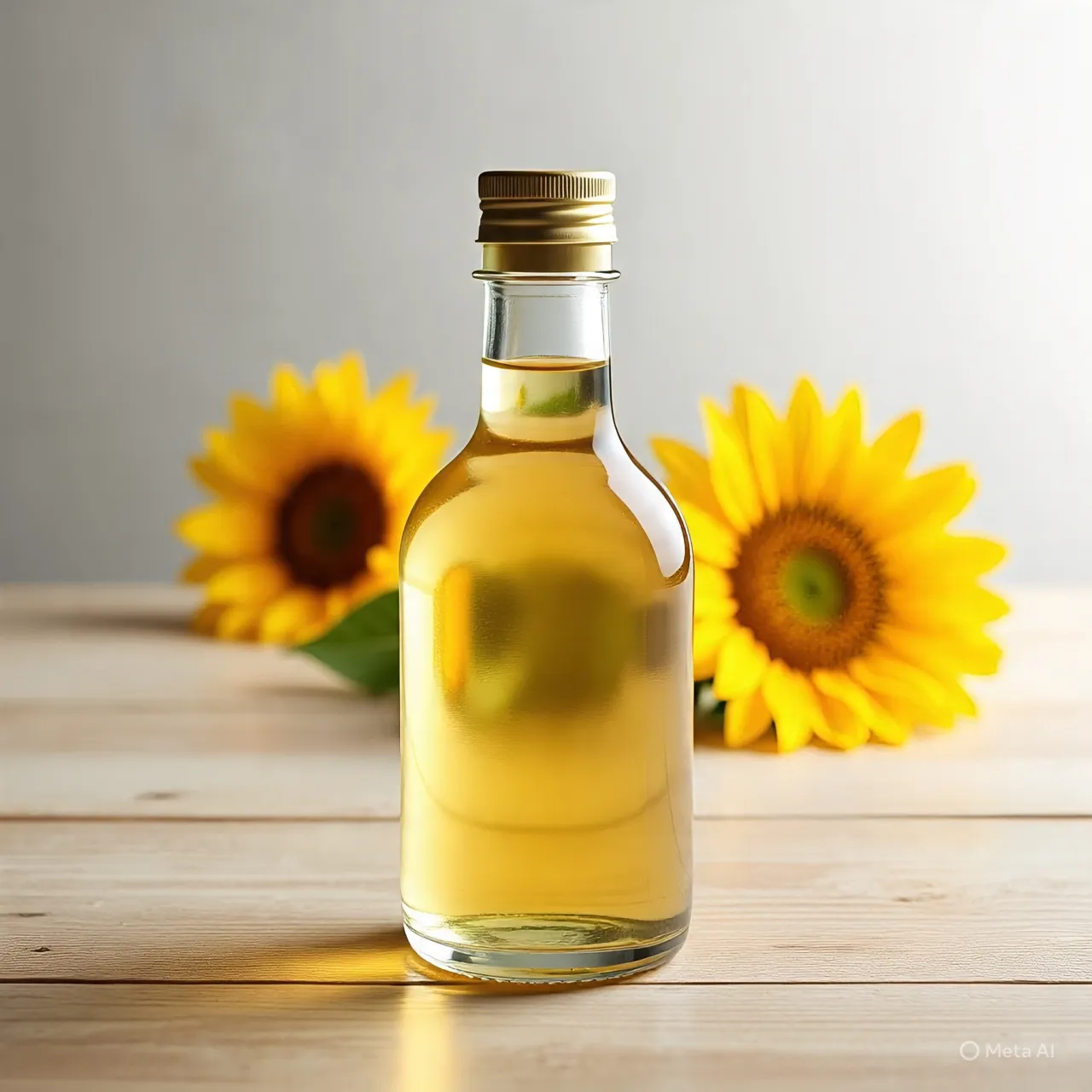
Sunflower Oil
Plant-based emulsifiers like sunflower lecithin carry a lighter footprint than synthetic alternatives.
A South American tree in the family Lecythidaceae.
Nutrition. Sunflower Oil has a nutrition profile of 4,082 kcal/lb and 453.59 g total fat/lb.
Cost. Sunflower Oil is currently priced at $6.84/kg.
Sustainability. Journey AI evaluates ingredient sustainability using environmental indicators such as water usage, greenhouse gas emissions, and upcycled status.
2. Artificial Colors (Red 40, Yellow 5, Yellow 6, Blue 1)
This is the highest-visibility clean-label issue right now, and the replacement landscape has matured significantly. The core challenge is stability — natural colorants are more sensitive to heat, pH, and light than their synthetic counterparts.
Natural colorants by color target:
Stability is the real engineering challenge. Spirulina-derived blue degrades quickly under heat — fine for a cold-pressed beverage, problematic for a baked snack. Your processing conditions have to inform your colorant selection, not just your target hue.
3. Synthetic Emulsifiers (DATEM, Polysorbate 80, Carboxymethylcellulose)
Emulsifiers hold oil-water systems together, improve texture, and extend softness in baked goods. They're also among the most scrutinized additives from a gut health research perspective — which is driving consumer avoidance even ahead of formal regulation.
Natural emulsification strategies:
The honest reality: you'll often need to adjust process parameters alongside the ingredient swap. Expect bench time.
4. Artificial Flavors
This one is more nuanced. "Artificial flavor" on a label triggers consumer skepticism, but the functional difference between natural and artificial flavor compounds is often minimal from a chemistry standpoint. The cost difference, however, is not minimal.
Natural flavor concentrates typically run 2x to 5x the cost of their artificial equivalents. For a flavor-forward product where the flavor system is a significant BOM line item, that's a real margin conversation.
Strategies that work:
The Margin Math: Where Clean-Label Formulation Actually Costs You
Let's be direct about the economics. Clean-label reformulation almost always increases ingredient cost in the short term. The question is by how much, and whether you can offset it.
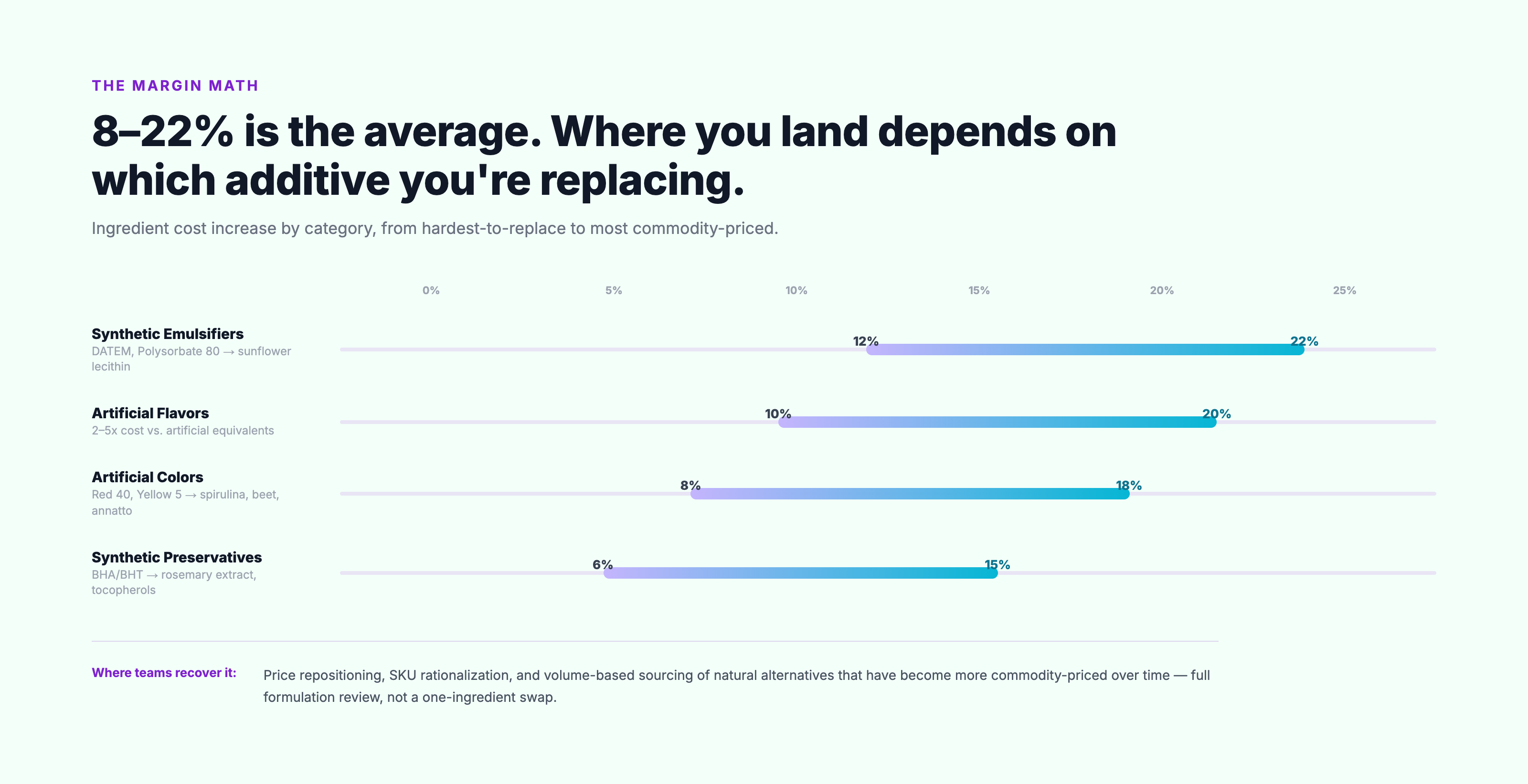
The numbers tell the story: Industry benchmarks suggest clean-label reformulations increase ingredient costs by 8% to 22% on average, depending on category and the number of additives replaced. For a product already running thin margins, that's not trivial.
Where teams recover margin:
The teams that struggle most with clean-label margin are the ones treating it as a one-ingredient swap rather than a full formulation review. If you're only replacing one additive, you're probably not optimizing the rest of the formula around it.
Journey Ingredient Intelligence
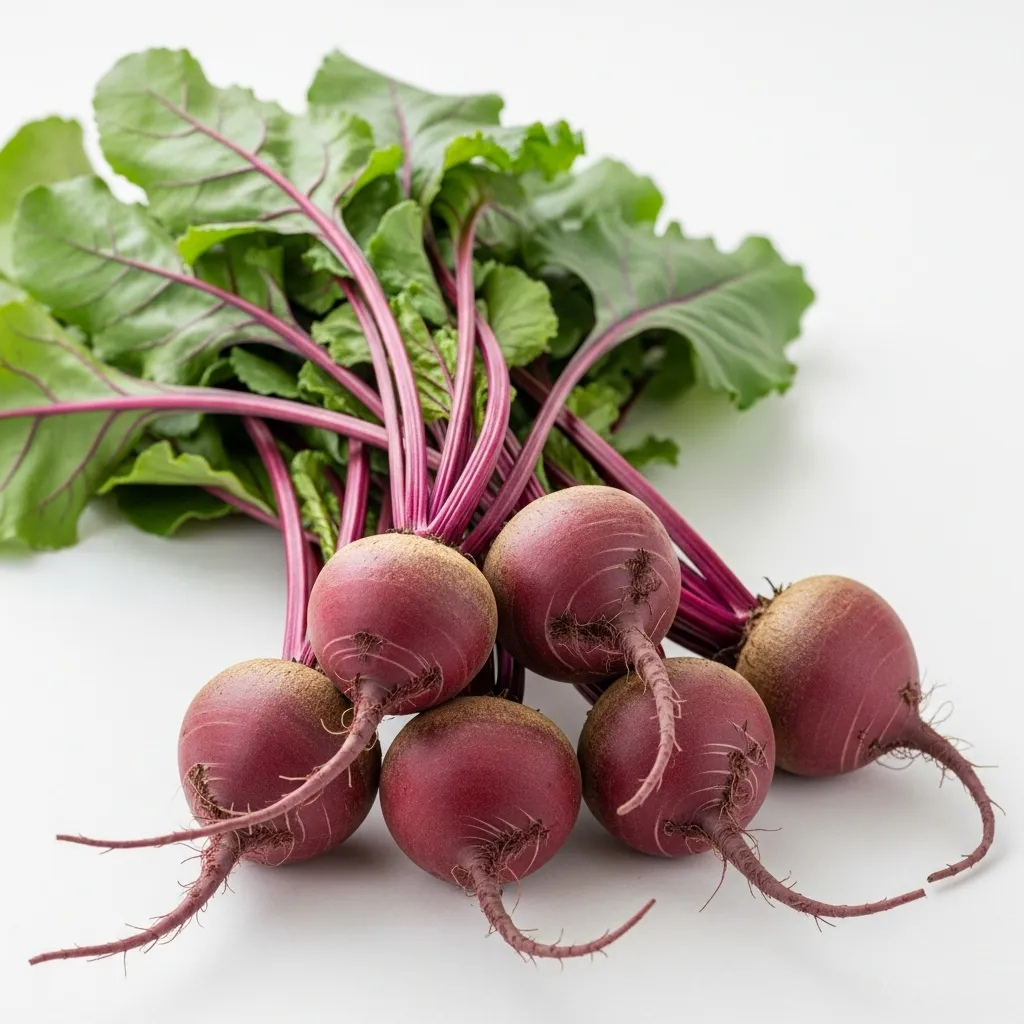
Beet
Natural colorants like spirulina and beet derive from lower-impact agricultural systems.
A South American tree in the family Lecythidaceae.
Nutrition. Beet has a nutrition profile based on the current Journey Foods nutrition table: Calories: 898 kcal/lb, Protein: 88.00 g/lb, Fiber: 0 g/lb, Total Sugars: 0 g/lb, Total…
Cost. Beef is currently priced at $13.18/kg.
Sustainability. Beet: Journey AI evaluates ingredient sustainability using environmental indicators such as water usage, greenhouse gas emissions, and upcycled status.
How AI-Powered Ingredient Intelligence Changes the Equation
This is where the operational reality of 2026 is genuinely different from five years ago.
Historically, clean-label reformulation meant extensive manual research: scanning supplier databases, cross-referencing regulatory lists, running cost models in spreadsheets, and leaning heavily on individual R&D expertise. That process is slow, expensive, and doesn't scale across a large portfolio.
AI-powered platforms now let R&D teams search and score ingredients across nutrition, cost, and sustainability dimensions simultaneously — so you're not just finding a natural alternative, you're finding the one that best fits your specific margin, label, and supply chain constraints. Supply chain monitoring flags when a preferred ingredient faces availability risk, so you're not caught mid-reformulation by a sourcing disruption.
At Journey Foods, the platform is built specifically for this kind of multi-variable ingredient decision. The ingredient scoring system surfaces alternatives you might not have considered, and version control for formulations means your team can iterate quickly without losing track of what changed and why. For CPG teams managing multiple SKUs through a clean-label transition, that traceability matters.
The broader shift toward AI and transparency in food supply chains is making this kind of intelligence more accessible at every stage of development — not just for large enterprises with dedicated data teams.
Clean-Label and Sustainability: The Overlap You Should Be Exploiting
Clean-label formulation and sustainability goals often point in the same direction. Smart CPG teams are treating them as a single workstream rather than parallel projects.
Natural colorants like spirulina and beet derive from lower-impact agricultural systems. Plant-based emulsifiers like sunflower lecithin carry a lighter footprint than synthetic alternatives. When you're evaluating ingredient swaps, factoring in sustainability metrics alongside cost and functionality doesn't add complexity — it adds decision quality.
This is also increasingly relevant to your retail relationships. Buyers at major chains are asking about sustainability credentials alongside clean-label compliance. Having both answers ready — backed by supply chain data — is a real competitive differentiator.
For teams thinking about the full picture, the conversation around sustainability and key supplier relationships is directly relevant to how you source natural alternatives at scale. And as packaging decisions increasingly intersect with formulation choices, understanding how CPG brands are reducing single-use plastics in food packaging gives you a more complete view of where the industry is heading.
A Practical Clean-Label Reformulation Checklist
Before you start swapping ingredients, make sure you've answered these questions:
Running through this checklist before you start saves you from the most common failure mode: picking a natural alternative that works in isolation but fails in your actual product system.
Journey Ingredient Intelligence
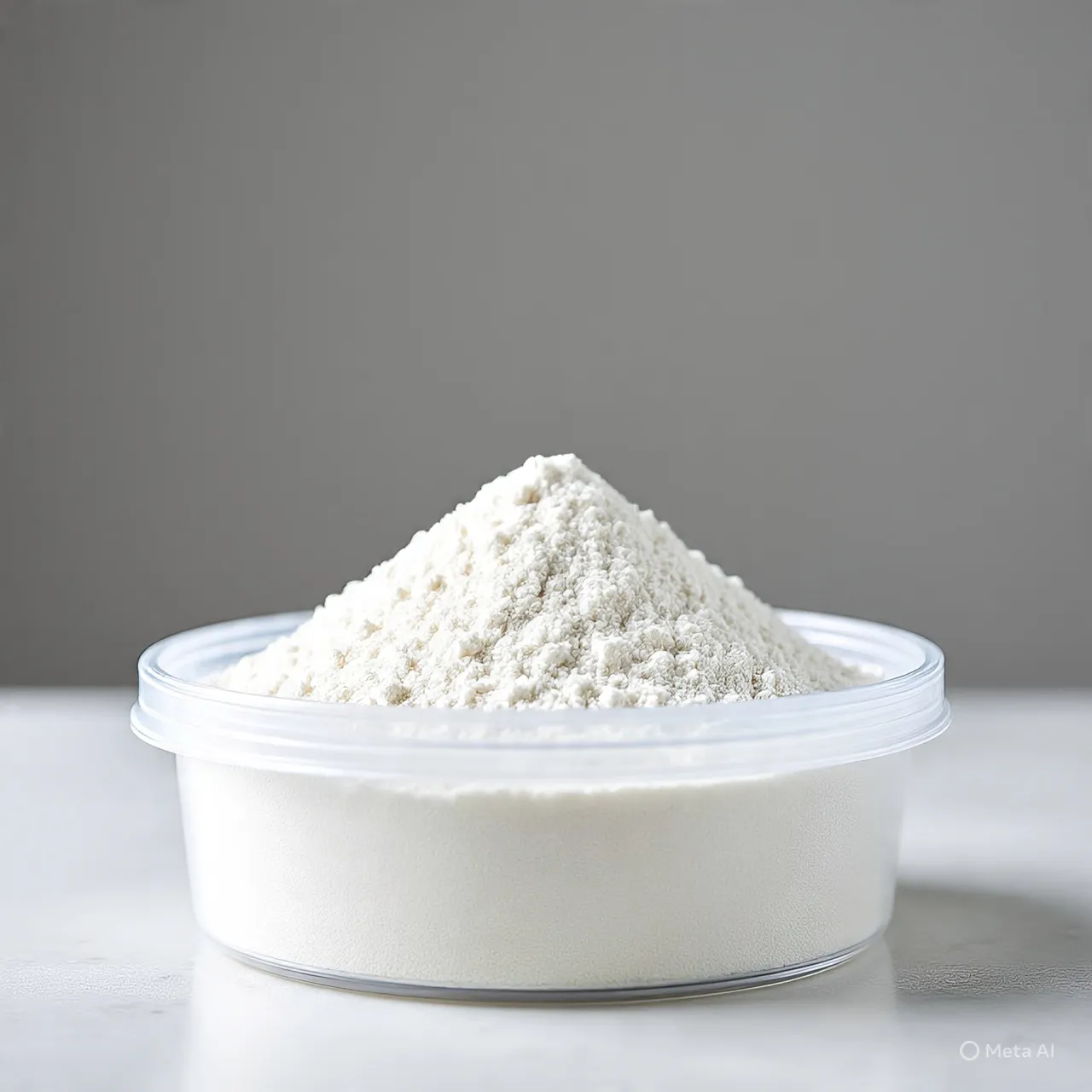
Baking Soda
For baked goods, high-amylose starches can partially replace synthetic emulsifiers by modifying starch behavior during baking.
A South American tree in the family Lecythidaceae.
Nutrition. Baking Soda has a nutrition profile based on the current Journey Foods nutrition table: Calories: 0 kcal/lb, Protein: 0.00 g/lb, Fiber: 0.00 g/lb, Total Sugars: 0.00 g…
Cost. Baking Soda is currently priced at $4.47/kg.
Sustainability. Baking Soda: Journey AI evaluates ingredient sustainability using environmental indicators such as water usage, greenhouse gas emissions, and upcycled status.
Conclusion
Clean-label formulation is a solvable problem. It requires treating ingredient replacement as a systems engineering challenge — accounting for functionality, cost, stability, supply chain, and regulatory trajectory all at once. The teams that do this well don't just end up with a cleaner label. They end up with a better-formulated product and a more defensible market position.
The tools available in 2026 make this faster and more data-driven than it's ever been. If your team is working through a clean-label transition and wants to see how AI-powered ingredient intelligence can accelerate the process, explore what's possible at Journeyfoods.io.
We'd love to hear from you! If you have questions about clean-label formulation, ingredient alternatives you've had success with, or challenges you're running into — throw them in the comments below.
Find us on Instagram, LinkedIn, and X.
FAQs
What is clean-label formulation?
Clean-label formulation is the process of developing food products using recognizable, minimally processed ingredients while removing synthetic additives, artificial colors, and chemical preservatives that consumers or retailers find objectionable. There's no single regulatory definition, but the practical standard is a label that a typical consumer can read and understand without a chemistry background.
How much does clean-label reformulation increase ingredient costs?
Industry benchmarks put the increase at 8% to 22% on average, depending on category and how many additives are being replaced. Teams can offset this through price repositioning, SKU rationalization, and volume-based sourcing of natural alternatives that have become more commodity-priced over time.
What are the best natural replacements for synthetic preservatives?
The most widely used options include rosemary extract (carnosic acid) for antioxidant protection, mixed tocopherols (Vitamin E) for fat-containing systems, and cultured dextrose or fermented ingredients for mold inhibition in baked goods and dairy. The right choice depends on your product matrix, processing conditions, and shelf life target.
Which natural colorants are most stable in food processing?
Stability varies significantly by colorant and application. Beta-carotene and annatto are relatively heat-stable and work well in baked and processed applications. Spirulina-derived blue degrades under heat, making it better suited to cold-process or ambient formats. Beet juice and hibiscus are pH-sensitive and behave differently in acidic versus neutral systems. Always validate under your actual processing conditions.
Can you replace synthetic emulsifiers without changing texture?
You can achieve comparable functionality in many applications, but it typically requires adjusting process parameters alongside the ingredient swap. Sunflower lecithin is the most versatile natural emulsifier and performs well across a wide range of systems. For baked goods, high-amylose starches can partially replace synthetic emulsifiers by modifying starch behavior during baking. Expect bench time and iteration.
How do retailers define clean-label requirements in 2026?
Major retailers maintain proprietary "unacceptable ingredients" lists that go beyond FDA standards and vary by chain. These lists are updated periodically and often reflect consumer advocacy pressure as much as regulatory guidance. Before starting a reformulation project, request the current list directly from your retail buyer — don't assume FDA compliance is sufficient.
How does AI help with clean-label formulation decisions?
AI-powered ingredient platforms let R&D teams search and score alternatives across nutrition, cost, and sustainability dimensions simultaneously, rather than evaluating each variable in isolation. They also provide supply chain monitoring to flag sourcing risks before they disrupt a reformulation project, and version control to track formulation changes across iterations — compressing the research and decision-making timeline significantly compared to manual methods.

Journey Ingredient Intelligence
Rosemary
The most widely used options include rosemary extract (carnosic acid) for antioxidant protection, mixed tocopherols (Vitamin E) for fat-containing systems, and culture…
A South American tree in the family Lecythidaceae.
Nutrition. Rosemary has a nutrition profile based on the current Journey Foods nutrition table: Calories: 1501 kcal/lb, Protein: 22.14 g/lb, Fiber: 193.23 g/lb, Total Sugars: 0.0…
Cost. Rosemary is currently priced at $25.08/kg.
Sustainability. Rosemary: Journey AI evaluates ingredient sustainability using environmental indicators such as water usage, greenhouse gas emissions, and upcycled status.
As published
2x
Journey Ingredient Intelligence · Comparison
Sunflower Oil
Beet
Data from this story
Shareable Journey Intelligence
Clean-Label Formulation: How to Replace Synthetic Additives Without Killing Your Margin
Labeling & Nutrition
2x
Natural flavor concentrates typically run 2x to 5x the cost of their artificial equivalents.
8%
The numbers tell the story: Industry benchmarks suggest clean-label reformulations increase ingredient costs by 8% to 22% on average, depending on category and the number of additives replaced.