.svg)
.svg)
.svg)
.svg)


.svg)
Three separate frozen food recalls landed in U.S. freezers this June. Different brands, different hazards, different root causes — but the same underlying story about where food safety systems are still falling short.

.svg)
Here's what's happening, what you need to check at home, and what these recalls reveal about the data gaps that make them so hard to prevent.
Power Plate Meals — Undeclared Soy Allergen
Power Plate's frozen meatloaf products are under recall after the USDA found undeclared soy in items carrying no soy allergen warning on the label. Approximately 6,000 pounds of product are affected. For the roughly 32 million Americans managing food allergies, an undeclared allergen isn't a labeling technicality — it's a genuine health risk.
Farm Rich Pizza Cheese Crunchers — Metal Fragments
Farm Rich issued a recall covering more than 160,000 pounds of frozen Pizza Cheese Crunchers after the FDA warned the product may contain metal pieces. Contamination at this scale almost always points to equipment failure somewhere in the manufacturing line — a worn blade, a degraded processing component, a co-packer QC checkpoint that didn't catch it.
MorningStar Farms Plant-Based Products — Plastic Contamination
MorningStar Farms recalled multiple plant-based frozen products nationwide, extending the scope to Costa Rica and Puerto Rico. The contaminant: plastic fragments. The geographic breadth here signals a shared-line or co-manufacturing scenario where foreign material entered the product stream before distribution could be stopped.
All three recalls are active. If you have any of these products at home, stop eating them now.
Here's what to look for, product by product.
Power Plate Frozen Meatloaf
Farm Rich Pizza Cheese Crunchers
MorningStar Farms Plant-Based Products
When in doubt, throw it out. The USDA and FDA both advise consumers not to eat recalled products even when the food looks and smells completely normal.
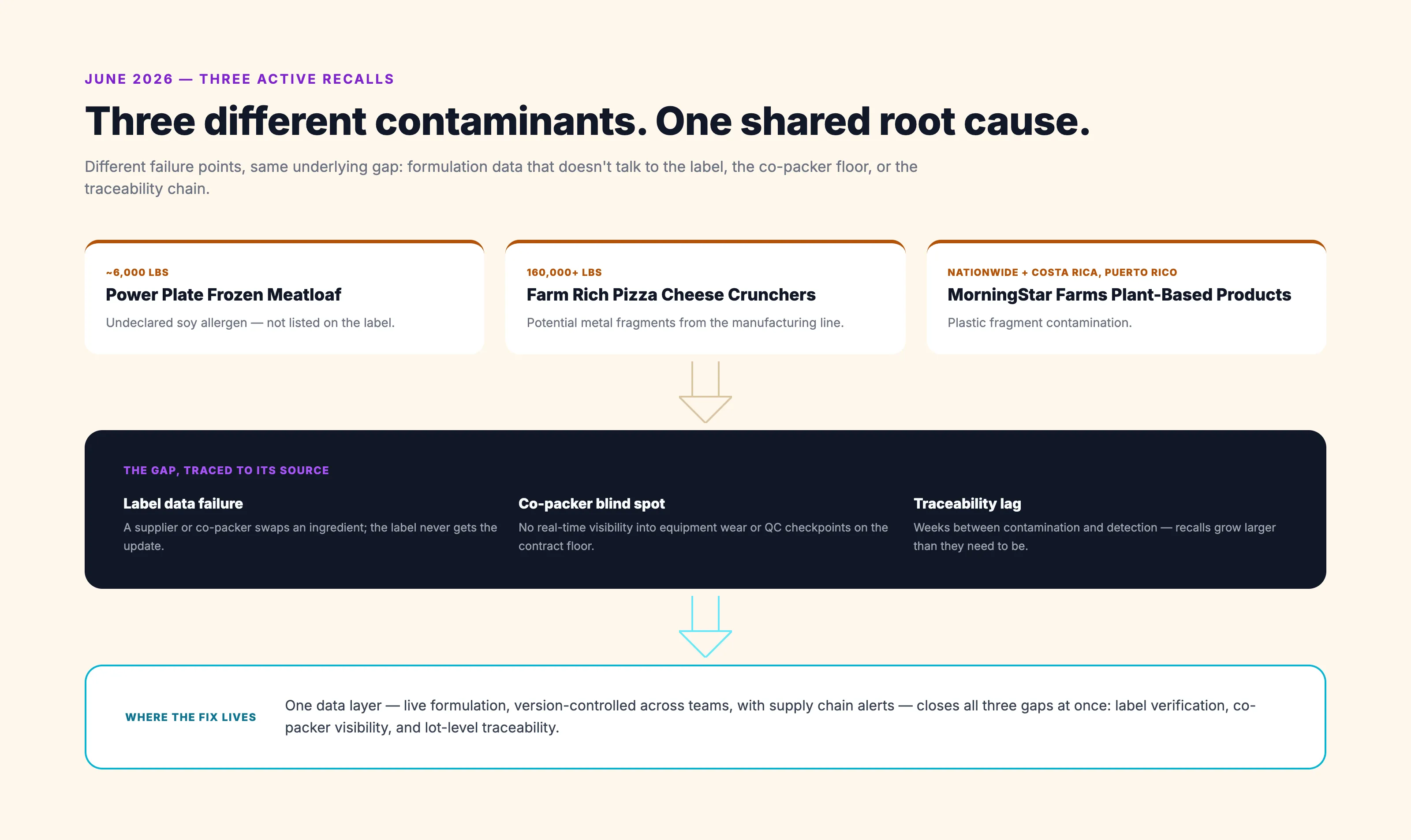
These three recalls share no single cause. That's exactly the point.
Undeclared allergens come from label data failures. When a formulation changes — a supplier substitutes an ingredient, a co-packer swaps a sub-component — that change doesn't automatically trigger a label update. The relevant data is scattered across disconnected systems: a supplier's spec sheet, a co-packer's internal records, a brand's own formulation database. When those systems don't talk to each other, allergen information falls through the gaps.
Foreign material contamination comes from co-packer blind spots. Metal and plastic fragments in finished products almost always trace back to equipment wear, shared processing lines, or inadequate QC checkpoints at a contract manufacturer. Brands often have no real-time visibility into what's happening on a co-packer's floor. By the time a fragment is detected — usually through a consumer complaint or a retailer quality audit — the product is already in distribution.
Traceability lag turns small problems into large recalls. The gap between when contamination enters a product and when a recall is issued can stretch across weeks. That lag is partly regulatory, partly logistical, and partly a data infrastructure problem. Brands that can't quickly trace which lots used which ingredient batches from which suppliers end up recalling far more product than necessary — or not enough.
None of these are new problems. They're recurring ones.
The honest diagnosis: ingredient and label data across most CPG supply chains is still fragmented, largely manual, and built for documentation rather than detection.
Spec sheets live in email threads. Allergen declarations are managed in spreadsheets. Co-packer formulation changes get communicated in PDFs. When a supplier substitutes soy-based binders in a meatloaf product, there's no automated flag cross-referencing the label. No API call that says: this ingredient change creates an undeclared allergen risk.
The industry needs two things it largely doesn't have yet: programmatic label verification tied to live formulation data, and real-time co-packer visibility that surfaces quality and ingredient changes before they become recall events.
Reactive recall systems — consumer complaints, retailer audits, post-distribution testing — will always lag behind the contamination. Prevention means moving the detection point upstream, into the ingredient data layer itself.
If you're a product developer, R&D director, or supply chain lead, these three recalls are a useful audit prompt. Here's where to start.
Audit your co-packer allergen controls today. Do you have current allergen attestations from every co-manufacturer? Are those attestations tied to specific formulations and lot codes, or are they blanket annual documents? If a co-packer changed a sub-ingredient in the last 90 days, would you know?
Verify your label data programmatically. Manual label review isn't enough at scale. If your allergen declarations aren't being cross-referenced against live formulation data — automatically, not just at launch — you have a gap.
Invest in real-time ingredient and supply chain data infrastructure. The brands that avoid recalls aren't just lucky. They've built systems that flag ingredient substitutions, track supplier changes, and surface supply chain alerts before product ships. That infrastructure is increasingly table stakes, not a competitive advantage.
Have a recall response protocol ready before you need it. Know your lot traceability depth. Know your co-packer communication chain. Know which retailers carry which SKUs. If you're building that map during a recall, you're already behind.
Journey Foods is built for exactly the upstream layer these recalls expose. The platform gives food and CPG teams a centralized place to manage ingredient data, track formulation versions, and receive real-time supply chain alerts — so when a supplier substitutes an ingredient or a co-packer changes a processing input, the signal surfaces in the data before it surfaces in a consumer complaint.
The Operations Scientist AI engine scores ingredients across nutrition, cost, and sustainability criteria, and keeps entire product teams working from the same version-controlled formulation data. That's the infrastructure layer that makes programmatic allergen verification and co-packer visibility possible.
Recalls like these aren't inevitable. They're the output of data systems that weren't built to catch them.
See how Journey Foods helps brands stay ahead — book a demo at journeyfoods.io.
What frozen food products are recalled in June 2026?
Three active recalls are in effect as of June 2026: Power Plate frozen meatloaf (approximately 6,000 lbs, undeclared soy allergen), Farm Rich Pizza Cheese Crunchers (over 160,000 lbs, potential metal fragments), and MorningStar Farms plant-based frozen products (plastic contamination, nationwide plus Costa Rica and Puerto Rico). Check FoodSafety.gov and the FDA recalls hub for current lot codes and UPC details.
What should I do if I have a recalled frozen food product?
Stop eating it immediately. Don't taste it to check — metal, plastic, and allergens aren't detectable by sight or smell. Discard the product or return it to the store where you purchased it for a full refund. If you've already consumed the product and are experiencing symptoms, contact your healthcare provider.
What causes undeclared allergens in packaged food?
Undeclared allergens most commonly result from ingredient substitutions that aren't reflected in label updates, co-packer formulation changes that aren't communicated back to the brand, or shared processing lines where allergen cross-contact isn't fully controlled. The root cause is almost always a data gap between what's in the formulation and what's printed on the label.
How do I find out if a frozen food product has been recalled?
The two primary sources in the U.S. are FoodSafety.gov and the FDA's recalls and safety alerts hub. The USDA's Food Safety and Inspection Service (FSIS) handles meat and poultry recalls separately. Most major recalls are also covered by food safety news outlets within 24 to 48 hours of the official notice.
What is the difference between a Class I, Class II, and Class III food recall?
The FDA classifies recalls by risk level. A Class I recall covers products with a reasonable probability of causing serious adverse health consequences or death — most allergen and foreign material recalls fall here. Class II covers products that may cause temporary adverse health effects. Class III covers products unlikely to cause harm but that violate FDA regulations.
What should CPG brands do to prevent allergen labeling errors?
Brands should maintain live, version-controlled formulation data that automatically cross-references allergen declarations on labels. Co-packer agreements should require prompt notification of any ingredient substitutions. Allergen attestations should be tied to specific lot codes and formulation versions — not issued as blanket annual documents. Programmatic verification, not manual review, is the standard that closes the gaps that lead to recalls.
How long does a food recall typically take, and what is the brand's responsibility?
The timeline from contamination detection to public recall notice can range from days to several weeks, depending on how quickly the issue is identified and traced. Brands are responsible for notifying the FDA or USDA, identifying affected lot codes, contacting retailers and distributors, and issuing a public consumer notice. Brands with strong lot traceability infrastructure can execute recalls faster and with greater precision — reducing both consumer risk and the volume of product pulled unnecessarily.
Journey Foods Team News
Structured Q&A marked up with FAQ Page schema so it can be surfaced and cited by Al engines and search.
In Journey Al's 12 month dataset, the median plant protein reformulation came in -6.5% on raw material cost versus an animal protein control the first year that line went negative, driven by Tier 1 isolate suppliers reaching spec parity.
In Journey Al's 12 month dataset, the median plant protein reformulation came in -6.5% on raw material cost versus an animal protein control the first year that line went negative, driven by Tier 1 isolate suppliers reaching spec parity.
In Journey Al's 12 month dataset, the median plant protein reformulation came in -6.5% on raw material cost versus an animal protein control the first year that line went negative, driven by Tier 1 isolate suppliers reaching spec parity.