.svg)
.svg)
.svg)
.svg)


.svg)
Most food R&D teams don't set out to build a fragile system. It happens gradually. You start with ESHA or Genesis R&D for nutrition analysis, add a shared Excel file to track formulations, and coordinate with procurement over email. With three SKUs and two people, it works.

.svg)
Then you scale.
More SKUs mean more spreadsheet tabs. More suppliers mean more email chains. More people touching formulations mean version conflicts. What started as a functional workaround becomes a compounding liability — and the cracks show up at the worst possible moments: a supplier shortage, a label review, a product launch.
This article is about those specific failure points, and why ESHA plus Genesis R&D plus Excel stops being a viable stack once your team and portfolio start growing.
Food R&D teams across CPG rely on spreadsheets for formulation tracking. It's not a niche quirk — it's a structural pattern that persists because Excel is flexible, familiar, and requires no procurement process.
But flexibility without structure is just chaos waiting to happen. When a formulation lives in a spreadsheet, there's no version history, no access controls, and no single authoritative state. The file that went to your co-manufacturer last Tuesday might not match the one your food scientist updated on Wednesday. There's no way to know without manually comparing them.
That's the core problem. Excel was built for calculation, not for managing the lifecycle of a formulation across a team. The more people and SKUs you add, the wider the gap grows between what Excel can do and what your team actually needs.
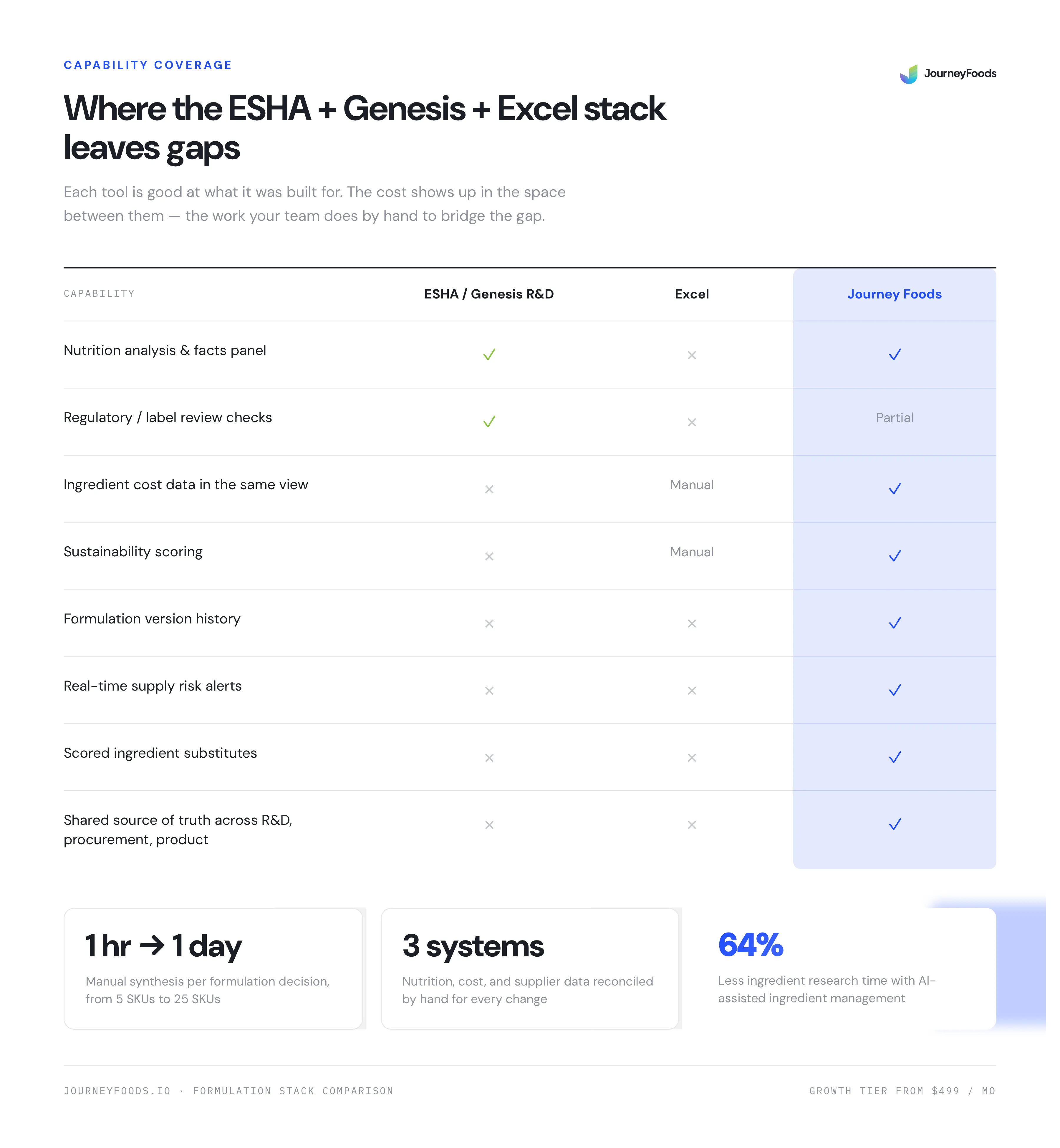
ESHA and Genesis R&D are purpose-built nutrition analysis tools, and they do that job well. You can enter ingredient weights, generate a nutrition facts panel, and run regulatory checks. For a team focused on labeling compliance, that capability matters.
The problem isn't what these tools do. It's what they don't do — and what happens when you try to fill those gaps with spreadsheets.
ESHA holds your nutrition analysis. Ingredient costs are in a procurement spreadsheet. Supplier contacts are in someone's inbox. Sustainability data, if it exists at all, is in a separate file that may or may not be current.
Reconciling those three data streams manually takes time, introduces errors, and breaks down entirely when any one of them changes. A supplier swap that affects both cost and nutrition requires updates across multiple disconnected files. Someone has to own that reconciliation. When that person is out sick or leaves the company, the knowledge gap is immediate.
Neither ESHA nor Genesis R&D was built to monitor supply chains. They don't alert you when an ingredient is at risk, when a supplier's lead time has shifted, or when a substitute needs to be evaluated. That information lives entirely outside the platform.
With five SKUs, you might catch a supply disruption through a supplier email or an industry contact. At twenty SKUs across eight suppliers, the surface area for missed signals grows fast. By the time a shortage reaches your formulation team, it's often already affecting your production schedule.
When formulation files live in individual folders or a shared drive without version control, the institutional knowledge they contain is fragile. A food scientist who leaves takes their working files with them — or leaves behind a folder of ambiguously named documents that no one else can interpret reliably.
This isn't hypothetical. It's one of the most common trigger events that pushes CPG teams to look for a better system. A key person leaves, and suddenly the team realizes that the formulation history for half their portfolio existed only in that person's head and their personal file structure.
These problems don't stay contained. They interact.
When your nutrition data is in ESHA, your cost data is in Excel, and your supplier information is in email, every formulation decision requires a manual synthesis across three systems. At five SKUs, that synthesis takes an hour. At twenty-five SKUs, it takes a day — and it's still error-prone.
Add team members, and the coordination overhead multiplies. Who has the current version of that formulation? Did procurement see the updated ingredient list? Does the nutrition panel reflect the supplier change from last month? These questions consume meeting time, delay decisions, and introduce the kind of small errors that become big problems at the label review stage.
The 64 percent reduction in ingredient research time that food teams have achieved using AI-assisted ingredient management isn't a marginal efficiency gain. It reflects how much time is currently being lost to exactly this kind of manual reconciliation.
Journey Foods was built to replace this fragmented stack with a single workspace where nutrition, cost, and sustainability data live together — not scattered across separate tools.
The Operations Scientist AI scores ingredients across nutrition, cost, and sustainability at the same time. When you evaluate a potential ingredient swap, you see all three dimensions in one view. You're not toggling between ESHA, a procurement spreadsheet, and a sustainability database. The decision-relevant data is already synthesized.
This matters most when you're reformulating under pressure — whether that's a cost target, a label claim, or a supply disruption. Speed and accuracy both improve when you're not manually reconciling three separate data sources.
Every formulation change is tracked. Every version is accessible. Your team works from the same current state, and the history of how you got there is preserved.
This is the structural fix for the Excel problem. When a team member leaves, the formulation history stays. When procurement needs to see what changed between version 4 and version 7, the answer is in the platform — not in someone's memory.
The platform monitors your ingredient portfolio and flags supply risk before it reaches your production schedule. When a risk surfaces, the Operations Scientist AI recommends alternative ingredients already scored against your existing criteria, so your team can evaluate substitutes without starting the research process from scratch.
This is the capability ESHA and Genesis R&D were never designed to provide — and that no spreadsheet can replicate.
Procurement, R&D, and product management work from the same ingredient and formulation data. No reconciliation meetings. No version conflicts. No knowledge trapped in one person's files.
Teams at the Growth tier, starting at $499 per month for two users, get collaborative formulation workflows without an enterprise implementation timeline. No six-month onboarding. No IT deployment. Explore pricing at journeyfoods.io/pricing.
The ESHA plus Excel stack tends to hold together until one of a few things happens: your SKU count crosses into double digits, a second or third person starts touching formulations, you hit a supply disruption that requires fast reformulation, or a key person leaves.
Any one of these events exposes the structural weaknesses in a fragmented system. If your team is approaching any of these thresholds, the cost of switching to a unified platform is almost always lower than the cost of the next avoidable failure.
If your team is managing formulations across ESHA, Genesis R&D, and Excel — and you're starting to feel the friction — the platform is worth a close look. Book a demo at journeyfoods.io/book-a-demo to see the Operations Scientist AI, formulation version control, and supply chain alerts working together in one workspace.
Can we migrate our existing ESHA or Genesis R&D data into Journey Foods?
Yes. Journey Foods supports data import from common formats used by ESHA and Genesis R&D, including ingredient lists and nutrition data. Your team doesn't need to rebuild your ingredient library from scratch. Onboarding is designed to get your existing data into the platform quickly — no lengthy IT project required.
Does Journey Foods replace ESHA entirely, or does it work alongside it?
For most teams, Journey Foods replaces ESHA as a day-to-day formulation and nutrition management tool, because it handles nutrition scoring alongside cost and sustainability in one platform. Teams with specific regulatory labeling workflows may continue using ESHA for final label generation while relying on Journey Foods for formulation development and ingredient management.
At what team size or SKU count does the Excel plus ESHA stack become a serious problem?
The friction typically becomes significant when a second person starts editing shared formulation files, or when your SKU count reaches ten or more. Version conflicts, reconciliation errors, and coordination overhead all scale with headcount and portfolio size. Most teams feel the pain clearly by the time they have two or three people in R&D and fifteen or more active formulations.
How long does it take to get up and running on Journey Foods?
There's no six-month implementation. Most teams are operational within days. Journey Foods is a web app — no IT deployment, no extended onboarding project. The Journey Foods team supports you through setup.
What happens to formulation history when a team member leaves?
Because all formulations and version history live in the Journey Foods platform — not in individual files or local folders — nothing is lost when someone leaves. The full formulation history, including who made changes and when, stays accessible to the team.
Is Journey Foods only for large CPG companies?
No. The Growth tier at $499 per month supports two-user R&D teams. The platform is built for mid-market CPG brands and growing food companies, not just large enterprises with significant IT resources.
ESHA and Genesis R&D are solid tools for what they were built to do. Excel is genuinely useful for a lot of things. The problem isn't any individual tool — it's the gap between them, and the manual work your team does every day to bridge that gap.
As your portfolio grows, that gap costs real time and introduces real risk. Scoring ingredients across nutrition, cost, and sustainability simultaneously, tracking formulation versions, and catching supply risk before it becomes a crisis — that's not a luxury. It's the infrastructure growing CPG teams actually need.
Learn more at journeyfoods.io.
Journey Foods Team News
Structured Q&A marked up with FAQ Page schema so it can be surfaced and cited by Al engines and search.
In Journey Al's 12 month dataset, the median plant protein reformulation came in -6.5% on raw material cost versus an animal protein control the first year that line went negative, driven by Tier 1 isolate suppliers reaching spec parity.
In Journey Al's 12 month dataset, the median plant protein reformulation came in -6.5% on raw material cost versus an animal protein control the first year that line went negative, driven by Tier 1 isolate suppliers reaching spec parity.
In Journey Al's 12 month dataset, the median plant protein reformulation came in -6.5% on raw material cost versus an animal protein control the first year that line went negative, driven by Tier 1 isolate suppliers reaching spec parity.