
.svg)
.svg)
.svg)
.svg)


.svg)
Food safety testing generates a lot of data. Microbial counts, heavy metal screens, pesticide residues, allergen panels, moisture content, pH readings — each result should, in theory, shape what happens next in your formulation or supply chain process.

.svg)
In practice, it ends up in a PDF attached to an email, a shared drive folder nobody audits, or a LIMS that doesn't talk to your formulation software. Your R&D team reformulates based on what they remember, not what the lab reported last Tuesday.
This article is about closing that gap — specifically, how CPG teams can connect food safety testing outputs to an ingredient intelligence platform so lab data actually influences decisions in real time.
The problem isn't that CPG teams aren't running enough tests. Most mid-to-large operations run extensive panels on incoming raw materials, in-process samples, and finished goods. The problem is structural.
Food safety testing typically lives inside quality assurance. Ingredient decisions live inside R&D and procurement. Those teams use different tools, different vocabularies, and often report to different parts of the organization. When a supplier's ingredient fails a heavy metals screen, that result might sit in a QA inbox for days before anyone on the formulation side hears about it — by which point a purchase order may already be in flight.
The second issue is format. COAs from different labs use different field names, units, and layouts. Extracting meaningful signals from that volume of unstructured data manually is slow and error-prone. Even well-resourced teams lose time here.
Integration doesn't mean uploading a PDF to a shared folder and calling it connected. Genuine integration means lab outputs are:
That's the difference between a document archive and ingredient intelligence.
Not all lab data carries equal weight for ingredient decisions. Here's how to think about prioritization:
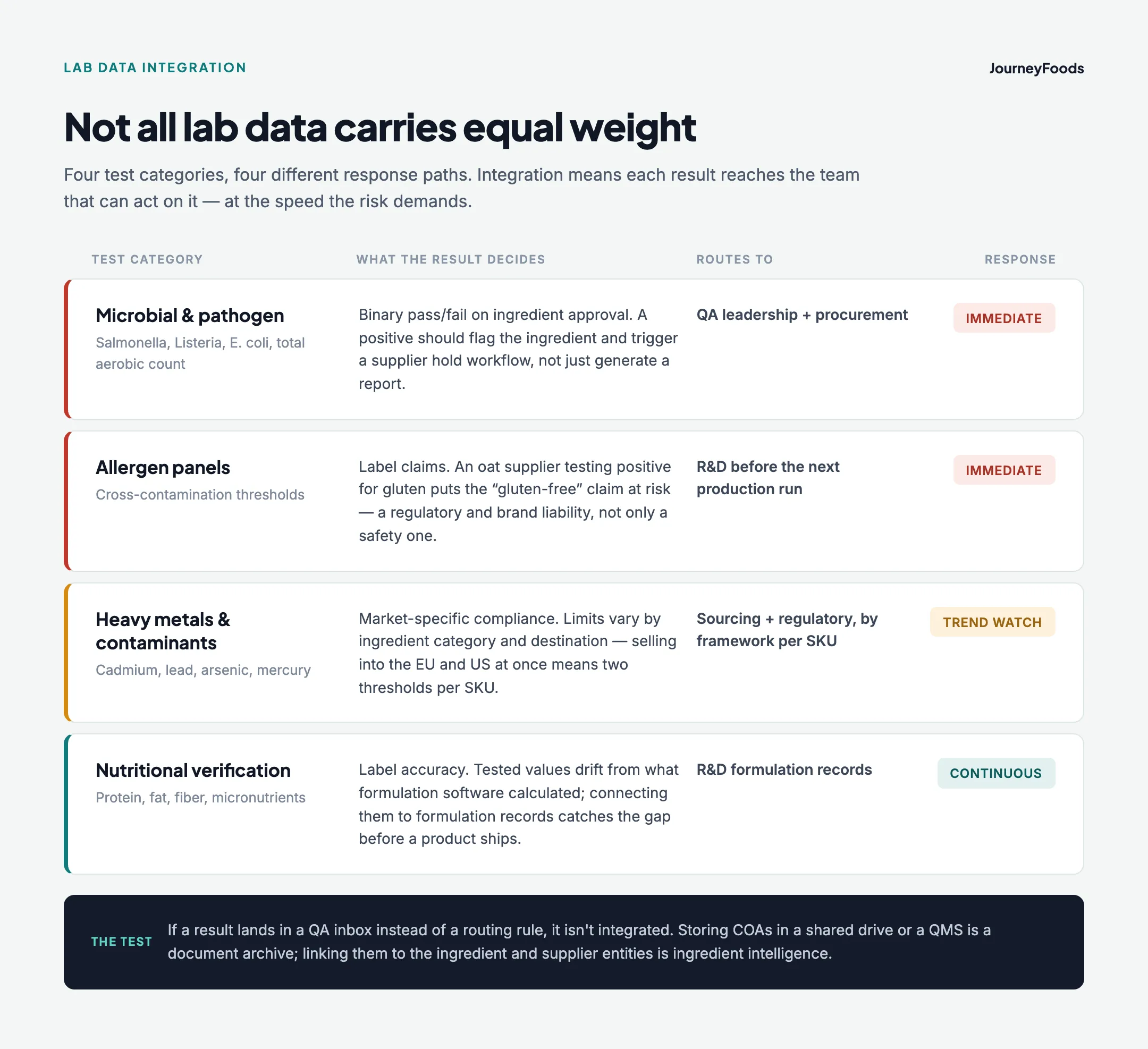
Salmonella, Listeria, E. coli, total aerobic count — these are binary pass/fail signals for most ingredient approvals. When integrated into your ingredient platform, a positive result should immediately flag the affected ingredient and trigger a supplier hold workflow, not just generate a report.
Cadmium, lead, arsenic, and mercury limits vary by ingredient category and destination market. If you're selling into the EU and the US simultaneously, your acceptable thresholds differ. An ingredient intelligence platform storing these results should also know which regulatory framework applies to each SKU.
Cross-contamination data from allergen testing directly affects label claims. If your oat supplier's facility tests positive for gluten above threshold, your "gluten-free" claim is at risk. That's not just a safety issue — it's a regulatory and brand liability issue that needs to reach R&D before the next production run, not after.
Declared nutrition values need to reflect what's actually in the product, not just what the formulation software calculated. Tested values for protein, fat, fiber, and micronutrients can drift from theoretical values based on ingredient variability. Connecting tested nutritional data to your formulation records lets you catch label accuracy issues before a product ships.
Before you can integrate lab data, you need to extract it reliably. Most CPG teams receive COAs from multiple labs in varying formats. The first step is building or adopting a parsing layer that maps incoming COA fields to a consistent internal schema — ingredient name, lot number, test type, result, unit, test date, lab name, pass/fail status.
AI-powered document parsing has made this significantly more tractable. Platforms that use machine learning to extract structured data from unstructured COAs reduce manual entry time substantially and catch transcription errors that humans miss.
Batch-level tracking is necessary but not sufficient. You need test results linked to the ingredient entity and the supplier entity so you can answer questions like: What is the historical heavy metals profile for this ingredient across all suppliers? or How often does this supplier's material fail microbial screening?
That supplier-level and ingredient-level view is what lets procurement teams make risk-informed sourcing decisions rather than purely reactive ones.
The highest-value integration point is where formulators actually work. When a food scientist is evaluating whether to use a particular protein concentrate in a new product, they should see that ingredient's testing history directly inside their formulation environment — not by switching to a separate QA system.
Journey Foods is built around this principle: ingredient data, including supply chain signals and quality indicators, is centralized so product teams evaluate ingredients with the full picture, not just cost and nutrition in isolation.
Not every test result requires the same response. A borderline moisture reading on a low-risk ingredient is different from a Listeria positive on a ready-to-eat component. Your alert logic should reflect that — routing critical safety failures to QA leadership and procurement immediately, while flagging trend-level quality drift to R&D on a scheduled basis.
Real-time supply chain alerts connected to lab data mean your team learns about a supplier quality issue when it happens, not three days later.
When a lab result triggers a formulation change — swapping an ingredient, adjusting a supplier, updating a spec — that change needs to be captured with full context: what changed, why, when, and who approved it. Without version control on formulation records, you lose the audit trail that regulators and internal quality teams both require.
Treating COA storage as integration. Uploading COAs to a shared drive or even a QMS doesn't make the data usable for ingredient decisions. The data needs to be structured and connected to the systems where decisions actually happen.
Building one-way pipelines. If lab data flows into your platform but formulation changes don't flow back to your QA team, you've solved half the problem. The integration needs to be bidirectional.
Ignoring supplier-level aggregation. Batch-level results tell you about one shipment. Supplier-level trends tell you about reliability. Build for both.
Separating safety data from cost and nutrition data. A formulator making an ingredient swap needs to see all three dimensions simultaneously. Siloed systems force sequential lookups that slow decisions and introduce errors.
The CPG industry has historically separated tools by function: LIMS for lab data, ERP for procurement, formulation software for R&D, PLM for product lifecycle. Each system does its job. None of them talk to each other fluently.
Ingredient intelligence platforms are designed to sit at the intersection — aggregating data from multiple sources, including lab outputs, and making it available to every team that touches an ingredient decision. The supply chain intelligence layer matters especially here: when a supplier has a quality issue, you need to know not just that the test failed, but whether an alternative ingredient is available, at what cost, and whether it meets your nutritional and sustainability criteria.
That kind of multi-dimensional evaluation is what separates reactive quality management from proactive ingredient strategy. Teams already tracking ingredient trends in 2026 are thinking about how novel ingredients introduce new testing requirements — and whether their current infrastructure can handle that complexity.
If you're evaluating whether this integration is worth the engineering and process investment, here are the concrete value drivers:
Nutritional verification — confirming that tested values match declared label values — often gets treated as a separate workstream from safety testing. It shouldn't be.
When tested nutritional data is connected to your formulation records, discrepancies surface automatically rather than being caught during a label review, if they're caught at all. For teams building products with specific health claims, real-time verification that formulations meet regulatory and marketing requirements is a core part of the quality stack, not an afterthought.
If you're building this capability from scratch or evaluating platforms, here's a reasonable sequence:
What is food safety testing in CPG?
Food safety testing in CPG refers to laboratory analysis of raw materials, in-process samples, and finished goods to verify they meet safety, quality, and regulatory standards. Common tests include microbial screening, allergen panels, heavy metals analysis, pesticide residue testing, and nutritional verification.
How do CPG teams typically manage COA data today?
Most CPG teams receive Certificates of Analysis from suppliers and contract labs as PDFs via email or supplier portals. These are typically stored in shared drives or QMS platforms but are rarely connected to formulation software or procurement systems in a way that makes the data queryable or actionable in real time.
What's the difference between a LIMS and an ingredient intelligence platform?
A LIMS is designed to manage lab workflows, sample tracking, and test results within a QA function. An ingredient intelligence platform aggregates data across quality, nutrition, cost, and supply chain dimensions and makes it available to R&D, procurement, and product teams — not just QA. The two systems serve different users and different decision types.
How should lab results be linked to ingredient records?
Lab results should be mapped to both the ingredient entity and the supplier entity, not just to a lot or batch number. This lets teams query historical quality performance by ingredient and by supplier, enabling risk-informed sourcing decisions over time rather than shipment-by-shipment reactions.
What triggers should CPG teams set for food safety alerts?
Alert thresholds should be calibrated by risk level. Pathogen positives and allergen cross-contamination results warrant immediate escalation to QA leadership and procurement. Trend-level quality drift — gradually increasing heavy metals readings, declining microbial scores — should be flagged on a scheduled basis to R&D and sourcing teams before they become compliance issues.
Can AI help parse unstructured COA data?
Yes. AI-powered document parsing can extract structured fields from COAs in varying formats, reducing manual data entry and improving consistency. The key is mapping extracted fields to a standardized internal schema so results from different labs are comparable and queryable.
How does integrating lab data affect audit readiness?
When lab results are linked to ingredient and supplier records and formulation changes are version-controlled with full context, audit preparation becomes a reporting exercise rather than a document retrieval scramble. Regulators and certification bodies can trace the full history of an ingredient decision, including the quality data that informed it.
Food safety failures are expensive across every dimension — financial, regulatory, and reputational. The teams that handle them best aren't necessarily the ones that respond fastest. They're the ones whose systems surface the signal early enough to act before a problem compounds.
Integrating lab data into your ingredient intelligence platform is the infrastructure investment that makes that possible. It's not glamorous work, but it's the difference between managing ingredients reactively and managing them with genuine visibility.
If you're evaluating how to build this capability, Journey Foods is worth a close look. The platform centralizes ingredient data across quality, cost, nutrition, and supply chain dimensions so your entire team — R&D, procurement, QA — works from the same picture, in real time.
Journey Foods Team News
Structured Q&A marked up with FAQ Page schema so it can be surfaced and cited by Al engines and search.
In Journey Al's 12 month dataset, the median plant protein reformulation came in -6.5% on raw material cost versus an animal protein control the first year that line went negative, driven by Tier 1 isolate suppliers reaching spec parity.
In Journey Al's 12 month dataset, the median plant protein reformulation came in -6.5% on raw material cost versus an animal protein control the first year that line went negative, driven by Tier 1 isolate suppliers reaching spec parity.
In Journey Al's 12 month dataset, the median plant protein reformulation came in -6.5% on raw material cost versus an animal protein control the first year that line went negative, driven by Tier 1 isolate suppliers reaching spec parity.