
.svg)
.svg)
.svg)
.svg)


.svg)
The ingredient decisions you make this year will shape your product line for the next three. That's not hyperbole. Between tightening clean-label regulations, protein supply volatility, and consumer demand splintering into smaller and more specific segments, the margin for slow research and reactive sourcing has disappeared.

.svg)
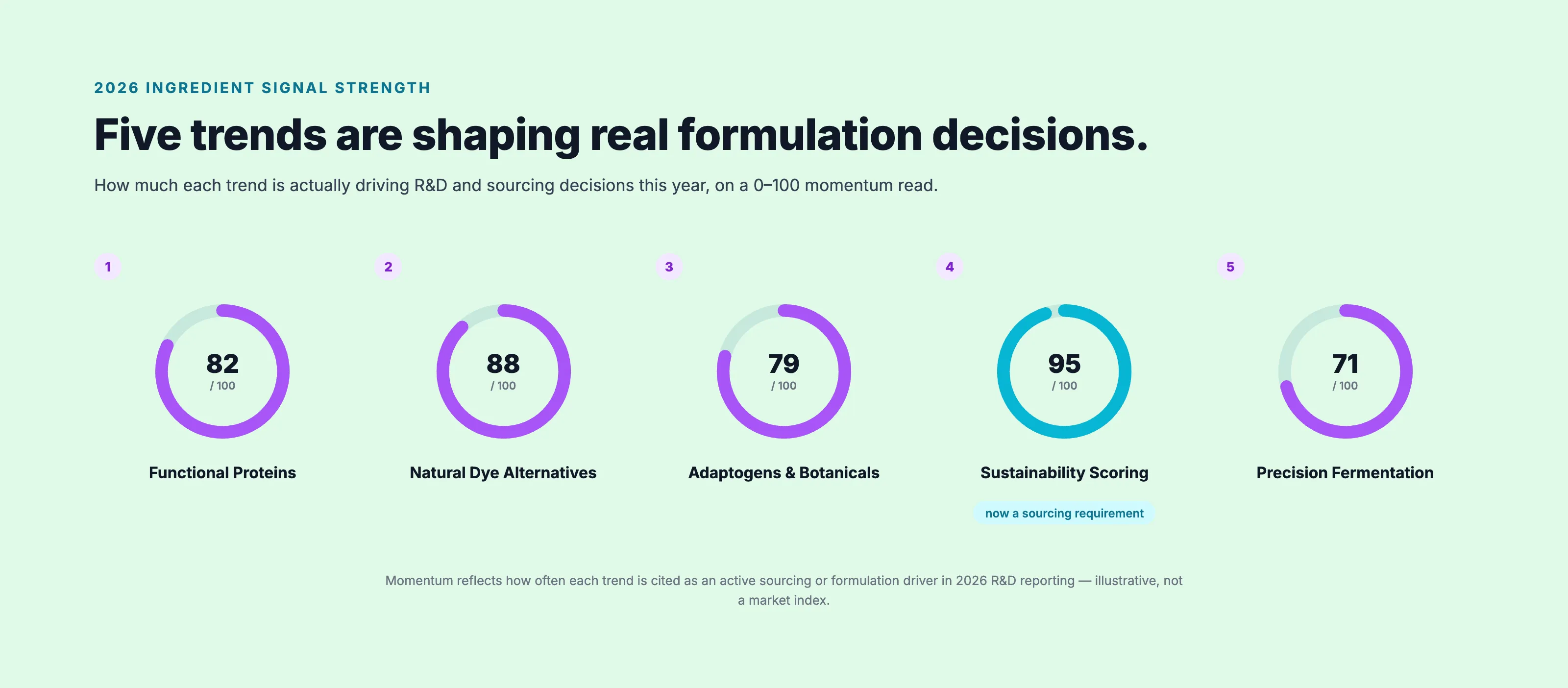
R&D teams tracking the right signals now are the ones who launch on time. Here are five ingredient trends driving real formulation decisions in 2026.
Whey and soy aren't going anywhere. But they're no longer the default answer.
R&D teams are actively evaluating a wider protein matrix: precision-fermented proteins, mycoprotein, insect-derived protein, and single-cell protein from algae and yeast. The shift isn't purely consumer-driven — it's supply chain-driven. Soy and whey face ongoing price volatility tied to agricultural inputs, climate-related yield disruptions, and geopolitical trade pressure. Teams that locked in single-source protein strategies in 2023 and 2024 spent much of 2025 reformulating under pressure.
What's changing in 2026 is the scoring criteria. Protein choice is now evaluated across three dimensions simultaneously: amino acid profile and bioavailability, landed cost and supply stability, and environmental footprint including water use and land impact. A single-criteria approach to protein sourcing leaves you slower and more exposed.
Protein innovation has been building for several cycles — what's different now is that multi-criteria scoring is becoming the baseline expectation, not a differentiator.
Regulatory pressure on synthetic dyes accelerated faster than most teams modeled. With FDA guidance tightening and major retail partners signaling clean-label requirements across their private label and supplier base, the question is no longer whether to reformulate away from synthetic dyes. It's how to do it without destroying shelf stability, color consistency, or margin.
The viable alternatives in 2026 include spirulina, butterfly pea flower, beet-derived pigments, paprika extract, and turmeric. Each comes with real trade-offs: pH sensitivity, heat stability, light degradation rates, and cost per unit of color intensity. None of them perform identically to their synthetic counterparts across all applications.
This is where formulation work gets specific. A dye replacement that works in a shelf-stable beverage won't behave the same way in a baked good or a refrigerated dairy product. Teams are running more formulation iterations per project than they were two years ago — and doing it under tighter timelines.
If you're still in the research phase on synthetic dye alternatives, the clean-label formulation guide on replacing synthetic additives covers the technical trade-offs in detail.
Ashwagandha, lion's mane, reishi, and rhodiola were fringe ingredients three years ago. They're now showing up in energy bars, RTD beverages, snack formats, and even condiments. The consumer demand signal is clear. The formulation complexity is equally real.
The challenge for R&D teams isn't finding these ingredients — it's sourcing them with consistent bioactive compound levels, verifiable origin, and supply chain depth. Ashwagandha, for example, varies significantly in withanolide content depending on cultivation region, harvest timing, and extraction method. A product that tests well in development can perform inconsistently at scale if sourcing isn't locked down before you build the formulation around it.
Regulatory clarity is also still developing in several markets. Claims around cognitive support, stress response, and immune function are under active scrutiny in both the US and EU. R&D teams need to track the ingredient science and the regulatory environment in parallel, not sequentially.
The teams moving fastest here evaluate botanical ingredients against nutrition, cost, and supply chain risk at the same time — not one after another.
This is no longer a marketing conversation.
Major grocery chains are pushing sustainability data requirements down to suppliers. Scope 3 emissions reporting increasingly demands ingredient-level data — not just facility-level data. For R&D and procurement teams, that means ingredient selection now carries a sustainability data burden that simply didn't exist two years ago. You need carbon footprint, water use, and land impact data for your inputs, and you need to be able to report it.
The practical problem is that most teams are still pulling this from separate sources: a sustainability database here, a supplier questionnaire there, a third-party audit somewhere else. That fragmentation slows sourcing decisions and creates reporting gaps at exactly the wrong moment.
Packaging sustainability is one piece of this, but ingredient-level sustainability data is where the harder work sits in 2026. Teams that build sustainability scoring into their ingredient evaluation workflow now will have a structural advantage when retail partner requirements tighten further — and they will.
Precision fermentation has been commercially viable for a narrow set of applications for several years. What's shifting in 2026 is the cost curve. Fermentation-derived dairy proteins, heme proteins, and specialty lipids are reaching price points that make them genuinely competitive with conventional alternatives in specific applications.
That matters for R&D teams because precision fermentation ingredients offer something conventional inputs can't: highly consistent composition, programmable functional properties, and a supply chain largely decoupled from agricultural weather and commodity markets.
The formulation work is still non-trivial. These ingredients behave differently in emulsification, heat processing, and texture applications compared to their conventional counterparts. But teams that start formulation trials now will be ahead of the curve when cost parity becomes the norm across more categories — and the sourcing landscape is already consolidating. Knowing which suppliers have the production capacity, regulatory clearances, and supply depth to support commercial scale is critical before you build a formulation dependency on a single provider.
Knowing these trends is the starting point. Acting on them quickly is where most teams lose time.
The bottleneck is rarely the science. It's the workflow: fragmented ingredient data, manual scoring across separate tools, and supply chain information that arrives too late to prevent a delay. One CPG brand cut ingredient research time by 64% by centralizing that workflow — and the time saved went directly into faster iteration cycles.
Journey Foods scores ingredients across nutrition, cost, and sustainability in a single workflow and surfaces real-time supply chain alerts before they become formulation problems. If your team is tracking any of these trends and wants to move from research to decision faster, explore the platform at journeyfoods.io or book a demo to see how it handles your specific ingredient categories.
What are the most important CPG ingredient trends in 2026?
The five trends R&D teams are actively tracking are functional and alternative proteins, synthetic dye replacement with natural pigments, adaptogens and functional botanicals entering mainstream formats, sustainability scoring as a sourcing requirement, and precision fermentation ingredients reaching competitive cost points.
Why is multi-criteria ingredient scoring important for CPG teams in 2026?
Ingredient decisions now carry simultaneous requirements across nutrition performance, cost and supply stability, and sustainability reporting. Evaluating these criteria sequentially — with separate tools — slows formulation timelines and increases the risk of sourcing a solution that fails on one dimension after it passes another.
Which natural dye alternatives are CPG brands using to replace synthetic dyes?
Spirulina, butterfly pea flower, beet-derived pigments, paprika extract, and turmeric are the most widely evaluated alternatives in 2026. Each has specific stability trade-offs depending on pH, heat exposure, and light sensitivity, which means performance varies significantly across product formats.
How do R&D teams evaluate adaptogens for CPG formulations?
The key criteria are bioactive compound consistency across batches, supplier origin and extraction method transparency, supply chain depth for commercial scale, and regulatory claim boundaries in target markets. Ashwagandha, lion's mane, and reishi are the most commonly formulated adaptogens in food and beverage applications right now.
What is driving the shift toward precision fermentation ingredients in food products?
Cost reduction is the primary driver in 2026. Fermentation-derived proteins and specialty lipids are reaching price points competitive with conventional alternatives in specific applications. The additional appeal is supply chain stability — precision fermentation production is largely decoupled from agricultural commodity volatility.
How are sustainability requirements changing ingredient sourcing for CPG brands?
Retail partners and Scope 3 emissions reporting requirements are pushing ingredient-level sustainability data down to suppliers. R&D and procurement teams now need carbon footprint, water use, and land impact data at the ingredient level — not just facility-level reporting — which changes how ingredient evaluation workflows need to be structured.
What tools do CPG R&D teams use to track ingredient trends and manage formulations?
Teams are moving toward platforms that centralize ingredient discovery, multi-criteria scoring, formulation version control, and supply chain monitoring in one place. The goal is to eliminate the lag between identifying a trend and acting on it with a validated, sourced formulation decision.
Journey Foods Team News
Structured Q&A marked up with FAQ Page schema so it can be surfaced and cited by Al engines and search.
In Journey Al's 12 month dataset, the median plant protein reformulation came in -6.5% on raw material cost versus an animal protein control the first year that line went negative, driven by Tier 1 isolate suppliers reaching spec parity.
In Journey Al's 12 month dataset, the median plant protein reformulation came in -6.5% on raw material cost versus an animal protein control the first year that line went negative, driven by Tier 1 isolate suppliers reaching spec parity.
In Journey Al's 12 month dataset, the median plant protein reformulation came in -6.5% on raw material cost versus an animal protein control the first year that line went negative, driven by Tier 1 isolate suppliers reaching spec parity.