
.svg)
.svg)
.svg)
.svg)


.svg)
Food scientists have spent decades refining formulations through iteration: adjust a ratio, run a bench test, evaluate sensory results, repeat. It works, but it's slow. A single reformulation project can consume weeks of research before a prototype even reaches the kitchen.

.svg)
Neural networks are changing that equation — not by replacing food scientists, but by compressing the search space dramatically. The question worth asking in 2026 isn't whether AI can generate food formulations. It clearly can. The better question is how it actually works, and where human judgment still matters.
This article breaks down the model architectures being applied to food formulation, what training data those models need, how outputs get validated, and where AI-generated formulations still require a food scientist to make them production-ready.
The phrase gets used loosely. In practice, a neural network recipe is a formulation where one or more AI models contributed to ingredient selection, ratio optimization, or flavor pairing. The model doesn't write a recipe the way a chef does. It identifies patterns across large datasets and proposes combinations that satisfy a defined set of constraints.
Those constraints might be nutritional targets, cost ceilings, textural requirements, allergen exclusions, or sustainability scores. The model searches for solutions that satisfy multiple constraints simultaneously — something humans struggle to do efficiently when the ingredient space is large.
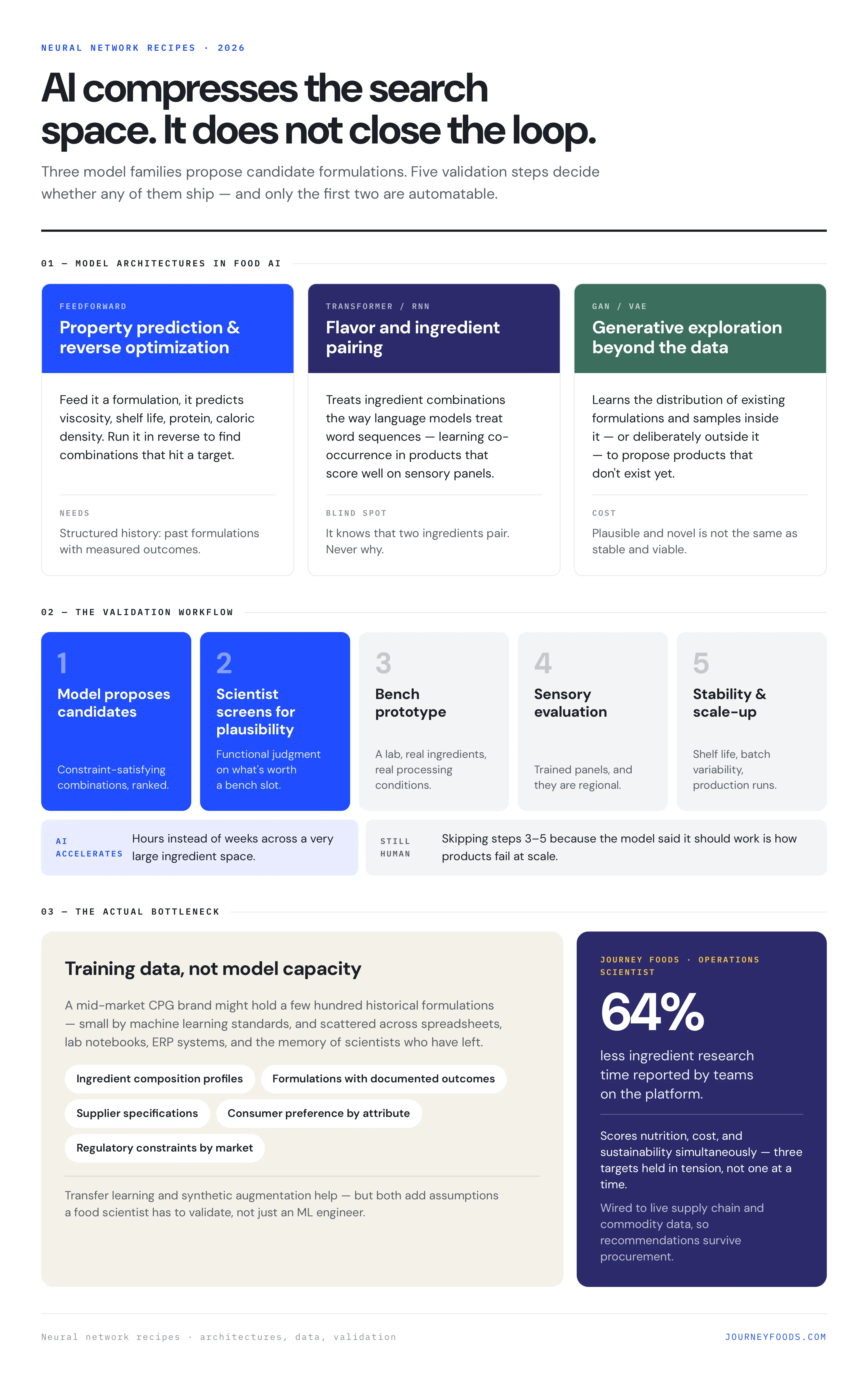
The most common application is a feedforward network trained to predict product outcomes from ingredient inputs. Feed it a formulation, it predicts a property: viscosity, shelf life, protein content, caloric density. Once trained, you can run the model in reverse, using optimization algorithms to find ingredient combinations that hit a target outcome.
This works well when you have structured historical data — past formulations with measured outcomes. The model learns the relationships between ingredients and results without needing to understand the underlying chemistry.
Flavor pairing is fundamentally a sequence problem. Some models treat ingredient combinations the way language models treat word sequences, learning which ingredients tend to appear together in successful products and which combinations are statistically unusual but potentially interesting.
Transformer architectures — the same class of models behind large language models — have been applied to ingredient co-occurrence data to suggest novel pairings. The model doesn't know why two ingredients work together. It knows they tend to appear in products that score well on sensory evaluations, and it generalizes from that pattern.
Generative adversarial networks (GANs) and variational autoencoders (VAEs) take a different approach. Rather than predicting outcomes from known inputs, they learn the distribution of existing formulations and generate new ones that fall within that distribution — or deliberately outside it, depending on how you configure the sampling.
This is where the "generative AI food product development" framing becomes accurate. The model can propose formulations that don't exist in the training data, which is useful for innovation but demands careful validation. A generated formulation might be chemically plausible and statistically novel without being functionally stable or commercially viable.
Every food AI model is only as good as the data it was trained on. Most discussions of AI food formulation gloss over this part — which is exactly where things break down in practice.
Useful training data for food formulation models includes:
The problem is that most CPG companies have this data scattered across spreadsheets, lab notebooks, ERP systems, and the institutional memory of food scientists who may no longer work there. Before a neural network can learn from any of it, the data has to be cleaned, structured, and tagged consistently.
Neural networks generally need substantial labeled data to generalize reliably. Food formulation datasets are often small by machine learning standards — a mid-market CPG brand might have a few hundred historical formulations, not tens of thousands.
Transfer learning (starting from a model pre-trained on a broader food science dataset) and data augmentation (generating synthetic training examples from known formulations) help address this. But both introduce assumptions that need to be validated by someone who understands food science, not just machine learning.
The most practical near-term application isn't fully generative formulation. It's AI-driven ingredient discovery: using models to surface candidate ingredients a food scientist might not have considered, scored against specific criteria.
This is where platforms built specifically for food R&D teams add real value. Journey Foods' Operations Scientist engine scores ingredients simultaneously across nutrition, cost, and sustainability. That three-dimensional scoring does something a spreadsheet genuinely can't — it holds multiple optimization targets in tension and surfaces candidates that perform well across all three, not just one.
Teams using the Journey Foods platform have reported reducing ingredient research time by 64 percent. That figure reflects the difference between manually cross-referencing supplier databases and nutritional tables versus querying a system that has already indexed and scored that information.
For a deeper look at how supply chain intelligence connects to formulation work, the AI and transparency in food blog covers how current technology is affecting ingredient safety and sourcing decisions.
This is the section most AI food coverage skips — and it's the most important one for food scientists and R&D managers to actually read.
A neural network trained on ingredient composition data doesn't understand:
A responsible AI-assisted formulation process looks like this:
AI accelerates steps one and two significantly. Steps three through five still require a lab, trained evaluators, and time. Skipping them because the model said the formulation should work is how products fail at scale.
Even with strong models and clean data, structural constraints limit how far AI-generated formulations can go without human intervention.
Minimum order quantities and supplier availability. An optimal formulation on paper may require an ingredient that's only available in quantities your production run can't absorb, or from a single supplier with no backup. Real-time supply chain data has to be part of the formulation decision, not an afterthought.
Cost modeling at scale. Ingredient costs shift with commodity markets, tariffs, and contract terms. A formulation optimized at today's prices may be uneconomical six months from now. Models that incorporate live cost data produce more durable recommendations.
Sensory preference is regional. A flavor profile that scores well in US consumer panels may not translate to other markets. Training data that reflects only one geography produces recommendations that are geographically narrow.
These aren't arguments against AI-powered formulation tools. They're arguments for choosing tools that integrate supply chain intelligence and multi-dimensional scoring, rather than treating formulation as a purely nutritional or flavor problem.
The most significant development in 2026 isn't a single breakthrough model. It's the integration of formulation AI with live operational data. Models that can see real-time ingredient availability, current commodity pricing, and supplier risk signals produce recommendations that are actually actionable — not just theoretically optimal.
The leading AI companies in the food industry overview covers how different platforms are approaching this integration, which is useful context for teams evaluating where to invest.
The gap between "AI can suggest a formulation" and "AI can suggest a formulation your procurement team can actually execute this quarter" is closing. Closing it requires connecting the R&D workflow to supply chain data — which is why platforms built specifically for food product teams are more useful here than general-purpose AI tools or legacy nutrition calculators.
For teams tracking where this technology is heading, the Food AI Summit coverage documents how practitioners across the industry are thinking about these integration challenges.
If you're a food scientist or R&D manager, the practical takeaway is straightforward: neural networks are genuinely useful for compressing the early-stage ingredient search and scoring process. They are not a replacement for bench work, sensory evaluation, or the formulation judgment that comes from years of working with specific ingredient categories.
If you're in procurement or supply chain, the relevant insight is that formulation decisions made without live supply chain data create downstream risk. A formulation that looks optimal in the lab can become a sourcing problem quickly if the model that generated it didn't account for supplier concentration or commodity volatility.
The platforms worth evaluating treat formulation and supply chain as connected problems, not separate ones. Journey Foods is built around exactly that connection — combining ingredient intelligence with real-time supply chain alerts and collaborative formulation versioning in one workspace.
Explore how the platform works at journeyfoods.io, or book a demo at journeyfoods.io/book-a-demo to see how the Operations Scientist engine handles ingredient scoring and formulation recommendations for your specific product category.
What is a neural network recipe in food science?
A neural network recipe is a food formulation where an AI model contributed to ingredient selection, ratio optimization, or flavor pairing. The model identifies patterns in large datasets and proposes combinations that satisfy defined constraints — nutrition targets, cost limits, sustainability criteria. The output is a candidate formulation, not a finished product. It still requires bench testing and sensory validation before it's production-ready.
Can AI fully replace food scientists in formulation?
No. AI models accelerate ingredient discovery and multi-constraint optimization, but they don't understand ingredient interactions at processing temperatures, supplier batch variability, or regional sensory preferences. Food scientist judgment is essential for evaluating functional plausibility, running bench prototypes, and interpreting sensory and stability results. AI compresses the search process; it doesn't replace the expertise needed to validate outputs.
What training data does a food formulation AI model need?
Useful training data includes ingredient composition profiles, historical formulations with documented outcomes, supplier specifications, consumer preference data tied to specific product attributes, and regulatory constraints by market. Data quality and consistency matter more than volume. Most CPG companies have this data scattered across spreadsheets and legacy systems, which is why structuring it is typically the first bottleneck in deploying food AI effectively.
What types of neural networks are used in food formulation?
Feedforward networks are commonly used to predict product properties from ingredient inputs and run in reverse for optimization. Transformer models are applied to ingredient co-occurrence data for flavor pairing. Generative models like GANs and VAEs can propose novel formulations outside the training distribution — useful for innovation, but they require careful validation because the outputs are by definition less tested.
How does real-time supply chain data improve AI food formulation?
A formulation that's nutritionally and cost-optimal on paper can become impractical if required ingredients face supply disruptions, minimum order constraints, or commodity price shifts. Models that incorporate live supply chain data produce recommendations that procurement teams can actually execute — not just theoretically optimal formulations that break down at sourcing.
What is the difference between AI ingredient discovery and generative food formulation?
AI ingredient discovery uses models to surface and score candidate ingredients against defined criteria — a targeted search within a known space. Generative formulation uses models to propose entirely new combinations that may not exist in the training data. Discovery is more immediately practical for most CPG teams. Generative approaches are more useful for innovation projects but require more rigorous validation precisely because the outputs are less tested.
How do I evaluate whether a food formulation AI platform is production-ready?
Look for platforms that score ingredients across multiple dimensions simultaneously — nutrition, cost, and sustainability, not just one. They should integrate real-time supply chain data rather than static databases, support formulation version control for team collaboration, and not require IT-led implementation. Platforms built specifically for food product teams handle the domain-specific constraints that general-purpose AI tools miss.
Structured Q&A marked up with FAQ Page schema so it can be surfaced and cited by Al engines and search.
In Journey Al's 12 month dataset, the median plant protein reformulation came in -6.5% on raw material cost versus an animal protein control the first year that line went negative, driven by Tier 1 isolate suppliers reaching spec parity.
In Journey Al's 12 month dataset, the median plant protein reformulation came in -6.5% on raw material cost versus an animal protein control the first year that line went negative, driven by Tier 1 isolate suppliers reaching spec parity.
In Journey Al's 12 month dataset, the median plant protein reformulation came in -6.5% on raw material cost versus an animal protein control the first year that line went negative, driven by Tier 1 isolate suppliers reaching spec parity.