How to Track Ingredient Cost Volatility Across a Live Formulation Portfolio


Quick answer
Ingredient costs don't move in straight lines. They spike when a harvest fails, compress when a supplier overshoots capacity, and shift again when tariffs change the landed cost of an import. If you're managing a live portfolio of five, ten, or fifteen active formulations, that volatility doesn't hit you once. It hits you everywhere, simultaneously, and usually at the worst possible moment.
The problem isn't that R&D and procurement teams don't know costs matter. It's that most teams track ingredient costs in a way that's structurally disconnected from the formulations those costs actually live inside.
This article is written for food scientists, R&D directors, and procurement leads who need a practical system for tracking ingredient cost volatility across a live portfolio — not a single product, not a single supplier, but the whole thing, in motion, at once.
Quick Answer
Tracking ingredient cost volatility across a live formulation portfolio requires connecting your cost data directly to your formulation records — so a price change in a single ingredient automatically surfaces every affected product. Most teams don't have this connection. They track costs in one place and formulations in another, which means volatility becomes visible only after it's already done damage.
Key Takeaways:
Why Ingredient Cost Volatility Is a Portfolio Problem, Not a Product Problem
Most cost-tracking workflows are built around individual products. A food scientist or procurement lead monitors the price of a key ingredient, flags a change, updates the relevant spec. That works when you have two products and one buyer. It breaks when you have twelve active formulations, forty-plus ingredients, and a team split across R&D, procurement, and finance.
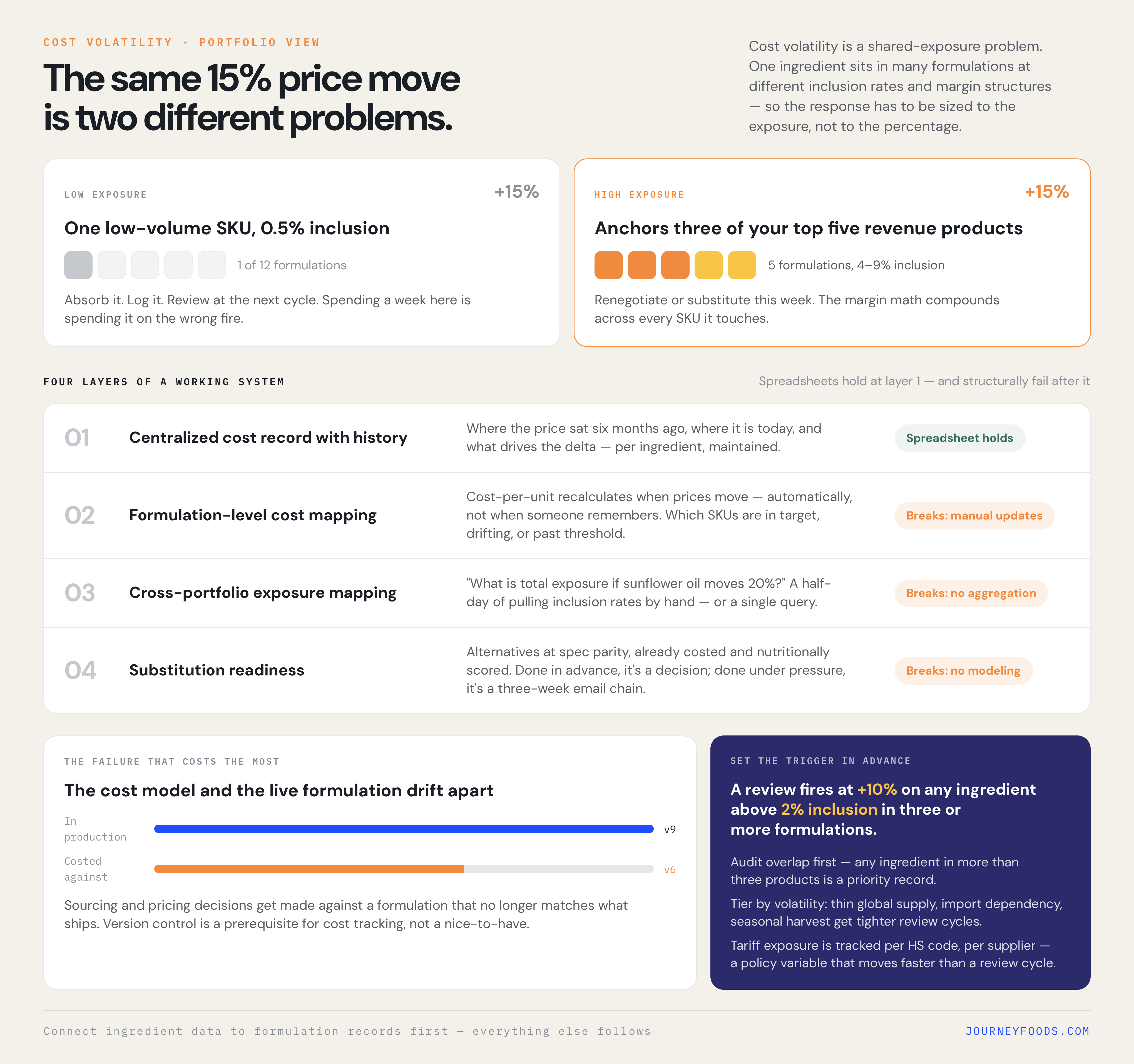
The structural failure is this: ingredient cost volatility is a shared exposure problem. A single ingredient — a specific protein isolate, a functional fiber — often appears across multiple formulations at different inclusion rates and in different roles. When its price moves, the cost impact isn't uniform. It depends on inclusion rate per product, the margin structure of each SKU, and whether a viable alternative exists at spec parity.
You can't answer those questions from a spreadsheet that tracks price history for one ingredient. You need to see that ingredient's cost history alongside every formulation it touches, with the ability to model substitutions before committing to a change.
That's the gap most teams are trying to close right now.
The Four Layers of a Working Cost Volatility Tracking System
1. A Centralized Ingredient Cost Record With History
The starting point is obvious but often skipped: every ingredient in your active portfolio needs a single, maintained cost record that tracks price over time. Not a static field in a spec sheet. A record that shows where the price was six months ago, what it is today, and what's driving the delta.
That record should include:
Without the history, you're always reacting. With it, you can start to see patterns and anticipate pressure before it lands.
2. Formulation-Level Cost Mapping
Every active formulation needs a cost model linked to live ingredient data — not a snapshot. That means cost-per-unit updates when ingredient prices update. Automatically, not because someone remembered to recalculate.
The practical output is a cost-per-formulation dashboard that shows, at any moment, which products are within target margin, which are drifting, and which have crossed a threshold that requires action.
This is where most teams fall short. Formulation records live in one system — or a folder of spec sheets — and cost data lives somewhere else. The connection between them is a manual step that happens infrequently and inconsistently.
3. Cross-Portfolio Ingredient Exposure Mapping
This is the layer that turns individual cost tracking into actual portfolio management. For every ingredient in your system, you need to know: which formulations use it, at what inclusion rate, and what the total cost exposure is across the portfolio if that ingredient's price moves by X%.
This cross-portfolio view is what lets you prioritize. Not every price movement deserves the same response. A 15% increase on an ingredient that appears in one low-volume SKU at 0.5% inclusion is a different problem than a 15% increase on an ingredient that anchors three of your top five revenue products.
Without this mapping, you'll spend time on the wrong fires.
4. Substitution Readiness
Cost volatility tracking is only useful if it connects to action. That action is usually one of three things: accept the cost increase, renegotiate with the supplier, or find an alternative at spec parity.
That third option requires knowing what alternatives exist, what they cost, how they perform nutritionally, and whether they create downstream formulation issues. Teams that have done this work in advance — before a price spike — move fast when one hits. Teams that haven't done it scramble. A three-week supplier email chain to evaluate alternatives becomes the norm instead of the exception.
Where Spreadsheet-Based Tracking Breaks Down
Spreadsheets can handle the first layer reasonably well. A maintained cost tracker with historical price data is achievable in Excel or Google Sheets, and many procurement teams run one.
The second and third layers are where spreadsheets fail structurally.
Linking formulation cost models to live ingredient data requires either manual updates — which create version-control failures — or complex formula dependencies across multiple files that break when someone edits the wrong cell. Neither is sustainable at portfolio scale.
The cross-portfolio exposure problem is worse. To answer "what is our total cost exposure if sunflower oil increases 20%?" from a spreadsheet, someone has to manually pull inclusion rates from every relevant spec sheet, calculate the impact per product, and aggregate the results. That's a half-day project. In a platform with connected formulation and ingredient data, it's a query.
The version-control failure causes the most damage. When formulation records and cost models live in disconnected files, the working version of a formulation and the version used for cost modeling diverge. You end up making sourcing decisions based on a formulation that no longer reflects what's actually in production.
What a Connected System Looks Like in Practice
Ingredient data and formulation records share a single source of truth. When a cost changes, every formulation using that ingredient reflects the update. No manual reconciliation.
Real-time supply chain alerts surface cost-relevant events — a supplier flagging allocation limits, a tariff change affecting landed cost, a harvest report pointing to a price increase next quarter. Those alerts connect to the affected ingredients and, by extension, the affected formulations.
Substitution modeling is built into the workflow. When a cost threshold is crossed, the system surfaces alternative ingredients scored across cost, nutrition, and supply chain stability simultaneously. R&D and procurement see the same options from the same data.
Version control on formulation records means the cost model always reflects the current formulation — not a version from three iterations ago.
This is the architecture that AI-powered ingredient management platforms for CPG companies are built around today. The manual version of this system exists — it's just expensive in time and headcount, and it still breaks at the seams.
The 2026 Tariff Factor
Ingredient cost volatility right now isn't just about commodity markets. The tariff environment has added a layer of cost exposure that's harder to model because it's policy-driven, not supply-driven — and it can change faster than a formulation review cycle.
For CPG teams sourcing ingredients with significant import exposure — specialty proteins, certain functional ingredients, packaging components — cost tracking now includes monitoring tariff status on specific HS codes and understanding which suppliers are absorbing tariff costs versus passing them through.
That's a procurement problem that requires ingredient-level data. You can't manage tariff exposure at the category level when your formulations are built at the ingredient level.
Procurement leads dealing with this in real time are increasingly looking for platforms that connect supply chain intelligence to formulation cost modeling — not separate tools that require manual bridging.
Practical Steps to Improve Your Current System
If you're not ready to move to a connected platform immediately, here's where to start:
Audit your ingredient overlap. Pull your active formulations and identify which ingredients appear in more than three products. Those are your highest-exposure ingredients. Start there.
Build a volatility tier for your ingredient list. Not all ingredients carry the same cost risk. Commodities with thin global supply, heavy import dependency, or seasonal harvest cycles deserve closer monitoring than stable, domestically sourced inputs. Tier your list and set review frequencies accordingly.
Establish cost thresholds that trigger action. Define in advance what a "material" cost change looks like for your portfolio — say, a 10% increase on any ingredient with more than 2% inclusion across three or more formulations. When that threshold is crossed, it triggers a review. Not a surprise.
Document your substitution options before you need them. For your ten highest-exposure ingredients, identify at least one alternative at spec parity and maintain a current cost estimate for it. This is the work that pays off when a price spike hits.
Connect your formulation records to your cost model. Even in a spreadsheet environment, make sure the formulation version used for cost modeling matches the current working version. A simple version-date field and a review protocol can prevent the most common failure mode.
For teams managing more than five active formulations, these manual steps get unwieldy fast. That's the point where food ingredient cost optimization becomes a platform question, not a process question.
How Journey Foods Addresses This Problem
Journey Foods is built around the connection between ingredient intelligence and formulation management that makes portfolio-level cost tracking possible. The Operations Scientist AI engine scores ingredients across cost, nutrition, and sustainability simultaneously — so when you're evaluating a substitution driven by cost pressure, you're not making a trade-off blind.
The platform's centralized portfolio dashboard shows active formulations with cost models connected to live ingredient data. Real-time supply chain alerts surface cost-relevant events — supplier allocation changes, tariff impacts, availability flags — before they become formulation emergencies.
Version-controlled formulation records mean the cost model always reflects the current formulation. R&D, procurement, and finance work from the same data, which eliminates the version-control failures that make cost tracking unreliable in spreadsheet-based workflows.
If you're evaluating whether a connected platform makes sense for your team, the 10 questions to ask before choosing a food formulation software platform is a useful starting point for structuring that decision.
Pricing starts at $199/month for individual users, with team and enterprise tiers available. Explore the platform and book a demo at journeyfoods.io.
FAQs
What is ingredient cost volatility tracking in CPG?
It's the practice of monitoring price changes for raw materials and ingredients across your active formulation portfolio — so you can identify cost exposure, model the impact of price changes on product margins, and make sourcing decisions before a cost spike becomes a margin problem.
Why is tracking ingredient costs at the portfolio level different from tracking them per product?
Per-product tracking shows you the impact of a price change on one SKU in isolation. Portfolio-level tracking shows total exposure across every formulation that uses a given ingredient, weighted by inclusion rate and product volume. That aggregate view is what lets you prioritize which cost changes actually require action.
What causes ingredient cost volatility in food and CPG?
The main drivers are commodity market fluctuations, harvest variability, logistics and freight cost changes, tariff and trade policy shifts, supplier capacity constraints, and currency exchange rates for imported ingredients. The current tariff environment has added a policy layer on top of the traditional supply-demand drivers.
How do formulation version-control failures create cost tracking problems?
When a formulation is updated but the cost model isn't, the cost data reflects an older version of the product. Sourcing and pricing decisions get made against a formulation that no longer matches what's in production. This is one of the most common — and costly — failures in spreadsheet-based workflows.
What should trigger a formulation cost review?
A useful rule of thumb: any ingredient price change above 10% on an input with more than 2% inclusion across multiple formulations should trigger a review. Supply chain alerts — allocation limits, tariff changes, supplier disruptions — should also trigger a review before a price change is confirmed, because they signal incoming cost pressure.
How do R&D and procurement teams stay aligned on ingredient cost changes?
The most reliable method is a shared platform where both teams work from the same ingredient data and formulation records. When cost data and formulation data are centralized, a price change is visible to both teams simultaneously — and substitution modeling happens collaboratively instead of through email chains.
What's the difference between a cost tracker and a formulation cost model?
A cost tracker records ingredient prices over time. A formulation cost model connects those prices to the inclusion rates in a specific product, calculating cost-per-unit as ingredient prices change. That model is only useful if it stays connected to the current version of the formulation — which is why version control is a prerequisite, not a nice-to-have.
Cost volatility isn't going to stabilize. The tariff environment, ongoing supply chain fragility, and commodity market swings mean ingredient prices will keep moving in ways that are hard to predict. The teams that manage this well aren't the ones with the most sophisticated forecasting models. They're the ones with the tightest connection between their ingredient data and their formulation records — so when something moves, they know immediately what it affects and what they can do about it.
Build that connection first. Everything else follows.