.svg)
.svg)
.svg)
.svg)


.svg)
Ingredient costs are one of the few line items in food manufacturing where smart decisions compound fast. A 5% reduction in one high-volume ingredient doesn't just save money this quarter — it shifts your unit economics across every SKU that uses it.

.svg)
Yet most CPG teams still approach ingredient cost optimization the way they did a decade ago: spreadsheets, supplier calls, manual research, and gut instinct. That process is slow, opaque, and expensive.
Here's what R&D teams, food scientists, and procurement leads are actually doing in 2026 to cut ingredient costs — without touching nutrition, clean-label positioning, or product performance.
The sticker price is the easy part. The real cost includes sourcing time, reformulation risk, regulatory compliance, and the opportunity cost of slow decisions.
When a supplier raises prices or a commodity spikes, you're facing a choice: absorb the margin hit, rush a substitution, or delay a launch. None of those are good options. The teams that handle it best aren't just reacting faster — they have better information before the crisis hits.
Supply chain volatility is now the baseline, not the exception. Climate disruptions, geopolitical shifts, and logistics constraints have made single-source dependency a liability. Cost optimization in 2026 means building flexibility into your formulations from the start, not scrambling to find it after the fact.
There's no single fix. Sustainable cost reduction comes from pulling multiple levers at once, each reinforcing the others.
The most direct path to savings is replacing a high-cost ingredient with a functionally equivalent one. The challenge is that "equivalent" is doing a lot of work in that sentence.
A viable substitute has to match on:
The research burden is significant. A developer evaluating five potential substitutes for a single ingredient has to cross-reference nutrition databases, supplier availability, cost data, and formulation history — often across disconnected tools and documents.
Journey Foods addresses this directly. The platform's ingredient search and scoring system evaluates candidates across nutrition, cost, and sustainability simultaneously, so you're not optimizing one dimension while unknowingly degrading another. One CPG team using the platform cut ingredient research time by 64% — time that had previously gone to manual research and cross-team back-and-forth.
Sometimes the cost problem isn't the ingredient itself — it's the usage rate. Small formulation adjustments can reduce the quantity of an expensive ingredient without affecting the finished product.
This is especially common with functional ingredients: stabilizers, emulsifiers, flavor compounds, and fortification blends. A 10% reduction in usage rate on a high-cost functional ingredient can move COGS meaningfully at scale.
Formulation efficiency work requires version-controlled development history. If you can't trace what changed between formulation v3 and v7, you can't improve systematically. This is one of the most underrated reasons to move off spreadsheets — not just for collaboration, but for institutional memory.
Single-source dependency is a cost problem as much as a risk problem. When you have one approved supplier for a critical ingredient, you have no negotiation leverage and no fallback when prices move.
Diversifying your approved supplier list — even to two or three vetted options — changes the dynamic entirely. You can benchmark pricing, create competitive tension, and qualify a backup before you need one under pressure.
The upfront investment in supplier qualification is almost always lower than the cost of an emergency reformulation or a margin hit absorbed under duress.
Reactive cost management is expensive. By the time a price spike or shortage reaches your procurement team through a supplier email, you've already lost the window to act strategically.
Teams that build proactive monitoring into their workflow — tracking commodity trends, supplier alerts, and availability signals — can make substitution or sourcing decisions before they become urgent. That lead time is worth real money.
This is where AI-powered supply chain tools create measurable advantage. Automated alerts for supply chain risks give R&D and procurement teams the information they need to act early, not after the fact.
Here's a number worth sitting with: 28% cost savings is achievable for CPG teams that optimize ingredient selection systematically. But that figure assumes you can actually execute the research fast enough to act on it.
Most teams can't. Not because they lack expertise — because the research infrastructure is broken. Developers spend hours cross-referencing supplier catalogs, nutrition databases, and internal spec sheets. Work that should take minutes.
Slow research has a direct cost. It delays launches, limits the number of substitution options you can realistically evaluate, and creates pressure to default to familiar (often more expensive) ingredients simply because there's no time to vet alternatives.
Speed and quality aren't in tension here. Better tooling means you can evaluate more options, faster, with more confidence in the data.
One of the harder optimization problems right now is finding cost-effective substitutes that also maintain clean-label positioning. Consumers and retailers have raised the bar on ingredient transparency, and "cheaper but synthetic" is rarely an acceptable trade.
This is where substitution research gets genuinely complex. You're not just looking for a functional match — you're looking for a functional match that's recognizable, minimally processed, and ideally shorter on the ingredient deck.
The clean-label ingredient market has matured considerably. There are more viable natural alternatives to synthetic stabilizers, colorants, and preservatives than there were five years ago. The challenge is knowing where to look and how to evaluate them efficiently.
For a closer look at the substitution logic without compromising product performance, the clean-label formulation guide on the Journey Foods blog covers this in detail.
Sustainable sourcing and cost optimization used to feel like competing priorities. That's less true now.
Ingredients with shorter, more transparent supply chains often carry more stable pricing. Locally or regionally sourced materials are less exposed to long-haul logistics costs and currency volatility. Suppliers with strong sustainability practices tend to have better operational discipline — which usually translates to more consistent quality and fewer supply disruptions.
This doesn't mean every sustainable ingredient is cheaper. But sustainability data is useful cost intelligence, not just a marketing consideration. Teams that factor sustainability metrics into ingredient decisions are often making better long-term cost calls at the same time.
One-off cost reductions don't compound. A repeatable process does.
The teams that consistently hit cost targets without quality regressions tend to share a few operational characteristics:
That last point matters more than most teams realize. When procurement is brought in after a formulation is finalized, their only lever is price negotiation. When they're involved during development, they can influence ingredient selection — and that's where the real cost leverage lives.
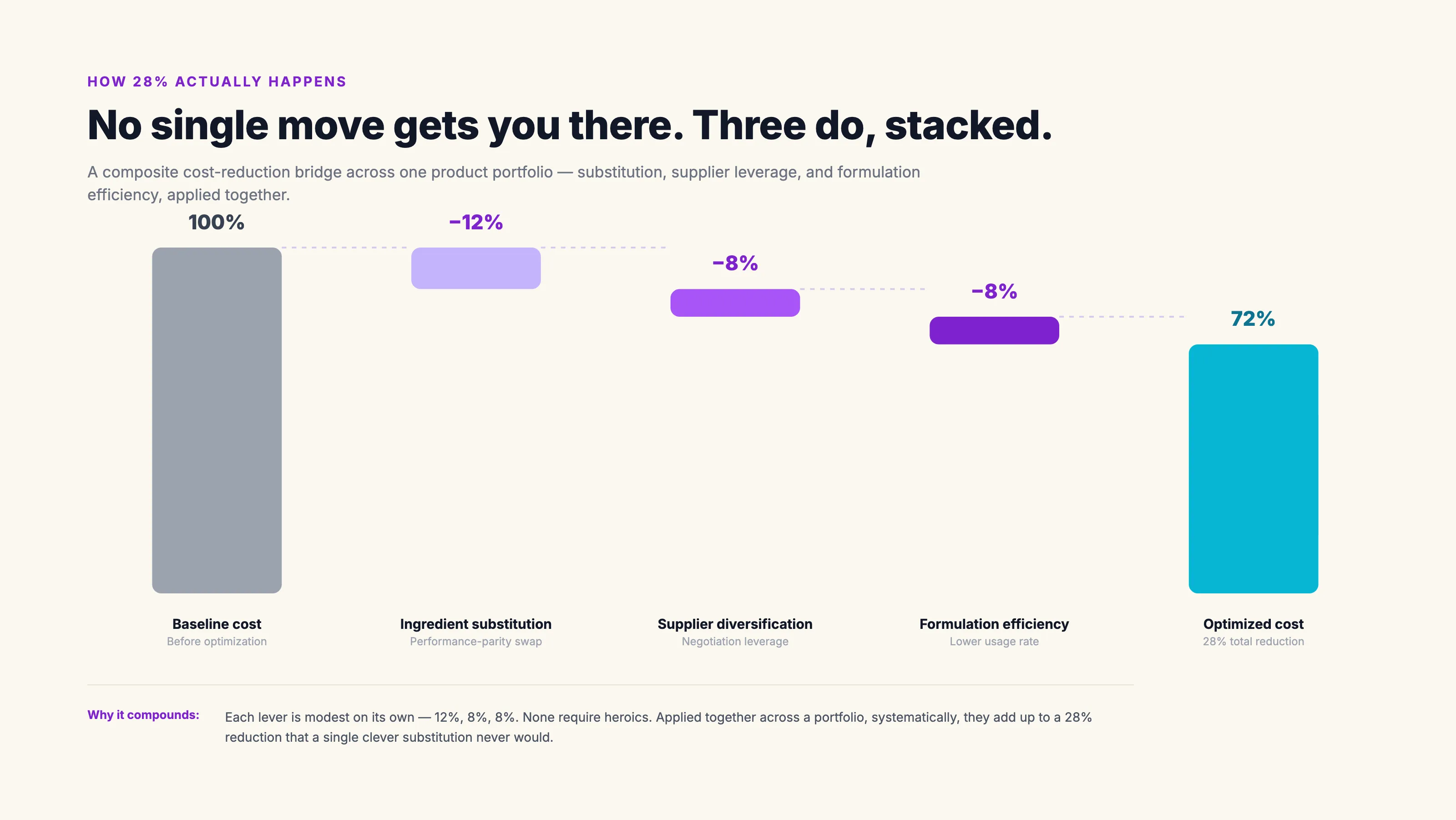
A 28% reduction in ingredient costs doesn't happen in one decision. It accumulates across a portfolio.
It might look like: a 12% reduction from substituting a high-cost functional ingredient with a clean-label alternative; an 8% reduction from qualifying a second supplier and negotiating on volume; another 8% from formulation efficiency work that trims usage rates on two expensive components.
None of those moves are dramatic. All of them require good data, fast research, and cross-functional coordination. That's the actual work of ingredient cost optimization — not a single clever substitution, but a systematic process applied consistently across your product portfolio.
Journey Foods is built for exactly this kind of work. The platform gives R&D and procurement teams a shared environment for ingredient discovery, scoring, supplier monitoring, and formulation management — so the process is repeatable, not dependent on individual heroics.
If you want to see how it works against your own product categories, book a demo and walk through a live use case.
What is food ingredient cost optimization?
It's the process of reducing raw material costs in food formulations without compromising product quality, nutritional profile, regulatory compliance, or consumer perception. In practice, it involves ingredient substitution, formulation efficiency, supplier diversification, and proactive supply chain monitoring — usually in combination.
How much can CPG companies realistically save through ingredient cost optimization?
Savings vary by product category, portfolio size, and how systematically the process is applied. Teams using data-driven ingredient research and supply chain monitoring have achieved cost reductions around 28% — accumulated across substitution decisions, supplier negotiations, and formulation efficiency improvements rather than from any single change.
What's the difference between ingredient substitution and reformulation?
Ingredient substitution replaces one ingredient with a functionally equivalent alternative, typically with minimal changes to the rest of the formula. Reformulation is broader — it may involve changing multiple ingredients, adjusting ratios, or rethinking the product's nutritional or functional profile. Both can drive cost savings, but reformulation carries more development risk and requires more rigorous testing.
How do you maintain clean-label positioning while cutting ingredient costs?
Focus substitution research on natural, recognizable alternatives to synthetic additives and functional ingredients. The clean-label ingredient market has expanded considerably, making it more feasible to find cost-effective options that also meet transparency standards. Scoring candidates across cost, function, and label-friendliness simultaneously — rather than sequentially — helps avoid trade-offs.
What role does supplier diversification play in cost optimization?
Multiple approved suppliers for critical ingredients creates negotiation leverage and reduces exposure to price spikes from single-source dependency. Even qualifying one backup supplier changes your position significantly. The upfront qualification cost is almost always lower than the cost of an emergency substitution or an absorbed margin hit.
How does AI help with ingredient cost optimization?
AI-powered platforms compress the research phase of ingredient substitution significantly — evaluating candidates across nutrition, cost, sustainability, and functional criteria in parallel rather than sequentially. They can also monitor supply chain signals proactively, giving teams lead time to act before a price spike or shortage becomes a crisis.
What data should CPG teams track to support ongoing cost optimization?
The numbers that matter most: ingredient unit costs and price trends by supplier, formulation version history with cost-per-unit calculations, supply chain risk signals for key ingredients, nutritional and functional performance data for substitution candidates, and sustainability metrics that correlate with supply stability. Centralizing this data in one platform — rather than across spreadsheets and email — is what makes the process repeatable.
Ingredient cost optimization isn't a project you finish. It's a capability you build. The teams that do it well have better data, faster research, and tighter coordination between R&D and procurement — and they apply that combination consistently across their portfolio.
The tools to get there exist now. The question is whether your process is built to use them.
We'd love to hear what cost challenges your team is working through. Connect with us on LinkedIn or drop your questions in the comments below.

Structured Q&A marked up with FAQ Page schema so it can be surfaced and cited by Al engines and search.
In Journey Al's 12 month dataset, the median plant protein reformulation came in -6.5% on raw material cost versus an animal protein control the first year that line went negative, driven by Tier 1 isolate suppliers reaching spec parity.
In Journey Al's 12 month dataset, the median plant protein reformulation came in -6.5% on raw material cost versus an animal protein control the first year that line went negative, driven by Tier 1 isolate suppliers reaching spec parity.
In Journey Al's 12 month dataset, the median plant protein reformulation came in -6.5% on raw material cost versus an animal protein control the first year that line went negative, driven by Tier 1 isolate suppliers reaching spec parity.