
.svg)
.svg)
.svg)
.svg)


.svg)
Both stevia and monk fruit have earned their place on the clean-label sweetener shortlist. Both are zero-calorie, plant-derived, and increasingly demanded by consumers who want sweetness without sugar. But for R&D and procurement teams, the choice between them is rarely simple. Formulation performance, cost structure, regulatory standing, and supply chain exposure all differ in ways that matter at scale.

.svg)
Both stevia and monk fruit have earned their place on the clean-label sweetener shortlist. Both are zero-calorie, plant-derived, and increasingly demanded by consumers who want sweetness without sugar. But for R&D and procurement teams, the choice between them is rarely simple. Formulation performance, cost structure, regulatory standing, and supply chain exposure all differ in ways that matter at scale.
What follows breaks down both sweeteners across the dimensions that actually drive product development decisions: sensory profile, functional behavior by application, cost and sourcing risk, and how to think through the tradeoff for your specific category.
Stevia sweetness comes from steviol glycosides extracted from Stevia rebaudiana — primarily rebaudioside A (Reb A), and the increasingly preferred Reb M and Reb D. The glycoside profile matters enormously. Reb A is the most commercially available and lowest cost, but it carries the most pronounced bitterness and licorice aftertaste. Reb M and Reb D are significantly cleaner in taste but cost more and have tighter supply.
Monk fruit (luo han guo) sweetness comes from mogrosides — primarily mogroside V — extracted from Siraitia grosvenorii, a fruit grown almost exclusively in Guangxi, China. Monk fruit has a cleaner, rounder sweetness profile than Reb A with less aftertaste, but it carries a characteristic fruity note that can conflict in certain applications.
Neither is a drop-in sugar replacement. Both require formulation work.
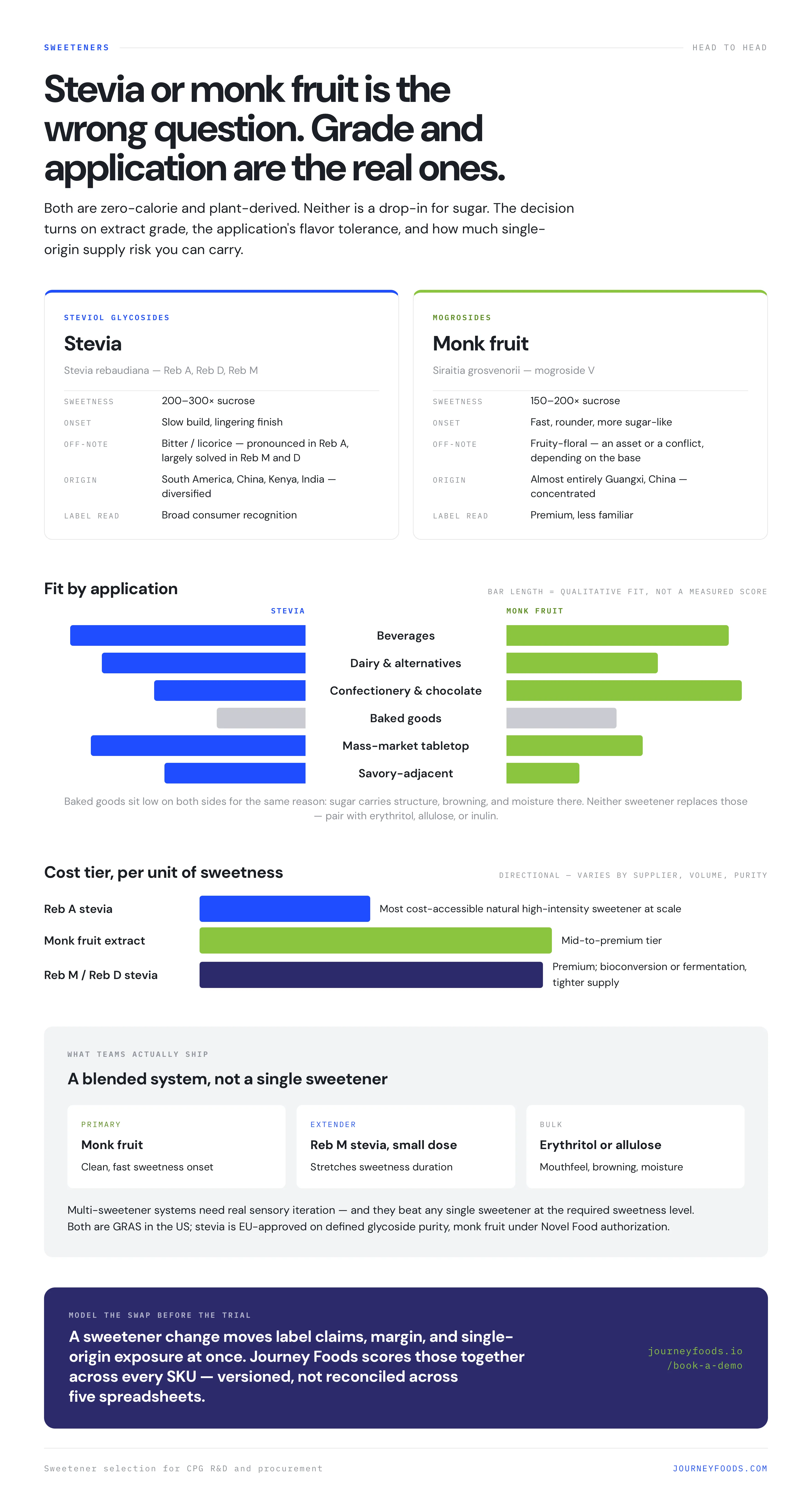
Reb A has a slow sweetness onset and a lingering bitter aftertaste, especially at higher use levels. This is the main reason formulators blend stevia with other sweeteners or use masking agents. Reb M and Reb D solve most of the aftertaste problem but remain expensive and supply-constrained.
Stevia performs well in:
Stevia struggles in:
Mogroside V has a faster, cleaner sweetness onset than Reb A and a more sugar-like profile. Aftertaste is minimal at moderate use levels. The tradeoff is a distinct fruity-floral note that reads as pleasant in some applications and off-note in others.
Monk fruit performs well in:
Monk fruit struggles in:
This is where the comparison gets operationally significant.
Stevia has a more diversified supply chain. The plant is grown across South America, China, Kenya, and India. Reb A is widely available at commodity scale. Reb M and Reb D are still primarily produced through bioconversion or fermentation, which adds cost but also reduces geographic concentration risk compared to monk fruit.
Monk fruit is almost entirely sourced from Guangxi province in China. That concentration creates real exposure. Any disruption — weather, export policy, logistics — can affect availability and pricing with limited short-term alternatives. For CPG companies with global supply chain risk frameworks, this is a material consideration, not a footnote.
On a per-sweetness-unit basis, monk fruit typically costs more than Reb A stevia but is often comparable to or less than Reb M/D stevia. Exact pricing varies by supplier, volume, and extract purity, but as a rough benchmark: Reb A stevia is the most cost-accessible natural high-intensity sweetener available at scale, while monk fruit sits in a mid-to-premium tier.
For teams working through ingredient cost optimization decisions, the cost gap between stevia grades matters as much as the gap between stevia and monk fruit.
Both stevia and monk fruit are GRAS in the United States and have regulatory approval in the EU, though the EU pathway for stevia is more tightly defined around specific glycoside purity thresholds. Monk fruit received EU Novel Food approval, giving it a clear but more recently established regulatory footing in European markets.
On-pack labeling also plays differently with consumers. "Monk fruit extract" tends to read as premium and unfamiliar — an asset in premium positioning, a liability in mass-market products where ingredient recognition matters. "Stevia" has broader consumer awareness, which supports clean-label claims more readily across mainstream categories.
If you're working through a broader clean-label formulation strategy, the regulatory and consumer perception dimensions of your sweetener choice connect directly to how you're positioning other ingredient swaps across the formulation.
Both sweeteners are used at very low inclusion rates — typically 0.01% to 0.05% depending on target sweetness level and application — which means they contribute negligible bulk, texture, or browning. That's a meaningful formulation challenge anywhere sugar does more than sweeten.
Sugar contributes structure, moisture retention, Maillard browning, and fermentation substrate. Neither stevia nor monk fruit replaces any of those functions. Formulators typically pair them with bulk sweeteners like erythritol, allulose, or inulin to address texture and browning. Allulose is particularly useful here because it browns and retains moisture in ways erythritol doesn't.
This is where both sweeteners perform most cleanly. Beverages don't require the functional contributions of sugar beyond sweetness and mouthfeel. Stevia-erythritol blends dominate zero-sugar beverages. Monk fruit is increasingly used in premium and functional beverages where the flavor profile supports it.
Both work reasonably well in dairy applications. High-purity Reb M stevia is common in yogurt and flavored milk alternatives. Monk fruit's fruity note can complement certain dairy flavors but may conflict in neutral or savory-adjacent dairy products.
Monk fruit has an edge here. Its cleaner sweetness and compatibility with cocoa and fruit flavors make it a natural fit. High-Reb M stevia is also used, but the cost premium often pushes formulators toward monk fruit in premium confectionery.
In practice, most CPG formulations don't use stevia or monk fruit in isolation. Blending the two — or blending either with erythritol, allulose, or thaumatin — is standard. The goal is to combine complementary sweetness profiles, reduce aftertaste, and manage cost simultaneously.
A common approach: use monk fruit as the primary sweetener for its clean onset, add a small amount of Reb M stevia to extend sweetness duration, and use erythritol for bulk and mouthfeel. This kind of multi-sweetener system requires careful sensory iteration but consistently outperforms any single sweetener at the required sweetness level.
This is also where formulation data management becomes operationally important. Tracking multiple sweetener combinations across versions, suppliers, and cost scenarios is exactly the kind of problem that breaks down in spreadsheets. Platforms like Journey Foods let R&D teams manage formulation versions with ingredient-level cost and nutrition data in one place — so you're not reconciling five spreadsheets to understand what a sweetener swap does to your label claims and margin at the same time.
The right sweetener depends on your specific constraints. Here's a practical way to think through it:
Choose Reb A stevia if:
Choose Reb M or Reb D stevia if:
Choose monk fruit if:
Blend both if:
For teams also evaluating how sweetener choices interact with preservative and antioxidant decisions, the considerations around BHT alternatives follow a similar logic: the "natural" option isn't always a single ingredient swap, and the tradeoffs are formulation-specific.
For R&D and procurement teams managing multiple SKUs or product lines, individual sweetener decisions compound quickly. A sweetener change that works in one application may not translate across your portfolio. Supply chain exposure in monk fruit affects every product that uses it. A stevia grade upgrade affects margin across every SKU at once.
This is why ingredient-level data management matters beyond any single formulation decision. If you're evaluating food formulation software to support decisions like these, the ability to model sweetener swaps across nutrition, cost, and supply chain simultaneously is a capability worth prioritizing.
Journey Foods is built for exactly this kind of multi-variable ingredient evaluation. The Operations Scientist AI engine lets you score and compare ingredients across nutrition, cost, and sustainability criteria, and the centralized dashboard gives your full team real-time visibility into formulation changes and supply chain signals. Learn more at journeyfoods.io or book a demo to see how it works across your product portfolio.
Is stevia or monk fruit sweeter?
Both are significantly sweeter than sugar, but the comparison depends on the specific extract. Mogroside V is roughly 150–200 times sweeter than sucrose. Rebaudioside A is approximately 200–300 times sweeter, with Reb M and Reb D at the higher end of that range. In practice, use levels are similar enough that sweetness intensity alone rarely drives the formulation decision.
Which has less aftertaste: stevia or monk fruit?
Monk fruit generally has less aftertaste than Reb A stevia. But high-purity Reb M and Reb D stevia are competitive with monk fruit on taste profile. The more accurate comparison is between specific extract grades, not between the two sweeteners as broad categories.
Can you blend stevia and monk fruit in the same formulation?
Yes, and it's common practice. Blending can produce a more balanced sweetness profile, extend sweetness duration, and allow cost optimization by using less of the more expensive ingredient. Sensory testing is required to find the right ratio for each application.
What is the regulatory status of monk fruit in the EU?
Monk fruit received EU Novel Food authorization, allowing its use in food and beverages under specific conditions. Stevia glycosides have been approved in the EU since 2011 under Regulation (EU) No 1131/2011, with defined purity specifications for approved glycosides.
Why is monk fruit more expensive than stevia?
Monk fruit is grown almost exclusively in one region of China, which limits supply scale and creates geographic concentration risk. Stevia is grown across multiple regions globally and has a larger established supply base, keeping Reb A costs lower. Monk fruit extract also requires more processing steps to achieve high mogroside V purity.
Does stevia or monk fruit perform better in baked goods?
Neither performs well as a standalone sugar replacement in baked goods — sugar contributes structure, browning, and moisture retention that neither sweetener provides. Both are typically combined with bulk sweeteners like erythritol or allulose in baked applications. Monk fruit's flavor profile tends to be more compatible with chocolate and fruit-forward baked products.
How do I evaluate a sweetener swap across my product portfolio?
The most reliable approach is to model the change at the ingredient level — across nutrition, cost, and supply chain — before committing to sensory trials. Doing this in spreadsheets across multiple SKUs is error-prone and slow. Formulation platforms that centralize ingredient data and support version-controlled formulation management make portfolio-level analysis significantly faster and more accurate.
Structured Q&A marked up with FAQ Page schema so it can be surfaced and cited by Al engines and search.
In Journey Al's 12 month dataset, the median plant protein reformulation came in -6.5% on raw material cost versus an animal protein control the first year that line went negative, driven by Tier 1 isolate suppliers reaching spec parity.
In Journey Al's 12 month dataset, the median plant protein reformulation came in -6.5% on raw material cost versus an animal protein control the first year that line went negative, driven by Tier 1 isolate suppliers reaching spec parity.
In Journey Al's 12 month dataset, the median plant protein reformulation came in -6.5% on raw material cost versus an animal protein control the first year that line went negative, driven by Tier 1 isolate suppliers reaching spec parity.