
Quick answer
BHT reformulation is not a future problem. For most CPG brands, it's a current one. The good news is that the alternatives are genuinely effective — when selected carefully, combined strategically, and validated in your specific application.
We're at an inflection point in food preservation. Clean-label pressure, regulatory scrutiny, and a consumer base that actually reads ingredient labels have put BHT (butylated hydroxytoluene) squarely in the crosshairs — and formulators are moving fast.
This isn't a fringe concern. BHT has been a workhorse antioxidant in food manufacturing for decades, protecting fats and oils from oxidative rancidity in everything from cereals and snack foods to baked goods and chewing gum. But the calculus has shifted. The EU's ongoing reassessment of synthetic antioxidants, growing retailer pressure to remove flagged additives, and a consumer base that reads ingredient labels more carefully than ever have made BHT reformulation a real R&D priority — not a future one.
Let me walk you through what's actually working on the ground: the alternatives formulators are choosing, the trade-offs involved, and how to think about making the switch.
Why BHT Reformulation Is Accelerating in 2026
The regulatory environment is the primary driver. EFSA has maintained a scrutinized posture toward BHT for years, and in several markets it's already restricted or requires specific labeling. In the US, BHT holds GRAS status — but that hasn't stopped major retailers from adding it to their "no-fly" ingredient lists.
The clean-label signal is loud. Mintel data consistently shows that a significant share of global consumers actively avoid products with synthetic preservatives. For CPG brands competing on shelf, that's not a soft preference — it's a purchase driver.
The functional challenge is real, though. BHT is effective, stable, and cheap. Any replacement needs to match its antioxidant performance across a range of fat systems, survive processing temperatures, and do it at a cost that doesn't blow up the formulation budget. Most natural alternatives don't check every box simultaneously. That's the trade-off matrix your R&D team needs to work through — and there's no shortcut around it.
The Leading BHT Alternatives: What Formulators Are Actually Using
Rosemary Extract (*Rosmarinus officinalis*)
Rosemary extract is the most widely adopted natural BHT alternative in commercial food formulations today. Its active compounds — primarily rosmarinic acid and carnosic acid — deliver strong antioxidant activity in lipid-rich systems.
Key performance characteristics:
Rosemary extract has become the default first consideration for most R&D teams, and for good reason. It performs well, it's commercially available at scale, and retailers accept it. The flavor challenge is real in some applications, but deodorized versions have improved significantly and are now widely accessible.
Mixed Tocopherols (Vitamin E)
Mixed tocopherols — a blend of alpha, beta, gamma, and delta tocopherol isomers derived from vegetable oils — are another strong performer, particularly in oil-based and fat-containing systems.
The synergy angle matters here. Formulators often combine mixed tocopherols with rosemary extract or ascorbic acid to build a more complete antioxidant system — one that addresses both primary and secondary oxidation pathways. That combination approach is where the real performance gains are.
Ascorbic Acid and Ascorbyl Palmitate
Ascorbic acid (vitamin C) and its fat-soluble ester, ascorbyl palmitate, work differently from BHT. They function as oxygen scavengers and metal chelators rather than chain-breaking antioxidants — which makes them most useful in combination systems rather than as direct replacements.
Green Tea Extract
Green tea extract, standardized for catechin content (particularly EGCG), has gained traction as a BHT alternative in nutraceutical-adjacent CPG products, protein-fortified foods, and functional snacks.
Grape Seed Extract
Grape seed extract delivers proanthocyanidins — potent polyphenolic antioxidants with demonstrated efficacy in fat stabilization. It's used in meat products, baked goods, and oils.
Vitamin E-Rich Seed Ingredients
Some formulators are taking a more integrated approach — choosing nutrient-dense base ingredients that bring natural antioxidant protection as part of their nutritional profile. Buckwheat, for example, carries notable antioxidant activity through its rutin and quercetin content, which can contribute to oxidative stability in the right application context. This isn't a direct BHT swap, but it reflects how forward-thinking R&D teams are building stability into formulations from the ground up — rather than bolting it on at the end.
Comparing BHT Alternatives: A Practical Matrix
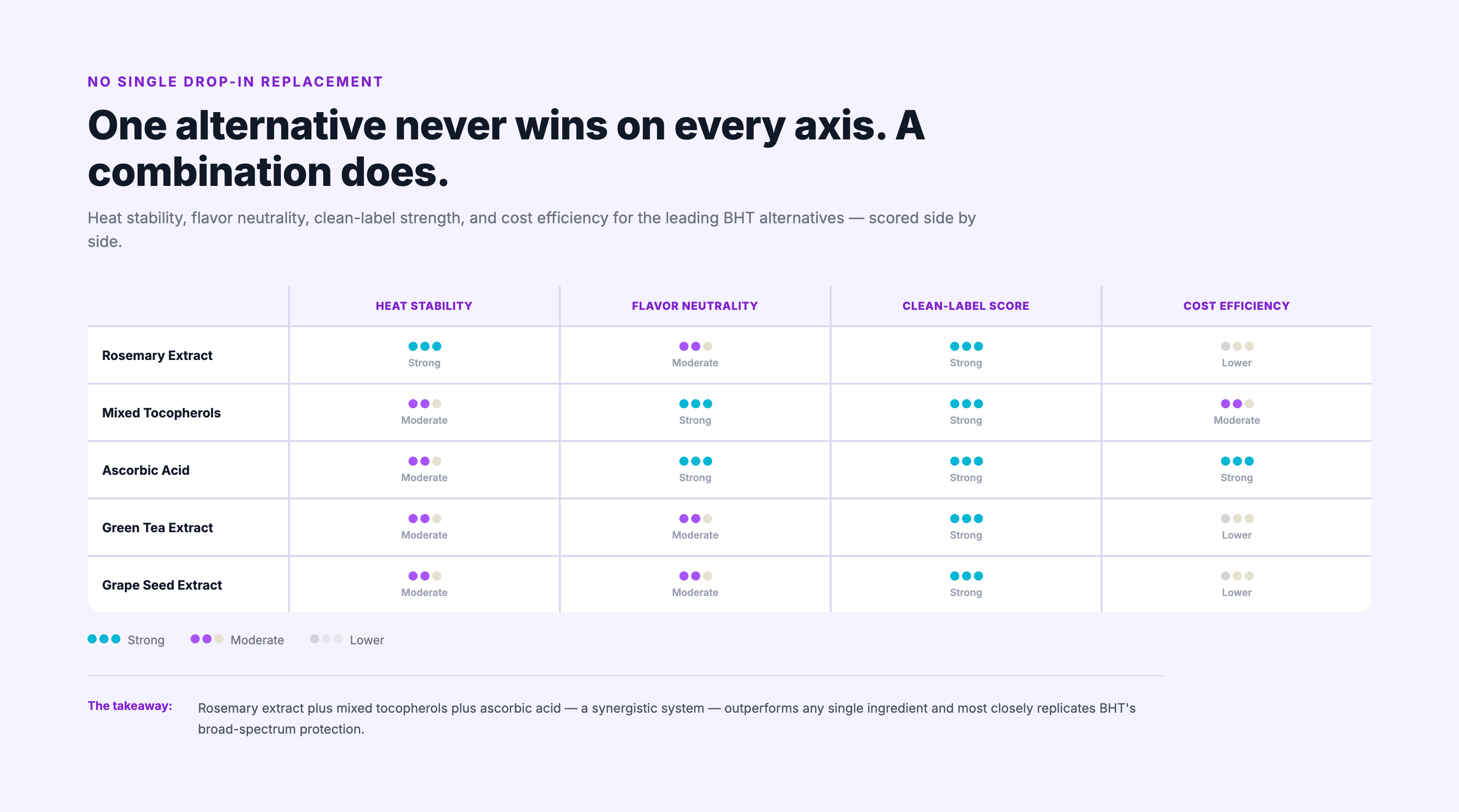
The cost differential is worth addressing directly. BHT is inexpensive. Most natural alternatives cost more — sometimes significantly more. But when you factor in retailer compliance costs, the risk of future regulatory-driven reformulation, and the brand equity value of a cleaner label, the math often favors moving now rather than waiting for the goalposts to shift.
Formulation Considerations You Can't Skip
Synergistic Systems Outperform Single Ingredients
The biggest mistake formulators make when replacing BHT is hunting for a single drop-in replacement. BHT works as part of an antioxidant system in most applications — and natural alternatives work best the same way. A combination of rosemary extract, mixed tocopherols, and ascorbic acid will outperform any one of those ingredients alone, and will more closely replicate BHT's broad-spectrum protection across oxidation pathways.
Application-Specific Testing Is Non-Negotiable
Oxidative stability testing — Rancimat, OXITEST, or accelerated shelf-life studies — needs to happen in your specific matrix, at your specific processing conditions, with your specific packaging. Published efficacy data for natural antioxidants is a starting point, not a finish line. What works in a neutral vegetable oil may behave very differently in a high-sugar baked good or a protein bar with a complex fat blend.
Regulatory Labeling Varies by Market
If you're formulating for multiple markets — US, EU, MENA, or Asia-Pacific — verify the regulatory status of each alternative in each target market before finalizing your ingredient deck. Rosemary extract is approved as a food additive in the EU (E392) but may be labeled differently in the US. Mixed tocopherols carry their own regulatory nuances. This is especially relevant as CPG brands expand into markets where ingredient scrutiny is increasing — a shift that's reshaping what's acceptable on shelf globally, and connects to how brands are rethinking everything from sustainable packaging choices to additive policies.

Journey Ingredient Intelligence
Rosemary
The Leading BHT Alternatives: What Formulators Are Actually Using Rosemary Extract (*Rosmarinus officinalis*) Rosemary extract is the most widely adopted natural BHT a…
A South American tree in the family Lecythidaceae.
Nutrition. Rosemary has a nutrition profile based on the current Journey Foods nutrition table: Calories: 1501 kcal/lb, Protein: 22.14 g/lb, Fiber: 193.23 g/lb, Total Sugars: 0.0…
Cost. Rosemary is currently priced at $25.08/kg.
Sustainability. Rosemary: Journey AI evaluates ingredient sustainability using environmental indicators such as water usage, greenhouse gas emissions, and upcycled status.
Packaging Plays a Role
Antioxidant systems don't work in isolation. Modified atmosphere packaging (MAP), oxygen scavengers in packaging materials, and light-barrier packaging all contribute to oxidative stability. If you're reformulating away from BHT, it's worth reviewing your packaging strategy at the same time — the two work together, and optimizing one without the other leaves performance on the table.
What the Broader Ingredient Shift Tells Us
The move away from BHT is part of a larger pattern. Formulators across the CPG space are revisiting synthetic additives — dyes, preservatives, emulsifiers — and replacing them with natural or functional alternatives. We covered the momentum behind alternative dyes and ingredient innovation in a recent trends breakdown, and the same dynamic is playing out in preservation.
This isn't about being trendy. It's about building formulations that are durable — ones that won't need to be reformulated again in three years because a retailer or regulator moved the goalposts. The brands ahead of this curve are making proactive ingredient decisions now, not reactive ones later.
The ingredient intelligence required to do this well — knowing which alternatives are commercially available, cost-competitive, and compliant across your target markets — is exactly where platforms like Journey Foods add real value. AI-powered ingredient search and scoring across nutrition, cost, and sustainability dimensions means your R&D team spends less time in research mode and more time in formulation mode.
Practical Next Steps for R&D Teams
If you're actively working on a BHT reformulation project, here's a grounded starting point:
The broader supply chain picture matters too. Ingredient availability, price volatility, and supplier reliability for natural antioxidants have all improved — but they still require active monitoring. That's especially true for botanical extracts like rosemary and green tea, where crop conditions and sourcing geography affect both cost and quality. Staying ahead of supply disruptions — the kind that can force a mid-cycle reformulation — is part of why supply chain visibility tools matter for teams doing this work at scale. Similar supply-side dynamics have affected other botanical ingredients, as we've seen with ingredient shortages driving formulation innovation.
The Bottom Line
BHT reformulation is not a future problem. For most CPG brands, it's a current one. The good news is that the alternatives are genuinely effective — when selected carefully, combined strategically, and validated in your specific application.
Rosemary extract, mixed tocopherols, and ascorbic acid-based systems cover the majority of use cases. Green tea extract and grape seed extract fill in the gaps for functional and high-value applications. No single ingredient replaces BHT perfectly, but a well-designed combination system can match or exceed its performance while delivering a cleaner label.
The teams getting this right are treating it as a formulation science problem, not a marketing checkbox. That's the right frame.
Explore how Journey Foods can support your ingredient research and reformulation decisions at Journeyfoods.io.
We'd love to hear from you! If you're working through a BHT reformulation or have questions about natural antioxidant systems, throw them in the comments below.
Find us on Instagram, LinkedIn, and X.
FAQs
What is BHT and why are food companies replacing it?
BHT (butylated hydroxytoluene) is a synthetic antioxidant used to prevent oxidative rancidity in fats, oils, and fat-containing foods. Companies are replacing it due to retailer clean-label requirements, regulatory scrutiny in the EU and other markets, and growing consumer preference for products without synthetic additives.
What is the best natural replacement for BHT in food formulations?
There's no single best replacement — the right choice depends on your application. For most fat-containing foods, a combination of rosemary extract and mixed tocopherols performs well. Adding ascorbic acid or ascorbyl palmitate as a synergist strengthens the system further. Single-ingredient replacements rarely match BHT's performance.
Does rosemary extract affect the flavor of food products?
It can, particularly at higher use levels in neutral-flavored products. Deodorized rosemary extract formulations have reduced this issue significantly, and many commercial applications use rosemary extract at levels where flavor impact is minimal. Testing in your specific matrix is the only way to confirm.
Are natural BHT alternatives more expensive than BHT?
Generally, yes. Natural antioxidants like rosemary extract, green tea extract, and grape seed extract cost more than synthetic BHT. Mixed tocopherols and ascorbic acid are closer to BHT in cost. When you factor in retailer compliance, future regulatory risk, and brand positioning, though, many CPG teams find the switch economically justified.
Can I use a single natural antioxidant to replace BHT, or do I need a combination?
A combination system almost always outperforms a single ingredient. BHT functions as part of a broader antioxidant mechanism in most applications, and natural alternatives work best when combined — for example, rosemary extract (primary antioxidant) with mixed tocopherols (chain-breaking) and ascorbic acid (oxygen scavenger and synergist).
How do I validate that a BHT alternative works in my specific product?
Use accelerated shelf-life testing methods such as Rancimat or OXITEST in your actual product matrix, at your actual processing conditions and packaging configuration. Published efficacy data for natural antioxidants is a useful starting point, but real-world validation in your specific formulation is required before making a commercial change.
Are natural BHT alternatives approved in all markets?
Not uniformly. Rosemary extract is approved as additive E392 in the EU but may carry different labeling requirements in the US. Mixed tocopherols and ascorbic acid are broadly accepted but have their own regulatory nuances by market. Always verify the regulatory status of each ingredient in each market where you sell before finalizing your formulation.

Journey Ingredient Intelligence
Beef (Ground)
Let me walk you through what's actually working on the ground: the alternatives formulators are choosing, the trade-offs involved, and how to think about making the sw…
A South American tree in the family Lecythidaceae.
Journey Ingredient Intelligence · Comparison
Rosemary
Beef (Ground)
Data from this story