
.svg)
.svg)
.svg)
.svg)


.svg)
Fragmented ingredient data doesn't announce itself. It shows up as a missed launch window, a reformulation that drags three weeks past deadline, or a supply disruption nobody caught because the alert was buried in someone else's inbox.
If you're leading R&D or product development at a mid-market CPG brand, you've felt this. The data exists. It's just scattered across spreadsheets, supplier PDFs, nutrition calculators, and email threads that no single person can fully reconstruct.
This framework gives you a practical audit to identify exactly where fragmentation is costing you time, money, and product quality — and what to prioritize first.
Most R&D teams underestimate these costs because the losses are distributed across the organization and rarely land in a single line item.
Time cost. Ingredient research that should take hours takes days when your team is cross-referencing supplier sheets, internal databases, and third-party nutrition tools that don't talk to each other. One CPG brand cut ingredient research time by 64% after consolidating that process into a single platform. The implication is straightforward: the status quo is expensive.
Quality cost. When nutrition, cost, and sustainability data live in separate systems, you optimize for one dimension at a time. You hit your protein target, then discover the ingredient blows your cost-per-serving. You find a clean-label alternative, then learn it carries single-source supply risk. Multi-criteria decisions made with single-criteria visibility produce suboptimal formulations — every time.
Coordination cost. Version confusion is a silent killer. When your food scientist is working from a different ingredient spec than your procurement manager, you don't find out until someone has already placed an order or filed a regulatory document. The rework that follows is expensive in both time and trust.
Risk cost. Reactive supply chain management is the most avoidable cost on this list. Teams without real-time ingredient availability data don't catch shortages until they're already affecting production. By then, options are limited and expensive.
Run this audit with your R&D, procurement, and supply chain leads in the room. It takes two to three hours done properly. The output is a clear picture of where your data infrastructure is working and where it's creating drag.
Start by mapping every place ingredient information currently lives in your organization.
Ask:
What good looks like: One centralized system where ingredient data — nutrition, cost, sourcing details — is updated in one place and visible to everyone.
Red flag: If the honest answer to the first question is "more than two," you have a fragmentation problem.
Formulation drift is one of the most common and costly data management failures in CPG R&D.
Ask:
What good looks like: Every formulation has a timestamped version history. Changes trigger notifications to relevant team members. Nobody is working from a stale spec.
Red flag: If version history lives in a shared Google Sheet or a folder of renamed files, you don't have version control. You have version hope.
Most R&D teams evaluate ingredients sequentially: nutrition first, then cost, then sustainability. That sequence creates rework.
Ask:
What good looks like: A single workflow that scores ingredients across all three dimensions at once — so you're making informed tradeoffs from the start, not discovering them late.
Red flag: If your team runs nutrition analysis in one tool, cost modeling in a spreadsheet, and sustainability scoring in a separate platform (or not at all), you're making decisions with incomplete information every time. Clean-label reformulation decisions, for example, require all three dimensions visible simultaneously — otherwise you risk trading one problem for another.
This is where fragmentation creates the most acute risk. A supply disruption visible three months out is a planning problem. The same disruption visible three days out is a crisis.
Ask:
What good looks like: Real-time alerts tied to your actual formulations, with AI-generated alternative ingredient recommendations ready before a disruption becomes a delay.
Red flag: If the answer to the first question is "our supplier calls us" or "we check periodically," you're operating reactively. That's not a supplier problem. That's a data infrastructure problem.
Data fragmentation isn't just a technical problem. It's a communication problem. When R&D, procurement, and supply chain teams work from different data sets, alignment requires constant manual effort.
Ask:
What good looks like: One dashboard, one data set, every team member working from the same information in real time.
Red flag: If any answer involves a recurring meeting whose primary purpose is to synchronize data that should already be synchronized, you're paying a coordination tax on every product cycle.
After running through the five areas, score each one:
AreaNo IssuesMinor GapsSignificant FragmentationIngredient Data SourcesCentralized, single sourceTwo systems, mostly alignedThree or more systems, no clear ownerFormulation Version ControlTimestamped, automatedManual but consistentAd hoc, version confusion commonMulti-Criteria ScoringSimultaneous, one workflowSequential, two toolsSeparate tools, no integrationSupply Chain VisibilityReal-time alerts, alternatives readyPeriodic checks, some coverageReactive, no alternatives documentedCross-Functional AlignmentSingle dashboard, shared dataRegular syncs, mostly alignedFrequent reconciliation required
Two or more areas in the "Significant Fragmentation" column means your data infrastructure is actively slowing product development and increasing launch risk.
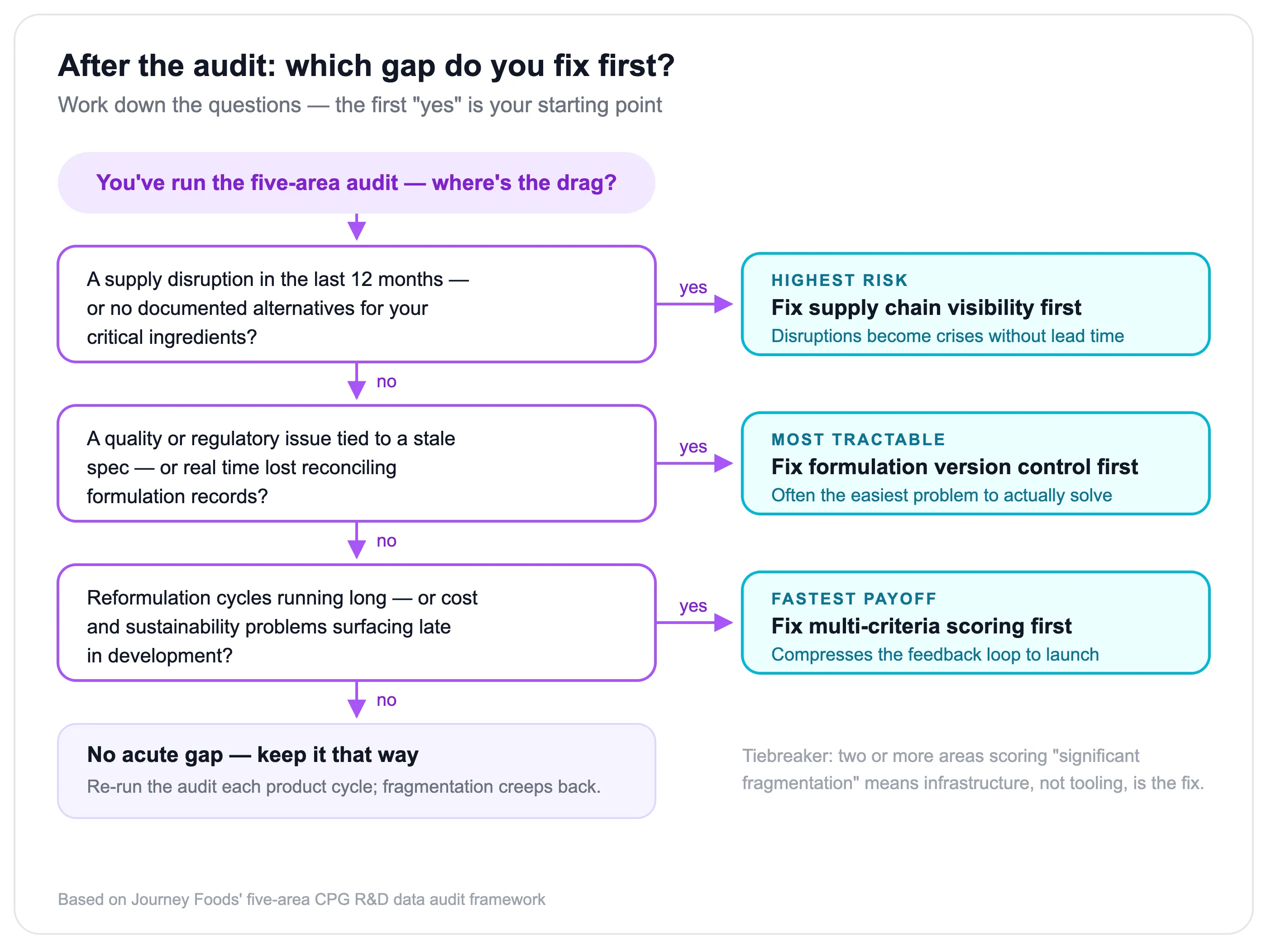
The audit tells you where the drag is. The next step is deciding which gaps to close first.
Start with supply chain visibility if you've experienced a disruption in the past 12 months or if your team has no documented alternatives for critical ingredients. This is the highest-risk gap and the one most likely to cause a visible business impact.
Start with formulation version control if you've had a quality or regulatory issue tied to a stale spec, or if your team spends meaningful time reconciling formulation records. It's often the most tractable problem to fix.
Start with multi-criteria scoring if your reformulation cycles are long or if you're regularly discovering cost or sustainability problems late in development. Compressing that feedback loop has a direct impact on time-to-launch.
For teams evaluating platform options that address all five areas in one place, this comparison of food product development platforms in 2026 is worth reviewing before making a decision.
Journey Foods is built specifically for the problems this audit surfaces.
The Operations Scientist AI engine scores ingredients across nutrition, cost, and sustainability simultaneously — so your team makes multi-criteria decisions from the start rather than discovering tradeoffs after the fact. Formulation version control is built into the platform: every change is logged, every team member works from the same data set, and there's no version confusion because there's no parallel record-keeping.
Real-time supply chain alerts are tied to your actual formulations, not generic commodity feeds. When an ingredient in your active product line shows availability risk, you get an alert and AI-generated alternative recommendations before the disruption reaches your production schedule.
Pricing runs from $199/month for solo users to $1,999/month for teams of 50, with custom enterprise pricing available. The platform is designed to sit between simple nutrition calculators and complex enterprise PLM systems — which means mid-market teams can implement it without a heavy IT lift.
See how it works at journeyfoods.io or book a demo to walk through the platform with your specific use case.
What is CPG R&D data management and why does it matter?
It's how product development teams organize, access, and act on ingredient, formulation, and supply chain data. When that data is fragmented across multiple tools, teams make slower decisions, miss supply risks, and spend more time on coordination than on actual development. Centralizing it reduces launch timelines and improves formulation quality.
How do I know if my team has a fragmented ingredient data problem?
The clearest signs: ingredient research taking days instead of hours, formulation version confusion between team members, discovering cost or sustainability issues late in the development cycle, and learning about supply disruptions from your suppliers rather than your own systems. The audit framework above gives you a structured way to assess each area.
What's the biggest risk of fragmented formulation data?
Version confusion. When R&D and procurement are working from different versions of a formulation, errors can reach production or regulatory review before anyone catches them. The rework cost — in time and regulatory exposure — is significant.
How long does a CPG R&D data audit take?
A thorough audit covering all five areas takes two to three hours with the right stakeholders in the room. R&D, procurement, and supply chain leads should all participate.
Can a mid-market CPG brand centralize ingredient and formulation data without a large IT project?
Yes. Journey Foods is specifically designed for mid-market teams that need centralized ingredient intelligence and formulation management without enterprise-scale implementation. It's SaaS-based, supports API integrations, and can be deployed without a dedicated IT team.
What's the difference between a nutrition calculator and an ingredient management platform?
A nutrition calculator tells you what's in a formulation. An ingredient management platform helps you find the right ingredients, score them across nutrition, cost, and sustainability, manage formulation versions, monitor supply chain risk, and keep your entire team aligned on a single data set. They solve different problems at different stages of product development.
How does real-time supply chain monitoring differ from standard supplier communication?
Standard supplier communication is reactive — you learn about a disruption when it's already affecting your supply. Real-time monitoring is proactive. It surfaces availability risks tied to your specific formulations before they become production problems, and pairs those alerts with AI-generated alternative ingredient recommendations.
The audit is a starting point, not a destination. Most R&D teams already know something is slowing them down. This framework names it precisely so you can fix the right thing first. If the results point to a data infrastructure problem, that's a solvable problem — and solving it has a direct impact on how fast you launch and how well your products perform.
We'd love to hear what you find. Drop questions in the comments, or book a demo to see how Journey Foods maps to your specific gaps.
Scientist. Nutrition Leader. Founder of Journey Foods