Food Supply Chain Management in 2026: Why It's the Highest-Leverage Decision in CPG


Quick answer
Your supply chain is not a logistics problem. It's a product development problem, a margin problem, and a brand reputation problem — all running simultaneously.
For CPG companies in 2026, how you manage ingredient sourcing, supplier relationships, and supply chain visibility doesn't just affect operations. It determines what products you can launch, when you can launch them, and whether you can hold your price point when input costs shift. That's why supply chain management has become the highest-leverage decision in food and beverage.
Let me walk you through exactly why that's true — and what it means for your R&D and procurement teams right now.
The Stakes Have Changed: What Supply Chain Disruption Actually Costs
The food industry spent the better part of 2022 through 2025 absorbing the downstream effects of pandemic-era supply shocks, climate-driven crop failures, and geopolitical disruptions to key commodity corridors. By 2026, those shocks aren't anomalies anymore. They're the baseline.
Ingredient price volatility is now a design constraint, not a finance problem. When your cocoa supply tightens or your oat supplier changes their minimum order quantity mid-cycle, your formulation team pays the price — in reformulation time, in delayed launches, and in margin compression that shows up quarters later.
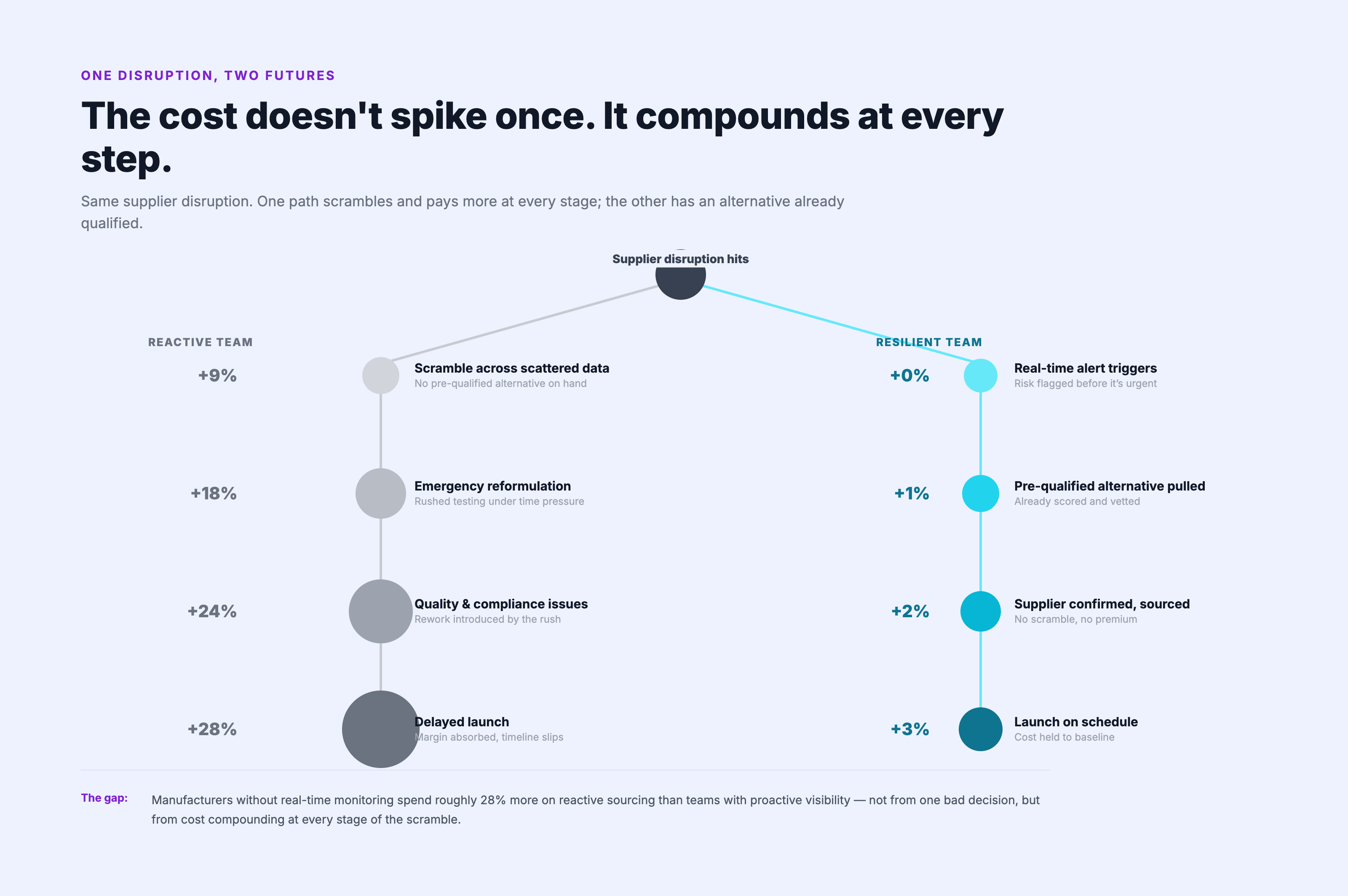
The numbers tell the story: food manufacturers without real-time supply chain monitoring spend 28% more on reactive sourcing decisions than those with proactive visibility tools. That's not a rounding error. That's the difference between a profitable SKU and one that gets quietly discontinued.
Why Supply Chain Management Is a Product Decision, Not Just an Operations Decision
Most CPG teams still treat supply chain as downstream from R&D. Product developers formulate first, then hand off to procurement to source. That sequence made sense when supply was stable and ingredient options were limited.
It doesn't make sense anymore.
Formulation and Sourcing Have to Move Together
When you formulate without real-time ingredient data — cost, availability, supplier reliability, sustainability profile — you're building on assumptions. Those assumptions get stress-tested the moment you try to scale. A clean-label protein that performs beautifully in your pilot batch may have a single-source supplier with a six-month lead time. You find that out at exactly the wrong moment.
The smarter approach: run supply chain intelligence in parallel with formulation. That means your product developers are working with ingredient data that includes cost trends, sourcing depth, and alternative supplier options from day one — not after the handoff.
This is the core of what supply chain intelligence tools are doing to food innovation — collapsing the gap between "what we want to make" and "what we can reliably make at scale."
Ingredient Substitution Is a Strategic Capability, Not a Fallback
Companies with strong supply chain management treat ingredient substitution as a planned capability. They maintain a ranked list of alternatives for every critical input, pre-vetted for nutrition, cost, regulatory compliance, and supplier reliability.
Companies without that infrastructure treat substitution as an emergency. The R&D team scrambles, the launch timeline slips, and the reformulation often introduces new quality or labeling issues.
The difference isn't talent. It's data infrastructure.
The Sustainability Dimension: Why It's Now a Commercial Requirement
Sustainability in supply chain used to be a reporting exercise — something you documented for your ESG deck and disclosed in your annual report. That era is over.
Retail buyers at major grocery chains now require supplier sustainability documentation as a condition of shelf placement. Foodservice operators face the same pressure from institutional clients. And consumers — particularly in the 18-to-35 demographic — actively cross-reference brand claims against third-party data when they can find it.
Your supply chain decisions have direct commercial consequences. Sourcing from suppliers with poor environmental or labor practices isn't just an ethics issue — it's a shelf-placement risk and a brand liability.
The path forward is building supplier relationships that prioritize sustainability outcomes — not as a values statement, but as a sourcing standard with measurable criteria. Traceability, carbon footprint per ingredient, water usage intensity, and fair labor certifications are becoming table-stakes data points in supplier evaluation.
Packaging decisions sit in the same frame. Reducing single-use plastics in food packaging is no longer a niche differentiator — it's a procurement and design requirement that flows directly from supply chain strategy.
Risk Management: The Compounding Cost of Reactive Supply Chains
Here's what a reactive supply chain actually looks like on the ground:
Each step compounds the cost. And it's almost entirely preventable with proactive monitoring.
Proactive supply chain management means you know about a supplier risk before it becomes a sourcing emergency. You have pre-qualified alternatives ready. Your R&D team isn't the last to know when a critical input is under pressure.
This is why supply chain monitoring — real-time alerts on ingredient availability, price movement, and supplier status — has become a core R&D infrastructure requirement, not just an operations nice-to-have.
What AI-Powered Supply Chain Management Actually Changes
The practical shift in 2026 is that AI tools have made supply chain intelligence accessible at a granularity that wasn't viable even three years ago. You no longer need a dedicated data science team to run scenario modeling on ingredient substitutions or to flag supplier concentration risk across your portfolio.
A CPG brand that cut ingredient research time by 64% using AI-powered ingredient intelligence didn't do it by hiring more researchers. They did it by giving their existing team better data, faster.
That's the actual value proposition: compress timelines by removing the manual research burden from your product developers and procurement leads so they can focus on decisions, not data collection.
At Journey Foods, the platform is built around exactly this problem — ingredient search and scoring across nutrition, cost, and sustainability dimensions; AI-powered recommendations for formulation improvement; supply chain monitoring with proactive alerts. All of it centralized so your team isn't working from disconnected spreadsheets and email threads.
The goal is a shared data layer for R&D and procurement — so formulation decisions and sourcing decisions happen in the same context, not in separate silos.
The Competitive Gap Is Widening
This is the part that should concern you if your supply chain management is still largely manual or reactive.
Companies that have invested in supply chain intelligence are compressing product development timelines, holding margins more effectively under input cost pressure, and meeting retailer sustainability requirements without scrambling. Companies that haven't are absorbing those costs in slower launches, higher reformulation spend, and reactive sourcing premiums.
The gap between those two groups is widening. It was a competitive advantage in 2023. By 2026, it's becoming a structural disadvantage for teams that haven't caught up.
Supply chain management isn't the unsexy back-office function it was once treated as. It's where product strategy meets operational reality. Get it right, and you compress timelines, protect margins, and build the kind of ingredient intelligence that lets you move fast when the market shifts.
Get it wrong, and every other investment in your product development process is working against a headwind.
Want to see how Journey Foods approaches supply chain intelligence for CPG teams? Explore the platform at Journeyfoods.io or book a demo to see the ingredient monitoring and formulation tools in action.
We'd love to hear how your team is thinking about supply chain risk in 2026. Throw your questions in the comments or find us on LinkedIn.
Frequently Asked Questions
Why is food supply chain management important for CPG companies?
Food supply chain management directly affects product cost, launch timing, formulation quality, and brand reputation. For CPG companies, supply chain decisions determine which products can be scaled, at what margin, and whether ingredient availability constraints derail development timelines. It's not a back-office function — it's a core product strategy decision.
How does supply chain disruption affect food product development?
When ingredient supply is disrupted, product developers are forced into reactive reformulation — adding weeks or months to launch timelines and often introducing new quality or compliance issues. Companies without proactive supply chain monitoring absorb these costs repeatedly, while teams with real-time visibility can respond before disruptions become emergencies.
What is the role of AI in food supply chain management?
AI tools can monitor ingredient availability, flag supplier risks, score ingredients across cost and sustainability dimensions, and recommend alternatives — all in real time. This compresses the research and decision-making cycle that used to require manual analysis across multiple data sources, freeing R&D and procurement teams to focus on higher-value decisions.
How does supply chain management connect to sustainability goals?
Sustainability performance is now a supplier evaluation criterion, not just a reporting metric. Retailers and foodservice operators increasingly require traceability and environmental documentation as conditions of doing business. Supply chain management that incorporates sustainability scoring — carbon footprint, water usage, labor certifications — makes compliance systematic rather than reactive.
What's the difference between reactive and proactive supply chain management in food?
Reactive supply chain management means your team learns about ingredient shortages, price spikes, or supplier issues after they've already affected your sourcing. Proactive management means you have monitoring in place that surfaces those signals early, with pre-qualified alternatives ready to evaluate. The cost difference between the two approaches is significant — both in direct sourcing costs and in delayed product launches.
How should CPG product developers and procurement teams work together on supply chain decisions?
The most effective teams run supply chain intelligence in parallel with formulation — not sequentially. Product developers need access to real-time ingredient data (cost, availability, supplier depth) during formulation, not after a handoff to procurement. A shared data platform that covers both ingredient scoring and supplier monitoring is the infrastructure that makes this possible.
What supply chain data should food companies be tracking in 2026?
At minimum: ingredient price trends, supplier concentration risk, lead times, sustainability certifications, and regulatory compliance status. Companies with more mature supply chain programs also track alternative ingredient availability, supplier financial health, and climate-related crop risk for key agricultural inputs.
Journey Ingredient Intelligence
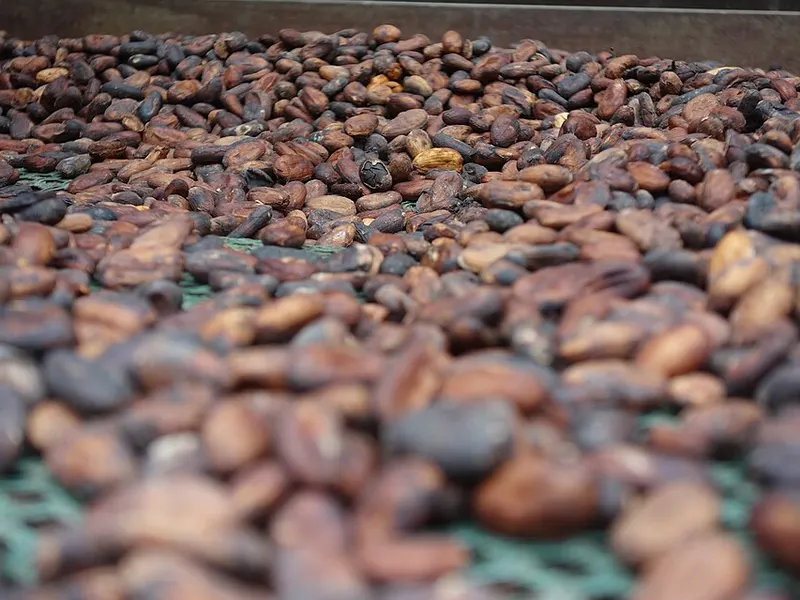
Cocoa
When your cocoa supply tightens or your oat supplier changes their minimum order quantity mid-cycle, your formulation team pays the price — in reformulation time, in d…
Cocoa: 228 kcal and 19.6 g protein per 100 g; top producer Côte d'Ivoire (36.1%, 2024); 29.1 kg CO2e per kg.
Explore Cocoa dataAs published
28%
Data from this story
Shareable Journey Intelligence
Food Supply Chain Management in 2026: Why It's the Highest-Leverage Decision in CPG
Supply Chain
28%
The numbers tell the story: food manufacturers without real-time supply chain monitoring spend 28% more on reactive sourcing decisions than those with proactive visibility tools.
64%
A CPG brand that cut ingredient research time by 64% using AI-powered ingredient intelligence didn't do it by hiring more researchers.