.svg)
.svg)
.svg)
.svg)


.svg)
Sustainability reporting used to be voluntary. In 2026, it's a procurement requirement, a retailer condition, and increasingly a regulatory obligation. If you're in R&D or product development at a CPG brand, you're not just being asked to build sustainable products — you're being asked to prove it, with numbers, at the ingredient level.

.svg)
The problem is that most teams are still measuring the wrong things, or measuring the right things in the wrong way.
This article covers the specific sustainability metrics CPG brands are tracking in 2026, why some matter more than others, and how to build a measurement framework that actually holds up when a retail partner or sustainability auditor asks for documentation.
A few years ago, "sustainable" was a brand claim. Now it's a data field.
Retailers like Kroger have supplier sustainability requirements baked into onboarding. The World Economic Forum's food system initiatives have pushed scope 3 emissions and water use onto the agenda of brands that previously only tracked packaging. Regulatory movement in the EU and California, ESG reporting requirements for publicly traded parent companies, and sustained consumer pressure have all tightened what "measuring sustainability" actually means in practice.
For CPG product teams, this creates two concrete problems. First, ingredient-level data is now a business requirement, not a nice-to-have. Second, single-metric sustainability scoring no longer holds up. A product can have a low carbon footprint but high water use intensity. It can use sustainably sourced ingredients that make reformulation economically impossible. You need to see all of it at once — and you need to see it early, while decisions are still being made.
Still the headline metric, but the scope has expanded significantly. Brands are no longer just tracking scope 1 and 2 emissions from their own operations. Scope 3 — which covers ingredient sourcing, transportation, and end-of-life packaging — now accounts for the majority of a food product's total carbon impact.
At the ingredient level, this means knowing the embedded carbon in each raw material. Cane sugar from Brazil carries a different emissions profile than beet sugar from the US Midwest. Whey protein concentrate from a conventional dairy supply chain looks different from a fermentation-derived protein alternative. These are not interchangeable inputs from a sustainability standpoint, even when they're functionally similar in a formulation.
Water stress is a material supply chain risk, not just an environmental concern. Almonds, avocados, and certain grains are grown in water-stressed regions — and that creates both a sustainability liability and a sourcing vulnerability. CPG brands tracking water use intensity at the ingredient level are doing so because retailers and institutional buyers are starting to require it, and because water-stressed sourcing regions correlate directly with supply disruptions.
Less standardized than carbon or water, but gaining traction fast. Deforestation risk linked to palm oil, soy, and cocoa supply chains is now a specific reporting category for brands selling into EU markets under the EU Deforestation Regulation. Biodiversity impact scores are being incorporated into supplier scorecards at larger CPG companies.
For mid-market brands, the practical question is straightforward: do you know which of your ingredients carry deforestation risk, and can you document that your sourcing addresses it?
Packaging metrics have their own complexity. Recyclability rate, recycled content percentage, and packaging weight reduction are the most commonly tracked. Single-use plastic reduction has become a specific KPI for brands in retail channels with public sustainability commitments. The CPG industry's ongoing effort to reduce single-use plastics in food packaging is now a measurable deliverable — not just a directional goal.
This is the metric that ties everything else together. Strong carbon and water numbers mean nothing if you can't trace them back to a specific supplier or origin. Traceability is increasingly a prerequisite for sustainability claims, both with retail partners and in consumer-facing marketing.
Digital tools that strengthen transparency, traceability, and trust in food supply chains have moved from pilot programs to operational infrastructure at brands that take this seriously.
Beyond environmental metrics, CPG teams are tracking fair labor certifications, regenerative agriculture sourcing percentages, and supplier diversity. These are harder to quantify but are showing up in retailer scorecards and B Corp certification frameworks. Brands that can document these metrics have a competitive advantage in retail negotiations — not just in marketing.
Knowing which metrics to track and actually tracking them are different problems.
The most common failure mode is fragmentation. Carbon data lives in one spreadsheet. Water use data is buried in a supplier questionnaire from 18 months ago. Packaging metrics are tracked by a different team using a different tool. When someone asks for a consolidated sustainability profile of a formulation, assembling the answer takes weeks — and it's usually incomplete.
The second failure mode is tracking at the wrong level of granularity. Brand-level sustainability commitments don't help you make a reformulation decision. You need ingredient-level data to answer questions like: if I swap this emulsifier for an alternative, what happens to the carbon footprint and the cost of goods? Without that answer in a single workflow, you're making reformulation decisions blind.
The third failure mode is treating sustainability as separate from product development entirely. When sustainability metrics live outside the formulation workflow, they get applied after the fact — usually during a packaging review or an annual sustainability report. By that point, the product decisions are already locked in.
A working framework has three properties: it operates at the ingredient level, it connects to the formulation workflow, and it runs in parallel with cost and nutrition data.
That last point matters more than it sounds. Sustainability and cost are not independent variables. An ingredient that scores well on carbon but drives up COGS by 15% creates a real business problem. A formulation that hits your sustainability targets but fails your nutrition profile creates a different one. You need to see all three dimensions together — at the point where you're making ingredient decisions, not after.
This is the specific gap that evaluating sustainability alongside key suppliers and services addresses. Supplier sustainability data needs to be integrated into the ingredient evaluation process, not maintained as a separate compliance exercise.
The practical output of a functional framework is a sustainability score at the formulation level that updates dynamically as you make ingredient changes. Swap an ingredient, and you see the impact on carbon, water, cost, and nutrition in the same view. That's the standard serious product teams are building toward in 2026.
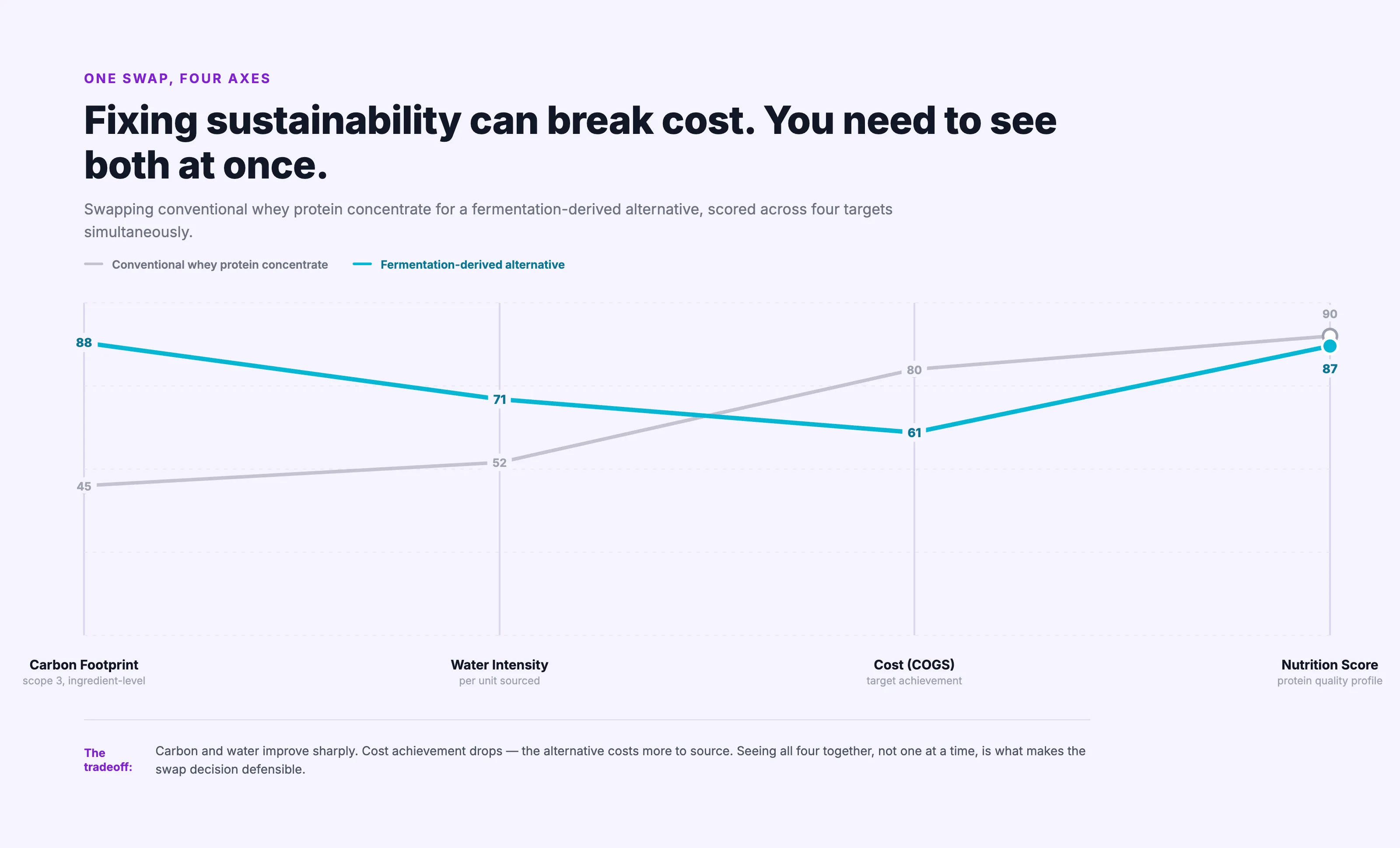
Journey Foods' Operations Scientist AI scores ingredients simultaneously across nutrition, cost, and sustainability. When you're evaluating an ingredient substitution, you're not running three separate analyses and trying to reconcile them manually — the trade-offs are visible in one place.
The platform also connects sustainability data to real-time supply chain monitoring. An ingredient that scores well on sustainability but comes from a single-source supplier in a water-stressed region carries supply risk that a static sustainability score won't capture. Seeing both the sustainability profile and the supply chain risk in the same dashboard changes how you make sourcing decisions.
Teams using Journey Foods have used this capability to cut ingredient research time significantly while building formulations that hit sustainability, cost, and nutrition targets simultaneously. You can see a documented example at the Journey Foods case study on cutting ingredient research time by 64%.
If your team is still reconciling sustainability data across separate tools, that's a process problem with a direct cost in time and decision quality. Explore the platform at journeyfoods.io or book a demo to see how the scoring workflow handles your specific formulation challenges.
What are the most important food sustainability metrics for CPG brands in 2026?
The most tracked metrics are scope 3 greenhouse gas emissions at the ingredient level, water use intensity, land use and deforestation risk, packaging recyclability and recycled content, and supply chain traceability. Brands selling into EU markets also need to address the EU Deforestation Regulation's specific requirements for palm oil, soy, and cocoa.
How do CPG brands measure sustainability at the ingredient level?
Ingredient-level sustainability measurement requires data on the carbon footprint, water intensity, and sourcing origin of each raw material in a formulation. The most effective approach integrates this data into the formulation workflow so that ingredient substitutions show their sustainability impact in real time, alongside cost and nutrition data.
Why is scope 3 emissions tracking important for food companies?
Scope 3 emissions — which include raw material sourcing, transportation, and packaging end-of-life — typically account for the majority of a food product's total carbon footprint. Tracking only scope 1 and 2 gives an incomplete picture and won't satisfy retailer sustainability requirements or ESG reporting frameworks.
What is the difference between sustainability reporting and sustainability measurement?
Sustainability reporting is the output: the annual report, the retailer scorecard, the ESG disclosure. Sustainability measurement is the ongoing operational process that makes reporting possible. Most CPG teams have reporting obligations but lack the ingredient-level measurement infrastructure to fulfill them accurately without significant manual effort.
How does sustainability scoring connect to formulation decisions?
Effective sustainability scoring runs inside the formulation workflow, not alongside it. When an R&D team evaluates an ingredient substitution, they should see the sustainability impact of that change at the same time as the cost and nutrition impact. Keeping these data streams separate leads to decisions that optimize one dimension while degrading another.
What tools do CPG brands use to track food sustainability metrics?
Some brands use standalone sustainability databases. Others rely on supplier questionnaires. Some use integrated platforms that score ingredients across sustainability, cost, and nutrition simultaneously. Integrated platforms reduce manual reconciliation work and make it possible to act on sustainability data during product development — not after it.
How do retailer sustainability requirements affect CPG product development?
Retailers with public sustainability commitments increasingly require suppliers to document ingredient-level sustainability data, packaging recyclability rates, and supply chain traceability. These requirements are now part of supplier onboarding at major retail chains, which means sustainability measurement is a prerequisite for distribution — not just a brand differentiator.
Sustainability metrics in CPG are no longer a reporting exercise. They're a product development input. The brands that build measurement into their formulation workflow now will move faster and make better decisions than those still assembling sustainability data manually after the fact. Start with ingredient-level scoring, connect it to your formulation process, and make sure cost and nutrition are in the same view. That's the standard in 2026.

Structured Q&A marked up with FAQ Page schema so it can be surfaced and cited by Al engines and search.
In Journey Al's 12 month dataset, the median plant protein reformulation came in -6.5% on raw material cost versus an animal protein control the first year that line went negative, driven by Tier 1 isolate suppliers reaching spec parity.
In Journey Al's 12 month dataset, the median plant protein reformulation came in -6.5% on raw material cost versus an animal protein control the first year that line went negative, driven by Tier 1 isolate suppliers reaching spec parity.
In Journey Al's 12 month dataset, the median plant protein reformulation came in -6.5% on raw material cost versus an animal protein control the first year that line went negative, driven by Tier 1 isolate suppliers reaching spec parity.