
.svg)
.svg)
.svg)
.svg)


.svg)
You have a byproduct. It is nutritious, available in volume, and currently going to compost or landfill — because turning it into a consistent, sellable ingredient is harder than it looks.
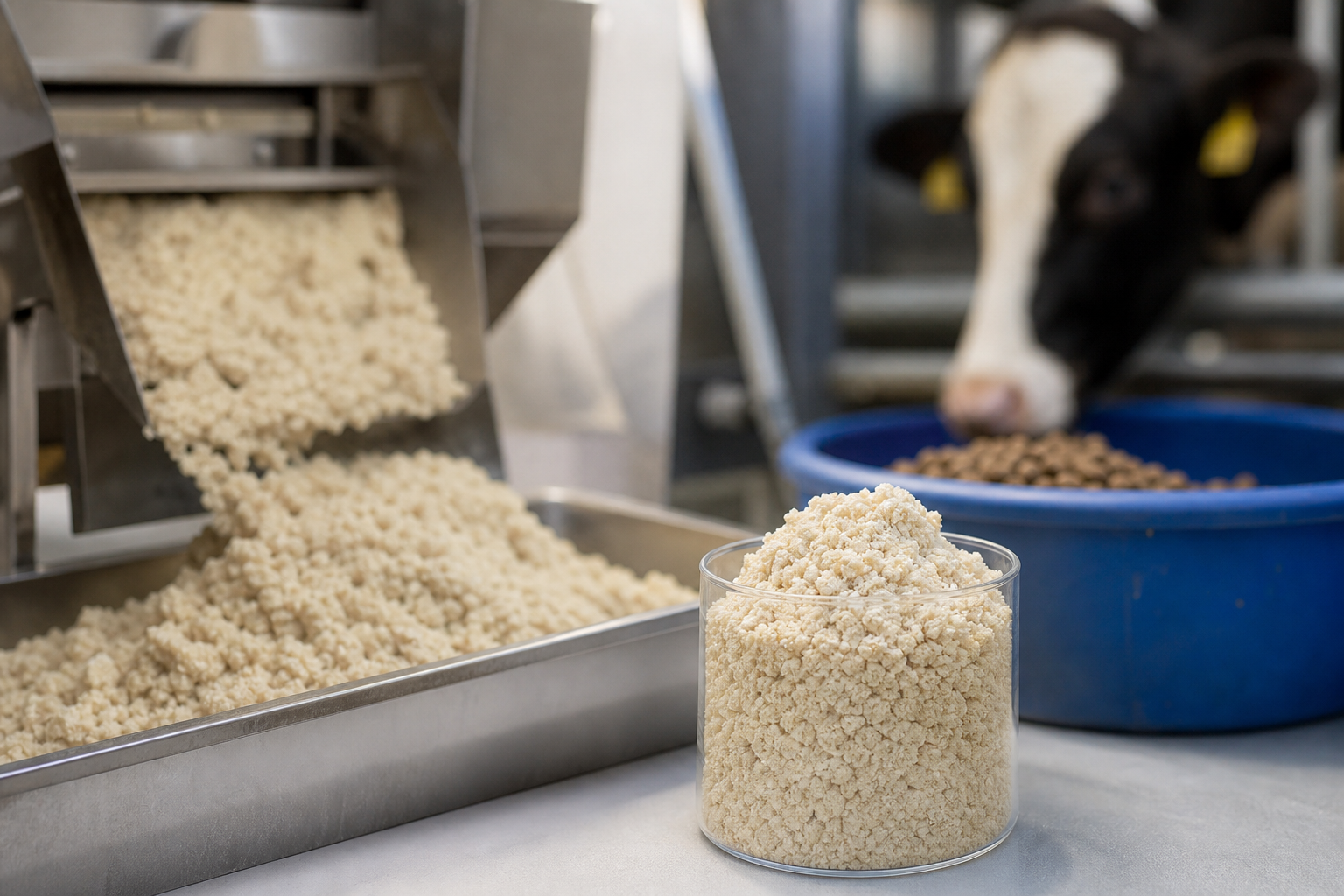
Okara is the clearest example. The fiber-rich pulp left after pressing tofu or soy milk is high in dietary fiber and protein. It also spoils quickly, costs real money to dry, and has historically sat in a regulatory gray zone that made building a supply chain around it more trouble than most producers wanted to take on.
FDA's Center for Veterinary Medicine just changed part of that equation.
Key takeaways:
According to Wiley Insights' summary of FDA's September 2026 announcement, CVM completed a two-year review of how it evaluates new animal food ingredients. The resulting process changes include earlier review feedback and published timelines, a second opportunity to amend a GRAS submission if questions remain after the initial review, and more flexibility in the types of science and manufacturing data companies can submit.
That last point matters more than it sounds. Byproduct ingredients like okara do not have decades of peer-reviewed safety literature behind them. They have processing records, compositional analyses, and a history of use that varies by producer and geography. A review process that accepts a broader range of data types is one that byproduct ingredient producers can actually meet.
Published formal timelines are the other meaningful shift. Unpredictable review windows are a capital planning problem. If you cannot estimate when a submission will resolve, you cannot build a supply chain around the ingredient, price it into a product, or commit to a customer. Faster and more predictable does not mean automatic approval — it means the math on building that supply chain gets easier to run.
All of these specific process details come from Wiley Insights' reporting on the FDA announcement, not from independently verified primary sources. Treat them as a strong signal, not a final rule.
There is a complication. Also per Wiley Insights' reporting, FDA has proposed making GRAS notification mandatory for self-affirmed human and animal food ingredients. Right now, self-affirmation is an option — a company can determine an ingredient is generally recognized as safe through its own expert panel and use it without filing with FDA. Mandatory notification would pull all of those ingredients into the formal review queue.
If that proposal is finalized without a corresponding increase in CVM reviewers, the queue grows faster than the process improvements can drain it. The producers who benefit from the new, faster process are the ones who get there early, with organized submissions — not the ones scrambling to assemble documentation after the rule takes effect.
This is not a reason to wait. It is a reason to move.
Okara illustrates the structural issue clearly. It is a genuine byproduct of an established food manufacturing process. Kikkoman and other soy processors generate it in volume. Its nutritional profile — dietary fiber, protein, and other nutrients — is documented. It has gone to animal feed, compost, and landfill for decades, not because it lacks value, but because converting it into a consistent, shelf-stable ingredient with a clean safety record is expensive and slow.
The expense is real: drying okara to extend shelf life and enable transport requires energy and equipment. The slowness is partly regulatory. A GRAS review process that was unpredictable in timeline and narrow in the data it would accept gave producers one more reason to let the material go to waste rather than invest in building a supply chain around it.
The same logic applies across the upcycled ingredient category. Spent grain from brewing. Fruit and vegetable pomace. Aquaculture byproducts. Each has a nutritional argument and a sourcing argument. Each also needs a regulatory argument — and that argument requires documentation.
A GRAS submission for an animal food ingredient is, at its core, a data problem. You need compositional data: what is in the ingredient, at what levels, with what variability across batches and sources. You need processing data: how the ingredient is produced, what steps affect safety-relevant characteristics, what quality controls exist. You need sourcing data: where the material comes from, what the upstream process looks like, what contaminants are plausible and at what concentrations.
Most producers working with byproduct streams have some of this. Few have it organized in a way that supports a submission without a significant data-gathering effort first.
That is where the work happens — before any filing. Getting composition, sourcing, processing, and safety history into a single, queryable data layer is not a regulatory task. It is an ingredient intelligence task. It is the same work that supports formulation decisions, supplier risk monitoring, and product development across the rest of your portfolio.
Journey Foods is built to support exactly that kind of data organization across ingredient, supplier, and formulation layers. The platform does not file GRAS submissions, does not provide regulatory or legal advice, and does not guarantee FDA outcomes. What it does is help food and CPG teams build and maintain the organized ingredient data layer that makes regulatory preparation faster and less painful — whether the end product lands on a grocery shelf or in a feed bag.
The CVM process improvements are a real shift. According to Wiley Insights' reporting, the changes are designed to make animal food ingredient review faster and more predictable for submitters. For producers sitting on a byproduct stream with genuine nutritional value, that lowers one of the real barriers to building a supply chain around it.
The mandatory GRAS notification proposal, if finalized, tightens that window. The producers who move now — who organize their ingredient data, document their processing and sourcing, and build the submission-ready record before the queue expands — are the ones who will see the benefit of the improved process. The ones who wait will meet a longer line.
Waste becomes an ingredient the moment someone can prove what it is. FDA just made that proof a bit faster to deliver.
What did FDA's Center for Veterinary Medicine change about animal food ingredient review?
According to Wiley Insights' reporting on FDA's September 2026 announcement, CVM completed a two-year process review and is implementing changes including earlier review feedback, published formal timelines, a second amendment opportunity for GRAS submissions with outstanding questions, and more flexibility in the science and manufacturing data submitters can provide.
What is okara and why is it relevant to animal food ingredient regulation?
Okara is the fiber-rich pulp byproduct of tofu and soy milk production. It is high in dietary fiber and protein, and it has historically gone to animal feed, compost, or landfill partly because it spoils quickly and the cost of drying it into a shelf-stable ingredient has been hard to justify without a clear regulatory pathway. Faster, more predictable GRAS review timelines lower one of the real barriers to building a supply chain around it.
What is the risk in FDA's proposed mandatory GRAS notification rule?
If FDA finalizes mandatory GRAS notification for self-affirmed human and animal food ingredients without adding reviewers, the formal review queue could grow faster than the process improvements can offset. Producers who organize their ingredient data and prepare submissions early will be ahead of that line.
What data does a GRAS submission for an animal food ingredient typically require?
A submission generally requires compositional data showing what is in the ingredient and at what levels, processing data documenting how it is produced and what quality controls exist, and sourcing data identifying where the material comes from and what contaminants are plausible. Byproduct ingredients often have some of this information but rarely have it organized in submission-ready form.
Can Journey Foods help with GRAS submissions or FDA regulatory filings?
No. Journey Foods does not file GRAS submissions, provide regulatory or legal advice, or guarantee FDA outcomes. The platform helps food and CPG teams organize ingredient, supplier, and formulation data in a centralized, queryable layer — the kind of data organization that makes regulatory preparation faster and less painful when the time comes to work with regulatory counsel.
Why do upcycled ingredients face regulatory barriers in animal food?
Upcycled ingredients often lack the extensive peer-reviewed safety literature that established ingredients have. Composition also varies depending on the upstream process and source. A review process that was historically unpredictable in timeline and narrow in the data types it accepted made it harder to justify the investment in building a supply chain around byproduct streams.
What should CPG and food companies do now in response to these FDA changes?
Start with the data layer. Organize composition, sourcing, processing history, and safety documentation for any byproduct or novel ingredient you are considering. That work supports both regulatory preparation and broader product development decisions — and it positions you to move quickly if the mandatory notification rule is finalized.