Quick answer
Ingredient substitution is one of the most time-consuming, high-stakes decisions an R&D team makes. A supplier drops out. A regulatory update flags an additive. A cost spike makes your current formulation unviable. And suddenly you're weeks into a manual search process that could derail a launch.
How AI Is Solving the Ingredient Substitution Problem for CPG R&D Teams
Ingredient substitution is one of the most time-consuming, high-stakes decisions an R&D team makes. A supplier drops out. A regulatory update flags an additive. A cost spike makes your current formulation unviable. And suddenly you're weeks into a manual search process that could derail a launch.
This is the operating reality of 2026. And AI is finally making it manageable.
Let me walk you through what's actually changing, why the old approach breaks down at scale, and how AI-powered ingredient substitution works in practice for CPG product developers and food scientists.
Why Ingredient Substitution Is Harder Than It Looks
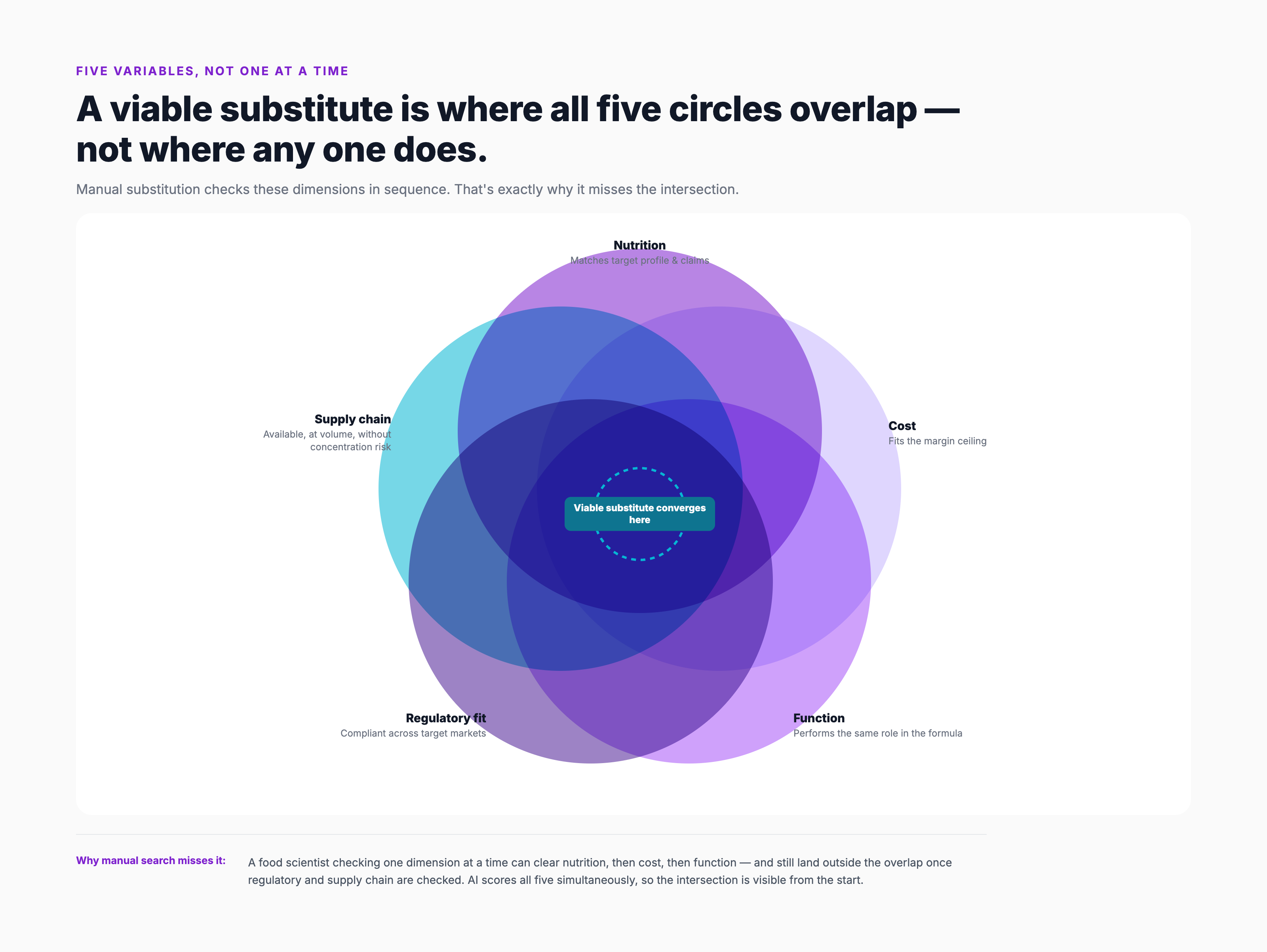
On the surface, swapping one ingredient for another sounds straightforward. In practice, it's a multi-variable optimization problem — and the variables don't wait for each other.
Every substitution decision touches at least five dimensions simultaneously:
Miss any one of these and you don't just slow down your launch. You risk a full reformulation cycle, a compliance issue, or a product that performs differently on shelf than it did in the lab. The manual research process most teams still rely on was never built for this level of complexity — and it shows.
The Manual Process Is a Bottleneck at Scale
Most R&D teams still handle substitution the same way: a food scientist searches ingredient databases, cross-references supplier catalogs, checks regulatory requirements, and loops in procurement to validate cost and availability. Per ingredient, that process can take weeks. Across a portfolio of dozens of SKUs, it compounds fast.
The bottleneck isn't expertise. It's data fragmentation. Nutritional data lives in one system. Supplier data lives in another. Regulatory requirements vary by market and sit buried in PDFs. Cost data is locked in procurement spreadsheets. No single person can hold all of that simultaneously, and no manual process connects it cleanly.
This is where AI changes the equation — not by replacing the food scientist's judgment, but by collapsing the data-gathering phase from weeks to minutes.
How AI Approaches Ingredient Substitution Differently
AI-powered substitution works by scoring and ranking alternatives across multiple dimensions at once, using structured ingredient data that's been pre-indexed and continuously updated. That's a fundamentally different starting point than a keyword search in a static database.
Here's what it looks like in practice.
Multi-Dimensional Scoring, Not Single-Variable Search
A traditional search returns a list of ingredients that match a category. An AI-powered system returns a ranked list of substitutes scored against your specific formulation requirements. You're not searching for "plant-based emulsifiers" generically — you're finding the ingredient that scores highest across your combination of nutritional targets, cost ceiling, functional requirements, and supply chain criteria.
Journey Foods does exactly this. The platform's ingredient search and scoring engine evaluates options across nutrition, cost, and sustainability dimensions simultaneously, so your team spends time evaluating the best candidates — not generating the list.
Supply Chain Signals Built Into the Recommendation
Supply chain viability is one of the most underappreciated parts of a substitution decision. An ingredient that looks perfect on paper means nothing if your supplier can't deliver at volume, or if there's a known risk in the sourcing region.
AI systems that integrate supply chain monitoring can flag these risks before you commit to a reformulation. Real-time tracking tools that monitor sourcing networks for disruption signals give teams an early warning system that manual supplier checks simply can't replicate — and in a supply chain environment that's remained volatile well into 2026, that proactive visibility matters.
Regulatory and Compliance Context at the Point of Decision
Compliance is not a post-formulation step. It should be part of the substitution decision from the start. AI platforms that surface regulatory flags during ingredient selection — rather than after — prevent the costly scenario of discovering a compliance issue late in the development cycle.
Organizations like AIB International (aibinternational.com), which provide certified food safety training and audit frameworks, have documented how frequently compliance gaps surface during reformulation. Embedding that compliance layer into ingredient selection is one of the clearest efficiency gains AI brings to R&D.
Real-World Impact: Where This Matters Most
Cost-Driven Reformulation Under Margin Pressure
When commodity prices spike, procurement needs substitution options fast. The question isn't just "what can replace this?" — it's "what can replace this at a cost that preserves our margin, without degrading the nutritional profile or triggering a label change?" That's a query that takes a skilled food scientist days to answer manually. An AI platform with indexed ingredient cost data and nutritional scoring can surface ranked options in minutes.
Clean-Label and Transparency Mandates
Consumer demand for clean-label formulations keeps pushing R&D teams to replace synthetic additives with functional alternatives. The substitution challenge here is particularly complex because functional performance often drops when you remove an additive. AI can identify natural alternatives that meet functional thresholds while improving label clarity.
Ingredient transparency tools that give consumers visibility into formulation decisions are increasingly part of the product story CPG brands tell. When substitution decisions are made with that transparency layer in mind from the start, you build cleaner products — and avoid reformulation cycles driven by consumer backlash.
Allergen and Dietary Restriction Compliance
Allergen substitution is high-stakes by definition. A missed cross-contamination risk or an incorrect allergen declaration is a recall waiting to happen. AI systems that flag allergen status, cross-reactivity risks, and labeling requirements as part of the substitution workflow give food scientists a safety net that manual processes don't reliably provide.
What Good AI Ingredient Substitution Actually Looks Like
The best implementations share a few characteristics that separate them from basic database search tools:
The supply chain intelligence approach reshaping food innovation at the enterprise level is built on exactly these principles. It's not about automating the food scientist out of the process. It's about giving them better data, faster, with the context they need to make confident decisions.
The Integration Question: AI Doesn't Work in Isolation
Worth being direct about this: AI ingredient substitution tools are most valuable when they connect to your existing workflows — not when they exist as a separate silo you have to manually update.
For teams implementing AI recommendations on the ground, supply chain consulting that bridges the gap between platform outputs and operational execution often determines whether a tool actually gets used. That kind of implementation support helps organizations turn AI-generated recommendations into decisions their procurement and production teams can act on.
As CPG companies scale their AI-assisted R&D, aligning product development decisions with broader business metrics also becomes important. Teams that track how substitution choices affect customer retention, margin, and portfolio performance have a clearer picture of where AI is actually delivering value — and where it isn't.
Where Ingredient Substitution Fits in the Broader AI-in-Food Picture
Ingredient substitution is one piece of a larger shift in how CPG companies approach product development and supply chain management. For a useful benchmark of where different platforms play, the overview of leading AI companies in food is worth reviewing.
The broader context matters because substitution decisions don't happen in isolation. They connect to sustainability goals, packaging decisions, nutritional positioning, and supply chain resilience. Teams that treat substitution as a standalone problem miss the compounding value of connecting those decisions across the full product development lifecycle.
For a deeper look at how AI intersects with ingredient safety and supply chain transparency specifically, the analysis on AI and transparency in food covers the 2026 technology landscape in detail.
The Bottom Line for R&D Teams
Ingredient substitution has always been a core R&D competency. What's changed is the speed and complexity at which it needs to happen. Supply chain volatility, regulatory pressure, clean-label demand, and margin compression don't wait for a three-week manual research cycle.
AI doesn't eliminate the expertise required to make a good substitution decision. It eliminates the data-gathering bottleneck that slows that expertise down. For CPG R&D teams managing complex portfolios, that's not a minor efficiency gain — it's a structural advantage.
If your team is still running substitution searches manually, the gap between your current process and what's possible in 2026 is wider than you probably think.
See what AI-powered ingredient substitution looks like for your formulation workflow at Journeyfoods.io.
We'd love to hear from you! If you have questions about AI ingredient substitution or want to share how your team is approaching reformulation challenges, throw them in the comments below.
Find us on Instagram, LinkedIn, and X/Twitter.
FAQs
What is AI ingredient substitution in CPG product development?
AI ingredient substitution uses machine learning and structured ingredient data to identify and rank alternative ingredients when a formulation needs to change. Instead of manually searching databases and cross-referencing supplier catalogs, AI platforms score substitutes across nutrition, cost, functionality, regulatory compliance, and supply chain availability simultaneously — returning ranked recommendations in minutes rather than days.
How does AI ingredient substitution differ from traditional ingredient database searches?
Traditional searches return lists of ingredients that match a category. AI-powered substitution returns ranked alternatives scored against your specific formulation requirements, with supply chain signals, regulatory flags, and cost data built into the recommendation. The key difference is context: AI understands your formulation constraints and surfaces options that meet multiple criteria at once.
What are the most common reasons CPG teams need ingredient substitutions?
The most frequent triggers are supplier disruptions or discontinuations, commodity cost spikes that compress margin, regulatory changes that flag existing additives, consumer-driven clean-label reformulation, and allergen or dietary restriction compliance requirements. Each scenario carries different priority weights, and AI platforms that let teams adjust scoring criteria by use case are more useful than one-size-fits-all tools.
Can AI ingredient substitution tools handle regulatory compliance across multiple markets?
The best platforms surface regulatory flags as part of the substitution recommendation — not as a separate post-formulation step. This matters for companies selling across markets with different approval frameworks. That said, AI tools should be treated as a first-pass filter, not a definitive compliance sign-off. Food safety certification bodies and audit organizations remain part of the compliance workflow.
How does ingredient substitution connect to supply chain risk management?
Every substitution decision is also a supply chain decision. An ingredient that looks ideal on a nutritional and cost basis can still be a poor choice if the sourcing region carries geopolitical risk, if the supplier base is concentrated, or if lead times don't fit your production schedule. AI platforms that integrate supply chain monitoring surface these risks before you commit to a reformulation — not after.
What should R&D teams look for when evaluating AI ingredient substitution platforms?
Key criteria: continuous data updates rather than static databases, formulation context awareness, version control and audit trail functionality, integration with existing procurement and regulatory workflows, and collaborative features that support handoffs between food science, procurement, and regulatory teams.
How long does AI-assisted ingredient substitution take compared to manual research?
Manual substitution research typically takes days to weeks per ingredient when you account for nutritional cross-referencing, supplier validation, regulatory checks, and cost analysis. AI platforms that index and score across all these dimensions simultaneously can surface ranked substitution candidates in minutes. The food scientist still makes the final call — but the data-gathering phase compresses dramatically.

Journey Ingredient Intelligence
Beef (Ground)
For teams implementing AI recommendations on the ground, supply chain consulting that bridges the gap between platform outputs and operational execution often determin…
A South American tree in the family Lecythidaceae.
Data from this story