.svg)
.svg)
.svg)
.svg)


.svg)
Most CPG product development workflows don't fail because of bad ideas. They fail because the process can't keep up with the product.

.svg)
You're managing ingredient research across spreadsheets, formulation versions buried in email threads, supply chain data in a separate system, and nutrition targets in yet another tool. Every handoff between R&D, procurement, and regulatory adds friction. By the time the team aligns on a formulation, the market window has shifted — or an ingredient is already on allocation.
This guide is for R&D and product development leads who are ready to build a workflow that actually scales: one that compresses timelines without sacrificing quality, cost discipline, or sustainability targets.
The problem usually isn't the people. It's the architecture.
A workflow that handles two product launches a year falls apart at six. The same process that runs fine with three team members creates chaos with ten. Fragmentation is the root cause: ingredient data in one place, formulation history in another, supply chain signals nowhere in particular.
Three failure patterns show up repeatedly:
These aren't process failures. They're infrastructure failures. Fixing them requires rethinking how information flows through your development cycle — not just adding another project management layer on top.
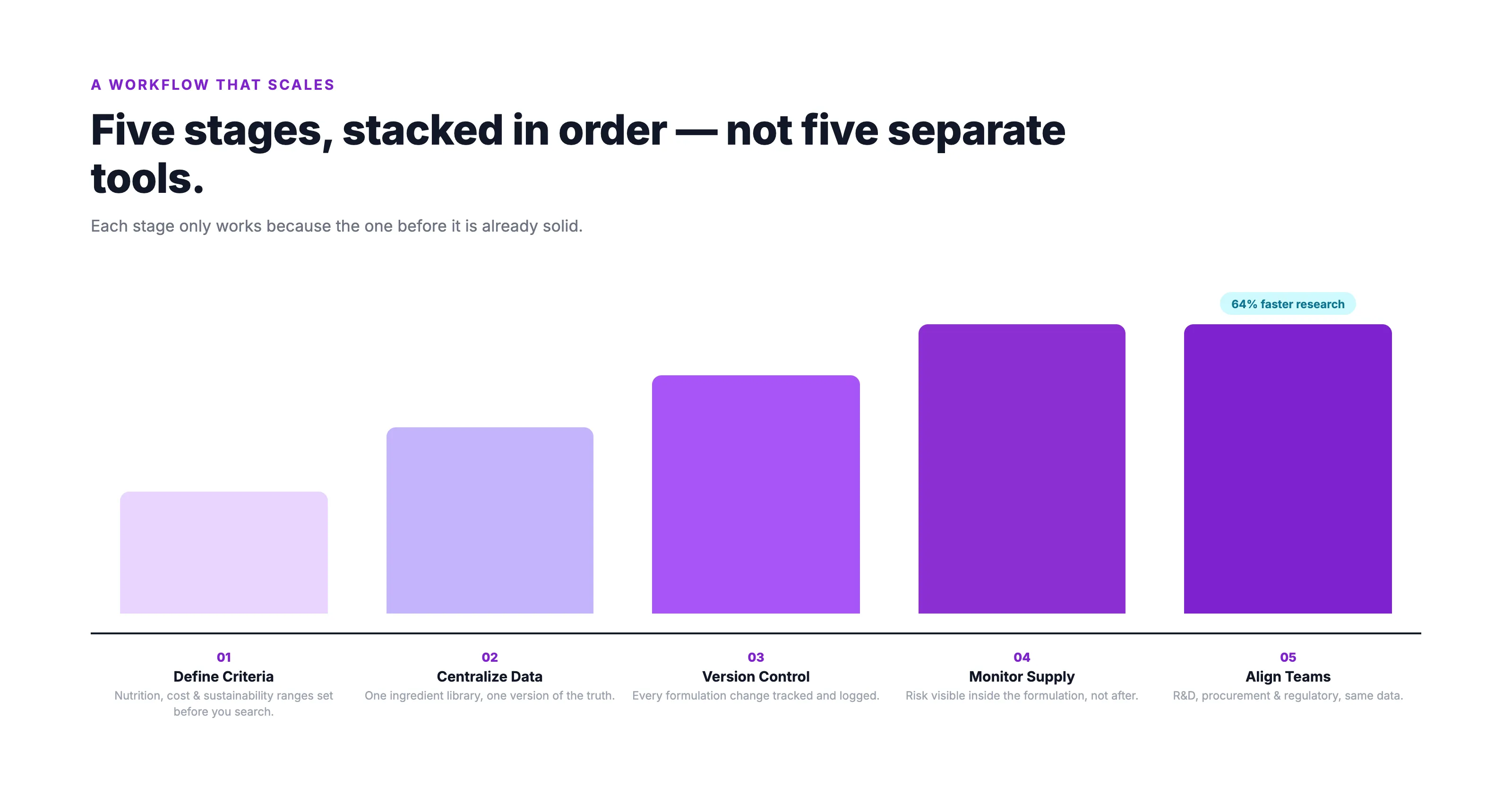
The most common time-waster in product development is evaluating ingredients that were never going to work. Teams spend weeks on options that fail on cost, or score well on nutrition but can't survive a supply disruption.
Set your scoring framework before you open any ingredient database. Define acceptable ranges for:
When you set these criteria upfront, every ingredient search returns actionable results instead of a list you have to manually filter. This is where AI-powered ingredient scoring changes the speed of the process significantly. Platforms like Journey Foods score ingredients simultaneously across nutrition, cost, and sustainability through their Operations Scientist AI engine — your team evaluates candidates that already meet your criteria rather than building that filter manually each time.
Ingredient research is only as good as the data behind it. If your food scientists are pulling from different sources than your procurement team, you'll spend more time reconciling information than making decisions.
A centralized ingredient library needs to do three things:
The teams that move fastest aren't necessarily the ones with the biggest databases. They're the ones whose entire team works from the same data set. That shared baseline eliminates the "which version are we looking at?" conversation that kills momentum in cross-functional reviews.
One CPG brand documented a 64% reduction in ingredient research time after centralizing their ingredient discovery process. The savings came primarily from eliminating redundant research across teams and cutting manual scoring work.
Formulation management is where most workflows break down in practice. R&D iterates. Regulatory reviews. Procurement adjusts based on availability. Marketing requests a label change. Without version control, you lose track of which iteration passed sensory, which one has the approved nutrition panel, and which one is actually in production.
Treat formulation management the way a software team treats code: every version is tracked, every change is logged, and no one works from an unnamed file.
In practice, that means:
This isn't just an organizational preference. It's a compliance requirement in many categories. A clean version history accelerates regulatory submissions and makes reformulation audits significantly less painful.
Supply chain risk management shouldn't be a separate workstream that occasionally intersects with R&D. It should be embedded in the formulation process from the start.
The standard approach — monitoring key ingredients quarterly or reacting to shortage notices from suppliers — is too slow for current market conditions. Ingredient availability, pricing, and geopolitical risk move faster than quarterly reviews can catch.
The workflow shift is straightforward: when you're evaluating a formulation, supply chain risk data should be visible alongside nutrition and cost data. If an ingredient is on allocation or has single-source risk, that information belongs in the formulation decision — not in a separate procurement conversation three months later.
Real-time supply chain alerts with AI-driven ingredient alternatives are what separate reactive teams from proactive ones. How supply chain intelligence is reshaping food innovation is worth reading for context on how this shift is playing out across the industry.
The final stage isn't a tool problem. It's a process design problem.
Product development involves R&D, procurement, regulatory, marketing, and operations. Each function has different priorities and different information needs. The workflow has to serve all of them without creating a coordination tax.
The practical answer is a single source of truth that each function accesses in their own context. R&D sees formulation data and ingredient scoring. Procurement sees cost and supply chain risk. Regulatory sees compliance flags and version history. No one is waiting on a weekly sync to get information they need to do their job.
When teams are aligned on the same data, decisions happen faster and with fewer revision cycles. That's not a soft benefit — it directly reduces time to market.
Even experienced teams make these errors when scaling.
Optimizing for one variable at a time. Hitting your nutrition target in isolation, then discovering the cost doesn't work, then reformulating for cost and losing the nutrition profile. Scoring all three criteria simultaneously from the start prevents this loop entirely.
Treating sustainability as a final-stage check. Sustainability requirements are increasingly tied to retailer listings, investor reporting, and consumer claims. If you're evaluating clean-label formulation and packaging sustainability at the end of development, you're building in reformulation risk. Integrate it at the ingredient selection stage.
Underinvesting in formulation documentation. Teams without clean version histories spend significant time in reconstruction mode during audits, line extensions, and reformulations. The documentation overhead at the start pays back many times over.
Scaling headcount instead of infrastructure. Adding more food scientists to a broken workflow produces more output from the same broken process. The bottleneck is usually the information architecture, not the team size.
A scalable CPG product development workflow has these characteristics:
Journey Foods is built for exactly this workflow. The platform centralizes ingredient discovery, formulation management, and supply chain monitoring in a single dashboard, with AI-driven scoring across nutrition, cost, and sustainability. Teams from funded startups to multi-brand enterprises use it to cut the time between concept and launch without sacrificing product quality or margin.
If your current process has any of the failure patterns described above, it's worth a close look. Book a demo at journeyfoods.io/book-a-demo to see how it handles your specific workflow.
What is a CPG product development workflow?
A CPG product development workflow is the structured process a consumer packaged goods team uses to move a product from concept to market. It typically covers ingredient research and selection, formulation development and iteration, regulatory review, supply chain sourcing, and cross-functional approval. A scalable workflow integrates these stages with shared data and version control so the team moves faster with fewer errors.
What are the biggest bottlenecks in CPG product development?
The most common bottlenecks are fragmented ingredient data across teams, lack of version control on formulations, and reactive supply chain management. These create redundant research, revision cycles caused by working from different information, and last-minute reformulations when ingredient availability issues surface too late.
How do you score ingredients across nutrition, cost, and sustainability at the same time?
Manual scoring across all three criteria simultaneously is time-intensive and inconsistent. AI-powered ingredient scoring platforms like Journey Foods evaluate candidates against all three dimensions in a single query, returning results that already meet your defined thresholds rather than requiring manual filtering after the fact.
How does version control improve CPG formulation management?
Version control gives every formulation iteration a tracked history with logged changes and visible approval status. This prevents teams from working from outdated files, accelerates regulatory submissions by providing a clean audit trail, and makes reformulation faster because previous iterations are accessible without reconstructing from email history.
When should supply chain risk be integrated into product development?
Supply chain risk should be visible at the ingredient selection stage, not after a formulation is committed. If an ingredient has single-source risk, is on allocation, or has significant price volatility, that information belongs in the formulation decision. Integrating it early prevents costly reformulations under launch pressure.
What tools do CPG teams typically use for product development, and what are their gaps?
Common tools include Genesis R&D for nutrition calculation, ESHA for nutrition analysis, and various spreadsheet-based formulation trackers. The gaps are consistent: most tools handle one dimension well but don't connect nutrition, cost, supply chain, and collaborative development in a single workflow. Teams end up stitching together multiple systems, which creates the fragmentation and version confusion that slow launches down.
How does a centralized ingredient management platform reduce time to market?
Centralized platforms reduce time to market by eliminating redundant research across teams, providing pre-scored ingredient candidates that already meet defined criteria, and keeping the whole team aligned on the same formulation data in real time. The reduction in back-and-forth between R&D, procurement, and regulatory at each stage compounds across a full development cycle.
The workflow problems that slow CPG teams down are solvable. The fix isn't more people or more meetings — it's better information architecture, earlier in the process.
Start with your scoring criteria. Centralize your ingredient data. Build version control into formulation from day one. Integrate supply chain signals before they become delays. When those four things are in place, the rest of the workflow gets faster on its own.
Explore the full platform at journeyfoods.io.

Structured Q&A marked up with FAQ Page schema so it can be surfaced and cited by Al engines and search.
In Journey Al's 12 month dataset, the median plant protein reformulation came in -6.5% on raw material cost versus an animal protein control the first year that line went negative, driven by Tier 1 isolate suppliers reaching spec parity.
In Journey Al's 12 month dataset, the median plant protein reformulation came in -6.5% on raw material cost versus an animal protein control the first year that line went negative, driven by Tier 1 isolate suppliers reaching spec parity.
In Journey Al's 12 month dataset, the median plant protein reformulation came in -6.5% on raw material cost versus an animal protein control the first year that line went negative, driven by Tier 1 isolate suppliers reaching spec parity.