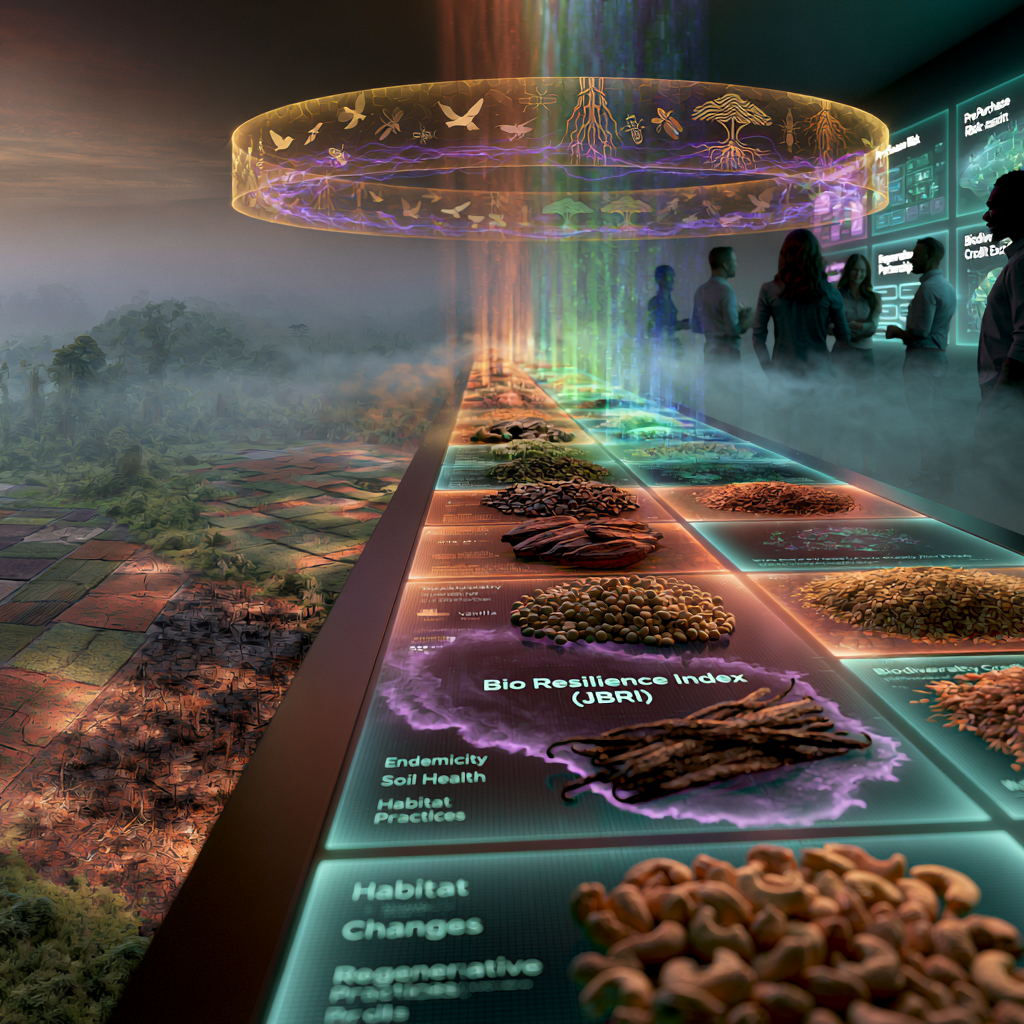


We've been focused on biodiversity and conversatios for years: likns: but we are not launching a full score and more than just tagging for sustainability.
Welcome to 2026, where Biodiversity Scoring has become the true north star for food investors—and Journey AI is leading the charge to quantify what was once considered unquantifiable.
Traditional supply chain management operates on a simple premise: source the ingredient, verify quality, optimize cost, deliver on time. But this framework ignores what economists are now calling "ecological debt"—the hidden environmental liabilities that don't appear on balance sheets until it's too late.
Consider the case of a leading plant-based protein company we worked with in early 2025. On paper, their supply chain was pristine: certified organic suppliers, renewable energy in production facilities, biodegradable packaging. They'd even achieved carbon neutrality two years ahead of their public commitment.
But when we ran their ingredients through our Bio-Resilience Index, the results were sobering. Their primary protein source—organic soy from a South American supplier—was contributing to a 12% annual decline in local bird populations. The monocropping practices, while organic, had reduced soil microbial diversity by 34% over five years. The farm's expansion had fragmented a critical habitat corridor for jaguars.
None of this showed up in their ESG reports. All of it showed up in our JBRIJ_{BRI}JBRI calculations.
Within six months, they'd restructured their sourcing strategy. Today, they're not just carbon neutral—they're biodiversity positive. And their Series C round? It was oversubscribed by 40%.
Let's get technical for a moment, because this is where Operations Science diverges from traditional supply chain analytics.
The Journey Bio-Resilience Index (JBRIJ_{BRI}JBRI) is calculated as follows:
But these aren't arbitrary variables pulled from thin air. Each component represents years of ecological research translated into actionable business metrics.
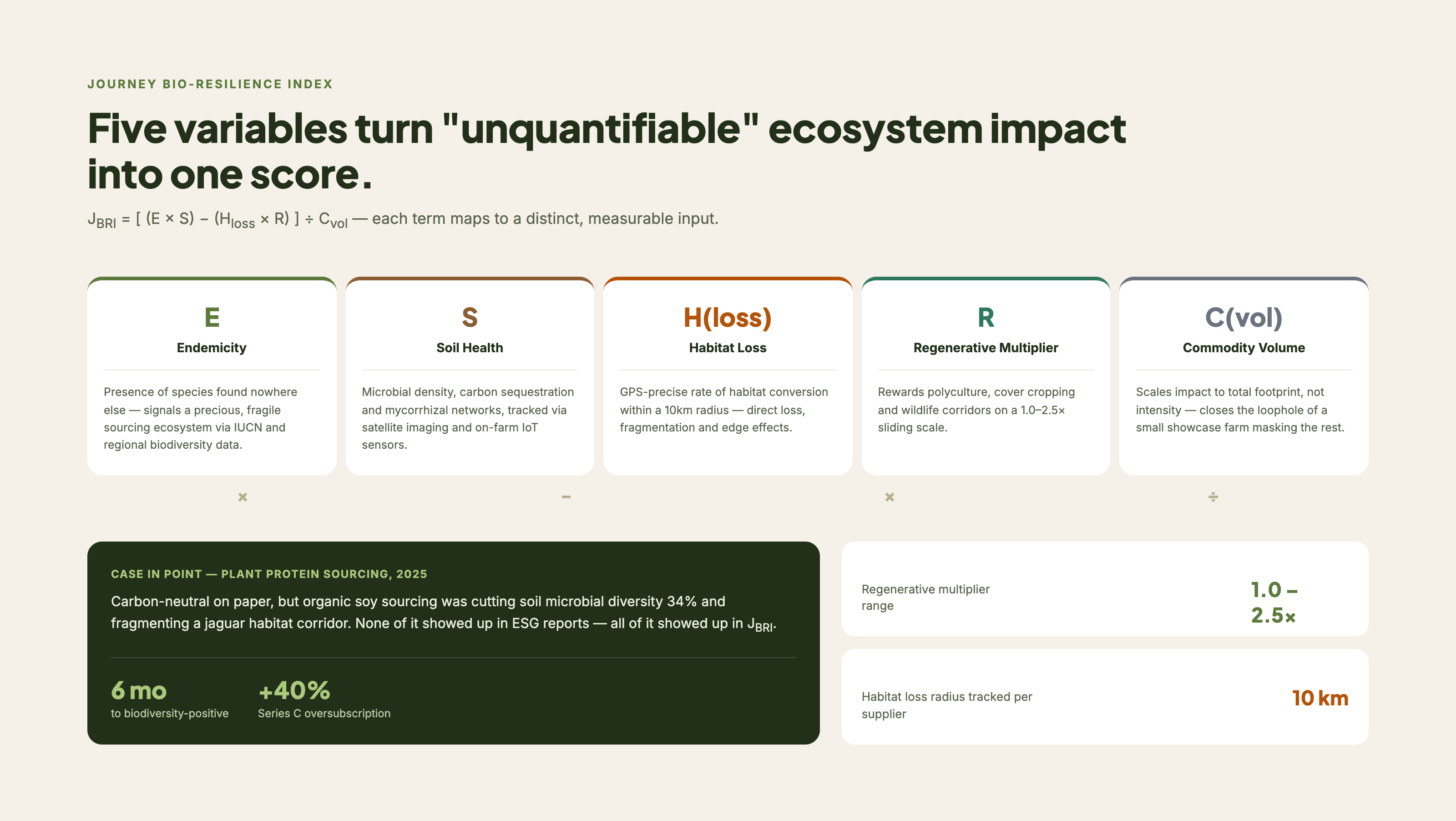
Endemicity measures the presence of species found nowhere else on Earth within your sourcing region. Why does this matter for a food company?
Because endemic species are canaries in the coal mine. When you source from regions with high endemicity, you're operating in ecosystems that are simultaneously precious and fragile. A single ingredient decision can have cascading effects that ripple through food webs in ways that affect long-term agricultural viability.
Journey AI calculates endemicity scores by integrating:
Real-world application: One of our clients discovered their vanilla supplier in Madagascar was operating in a region with 47 endemic plant species, 12 of which were threatened. By shifting 40% of their sourcing to a regenerative vanilla cooperative in the same region—one that actively protected forest corridors—they maintained quality while improving their JBRIJ_{BRI}JBRI score by 28 points.
If biodiversity above ground matters, biodiversity below ground is absolutely critical. Soil isn't dirt—it's a living ecosystem containing more organisms than there are humans on Earth in just a handful of material.
Our Soil Health Data variable integrates:
Here's what makes Journey AI different: we don't rely on annual soil reports filed for compliance. We've partnered with precision agriculture firms and remote sensing platforms to gather real-time soil health data.
Through a combination of:
We can tell you not just the current state of soil health, but its trend line. Is it improving or degrading? At what rate? And critically: what will the soil health be in 12-24 months when you need to scale your order by 200%?
This is where Journey AI gets radically specific. We don't accept regional averages or country-level deforestation statistics. We demand GPS-coordinate precision.
Using satellite imagery analysis and land-use change detection algorithms, we calculate the rate of habitat conversion within a 10-kilometer radius of each supplier facility. This captures:
Case study: A snack food company was sourcing cashews from a supplier in West Africa with excellent labor practices and organic certification. Our HlossH_{loss}Hloss analysis revealed that surrounding smallholder farms were clearing forest fragments at a rate of 3.2% annually—primarily to expand cashew production in response to growing demand.
Rather than abandoning the region, our AI identified an opportunity: a nearby cooperative that had implemented agroforestry systems, growing cashews under a canopy of native trees. The habitat loss rate there? Negative. They were actually restoring forest cover.
The switch required accepting slightly higher per-unit costs and longer processing times. But the improved JBRIJ_{BRI}JBRI score opened doors to premium retail partnerships that more than offset the cost difference.
Not all agricultural practices are created equal. The Regenerative Multiplier is Journey AI's way of quantitatively rewarding suppliers who go beyond "doing less harm" to actively healing ecosystems.
Practices that earn regenerative multiplier credits include:
Polyculture and intercropping: Growing multiple crops together mimics natural ecosystems and builds resilience. A supplier using a coconut-cacao-banana-vanilla polyculture system scores higher than a monoculture coconut plantation, even if both are organic.
Cover cropping and nitrogen fixation: Planting species like legumes that pull nitrogen from the air and deposit it in soil reduces synthetic fertilizer needs while building soil health. Our algorithms track the specific cover crop species used and their proven nitrogen-fixing rates.
Wildlife corridor maintenance: Suppliers who preserve or restore habitat connections between fragmented ecosystems earn significant multiplier bonuses. We verify this through satellite imagery and biodiversity monitoring data.
Water conservation systems: Techniques like drip irrigation, rainwater harvesting, and constructed wetlands that reduce water extraction from stressed watersheds.
Integrated pest management with habitat provision: Creating beetle banks, hedgerows, and flowering strips that support beneficial insects and birds reduces pesticide needs while enhancing biodiversity.
The multiplier works on a sliding scale from 1.0 (conventional agriculture) to 2.5 (truly regenerative systems that are measurably improving ecosystem function).
Here's the crucial denominator that many biodiversity initiatives miss: impact must be scaled to volume.
A small artisanal producer with middling biodiversity practices and a large regenerative farm have very different absolute impacts. The JBRIJ_{BRI}JBRI formula ensures that your score reflectstotal ecological footprint, not just intensity.
This prevents gaming the system. You can't source 95% of an ingredient from biodiversity-destructive sources and claim a high score because you source 5% from a regenerative showcase farm.
The Journey Bio-Resilience Index isn't an academic exercise—it's a decision-making engine that transforms how companies approach sourcing.
Before committing to a new supplier or scaling an existing relationship, procurement teams can model the biodiversity impact. Our platform generates:
Low biodiversity scores aren't always deal-breakers—they're opportunities for partnership. Journey AI's platform facilitates:
This is where the rubber meets the road in 2026. Institutional investors are increasingly incorporating biodiversity metrics into investment theses. The JBRIJ_{BRI}JBRI provides:
Here's what the market is telling us:
Premium shelf space: Major retailers are now allocating preferred shelf positioning and promotional support to brands with verified high biodiversity scores. Whole Foods' "Biodiversity Verified" shelf tags, launched in late 2025, have driven 23% average sales lifts for participating brands.
Insurance and finance: Agricultural lenders are beginning to price biodiversity risk into loan terms. Farms with high biodiversity scores qualify for lower interest rates, while monoculture operations face higher premiums. The logic is sound: biodiverse farms are more resilient to climate shocks, pest outbreaks, and market volatility.
Consumer consciousness: Gen Z and younger Millennials are moving past carbon consciousness to biodiversity awareness. A recent survey found that 64% of consumers under 35 would pay a 15-20% premium for products with verified biodiversity-positive sourcing.
Regulatory momentum: The EU's Nature Restoration Law and Corporate Sustainability Due Diligence Directive now require large companies to assess and address biodiversity impacts in their value chains. Similar legislation is advancing in California and New York. Companies without robust biodiversity tracking systems face compliance risks.
None of this is easy. Calculating JBRIJ_{BRI}JBRI scores requires infrastructure that didn't exist three years ago:
Building this capability requires investment with uncertain short-term ROI. It requires convincing suppliers to share data they've never tracked before. It requires educating buyers who've spent careers optimizing for cost and quality alone.
But here's what we're seeing in 2026: the companies making these investments aren't doing it because it's easy. They're doing it because it's necessary.
The food system is hitting hard ecological limits. Pollinator declines threaten $577 billion in annual crop production. Soil degradation affects 33% of global agricultural land. Monoculture farming systems are increasingly vulnerable to catastrophic failures as climate patterns destabilize.
The companies that will thrive in the next decade aren't those that greenwash their way through ESG questionnaires. They're the ones fundamentally rewiring their operations around ecological reality.
Journey AI is currently piloting what we call the Biodiversity Credit Exchange—a marketplace where high-performing suppliers can monetize their JBRIJ_{BRI}JBRI scores.
Here's how it works: A regenerative cacao cooperative in Ecuador has a JBRIJ_{BRI}JBRI score of 87 (excellent). A conventional almond supplier in California scores 34 (poor). A snack company sources from both.
Rather than forcing the company to immediately abandon the California supplier (which may not be feasible), we enable them to purchase biodiversity credits from the Ecuador cooperative. The cooperative receives premium payments that fund continued ecosystem restoration. The California supplier receives technical assistance to improve their practices. The snack company maintains sourcing relationships while improving their aggregate biodiversity impact.
It's not a perfect solution—nothing replaces actual on-the-ground improvement. But it creates economic incentives aligned with ecological outcomes while acknowledging the messy reality of supply chain transitions.
In 2026, a high JBRIJ_{BRI}JBRI score is becoming what "organic certification" was in 2010: a market differentiator that separates leaders from laggards.
But unlike organic certification, biodiversity scoring isn't about following a prescribed set of practices. It's about measuring actual outcomes in complex, dynamic ecosystems. It requires sophisticated data infrastructure, scientific rigor, and a willingness to make decisions based on ecological reality rather than marketing narratives.
The question for food companies is no longer "Can we afford to prioritize biodiversity?"
It's "Can we afford not to?"
Because by 2026, the market has spoken. Investors demand it. Consumers reward it. Regulators are beginning to require it.
And most importantly: the planet needs it.
Ready to calculate your biodiversity impact? Journey AI's Bio-Resilience Index assessment is now available for food companies sourcing ingredients globally. Contact our Operations Science team to get started.


.png)