.svg)
.svg)
.svg)
.svg)


.svg)
If you've spent any part of 2026 scrambling for an ingredient alternative after a supplier went quiet, you already know this isn't theoretical. Food supply chain disruption has shifted from a periodic risk event to a near-constant operating condition for CPG teams.

.svg)
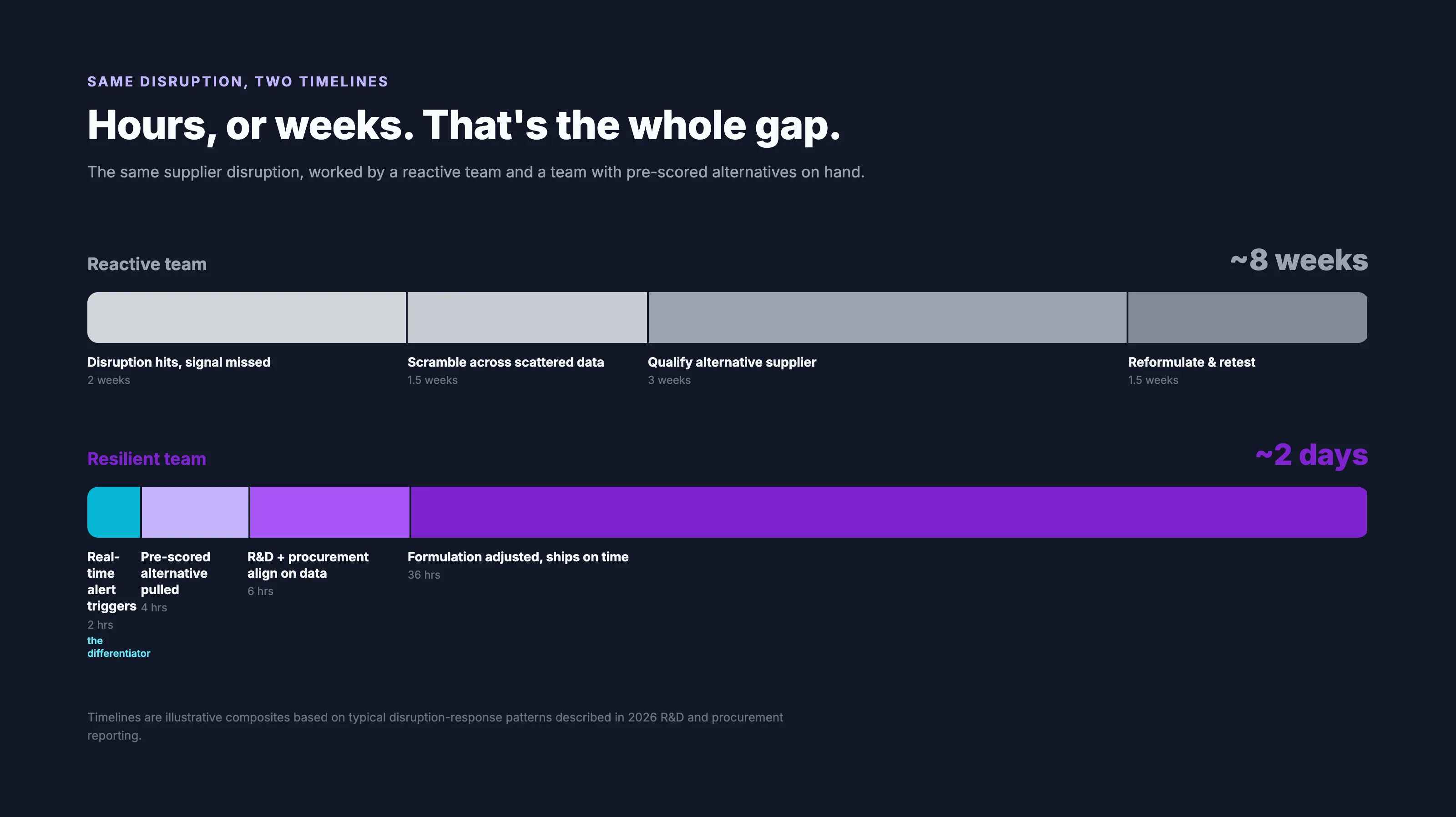
The question isn't whether your sourcing strategy will get tested this year. It's whether your team responds in hours or weeks.
This article covers the specific disruption patterns hitting CPG ingredient sourcing in 2026, what the most resilient teams are doing differently, and where the real operational gaps still exist.
The post-pandemic supply chain narrative was supposed to resolve by now. It hasn't.
What's changed is the character of the disruption. Earlier volatility was largely logistical — port backlogs, container shortages, labor gaps. What's hitting food and CPG ingredient sourcing in 2026 is more structural. It's driven by climate-related agricultural output swings, ongoing trade policy instability, and supplier consolidation that has quietly stripped redundancy from key ingredient categories.
Three patterns keep showing up:
Concentrated sourcing risk. Many mid-market CPG brands still rely on a single supplier for critical ingredients. When that supplier hits a crop failure, a regulatory hold, or a capacity constraint, there's no backup. Qualifying an alternative can take four to twelve weeks depending on the ingredient and regulatory requirements — time most teams don't have.
Sustainability pressure creating unplanned reformulation. Retailer sustainability mandates and emerging reporting requirements are forcing reformulation on timelines that weren't built into any roadmap. Teams are swapping ingredients not because of a supply failure, but because the current ingredient no longer meets a buyer's environmental criteria. Most procurement workflows weren't designed for this category of pressure.
Cost volatility compressing margins. Commodity price swings in cocoa, oats, and several specialty botanical categories have been significant in 2026. Brands that locked in pricing on the wrong side of a move are now absorbing margin hits or rushing reformulations. The chocolate shortage and oat flour innovation cycle that started gaining traction in earlier years has accelerated — more teams are actively exploring functional substitutes.
The honest answer to "how resilient is your supply chain?" for most mid-market CPG brands right now: more reactive than you'd want to admit.
The gaps tend to cluster in predictable places.
Procurement has one spreadsheet. R&D has another. The food scientist who sourced the original ingredient three years ago has a folder of supplier emails. When a disruption hits, the first thirty minutes are often spent just figuring out what you're actually working with — who the current supplier contact is, whether the spec sheet matches the current formulation.
This isn't a people problem. It's a systems problem. Fragmented ingredient data means every disruption response starts from scratch.
Most teams don't identify backup suppliers or alternative ingredients until they need them. That reactive posture means qualification work, nutrition impact assessment, cost modeling, and sustainability scoring all happen under pressure, with a launch date already at risk.
Pre-qualifying alternatives requires time that most R&D and procurement teams don't have in their normal workflow. So it doesn't happen until it has to.
By the time a supplier sends a formal allocation notice or a commodity price spike shows up in your purchasing data, you've already lost days or weeks of lead time. The teams that respond fastest aren't faster at reacting — they have earlier warning signals.
The CPG teams building real supply chain resilience share a few operational habits that separate them from teams still running on reactive mode.
The most resilient teams evaluate ingredients not just on cost or availability, but across nutrition, cost, and sustainability simultaneously. This matters because an ingredient that looks like a solid alternative on cost may fail a sustainability audit or shift the nutritional profile in ways that require label updates.
Doing this scoring work proactively — before a disruption — means alternatives are ready to move when you need them. Doing it reactively means running three parallel workstreams under pressure.
Quarterly supplier reviews don't catch mid-quarter disruptions. The teams with the tightest response times are monitoring supply signals continuously, not just when something goes wrong.
This is where AI-driven alerting has become genuinely useful. Real-time monitoring across ingredient categories, with alerts that flag risk before it becomes a shortage, compresses the time between signal and response. The role of AI and transparency in food supply chains has moved well beyond pilot programs at this point. Teams using these tools are catching disruptions earlier and acting on alternatives faster.
When your formulation version history, ingredient specs, supplier data, and supply chain alerts live in one system, your response to a disruption is faster by default. You're not assembling information from four sources. You're acting on information that's already assembled.
This is the operational shift that matters most for mid-market CPG teams. Not a bigger procurement team. Not more supplier relationships. A centralized system that makes the information you already have actually usable.
Sustainability used to sit in a separate lane from supply chain operations. That's no longer true.
Retailer sustainability requirements, scope 3 emissions reporting, and clean-label consumer expectations are now directly affecting which ingredients you can use, which suppliers you can source from, and how quickly you need to reformulate when a supplier's practices fall short of new standards.
The teams that treat sustainability scoring as a supply chain input — not a post-hoc reporting exercise — are better positioned for this. They're evaluating ingredient sustainability at the sourcing stage, not discovering a compliance gap after a product is already in market.
For a practical look at how supplier sustainability criteria are being applied, the sustainability key suppliers and services breakdown covers the specific criteria that matter most.
Journey Foods was built specifically for the operational problems described above. The platform centralizes ingredient discovery, scoring, formulation management, and supply chain monitoring in a single dashboard.
The Operations Scientist AI engine scores ingredients across nutrition, cost, and sustainability simultaneously. When a supply disruption hits, you're not starting from scratch — you're pulling from a pre-scored ingredient database and seeing AI-driven alternatives ranked across all three criteria at once.
Real-time supply chain alerts flag risk before it becomes a shortage. Your team gets earlier warning signals, not just faster reaction tools.
Formulation version control means every team member works from the same data. No more reconciling R&D's spreadsheet with procurement's tracker when a reformulation is urgent.
The platform is built to serve teams below enterprise scale. Pricing starts at $199/month for smaller teams, with the Group plan at $999/month supporting ten users and the Enterprise plan at $1,999/month supporting fifty users with full product optimization AI and customer reporting.
The supply chain intelligence and food innovation connection is worth reading if you want more context on how teams are using these tools in practice.
Explore the platform at journeyfoods.io or book a demo to see how it handles your specific ingredient categories.
If you're a procurement or R&D lead reading this in 2026, here's where to focus:
The brands navigating 2026's volatility well aren't doing anything exotic. They've closed the information gaps that slow down every response.
What is causing food supply chain disruption in 2026?
The primary drivers are climate-related agricultural output volatility, trade policy instability, and supplier consolidation that has reduced redundancy across key ingredient categories. Sustainability compliance requirements are also creating a new category of reformulation pressure that most procurement workflows weren't originally designed to handle.
How can CPG brands reduce ingredient sourcing risk?
The most effective approach combines three practices: auditing single-source supplier dependencies, pre-qualifying alternative ingredients before a disruption occurs, and moving supply chain monitoring from periodic reviews to continuous real-time alerting. Centralizing ingredient and formulation data so your team works from one source of truth also significantly compresses response time when a disruption hits.
What is the difference between reactive and proactive supply chain management in food?
Reactive supply chain management means responding to shortages, price spikes, or supplier failures after they've already affected your operations. Proactive management means scoring alternative ingredients in advance, monitoring supply signals continuously, and maintaining pre-qualified backups so your team can act on an alert rather than starting qualification work from scratch.
How does sustainability affect ingredient sourcing decisions in 2026?
Retailer sustainability mandates, scope 3 emissions reporting requirements, and clean-label consumer expectations are now directly affecting which ingredients are viable. Brands that evaluate sustainability at the sourcing stage — rather than as a post-launch reporting exercise — avoid reformulation surprises and retailer compliance issues.
What role does AI play in food supply chain resilience?
AI is most useful in two areas: scoring ingredients across multiple criteria simultaneously so teams can identify alternatives quickly, and providing real-time supply chain alerts that flag risk before it becomes a shortage. Both functions compress the time between a supply signal and a team's response.
How long does it typically take to qualify an alternative ingredient?
Qualification timelines vary by ingredient and regulatory category, but four to twelve weeks is a common range for mid-market CPG brands. That window includes supplier vetting, spec review, nutrition impact assessment, and any required reformulation testing. Pre-qualifying alternatives before a disruption is the only way to avoid that delay when you actually need a substitute.
What should a CPG procurement team do immediately after a supply disruption?
First, confirm the scope of the shortage and which formulations are affected. Second, pull your pre-qualified alternatives and score them against your current ingredient's nutrition, cost, and sustainability profile. Third, align R&D and procurement on the same data before making any supplier decisions. If your team doesn't have pre-qualified alternatives or centralized ingredient data, those gaps become the first priority to close before the next disruption hits.
Journey Foods Team News
Structured Q&A marked up with FAQ Page schema so it can be surfaced and cited by Al engines and search.
In Journey Al's 12 month dataset, the median plant protein reformulation came in -6.5% on raw material cost versus an animal protein control the first year that line went negative, driven by Tier 1 isolate suppliers reaching spec parity.
In Journey Al's 12 month dataset, the median plant protein reformulation came in -6.5% on raw material cost versus an animal protein control the first year that line went negative, driven by Tier 1 isolate suppliers reaching spec parity.
In Journey Al's 12 month dataset, the median plant protein reformulation came in -6.5% on raw material cost versus an animal protein control the first year that line went negative, driven by Tier 1 isolate suppliers reaching spec parity.