.svg)
.svg)
.svg)
.svg)


.svg)
African ingredients are an underutilized and overlooked topic in the food and beverage CPG industry that have incredible potential to make unique and nutritious products.
Africa is the homeland of some of the most ancient and nutritious foods in human history. Despite this, it remains largely unexplored in the food and beverage CPG industry. Companies that wish to liven up their products and create something special should consider the potential in sourcing these ingredients.
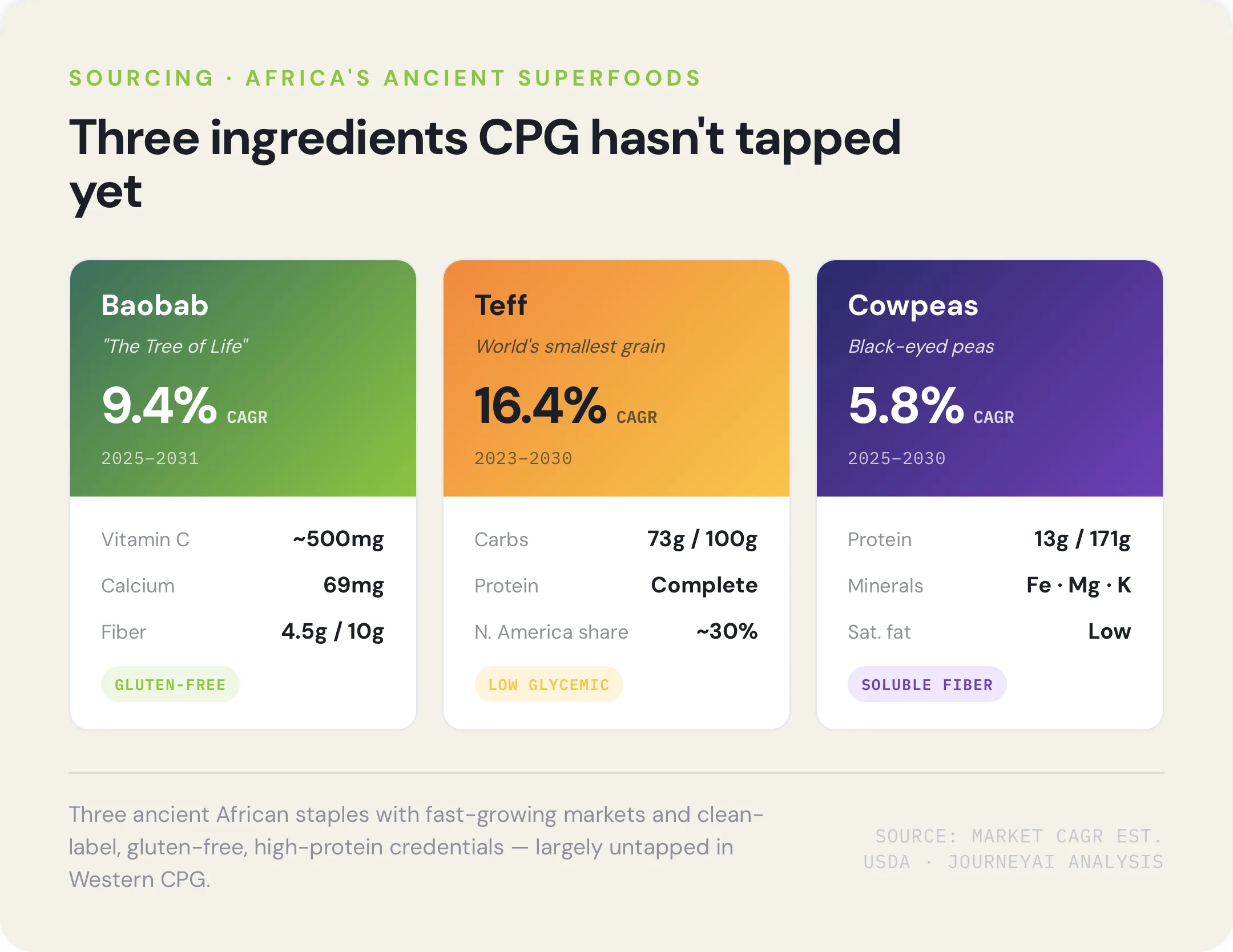
Known as "The Tree of Life" (a great marketing line), baobab fruit has been farmed and consumed for centuries. Baobab - fruit or powder - is a veritable superfood that greatly appeals to health-conscious consumers looking to try something brand new. The CAGR is also staggering with a rate of 9.4% for 2025 - 2031.
Nutritional Benefits:
Baobab can be consumed in many forms including powders, capsules, energy bars, yogurt, cereals.
Teff is the world’s smallest grain that has been globally exported from Ethiopia to countries like the United States, Australia, and India. It has a unique earthy taste that gives it a distinct flavor over its common counterparts. With a strong CAGR of 16.38% between 2023 - 2030, the teff market is expected to grow substanially with North America holding approximately 30% of its market share.
Nutritional Benefits:
Teff being a grain makes it versatile in ways that can be applied to products, including but not limited to bread, flour, porridge, snacks, etc.
Cowpeas - or black-eyed peas - are native to Africa. They are a very good source of protein with 13g found in 171g of cowpeas as well as other vitamins and minerals. Cowpeas are a staple in African cuisine and interestingly used in a dish called Hoppin' Johns on New Year's Day. There are innovations being made with them as well such as plant-based meat, cowpea flour, and snacks such as cowpea chips - making this a legume to keep an eye on. The numbers speak for themselves as well: a CAGR of 5.8% for 2025- 2030.
Nutritional Benefits:
As aforementioned the power of cowpeas is emerging as a formidable force in the food and CPG industry with no shortage of creative products that can be manufactured from them.
For brands formulating with these popular African ingredients, leveraging advanced data and sourcing intelligence is critical. Journey Foods offers real-time ingredient trend analysis, sustainability metrics, and regulatory data, making it seamless for product development teams to design, prototype, and launch innovative mood-supporting foods and drinks that meet today’s consumer demand.
Want to accelerate your next breakthrough? Journey Foods is your technology partner for functional food success—empowering companies with science-backed, market-driven ingredient solutions.