

Quick answer
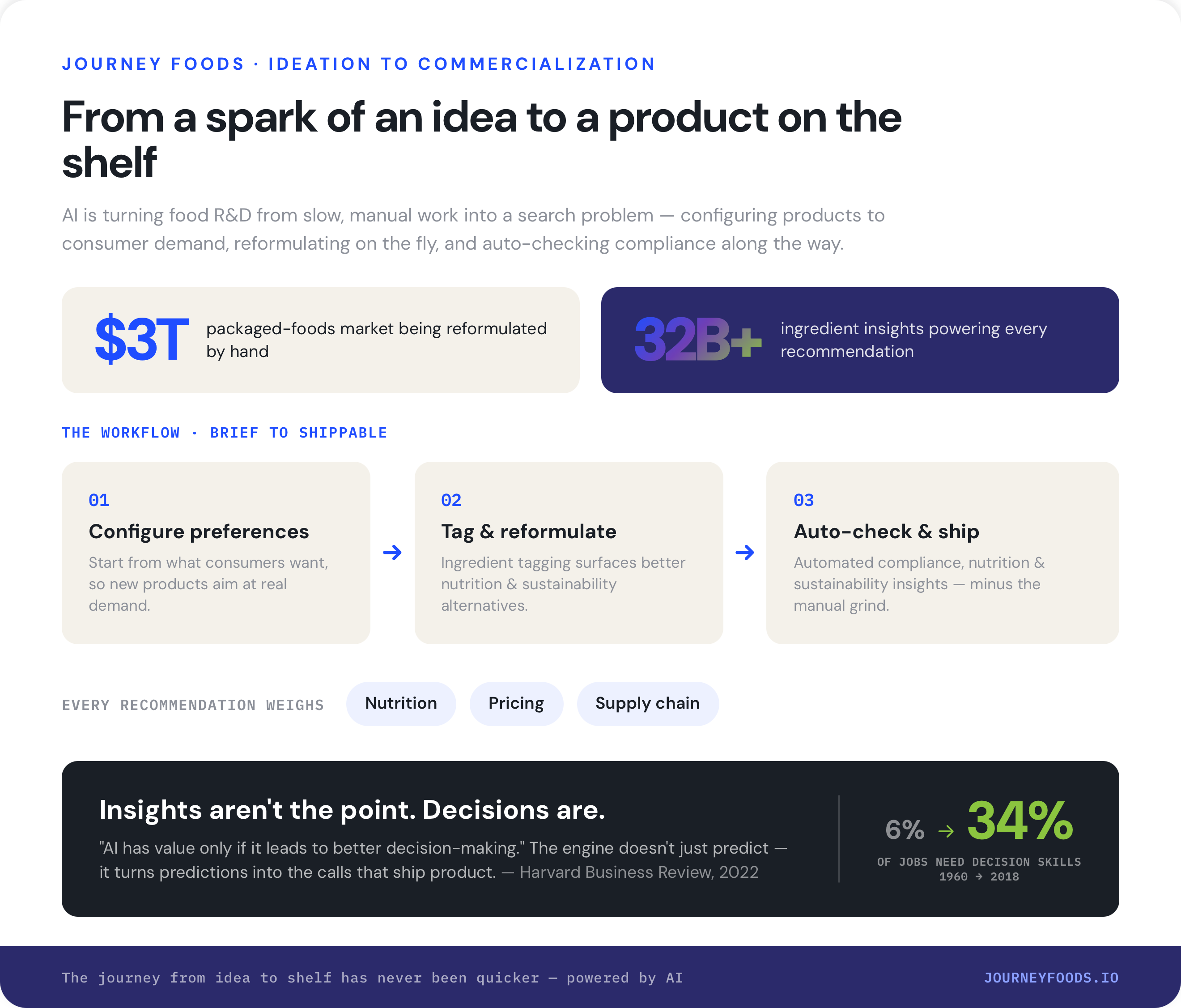
Journey Foods leverages AI to revolutionize ingredient discovery, enabling rapid transition from product ideation to commercialization with features like consumer preference configuration, ingredient tagging, and automated compliance insights. Their extensive database, containing over 32 billion ingredient insights, allows dynamic analysis and methodical recommendations based on nutrition, pricing, and supply chain parameters. By enhancing strategic decision-making, Journey Foods ensures quicker data access and continuous product monitoring, crucial in the fast-paced food industry. This AI-driven approach transforms insights into actionable decisions, paving the way for seamless and efficient food innovation.
In the ever-evolving world of food production, the ability to innovate rapidly while maintaining high standards for nutrition, sustainability, and consumer preferences is paramount. Journey Foods is at the forefront of this transformation, leveraging cutting-edge artificial intelligence to streamline the journey from product ideation to commercialization. Their innovative software is revolutionizing ingredient discovery, setting new standards for the $3 trillion packaged foods market.
Accelerating Innovation with AI
The core strength of Journey Foods lies in its ability to enable food companies to swiftly transition from new ideas or improvements to market-ready products. This is achieved through a combination of advanced features designed to meet the demands of modern consumers and regulatory environments. Here's how they do it:
1. Consumer Preference Configuration: Journey Foods’ software starts by configuring desired consumer preferences. This step ensures that new products or product improvements are aligned with what consumers are looking for, enhancing the likelihood of market success.
2. Ingredient Tagging and Formulation Improvement: The software uses ingredient tagging to generate improved product formulations. By tagging ingredients, the system can identify and suggest alternatives that may offer better nutritional profiles or sustainability benefits.
3. Automated Compliance and Supply Chain Insights: One of the standout features of Journey Foods' solution is its ability to provide automated insights on compliance, nutrition, and sustainability. This automation significantly reduces the time and effort required to ensure that products meet regulatory standards and sustainability goals.
Harnessing the Power of Data
Journey Foods has built an extensive and standardized database, which is pivotal to their success. This database, which houses over 32 billion ingredient insights, allows for dynamic analysis and methodical recommendations. Here's how it works:
- Extensive Ingredient Database: The database extracts data from millions of ingredients, creating a rich resource for analysis. This extensive data pool is crucial for the algorithms to perform their magic.
- Dynamic Analysis and Recommendations: The algorithms dynamically analyze the extracted data and provide methodical recommendations. These recommendations are not just based on the nutritional value of the ingredients but also consider pricing and supply chain parameters, ensuring a holistic approach to product optimization.
Strategic Decision-Making with AI
For management teams, the ability to access data quickly and efficiently is a game-changer. Journey Foods' solutions offer significantly quicker data access, enabling better strategic decision-making. This ease of monitoring products is essential in a market where speed and accuracy can determine success.
- Improved Strategic Decisions: With quick access to comprehensive data, management can make informed decisions that align with their strategic goals, whether it's entering a new market, reformulating existing products, or optimizing supply chains.
- Ease of Monitoring: Continuous monitoring of products is simplified, allowing companies to stay ahead of potential issues and adapt swiftly to changing market conditions.
Transforming Insights into Decisions
A December 2022 article from Harvard Business Review highlights an essential perspective on the role of AI in business transformation: "Though it’s the stock response, 'insights' is precisely the wrong way to think about how an advance in AI will create value. In fact, we feel that 'insights' often is code for 'We don’t know what to do with our AI’s predictions.' A much better answer would be to describe the decisions that the predictions will improve, because AI has value only if it leads to better decision-making."
This perspective underscores the importance of AI-driven solutions like those offered by Journey Foods. The software not only provides insights but translates these into actionable decisions that enhance product development and strategic planning. This capability is increasingly critical as the number of decisions businesses need to make rises. According to research by David Deming of the Harvard Kennedy School, by 2018, 34% of jobs required core decision-making skills, a significant increase from just 6% in 1960.
The Future of Food Innovation
As the food industry continues to grow and evolve, the role of AI in ingredient discovery and product development will only become more significant. Journey Foods is leading the charge, demonstrating how AI can be harnessed to meet the complex demands of today's food market. By providing tools that streamline the innovation process, improve product formulations, and enhance strategic decision-making, Journey Foods is not just keeping pace with the industry but setting the pace.
The journey from a spark of an idea to a product on the shelves has never been quicker or more efficient. With AI-driven insights and a vast database at their fingertips, food companies can look forward to a future where innovation is not just a goal but a seamless, ongoing process. Journey Foods is proving that the future of food is here, and it's powered by AI.
As published
$3
Data from this story
Shareable Journey Intelligence
Using AI in Ingredient Database Management
Industry Insights
$3
Their innovative software is revolutionizing ingredient discovery, setting new standards for the $3 trillion packaged foods market.
34%
According to research by David Deming of the Harvard Kennedy School, by 2018, 34% of jobs required core decision-making skills, a significant increase from just 6% in 1960.