Quick answer
You've probably already sat through a demo that looked impressive until you tried to map it to your actual workflow. Or you bought something that solved one problem and quietly created three others.
This guide is for R&D directors, food scientists, and product development leads who are past the awareness stage. It covers what features actually matter, how to categorize the platforms available today, what to test before you sign anything, and where most buying decisions go wrong.
What a Food Product Development Platform Should Actually Solve
Start here before you look at any feature list.
The core problems in food product development are consistent across mid-market CPG brands and funded food startups: ingredient research takes weeks when it should take hours, formulation changes get tracked in spreadsheets that fork into multiple versions, and supply chain disruptions arrive as surprises rather than early warnings.
A platform worth buying solves all three. Not one. Not two. All three, in a connected workflow.
If a platform handles formulation management but forces you to pull ingredient data from a separate tool and monitor supply chain risk in your inbox, you haven't solved the problem. You've added another system to manage.
The right question to ask any vendor early: does your platform score ingredients across nutrition, cost, and sustainability in one search, or do those live in separate modules?
The answer tells you a lot about how the product was actually designed.
Core Features That Actually Matter
Ingredient Intelligence With Multi-Criteria Scoring
Single-dimension ingredient databases are a dead end. A tool that scores only on nutrition forces your procurement manager to run a parallel cost analysis. A tool that scores only on sustainability leaves your food scientist guessing on protein functionality.
What you need is simultaneous scoring across all three criteria: nutrition, cost, and sustainability. Not tabs. Not separate reports. One search result that shows you where an ingredient stands across all three dimensions so you can make a real decision.
AI-driven recommendations matter here too. The best systems don't just return search results — they suggest alternatives based on your formulation goals. Looking for a plant-based protein that hits your cost target and clears your sustainability threshold? The platform should surface candidates ranked against your specific constraints, not a generic list.
Watch out for platforms with limited ingredient databases that require manual data entry for basic nutritional values. If your team is maintaining ingredient data instead of using it, the platform is working against you.
Formulation Management and Version Control
Version control is not a nice-to-have. It's the difference between a team that ships and a team that spends Fridays reconciling spreadsheets.
Your platform needs to track every formulation change, log who made it, and allow rollbacks to any previous version. This sounds basic. It's surprisingly rare to find it implemented well.
Beyond change tracking, look for sub-recipe handling and automatic scaling. If you develop products across multiple SKUs or size variations, the platform should recalculate ingredient quantities and costs without manual intervention. Side-by-side version comparison — with visible deltas in nutrition profiles, cost, and sustainability scores — is essential for any serious reformulation decision.
One CPG brand cut ingredient research time by 64% after centralizing formulation management and ingredient scoring in one place. That kind of gain doesn't come from a better spreadsheet. It comes from eliminating the structural friction between data, formulation, and team communication.
Supply Chain Integration and Real-Time Alerts
This is where most platforms fall short — and where the cost of getting it wrong is highest.
Reactive supply chain management is expensive. You find out about an ingredient shortage when your supplier calls, not when you still have time to reformulate. You discover a price spike when it hits your cost model, not three weeks earlier when you could have locked in an alternative.
A serious food product development platform connects to supplier data and monitors ingredient availability, price changes, and disruption signals continuously. It sends alerts before the issue becomes a delay. And it pairs those alerts with AI-suggested alternatives so your team can act immediately rather than starting a new research cycle from scratch.
Supply chain intelligence has become central to how food innovation actually works at the companies moving fastest. R&D and supply chain can no longer operate in separate lanes. The platform you choose should reflect that reality.
Collaborative Workflows Across Functions
Your food scientists, regulatory specialists, and procurement managers need to work from the same data. Not synchronized copies. Not emailed exports. The same live dataset.
Look for comment threads on specific formulations, task assignment for development milestones, and role-based access so each function sees what they need without noise from irrelevant data. Approval workflows for formulation sign-offs reduce the back-and-forth that kills timelines.
The test here is simple: can your procurement manager see current formulation costs and flag a sourcing issue without asking your food scientist to export anything? If the answer is no, the platform isn't truly collaborative.
Platform Types: What You're Actually Choosing Between
Enterprise PLM Systems
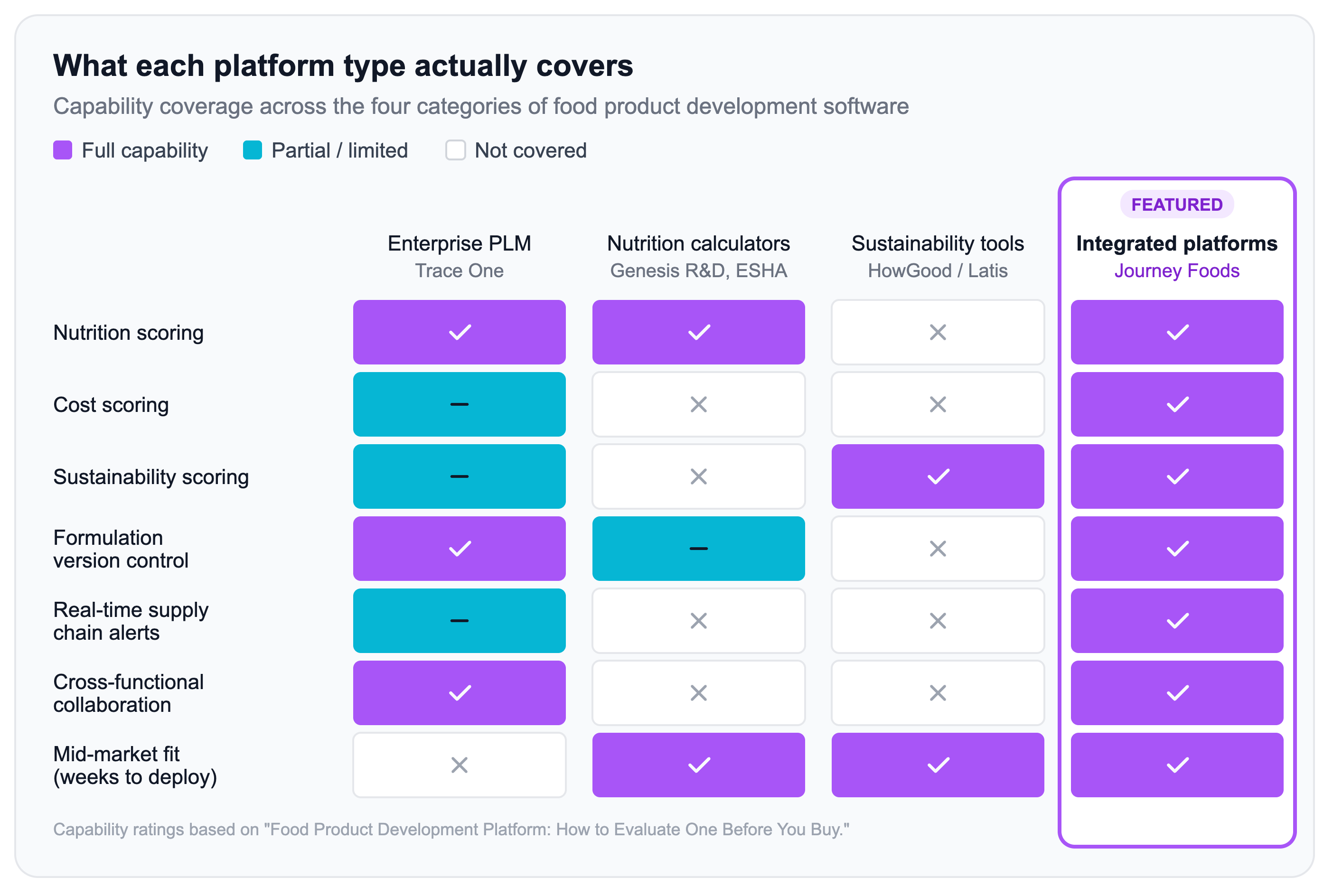
Trace One is the clearest example in this category. Strong product lifecycle management heritage, a 2026 AI copilot, and deep regulatory compliance tooling. The tradeoff is real: enterprise-only pricing, complex implementation, and weak real-time supply chain intelligence.
If you run a large CPG organization with dedicated IT resources and a six-to-twelve month implementation runway, enterprise PLM may be the right fit. If you have 50 to 500 employees and need to be operational in weeks, it probably isn't.
Nutrition-Focused Calculators
Genesis R&D and ESHA sit here. Established nutrition calculation engines, familiar to food scientists, useful for regulatory submissions. The problem is the ceiling. Genesis R&D has no supply chain integration. ESHA lacks ingredient sourcing intelligence. Neither handles collaborative development workflows.
These tools work well as a component of your stack. They don't work as a platform.
Sustainability-Only Tools
HowGood (now Latis) covers more than 33,000 ingredients and is used by six of the top ten food companies. Its sustainability scoring is serious. But it doesn't score on cost, doesn't include nutrition analysis, and has no collaborative development features.
If sustainability reporting is your only requirement, HowGood is worth evaluating. If you need to balance sustainability against cost, and nutrition in a live formulation workflow, it can't do that job.
Integrated Development Platforms
This is the category that fills the gap between simple calculators and enterprise PLM. Platforms here handle ingredient discovery, multi-criteria scoring, formulation management, version control, supply chain monitoring, and team collaboration in one system.
Journey Foods sits in this category. The Operations Scientist AI engine scores ingredients simultaneously across nutrition, cost, and sustainability. Formulations are built, versioned, and compared in the same dashboard. Supply chain alerts fire before disruptions reach your timeline. The entire team works from one dataset.
Pricing runs from $199 per month for a single user on the Fresh tier through $1,999 per month for the Enterprise tier with 50 users, product optimization AI, and customer reporting. Custom pricing is available for larger organizations. That range is specifically designed for teams that need real capability without an enterprise implementation project.
AI in food product development has matured enough that integrated platforms now deliver what only enterprise systems could handle a few years ago. The question is whether the platform you're evaluating has actually caught up.
Evaluation Framework: What to Test Before You Buy
Don't evaluate a food product development platform on demo slides. Evaluate it on your actual work.
Before the demo, prepare these four test cases:
Bring these to the demo and ask the vendor to show you exactly how their platform handles each one. Not a hypothetical. Your specific scenario.
Questions that separate serious platforms from feature lists:
The free trial or pilot is non-negotiable. Any platform worth buying should give you access to test it with real data. If a vendor resists a structured pilot, that tells you something about their confidence in the product.
Red Flags to Watch For
These are patterns that should make you pause regardless of how good the demo looked.
Single-dimension scoring presented as complete. A platform that scores only on nutrition and calls it ingredient intelligence is missing the point. Cost and sustainability are not optional dimensions for most CPG teams in 2026.
No real-time supply chain data. If the platform shows historical supplier information but can't alert you to current disruptions, it's a database — not a supply chain tool.
Version control that lives in a separate module. Formulation history and current formulation should be in the same view. If you have to navigate elsewhere to see version history, the workflow will break down in practice.
Pricing that hides per-feature costs. If the base price gets you the interface but AI recommendations, supply chain alerts, or API access require add-on purchases, model the real cost before you compare anything.
Implementation timelines measured in months. A platform designed for mid-market teams should not require a six-month IT project to deploy. If the vendor's standard onboarding extends beyond your next product launch cycle, that's a structural mismatch.
No cross-functional access model. If the platform is built for a single user type, it will create new silos rather than eliminating existing ones. Confirm that food scientists, procurement managers, and supply chain leads can all work in the same system with appropriate role-based access.
Implementation and Team Adoption
A platform your team doesn't use is worse than no platform. It costs money and creates the illusion of a solved problem.
Three things drive adoption in food product development teams.
First, the platform has to reduce friction on day one. If your food scientists spend the first week migrating data before they can do anything useful, you'll lose them. Look for structured onboarding, pre-built integrations with common data sources, and import tools for existing formulation data.
Second, every role needs a clear reason to log in. Your food scientist needs better ingredient search. Your procurement manager needs supply chain visibility. Your regulatory specialist needs formulation documentation. If the platform serves all three, adoption follows. If it only serves one, the others will route around it.
Third, the data has to be trusted. Version confusion is the adoption killer. If team members aren't sure whether the formulation in the platform is the current one, they'll go back to email. Automated version control with clear change logs removes that doubt.
Digital tools that build transparency and traceability across the product development workflow do more than improve efficiency. They create an audit trail that supports regulatory submissions, sustainability reporting, and cross-functional trust — a capability that compounds over time.
Making the Final Decision
You're comparing platforms across multiple dimensions simultaneously: feature depth, pricing, implementation complexity, and vendor stability. Here's how to structure the final call.
Build a weighted scorecard. Assign weights to the criteria that matter most for your specific situation. If you're mid-reformulation, supply chain intelligence and formulation management weight heavily. If you're scaling a startup, pricing and time-to-value weight heavily. Don't use a generic scorecard from a vendor's website.
Run the pilot with your actual team. Not just the power user who drove the evaluation. Include the procurement manager who will check supply alerts and the food scientist who will run ingredient searches daily. Their friction points will surface in a pilot that never appear in a demo.
Model the total cost over 24 months. Include the base subscription, any per-feature add-ons, implementation costs, and the time your team spends on onboarding. Then compare that against the cost of your current process: hours spent on manual ingredient research, delays from version confusion, and the last supply disruption that caught you off guard.
Check the vendor's track record with teams your size. Partners like Kroger, NASA, SAP, and the World Economic Forum signal enterprise credibility. But if you're a 100-person CPG brand, you also want to know the platform works at your scale. Ask for references from companies with similar headcount and product complexity.
The right platform doesn't ask you to choose between capability and complexity. It fits your team's workflow, scales as you grow, and starts delivering value before your next launch cycle.
See how Journey Foods handles this end-to-end — from ingredient scoring through supply chain alerts to team collaboration. Book a demo at journeyfoods.io/book-a-demo.
FAQs
What is a food product development platform?
A food product development platform is software that centralizes the tools R&D and product teams use to develop food and beverage products. Core capabilities typically include ingredient search and scoring, formulation management with version control, supply chain monitoring, and collaborative workflows across R&D, procurement, and regulatory functions.
How is a food product development platform different from a nutrition calculator?
A nutrition calculator handles one task: computing nutritional values for a formulation. A food product development platform covers the full development workflow — ingredient discovery, multi-criteria scoring across nutrition, cost, and sustainability, formulation versioning, supply chain alerts, and team collaboration. Tools like Genesis R&D or ESHA are useful components, but they don't replace a full platform.
What should I look for in ingredient scoring?
Look for simultaneous scoring across at least three dimensions: nutrition, cost, and sustainability. Single-dimension scoring forces parallel analyses in separate tools, which defeats the purpose of a platform. AI-driven alternative suggestions based on your specific formulation constraints add significant value beyond basic search.
How do I evaluate a food product development platform before buying?
Prepare four to five real scenarios from your recent work — a formulation revision cycle, a supply chain disruption, and a cross-functional approval process are good starting points. Bring those to the demo and ask the vendor to walk through each one in the actual product. Run a structured pilot with your full team before signing. Evaluate on real workflow fit, not feature lists.
What is the typical pricing for food product development platforms?
Pricing varies significantly by platform type and team size. Journey Foods ranges from $199 per month for a single user on the Fresh tier to $1,999 per month for 50 users on the Enterprise tier, with custom pricing available above that. Enterprise PLM systems like Trace One operate at a different price point entirely and are designed for large organizations with dedicated IT resources.
How long does implementation typically take?
For integrated platforms designed for mid-market teams, implementation should be measured in days to weeks, not months. If a vendor's standard onboarding for a team of ten extends beyond four to six weeks, the platform likely wasn't built for your scale. Enterprise PLM systems are the exception and often require multi-month implementation projects.
Can a food product development platform help with supply chain risk?
Yes — if it's built for it. Look specifically for real-time supply chain monitoring with proactive alerts, not just historical supplier data. The best platforms flag ingredient shortages, price volatility, and disruption signals before they affect your timeline, and pair those alerts with AI-suggested alternatives so your team can act without starting a new research cycle from scratch.
As published
64%
Data from this story
Shareable Journey Intelligence
Food Product Development Platform: How to Evaluate One Before You Buy
Industry Insights
64%
One CPG brand cut ingredient research time by 64% after centralizing formulation management and ingredient scoring in one place.
$199
Pricing runs from $199 per month for a single user on the Fresh tier through $1,999 per month for the Enterprise tier with 50 users, product optimization AI, and customer reporting.