

.svg)
.svg)
.svg)
.svg)


.svg)
Most supplier qualification processes work fine until they don't. They're built for steady-state operations: stable lead times, predictable pricing, suppliers who reliably pick up the phone. Then a shortage hits, and the whole thing falls apart.
The problem usually isn't that teams skipped qualification. It's that qualification was treated as a one-time gate rather than a continuous discipline. You approved a supplier, filed the paperwork, and moved on. When disruption arrived, you discovered your approved vendor list was a historical document — not an operational tool.
Here's how to build a supplier qualification process that holds up under pressure, not just in normal conditions.
The structural flaw is almost always the same: qualification is static, and supply chains are not.
A supplier who passed your audit 18 months ago may have changed contract manufacturers, shifted their raw material sourcing, or taken on volume commitments that push your orders to the back of the queue. You won't know any of that until you need them urgently.
Three failure modes show up repeatedly:
Generic qualification checklists ask for certifications, insurance, and a food safety plan. That's the floor, not the standard.
A framework built for resilience scores suppliers across dimensions that predict failure during a shortage:
Score each supplier against these dimensions at onboarding, then re-score on a defined cadence.
Not all approved suppliers are equal. Treating them as if they are creates false confidence.
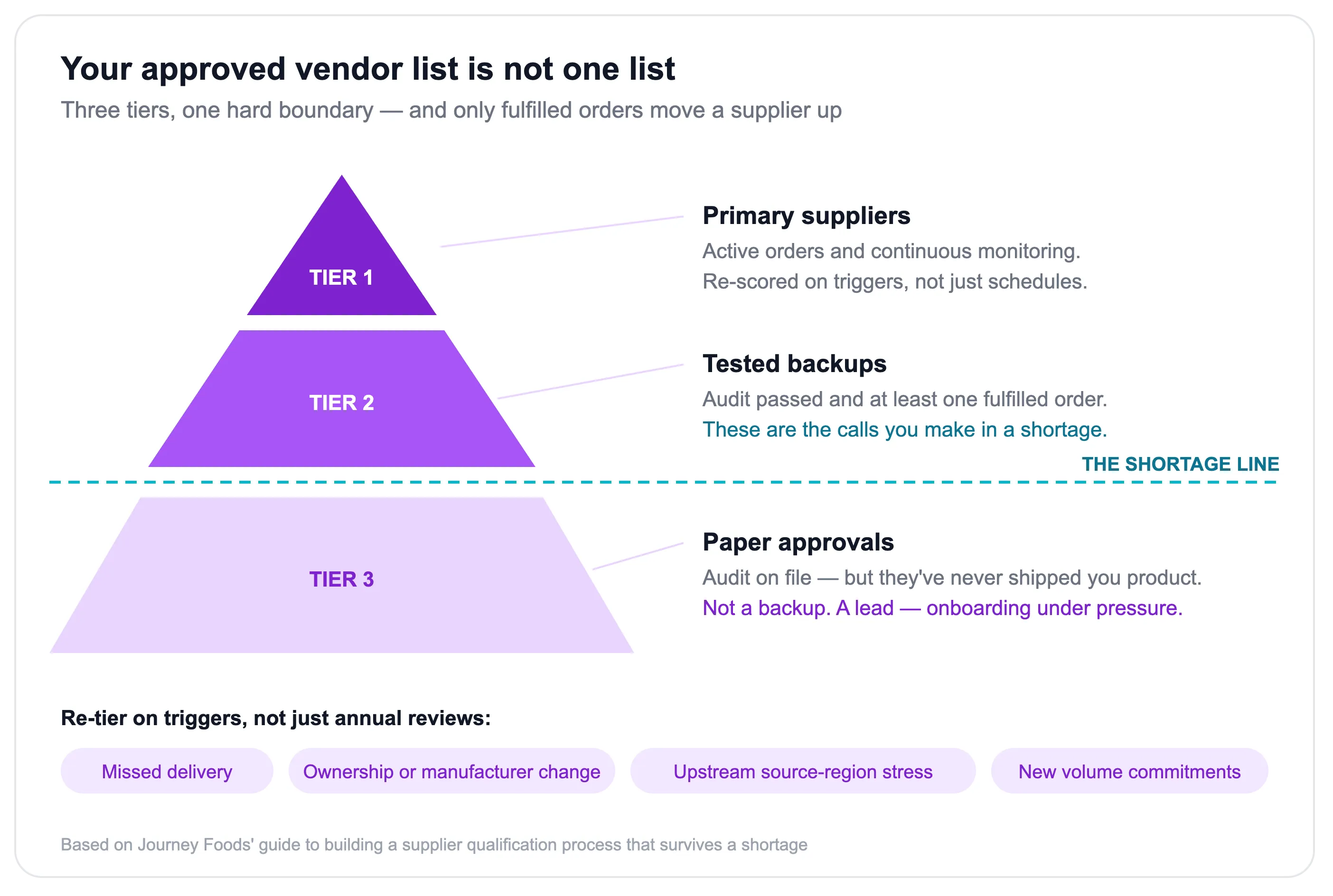
A tiered structure gives your team a real operational picture:
The critical rule: Tier 2 status requires an actual fulfilled order, not just a completed audit. A supplier who has never shipped you product is not a backup. They're a lead.
During a shortage, you want to be calling Tier 2 suppliers — not starting Tier 3 conversations.
Annual re-qualification is better than nothing. Event-based re-qualification is better than annual.
Define the specific events that automatically trigger a review:
That last trigger is the one most teams miss. If your sunflower oil supplier's primary source region is experiencing a drought or export restriction, their ability to fulfill your next order is already compromised — even if they haven't told you yet.
Real-time monitoring of ingredient-level supply chain signals is what separates reactive teams from proactive ones. Journey Foods' Operations Scientist engine tracks these signals and surfaces alerts before they become shortages, giving procurement teams time to act rather than scramble. See how it works at journeyfoods.io.
Supplier qualification data is only useful if the people who need it can access it when they need it.
In most mid-market CPG companies, that data is fragmented:
When a shortage hits and you need to make a fast decision about an alternative supplier, someone is sending emails to three different departments trying to assemble a complete picture. That process takes days you don't have.
Centralizing this data doesn't require a massive IT project. It requires agreement on a single system of record that all functions can access and update. The qualification record for any supplier should show current tier status, last audit date, open quality issues, pricing history, and active supply chain alerts — all in one view.
For teams evaluating what this actually changes operationally, the case study on cutting ingredient research time by 64% is worth reading.
This is the step most teams skip because it feels theoretical. It isn't.
A shortage simulation is straightforward: pick your three most critical ingredients and ask what happens if your primary supplier can't deliver for 60 days. Work through the actual steps:
Running this exercise once will surface gaps you didn't know existed. It will also tell you whether your qualification tiers are real or just labels.
Document the findings. Update your qualification records based on what you learn. Repeat annually, or whenever you add a new critical ingredient to your portfolio.
Supplier qualification doesn't exist in isolation. It's downstream of ingredient selection decisions.
If you select an ingredient with only two viable global suppliers, you've already constrained your qualification options before the process starts. Building supplier resilience begins with understanding the supply chain depth of an ingredient before you commit to it in a formulation.
This is where ingredient scoring across cost, nutrition, and sustainability becomes operationally relevant — not just strategically interesting. An ingredient with strong nutritional and sustainability credentials but a fragile supply base carries a risk profile that should factor into the formulation decision. For teams thinking through sustainability criteria at the supplier level, the sourcing depth question and the sustainability question are inseparable.
The best qualification processes are built backward from ingredient strategy, not bolted on afterward.
A mature supplier qualification process for a mid-market CPG team has these characteristics:
None of this requires a large team. It requires clear ownership and the right data infrastructure.
What is supplier qualification in food and CPG?
Supplier qualification is the process of evaluating and approving ingredient or material suppliers before using them in production. It typically covers food safety certifications, quality standards, regulatory compliance, financial stability, and supply chain reliability. In food and CPG, it also includes ingredient-specific criteria like traceability, sustainability certifications, and technical specifications relevant to formulation.
How often should CPG companies re-qualify suppliers?
Annual re-qualification is a common baseline, but it's not sufficient on its own. Leading teams also set event-based triggers that initiate a review when a supplier misses a delivery, changes ownership, or when upstream raw material conditions shift. High-criticality suppliers warrant more frequent review than low-risk commodity sources.
What's the difference between an approved supplier and a qualified backup supplier?
An approved supplier has passed your qualification criteria on paper. A qualified backup has passed your criteria and fulfilled at least one actual order. The distinction matters during a shortage: a backup who has never shipped you product requires a full onboarding process under time pressure — which is not a backup in any practical sense.
How do you qualify a supplier faster during an active shortage?
Fast-track qualification prioritizes the highest-risk criteria: food safety certification status, regulatory standing, and the ability to meet your technical specs. Pre-negotiating a fast-track protocol with your quality and regulatory teams before a shortage occurs is the only reliable way to compress the timeline when you actually need it.
How does ingredient scoring connect to supplier qualification?
Ingredient selection directly shapes your supplier options. Ingredients with narrow global supply bases or high geographic concentration carry inherent supplier risk. Scoring ingredients across supply chain depth, cost stability, and sustainability at the selection stage helps you avoid building formulations that are structurally difficult to source — before qualification becomes the problem.
What data should a supplier qualification record include?
At minimum: current approval status and tier, last audit date and outcome, active certifications with expiry dates, quality incident history, pricing and order history, supply chain alerts or flags, and contact information for key account and quality contacts. The record should be accessible to procurement, quality, and R&D without requiring a cross-departmental request.
What tools do CPG teams use to manage supplier qualification data?
Approaches range from spreadsheets and shared drives at smaller companies to dedicated supplier management modules within ERP systems at larger ones. Mid-market teams increasingly use ingredient and supply chain platforms that centralize qualification data alongside formulation management and real-time supply chain monitoring — reducing the fragmentation that makes shortage response slow.
A supplier qualification process that holds up during a shortage is built during normal operations, not assembled in response to one. The teams who navigate disruptions without major delays are the ones who treated qualification as a continuous operational discipline rather than a compliance checkbox.
Start with your highest-criticality ingredients. Map your current supplier tiers honestly. Identify where you have paper backups versus tested ones. Run one shortage simulation this quarter.
If you want to see how Journey Foods helps procurement and R&D teams centralize supplier and ingredient data to make faster decisions under pressure, book a demo at journeyfoods.io/book-a-demo.
Scientist. Nutrition Leader. Founder of Journey Foods