
.svg)
.svg)
.svg)
.svg)


.svg)
Fast-casual chains are a live laboratory for CPG product development. They move fast, serve millions of people, and get real-time feedback on what works — and what doesn't.
Fast-casual chains are a live laboratory for CPG product development. They move fast, serve millions of people, and get real-time feedback on what works — and what doesn't.
Noodles & Company is one of the more instructive case studies in that lab. With over 450 U.S. locations and a menu built around global noodle dishes, they've had to solve the same problems your R&D team wrestles with: ingredient consistency, allergen management, clean-label pressure, and supply chain reliability at scale. Let's look at what's actually in the bowl — and what it tells you about where the food industry is heading.
Noodles & Company isn't a trendy startup. It's a 30-year-old chain that has survived multiple rounds of consumer preference shifts — low-carb panic, gluten-free demand, and now the protein-forward moment.
That durability is the point. They've reformulated, adapted sourcing, and communicated ingredient changes to a broad consumer base, repeatedly, under pressure. For CPG brands, that's a masterclass in ingredient strategy that actually holds up.
They also publish detailed nutritional and allergen information for every menu item. That gives us real data to work with.
The foundation of every dish is the noodle format — and Noodles & Company runs a wide range. Their core offerings include:
The zucchini noodle and cauliflower gnocchi additions are worth noting. They reflect direct consumer demand for lower-carb, vegetable-forward formats — without abandoning the noodle concept entirely. That's disciplined formulation thinking.
Proteins vary by dish, but the sourcing signals are consistent:
The tofu option isn't just a trend accommodation. It's a formulation decision that broadens the addressable market without adding a new dish. CPG teams should note that.
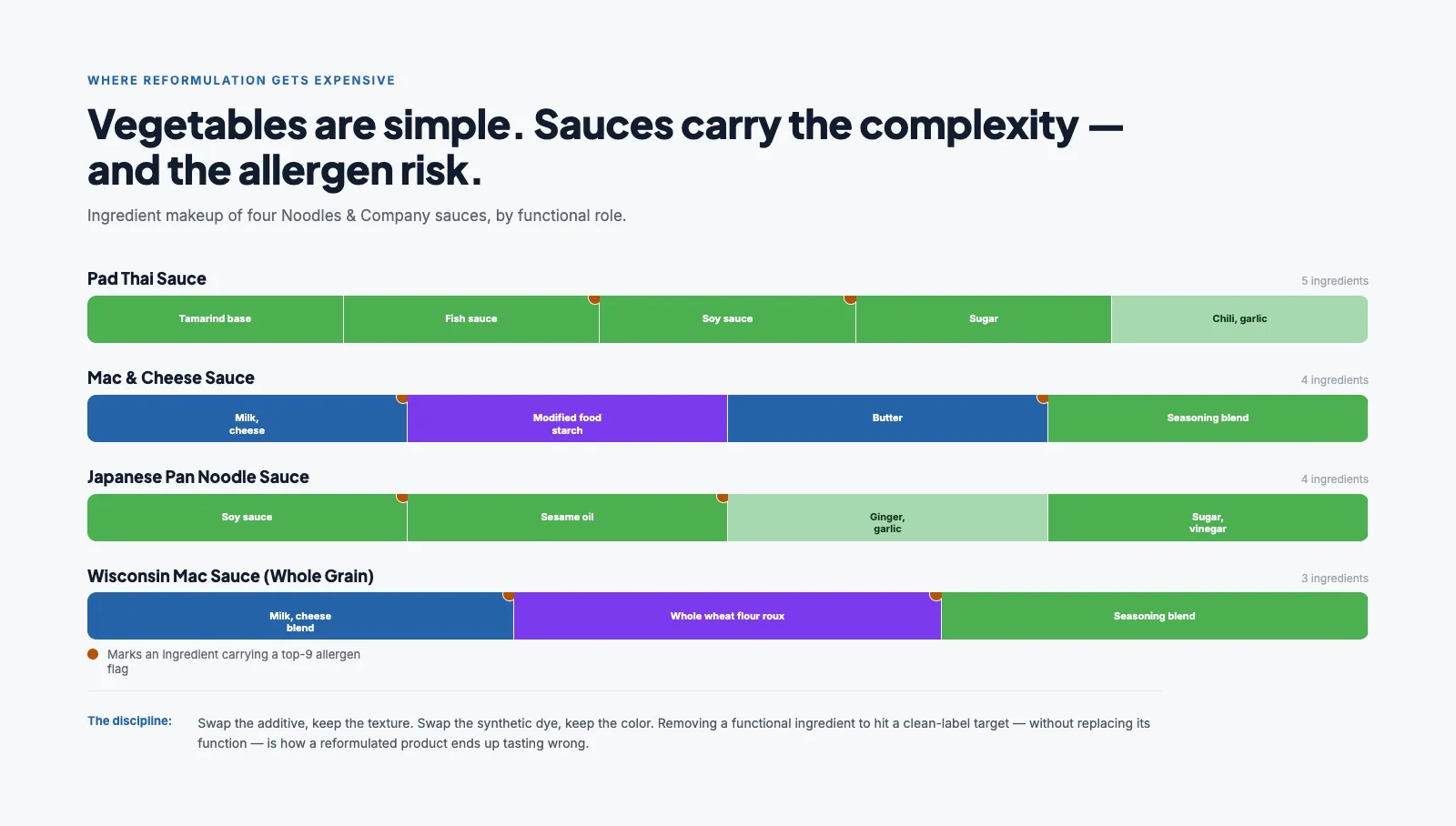
This is where ingredient complexity lives. Sauces are the hardest part of any noodle dish to standardize at scale — they carry the most flavor variables and the most allergen risk.
Key sauce ingredients across the menu:
The Pad Thai sauce carries both shellfish-adjacent and gluten allergen flags — fish sauce and soy sauce. They disclose this clearly. That transparency isn't accidental.
Most dishes include fresh or lightly prepared vegetables:
Simple, recognizable, clean-label. No ingredient here requires a food scientist to decode it.
Over the past several years, Noodles & Company made a deliberate move toward cleaner ingredient lists — removing MSG from most sauces, reducing preservative use, and adding more whole-food options to the menu.
This is exactly the pressure CPG brands face from retail buyers and consumers at the same time. Clean-label isn't a niche request anymore. It's a baseline expectation, especially in better-for-you and premium segments.
What they did well:
The lesson for CPG R&D teams: clean-label reformulation works best when you preserve the functional role of the ingredient you're removing. Swap the additive, keep the texture. Swap the synthetic dye, keep the color. That's the discipline.
If you're tracking where the food industry is heading on ingredient transparency, the AI and transparency trends shaping 2026 are worth understanding.
Noodles & Company lists the top nine allergens for every menu item — wheat, milk, eggs, soy, peanuts, tree nuts, fish, shellfish, and sesame — and flags cross-contact risk clearly.
That's above the regulatory minimum. And it's smart business.
Consumers with dietary restrictions are intensely loyal to brands that make their lives easier. If your product clearly communicates what's in it, you earn trust that competitors burying allergen info in fine print simply don't have.
For CPG brands, allergen labeling isn't just a compliance function — it's a marketing asset. Your packaging, your product page, and your retail shelf presence all benefit from leading with what's not in the product, not just what is.
Here's the practical read for product developers and R&D leads.
1. Ingredient variety is a supply chain problem first.
Noodles & Company runs five noodle formats across 450+ locations. That's five separate supply chains, five sets of quality specs, five allergen management protocols. At CPG scale, ingredient variety multiplies operational complexity fast. Every ingredient you add to a formulation is a sourcing decision, a cost variable, and a risk vector.
2. Vegetable-forward formats are durable, not trendy.
Zucchini noodles and cauliflower gnocchi aren't novelties anymore — they're permanent menu items because the demand held. CPG brands building pasta, grain, or noodle-adjacent products should be evaluating vegetable-based formats as core SKUs, not line extensions.
3. Sauce complexity is where reformulation gets expensive.
The Mac & Cheese sauce uses modified food starch. The Pad Thai sauce uses fish sauce and soy. These are functional ingredients doing real work. Removing them to hit a clean-label target without replacing their function is how you end up with a product that tastes wrong. Reformulation discipline means understanding why an ingredient is there before you decide to cut it.
4. Transparency scales.
Publishing full ingredient lists and allergen data for every SKU is operationally demanding — but it builds consumer trust and reduces liability. The brands winning shelf space are the ones whose ingredient sourcing can hold up to scrutiny. That connects directly to the sustainability and supplier transparency practices leading food companies are building into their operations now.
5. Watch the protein swap trend.
Tofu as a protein swap isn't just a vegetarian accommodation. It's a signal that consumers want modularity in their meals. CPG brands building protein-forward products should think about how their formulations can flex across protein sources without losing identity. The protein innovation trends shaping Q4 give a useful picture of where this is heading.
Noodles & Company isn't a CPG company. But the ingredient decisions they've made at scale — under consumer pressure, with real supply chain constraints — mirror exactly what product developers face when building packaged food.
The through-line: ingredient decisions are business decisions. Every swap, every addition, every allergen disclosure has downstream effects on cost, sourcing, consumer trust, and competitive positioning.
If you're building or reformulating a food product, the tools you use to make those calls matter. Journey Foods gives R&D teams and supply chain decision-makers AI-powered ingredient intelligence — scoring ingredients across nutrition, cost, and sustainability simultaneously — so you're not making these decisions on gut instinct alone. The AI tools now available for food industry teams have made this kind of analysis faster and more accessible than ever.
The brands getting ingredient strategy right aren't guessing. They're working from data.
What ingredients does Noodles & Company use in their noodles?
Noodles & Company uses several noodle formats depending on the dish: egg noodles (enriched wheat flour, eggs, water), rice noodles (rice flour, water), semolina spaghetti, zucchini noodles (whole zucchini), and cauliflower gnocchi (cauliflower, cassava flour, potato starch, olive oil, sea salt).
Does Noodles & Company have gluten-free options?
Yes. Their rice noodles and zucchini noodles are naturally gluten-free. They do note cross-contact risk in their kitchens, so guests with celiac disease should review the full allergen disclosures before ordering.
What allergens are present in Noodles & Company menu items?
Noodles & Company discloses the top nine allergens for every menu item: wheat, milk, eggs, soy, peanuts, tree nuts, fish, shellfish, and sesame. Many dishes — particularly sauces like Pad Thai (fish, soy) and Mac & Cheese (milk, eggs) — contain multiple allergens.
What can CPG brands learn from Noodles & Company's ingredient strategy?
Quite a bit: the operational complexity of ingredient variety, the staying power of vegetable-based formats, the real cost of sauce reformulation, and the competitive value of allergen transparency. Their menu evolution mirrors the clean-label and protein-forward pressures CPG brands face in retail.
How does Noodles & Company handle clean-label demands?
They removed MSG from most sauces, reduced preservative use, and added whole-food alternatives like zucchini noodles and cauliflower gnocchi — all while maintaining dish identity rather than overhauling the menu.
Why does ingredient transparency matter for CPG brands?
Consumers with dietary restrictions show strong loyalty to brands that communicate clearly. Retailers increasingly require full ingredient and allergen disclosure. Transparency reduces liability and builds trust — making it both a compliance requirement and a genuine marketing asset.
What tools do CPG brands use to manage ingredient decisions at scale?
AI-powered platforms like Journey Foods help R&D teams search, score, and monitor ingredients across nutrition, cost, and sustainability dimensions. That kind of data-driven approach reduces guesswork in formulation and helps teams move faster without sacrificing quality.
We'd love to hear from you! If you have questions or thoughts on ingredient strategy, throw them in the comments below. You can also hit us up on Instagram, LinkedIn, or Twitter.
The Team at Journey
Journey Foods Team News