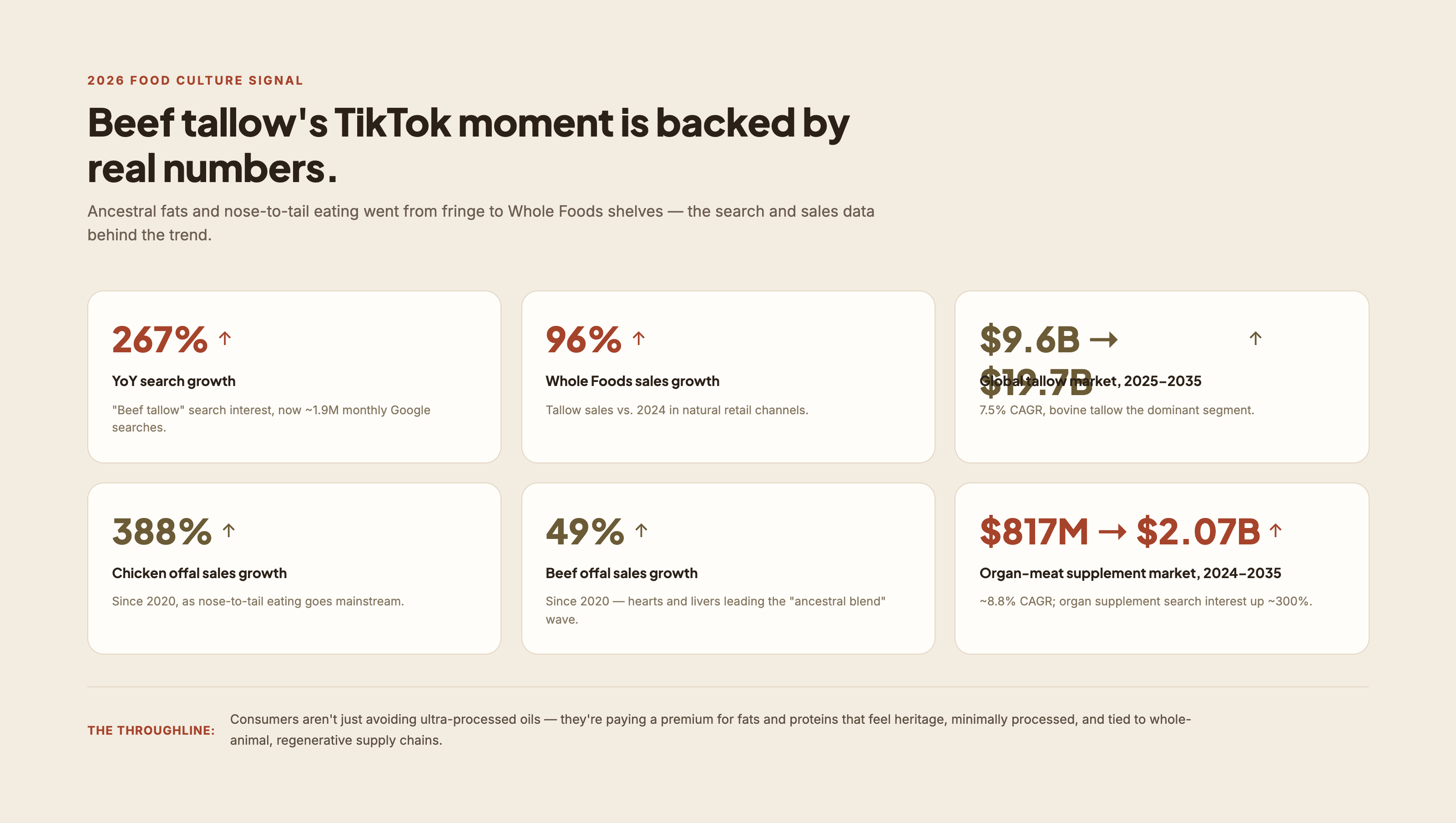
If someone told me three years ago that beef tallow would be trending on TikTok, showing up at Whole Foods, and growing 267% in search interest year over year, I'd have asked what century we were living in.
But here we are in 2026, and beef tallow—along with organ meats, "ancestral blends," and whole-animal utilization—is having a full-blown cultural moment. Search interest in "beef tallow" has reached about 1.9 million monthly Google searches, and in North America, Whole Foods is reporting 96% sales growth versus 2024 in some natural retail channels.[1][4]
This isn't just nostalgia for grandma's cooking. This is a structural shift in how consumers think about fats, processing, and sustainability. And it's reshaping everything from the snack aisle to skincare to biodiesel supply chains.
Let me break down what's actually driving the tallow trend—and what it tells us about where food culture is headed.
The numbers are striking. Globally, the tallow market is projected to rise from $9.6 billion in 2025 to $19.7 billion by 2035, growing at a 7.5% CAGR, with bovine tallow remaining the dominant segment.[2]
In North America specifically, beef tallow is being cited as a top 2026 food trend by Whole Foods—a retailer that's famously good at spotting early signals and translating them into mainstream appeal.[4]
What changed?
Two things happened simultaneously:
1. The backlash against ultra-processed oils intensified.
Health-conscious consumers started questioning seed oils and industrial fats. Reports are flagging "natural fats over artificial alternatives" and "ancestral ingredients" as key drivers behind tallow's renewed appeal.[6][2]
2. Regenerative agriculture gave tallow a sustainability story.
Tallow stopped being just a cooking fat and became part of a larger narrative about whole-animal utilization, waste reduction, and circular food systems. More on that below.
Here's the shift: consumers aren't just avoiding highly processed foods anymore. They're actively seeking out ingredients that feel heritage, simple, and less tampered with.
Beef tallow checks all those boxes. It's rendered fat from beef—literally one ingredient. It has oxidative stability at high heat, which makes it attractive for fryers and shelf-stable products. And it lets brands keep ingredient lists short while maintaining texture and flavor.[2][5]
Analysts attribute tallow's growth to the food and biofuel sectors: it's used in frying, bakery, and snack applications, but also as biodiesel feedstock for companies chasing lower carbon footprints.[5][2] That dual-use flexibility is driving investment and innovation across multiple industries.
But the consumer psychology is what's fascinating here. People want to feel like they're choosing something real—and tallow, with its deep culinary history and minimal processing, delivers that emotional payoff.
Tallow isn't showing up alone. It's part of a broader "nose-to-tail" and ancestral eating movement that's gone from fringe to mainstream remarkably fast.
The organ meat explosion:
The global organ-meat supplement market is projected to grow from about $817 million in 2024 to roughly $2.07 billion by 2035 (around 8.8% CAGR), with search interest in organ supplements up nearly 300%.[6]
What's driving this? A mix of nutrient-density claims, ancestral diet philosophies, and a genuine consumer desire to maximize the value of every part of the animal. These products let shoppers "trade up" to nose-to-tail nutrition without fully committing to cooking liver for dinner—similar to how ancestral blends work in the meat case.
At JourneyAI, we're tracking these formulations closely because they represent a genuine innovation opportunity: brands that can deliver nutrient density, clean labels, and familiar eating experiences are winning with consumers who want both health benefits and comfort.
Here's where tallow gets even more interesting: it's becoming a sustainability asset.
Regenerative and grass-fed beef programs increasingly valorize "whole-animal" usage, with tallow framed as a way to reduce waste and add value to by-products of beef production.[5][2] Market reports highlight regulatory and corporate pressure to cut carbon footprints, and tallow's role as a bio-based input for biodiesel and oleochemicals aligns perfectly with these sustainability narratives.[2][5]
This gives brands a powerful dual claim: they're using "heritage" cooking fats while participating in regenerative or circular-economy systems that leverage every part of the animal.[7][2]
That's compelling storytelling—and it's backed by real infrastructure investment. Companies are building out rendering capacity, certification systems, and supply chains that can scale tallow for both food and fuel applications.
Now let's talk about the cultural moment, because tallow isn't just showing up in food.
Tallow is trending in skincare. It's one of the fastest-rising skincare ingredients on TikTok and Google, with tallow-balm search interest up about 40% since 2021, reinforcing its "natural, ancestral" halo.[8][9]
Dermatology reviews note research gaps and caution about overblown claims—which mirrors nutrition debates.[10][11] Enthusiasm for "ancestral" doesn't always equal robust evidence. That's a nuance worth acknowledging, because the tallow trend is as much about perception and cultural identity as it is about hard science.
Here's the tension I find most interesting: tallow, organ meats, and nose-to-tail eating sit in an ambiguous relationship with ultra-processed food discourse.
These are minimally processed ingredients, yes. But they're often used in highly indulgent dishes—think tallow fries, organ-inclusive burgers, rich pâtés. Consumers get to feel like they're choosing something less processed even when the dish itself is decadent.[3][7]
That's not a contradiction—it's a feature. People want flavor, nostalgia, and perceived simplicity. Tallow delivers all three while letting consumers feel good about their choices.
If you're in product development or innovation, here's what the tallow trend signals:
1. Heritage ingredients are premium positioning tools.
Consumers will pay more for fats and proteins that feel real, even if they cost more to source and formulate with.
2. Whole-animal utilization is both a sustainability and differentiation play.
Brands that can tell a complete supply chain story—from regenerative ranching to nose-to-tail products—have a competitive advantage.
3. The ultra-processed backlash is evolving.
It's not just about removing ingredients anymore. It's about what you're adding—and whether those additions feel ancestral, simple, and aligned with how people imagine their great-grandparents ate.
4. Evidence gaps matter.
Whether it's tallow skincare or organ supplements, consumers are ahead of the science in some cases. Brands that invest in substantiation will win long-term trust.
At JourneyAI, we're processing data on tallow formulations, organ-inclusive products, and ancestral ingredient sourcing across our 60+ billion data points. The brands that succeed are the ones balancing consumer enthusiasm with supply chain reality—and understanding exactly where tallow works (and where it doesn't) in different applications.
Beef tallow's 2026 moment is part of a larger story: consumers are rethinking what "processed" means, what "sustainable" looks like, and what "healthy" feels like.
They're choosing heritage over innovation theater. Simplicity over complexity. Whole-animal utilization over waste. And they're willing to pay a premium for products that deliver on those values.
Is tallow a fad? Maybe for some use cases. But the underlying shift—away from ultra-processed oils and toward fats with traceable origins, minimal processing, and sustainability narratives—that's structural. And it's reshaping how we think about everything from french fries to biodiesel.
[1] Glimpse. "Beef Tallow Trend Analysis." Meet Glimpse, 2025. https://meetglimpse.com/trend/beef-tallow/
[2] Fact.MR. "Tallow Market: Global Industry Analysis and Forecast." Fact.MR Market Research, 2025. https://www.factmr.com/report/tallow-market
[3] Shanker, Deena. "Liver, Heart, and Tallow Are MAHA Favorites Found at Whole Foods." Bloomberg, January 9, 2026. https://www.bloomberg.com/news/articles/2026-01-09/liver-heart-and-tallow-are-maha-favorites-found-at-whole-foods
[4] Severson, Kim. "Beef Tallow, Food Pyramid, and RFK Jr.: The New Food Politics." The New York Times, January 10, 2026. https://www.nytimes.com/2026/01/10/dining/beef-tallow-food-pyramid-rfk-jr.html
[5] LinkedIn Pulse. "North America: Comprehensive Analysis of Beef Tallow Market." LinkedIn, 2025. https://www.linkedin.com/pulse/north-america-comprehensive-analysis-beef-tallow-market-0l0qc
[6] Accio. "Trends of Organ Meat Supplements." Accio Business Intelligence, 2025. https://www.accio.com/business/trends-of-organ-meat-supplements
[7] Expana Markets. "Health-Focused Consumer Trends Impact Beef Organ Meat Prices Amid Rise of Ancestral Blends." Expana Markets Insights, 2025. https://www.expanamarkets.com/insights/article/health-focused-consumer-trends-impact-beef-organ-meat-prices-amid-rise-of-ancestral-blends/
[8] Cosmetics Business. "Beef Tallow: Inside Gen Z's Skin Care Obsession." Cosmetics Business, 2025. https://cosmeticsbusiness.com/beef-tallow-inside-GenZ-skin-care-obsession
[9] Accio. "Trend of Tallow in Beauty and Skincare." Accio Business Intelligence, 2025. https://www.accio.com/business/trend-of-tallow
[10] Bonjour Beauty. "Top 10 TikTok Skincare Trends: Science vs. Hype — A Dermatological Analysis." Pharmacist's Notes, 2024. https://www.bonjoutbeauty.com/blogs/pharmacists-notes/top-10-tiktok-skincare-trends-science-vs-hype-a-dermatological-analysis-of-viral-skincare-sensations
[11] Blakemore, Erin. "Beef Tallow for Skin and Pores: What Dermatologists Say." The Washington Post, November 15, 2024. https://www.washingtonpost.com/wellness/2024/11/15/beef-tallow-skin-pores/
[12] Lee, Bruce Y. "The Beef Tallow TikTok Skincare Trend: Here Are the Concerns." Forbes, December 8, 2024. https://www.forbes.com/sites/brucelee/2024/12/08/the-beef-tallow-tiktok-skincare-trend-here-are-the-concerns/
[13] Institute of Dermatologists. "Beef Tallow Skincare Analysis." TikTok, 2024. https://www.tiktok.com/@institute_dermatologists/video/7472357159364234518
[14] Eater. "TikTok's Tallow Skincare Trend: Suet and Lard Explained." Eater, 2024. https://www.eater.com/24339439/tiktok-tallow-skincare-trend-suet-lard
[15] Knowledge Sourcing Intelligence. "Beef Tallow Market Forecasts." Market Research, 2025. https://www.marketresearch.com/Knowledge-Sourcing-Intelligence-LLP-v4221/Beef-Tallow-Forecasts-40961403/
Scientist. Nutrition Leader. Founder of Journey Foods