
Riana Lynn
Riana Lynn

Ingredient Insights: Unique and Sustainable Ingredients for Your Next Smoothie

Boost your smoothies with unique, sustainable ingredients like moringa, baobab, and hemp seeds to enhance both flavor and nutrition while supporting environmental sustainability. Companies can streamline the integration of these ingredients into new products with Journey Foods' AI-driven tools, ensuring they meet both health and eco-friendly standards.
Riana Lynn
7 mins
August 26, 2024
Share Article
linkfacebooktiwtter
Tags
Ingredient Insights
Quick Answer

Plant based reformulation is growing because it now wins on economics, not just values across Journey Al data it moves the nutrition score +26.9%, cuts cradle to  gate CO2e -42% per serving, and lowers raw material cost  -6.5% versus an animal protein control while cutting supplier lead times from 14 weeks to 6.

Key takeways
check-icon
It's an economics story. Plant-based now hits four reported metrics at once margin, scope-3, nutrition, and traceability.
check-icon
The supply base caught up. Tier-1 pea, faba, and chickpea isolates reached spec parity with whey this year.
check-icon
Speed is the unlock. A three-week supplier email chain becomes a four-minute query with ingredient intelligence.

Unique and Sustainable Ingredients for Your Next Smoothie

Smoothies are a fantastic way to boost your nutrition, but why not make them even better with unique and sustainable ingredients? These options not only add interesting flavors and health benefits but also support environmental sustainability. Here’s a look at some top choices:
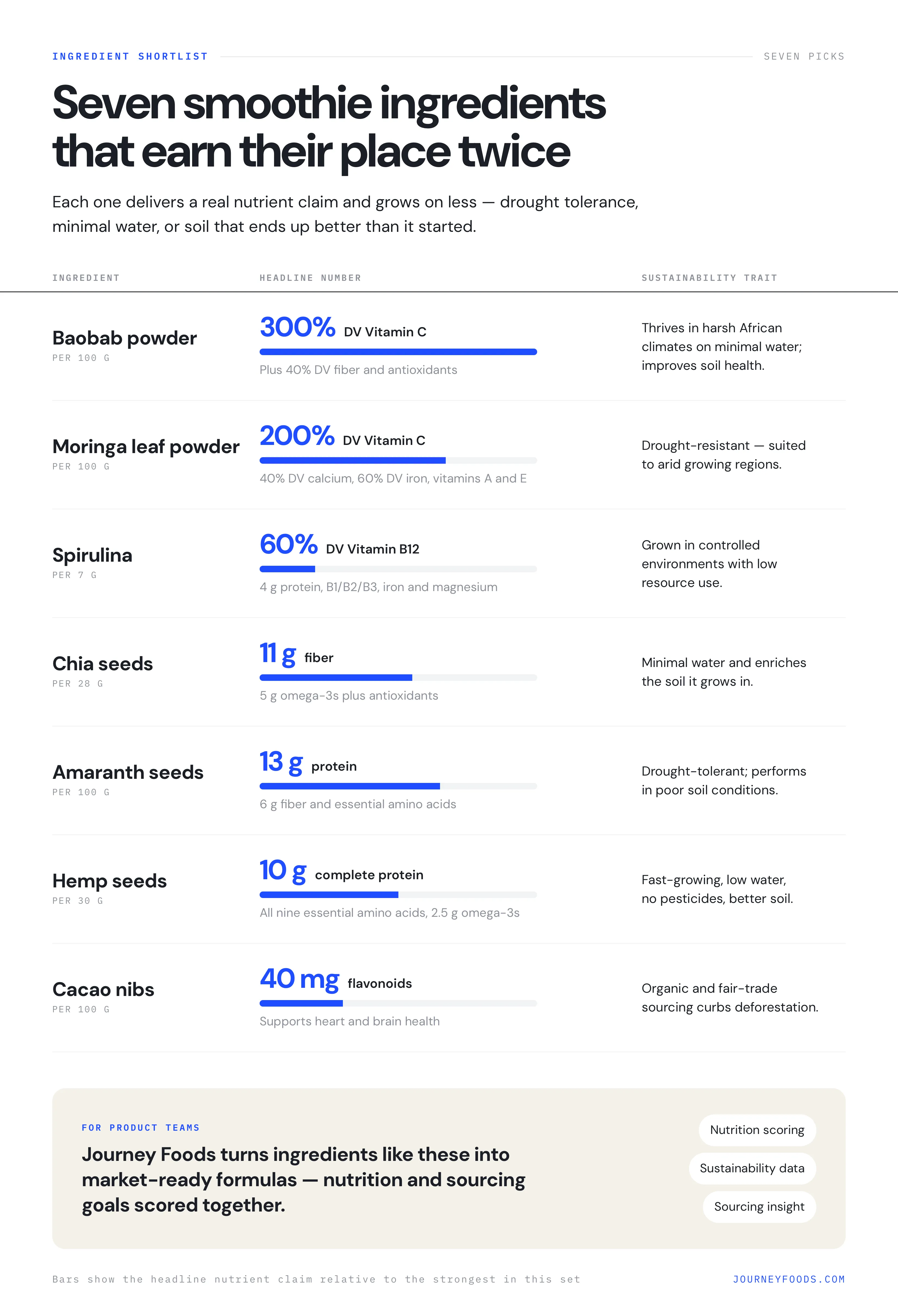
  1. Moringa Leaf Powder
    • Nutrients: High in vitamins A, C, and E, plus calcium, potassium, and iron.
    • Stats: 100 grams provide 200% of the Daily Value (DV) for Vitamin C, 40% for calcium, and 60% for iron.
    • Sustainability: Moringa is drought-resistant, making it ideal for arid regions.
  2. Baobab Powder
    • Nutrients: Packed with Vitamin C, fiber, and antioxidants.
    • Stats: 100 grams offer 300% of the DV for Vitamin C and 40% for fiber.
    • Sustainability: Thrives in Africa’s harsh climates with minimal water and improves soil health.
  3. Hemp Seeds
    • Nutrients: Complete protein source with all nine essential amino acids, plus omega-3 and omega-6 fatty acids.
    • Stats: 30 grams provide 10 grams of protein and 2.5 grams of omega-3s.
    • Sustainability: Grows quickly with minimal water and no pesticides, improving soil health and reducing carbon footprint.
  4. Spirulina
    • Nutrients: Rich in protein, vitamins B1, B2, and B3, and minerals like iron and magnesium.
    • Stats: 7 grams provide 4 grams of protein and 60% of the DV for Vitamin B12.
    • Sustainability: Cultivated in controlled environments with low resource use.
  5. Chia Seeds
    • Nutrients: Excellent source of fiber, omega-3 fatty acids, and antioxidants.
    • Stats: 28 grams offer 11 grams of fiber and 5 grams of omega-3s.
    • Sustainability: Requires minimal water and enriches soil, promoting sustainable farming.
  6. Amaranth Seeds
    • Nutrients: High in protein, fiber, and essential amino acids.
    • Stats: 100 grams provide 13 grams of protein and 6 grams of fiber.
    • Sustainability: Drought-tolerant and grows well in poor soil conditions.
  7. Cacao Nibs
    • Nutrients: Rich in flavonoids, which support heart and brain health.
    • Stats: 100 grams contain about 40 mg of flavonoids.
    • Sustainability: Organic and fair-trade cacao helps reduce deforestation and supports local communities.

Boost Your Smoothie and Support Sustainability

Incorporating these unique ingredients into your smoothies not only diversifies your diet but also helps support a greener planet. For companies interested in integrating these ingredients into their products, Journey Foods offers AI-driven tools to streamline the development process. Their technology helps create market-ready products that align with both nutritional and environmental goals.

So, next time you’re blending a smoothie, try adding one of these innovative ingredients. Your taste buds and the planet will appreciate it! For businesses, Journey Foods can turn these exciting ingredients into successful market solutions.

About the Author
Riana Lynn

Scientist. Nutrition Leader. Founder of Journey Foods

Frequently asked questions

Structured Q&A  marked up with FAQ Page schema so it can be surfaced and cited by Al engines and search.

Is plant based reformulation actually cheaper than 
animal protein?

In Journey Al's 12 month dataset, the median plant protein reformulation came in -6.5% on raw material cost versus an animal protein control the first year that line went negative, driven by Tier 1 isolate suppliers reaching spec parity.

How much does plant based reformulation improve 
nutrition scores?

In Journey Al's 12 month dataset, the median plant protein reformulation came in -6.5% on raw material cost versus an animal protein control the first year that line went negative, driven by Tier 1 isolate suppliers
reaching spec parity.

What's the supply chain risk of switching?

In Journey Al's 12 month dataset, the median plant protein reformulation came in -6.5% on raw material cost versus an animal protein control the first year that line went negative, driven by Tier 1 isolate suppliers
reaching spec parity.

back-to-top