
Riana Lynn
Riana Lynn

Ingredient Insights: The Power of Quinoa: A Sustainable Superfood with Nutritional Benefits

Quinoa is a nutrient-packed, sustainable superfood that offers complete protein, high fiber, and essential micronutrients, making it a popular choice for health-conscious consumers. With its minimal water usage and eco-friendly farming practices, quinoa is also an ideal ingredient for companies focused on sustainability. Journey Foods helps businesses unlock quinoa’s full potential by providing AI-driven insights to optimize formulations, align with consumer trends, and track sustainability.
Riana Lynn
5 mins
January 24, 2025
Share Article
linkfacebooktiwtter
Tags
Ingredient Insights
Quick Answer

Plant based reformulation is growing because it now wins on economics, not just values across Journey Al data it moves the nutrition score +26.9%, cuts cradle to  gate CO2e -42% per serving, and lowers raw material cost  -6.5% versus an animal protein control while cutting supplier lead times from 14 weeks to 6.

Key takeways
check-icon
It's an economics story. Plant-based now hits four reported metrics at once margin, scope-3, nutrition, and traceability.
check-icon
The supply base caught up. Tier-1 pea, faba, and chickpea isolates reached spec parity with whey this year.
check-icon
Speed is the unlock. A three-week supplier email chain becomes a four-minute query with ingredient intelligence.

In a world where consumers prioritize both health and sustainability, quinoa has emerged as a key ingredient that meets these needs. Once a staple of ancient civilizations, quinoa is now a modern superfood that offers numerous health benefits and helps support eco-conscious food production.
Nutritional Benefits of Quinoa

Quinoa is packed with essential nutrients that make it an attractive choice for health-conscious consumers:

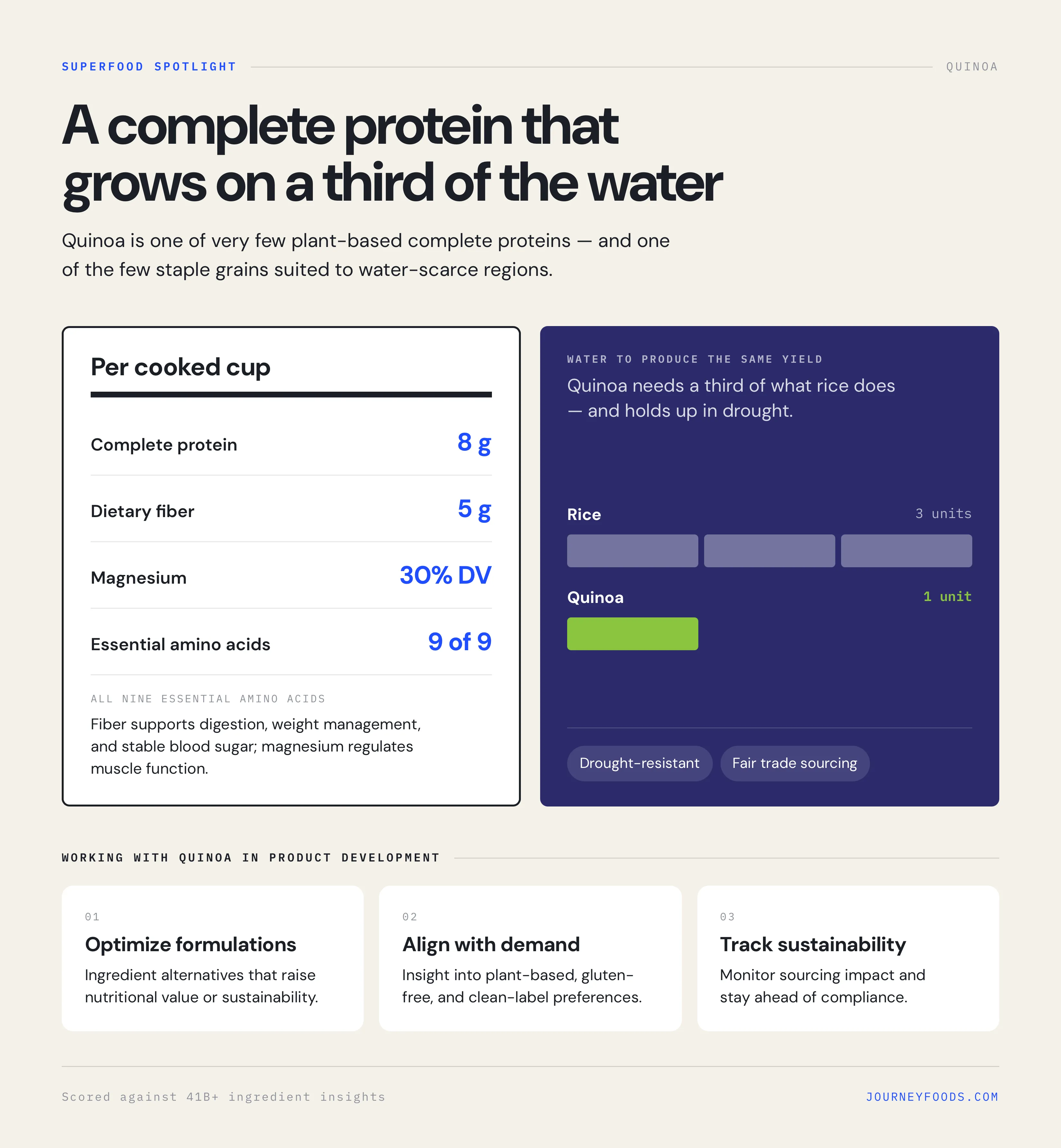
  • Complete Protein: Quinoa contains all nine essential amino acids, making it one of the few plant-based complete proteins. With 8 grams of protein per cup, it’s an excellent choice for vegans and vegetarians.
  • High in Fiber: Quinoa is rich in fiber, providing 5 grams per cup, which supports digestive health, weight management, and stable blood sugar levels.
  • Micronutrients: It’s also an excellent source of important vitamins and minerals, such as 30% of your daily magnesium needs, which helps regulate muscle function and blood sugar levels.

Sustainability: Quinoa’s Eco-Friendly Edge

Quinoa is a sustainable crop that requires 1/3 of the water used by rice to produce the same amount. It’s drought-resistant, making it well-suited for water-scarce regions, and it is increasingly grown with fair trade and sustainable practices.

How Journey Foods Can Help

For food companies looking to harness quinoa’s potential, Journey Foods provides AI-driven insights to optimize product development. Their platform analyzes over 41 billion ingredient insights, helping businesses:

  • Optimize formulations: Journey Foods can suggest ingredient alternatives to enhance nutritional value or sustainability.
  • Align with consumer trends: The platform offers insights into consumer preferences for plant-based, gluten-free, and clean-label products.
  • Track sustainability: Journey Foods helps companies monitor the environmental impact of quinoa sourcing and ensure compliance with regulations.

Conclusion

Quinoa isn’t just a superfood; it’s also a sustainable solution for the future of food. With Journey Foods’ AI-powered tools, businesses can innovate with quinoa in a way that’s both nutritious and eco-friendly. The future of food is green, clean, and quinoa-powered.

About the Author
Riana Lynn

Scientist. Nutrition Leader. Founder of Journey Foods

Frequently asked questions

Structured Q&A  marked up with FAQ Page schema so it can be surfaced and cited by Al engines and search.

Is plant based reformulation actually cheaper than 
animal protein?

In Journey Al's 12 month dataset, the median plant protein reformulation came in -6.5% on raw material cost versus an animal protein control the first year that line went negative, driven by Tier 1 isolate suppliers reaching spec parity.

How much does plant based reformulation improve 
nutrition scores?

In Journey Al's 12 month dataset, the median plant protein reformulation came in -6.5% on raw material cost versus an animal protein control the first year that line went negative, driven by Tier 1 isolate suppliers
reaching spec parity.

What's the supply chain risk of switching?

In Journey Al's 12 month dataset, the median plant protein reformulation came in -6.5% on raw material cost versus an animal protein control the first year that line went negative, driven by Tier 1 isolate suppliers
reaching spec parity.

back-to-top