Tastewise Alternatives for CPG Teams That Need Formulation Control Alongside Trend Data


Quick answer
Tastewise is good at one thing: telling you what consumers want. Social listening, trend prediction, flavor signals pulled from millions of data points. If your job is figuring out which flavor profiles are gaining traction or what macro categories are heating up, it does that well.
But that's where it stops. No formulation tools. No ingredient scoring. No supply chain alerts. No version-controlled records. Once you know a trend is real, you're on your own to translate it into an actual product.
For CPG teams managing 3 to 15 active formulations at once, that gap is a real problem. Trend data without formulation infrastructure means you're still bouncing between spreadsheets, email chains, and disconnected tools to get from insight to launch. Here's what's actually worth considering in 2026 — specifically for teams that need both.
Quick Answer: Tastewise is a consumer trend intelligence platform, not a formulation or ingredient management tool. CPG teams that need to act on trend data — not just observe it — need a platform that also handles ingredient scoring, supply chain monitoring, and formulation workflow. Journey Foods, Trace One, HowGood, and Genesis R&D each address different parts of that gap.
Key Takeaways:
Why CPG Teams Outgrow Tastewise
Tastewise processes social media, restaurant menus, and retail data to surface emerging flavor trends, ingredient popularity signals, and consumer preference shifts. That's genuinely useful for innovation pipeline planning.
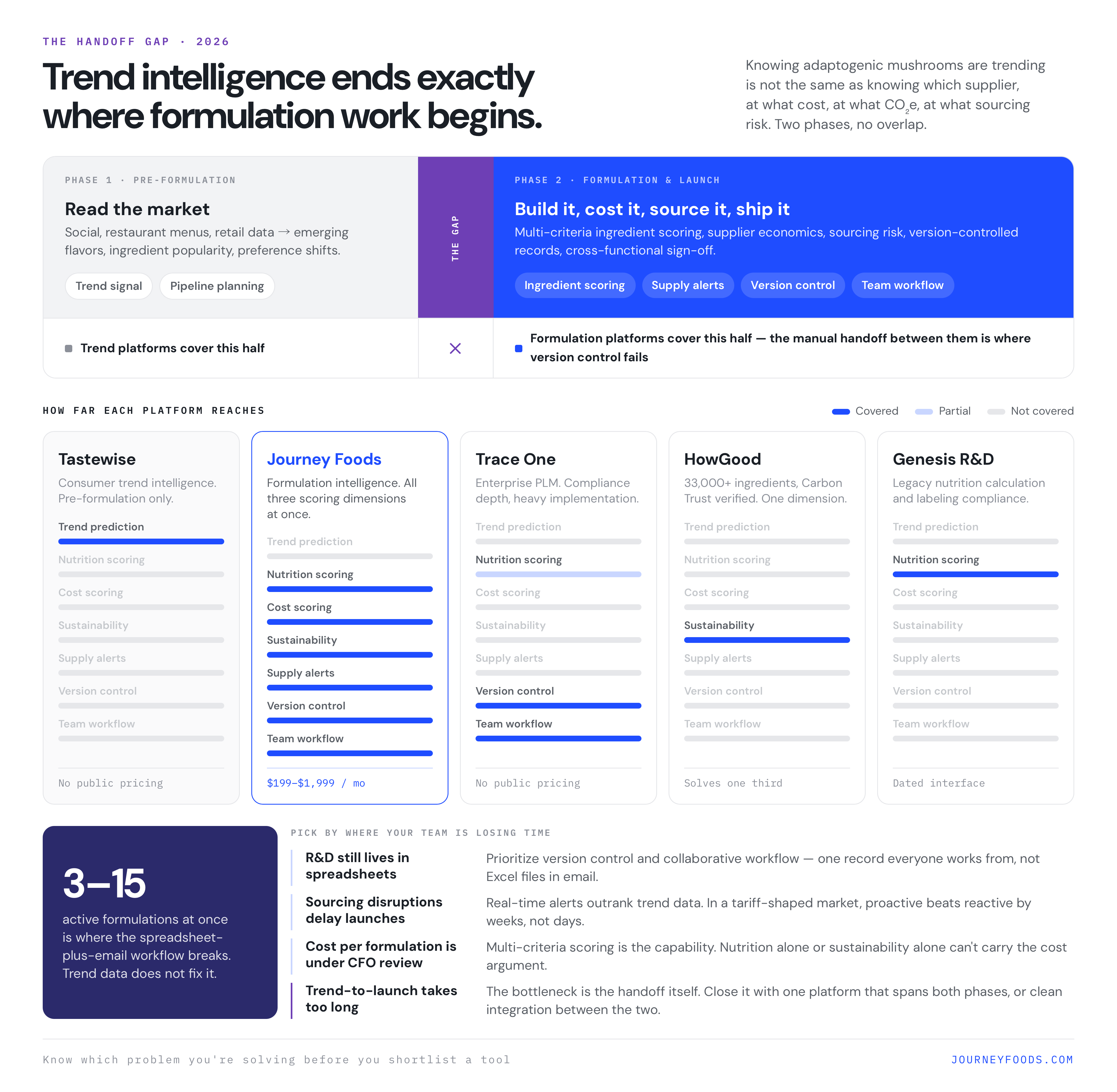
The limitation is structural. Tastewise is consumer-trend-focused, not ingredient-centric. It can tell you that adaptogenic mushrooms are trending in functional beverages. It cannot tell you which supplier offers the best cost-per-unit, what the CO2e impact of that ingredient is, or whether your current formulation is at supply chain risk because of a sourcing disruption.
R&D leads and food scientists don't just need to know what's trending. They need to build it, cost it, source it, and launch it without losing version control along the way. That's a different problem set entirely.
The Four Alternatives Worth Evaluating
Journey Foods: Formulation Intelligence With Multi-Criteria Scoring
Journey Foods is the most direct answer for teams that need to act on trend data rather than just collect it. The platform combines ingredient intelligence, supply chain monitoring, and collaborative formulation management in a single workspace.
The core AI engine — Operations Scientist — scores ingredients simultaneously across nutrition, cost, and sustainability. Not three separate reports you reconcile manually. One scoring layer where R&D, procurement, and finance work from the same data at the same time.
Here's what that looks like in practice. You've identified a trend signal: a shift toward high-protein, low-glycemic snack formats. In Tastewise, that's where the workflow ends. In Journey Foods, you can immediately query ingredient options scored against your formulation targets, get real-time supply chain alerts on sourcing risk, and maintain version-controlled records as the formulation evolves. The platform is built for cross-functional teams — so the R&D lead, procurement manager, and finance stakeholder aren't working from separate spreadsheets or waiting on email updates.
Pricing starts at $199/month and scales to $1,999/month for enterprise teams with 50 users, product optimization AI, and customer reporting. For mid-market CPG brands with a $30,000 to $150,000 annual SaaS budget, the Group tier at $999/month for 10 users is typically the right entry point.
If ingredient cost optimization is a priority alongside formulation work, the food ingredient cost optimization approach CPG teams use to cut costs without sacrificing quality is worth reading before you evaluate.
Explore the full platform at journeyfoods.io or book a demo at journeyfoods.io/book-a-demo.
Trace One: Enterprise PLM With Compliance Depth
Trace One is an enterprise product lifecycle management platform built for large food and beverage companies. It has deep compliance capabilities, a 2026 AI copilot addition, and a track record in highly regulated categories.
The tradeoffs are significant for mid-market teams. Implementation is complex, pricing is well above mid-market platforms, and it doesn't offer real-time supply chain intelligence or multi-criteria ingredient scoring at the depth of purpose-built ingredient management tools. If you're a large CPG company with a dedicated implementation team and compliance as your primary driver, it belongs on your list. If you're a 50 to 200 person brand trying to move fast, the overhead will slow you down.
Trace One does not publish pricing publicly.
HowGood (Latis): Sustainability Intelligence, Single Dimension
HowGood covers sustainability data for 33,000-plus ingredients with Carbon Trust verification. Six of the top ten food companies use it — which confirms the enterprise demand for this category. If sustainability scoring is your primary gap, it's a serious tool.
The limitation is scope. HowGood is single-dimension: sustainability only. No cost optimization, no nutrition scoring, no collaborative formulation development, no supply chain alerts. For teams that need to score an ingredient across all three criteria simultaneously, HowGood solves one-third of the problem.
Genesis R&D: Nutrition Calculation and Labeling
Genesis R&D is a legacy nutrition calculation and food labeling tool with an established compliance engine. Most food scientists have used it at some point in their career.
The gaps are real in 2026. The interface is dated, there's no supply chain integration, and the platform doesn't support the kind of collaborative, cross-functional workflow modern CPG teams require. It's solid for nutrition compliance work. It's not a formulation intelligence platform.
For teams evaluating Genesis R&D alongside other options, the ESHA alternatives comparison for CPG teams that need more than nutrition analysis in 2026 covers the broader nutrition-tool category in more depth.
The Capability Gap Tastewise Leaves Open
Here's the map:
CapabilityTastewiseJourney FoodsTrace OneHowGoodGenesis R&DConsumer trend predictionYesNoNoNoNoIngredient scoring (nutrition)NoYesPartialNoYesIngredient scoring (cost)NoYesNoNoNoIngredient scoring (sustainability)NoYesNoYesNoFormulation version controlNoYesYesNoNoReal-time supply chain alertsNoYesNoNoNoCollaborative team workflowNoYesYesNoNoMulti-criteria simultaneous scoringNoYesNoNoNo
The pattern is clear. Tastewise occupies the pre-formulation phase. Every other tool in this table operates in the formulation and ingredient management phase. There's no overlap.
For CPG teams, the question isn't whether trend data is valuable. It is. The question is whether you have the infrastructure to act on it. If the answer is no, adding another trend intelligence tool doesn't fix the problem.

Journey Ingredient Intelligence
Mushrooms (White Button)
It can tell you that adaptogenic mushrooms are trending in functional beverages.
A legume of the family Fabaceae, also known as garbanzo bean.
What to Look for in a Tastewise Alternative
The right criteria depend on where your team is actually losing time.
If your R&D team is still working in spreadsheets, the priority is formulation version control and collaborative workflow. You need a platform where everyone works from the same record — not emailing Excel files back and forth.
If supply chain disruptions are slowing launches, real-time supply chain alerts matter more than trend data. The 2026 tariff environment has made reactive sourcing expensive. Proactive alerts are the difference between a reformulation that takes two weeks and one that takes four months.
If cost-per-formulation is under CFO scrutiny, multi-criteria ingredient scoring is the capability you need. Scoring on nutrition alone, or sustainability alone, doesn't help you make the cost argument internally.
If you need to move from trend to launch faster, the bottleneck is usually the handoff between trend intelligence and formulation work. A platform that handles both — or integrates cleanly with what you already use — closes that gap.
The best AI-powered ingredient management platforms for CPG companies in 2026 covers this evaluation framework in more depth if you're building an internal business case.
A Note on Combining Tools
Some teams run Tastewise alongside a formulation platform. That's a reasonable approach if your organization has the budget and the workflow discipline to maintain two systems without creating data silos.
The risk is version control. When trend insights live in one platform and formulation records live in another, the handoff between them is manual. Manual handoffs create gaps. Gaps create the kind of version-control failures that slow launch timelines and generate rework.
If you're running two tools, make sure the formulation platform has strong enough workflow and collaboration features to compensate for the integration overhead. API access and third-party integrations matter here. Journey Foods supports both.
How to Evaluate Your Options
Before booking demos, answer these questions internally:
The food formulation software market overview for 2026 is a useful reference for structuring that internal evaluation.
FAQs
What does Tastewise actually do, and what doesn't it do?
Tastewise is a consumer trend intelligence platform. It uses AI to analyze social media, restaurant menus, and retail data to surface emerging flavor trends and consumer preferences. It does not offer ingredient-level data, formulation development tools, supply chain monitoring, or version-controlled formulation records. It's a pre-formulation research tool — not a product development platform.
What is the best Tastewise alternative for CPG teams that need formulation control?
Journey Foods is the most direct alternative for teams that need to move from trend insight to formulation execution. It combines ingredient scoring across nutrition, cost, and sustainability with real-time supply chain alerts, version-controlled formulation records, and collaborative workflow tools for R&D, procurement, and finance. Trace One covers enterprise PLM with compliance depth. HowGood covers sustainability scoring. Genesis R&D handles nutrition calculation and labeling. None of the alternatives except Journey Foods address all three scoring dimensions simultaneously.
Can you use Tastewise alongside a formulation platform?
Yes. Some CPG teams run Tastewise for trend intelligence and a separate platform for formulation management. The risk is manual handoffs between systems, which can create version-control failures and slow launch timelines. If you run both, the formulation platform needs strong API access and collaboration features to minimize that overhead.
Does Journey Foods replace Tastewise?
Not directly. Journey Foods doesn't offer consumer trend prediction from social or restaurant data. What it handles is everything that comes after a trend signal: ingredient evaluation, formulation development, cost and sustainability scoring, supply chain monitoring, and team collaboration. If trend intelligence is a core workflow, you may still want a dedicated tool for that layer.
What should CPG teams prioritize when evaluating formulation platforms in 2026?
The most common gaps are multi-criteria ingredient scoring (nutrition, cost, and sustainability together), real-time supply chain alerts, formulation version control, and cross-functional team access. Platforms that address only one dimension — sustainability-only or nutrition-only tools — require additional tools to cover the rest. The 2026 tariff environment has made supply chain alerting a higher priority than it was two years ago.
How much does Journey Foods cost compared to Tastewise?
Journey Foods pricing starts at $199/month and scales to $1,999/month for enterprise teams. Tastewise does not publish public pricing. For mid-market CPG brands, Journey Foods' Group tier at $999/month for 10 users is typically the relevant comparison point.
What makes multi-criteria ingredient scoring different from single-dimension tools?
Single-dimension tools — sustainability-only platforms or standalone nutrition calculators — give you one answer at a time. Multi-criteria scoring evaluates an ingredient against nutrition, cost, and sustainability targets simultaneously, in a single query. That matters because reformulation decisions always involve tradeoffs across all three dimensions. Scoring them separately means reconciling three reports manually, which takes time and creates errors. Scoring them together surfaces tradeoffs immediately.
The Bottom Line
Tastewise is a useful tool for the right use case. If your team needs consumer trend intelligence to guide innovation pipeline decisions, it does that job.
It does not do formulation. It does not score ingredients. It does not alert you when a key supplier is at risk. For CPG teams that need to move from trend signal to finished product, the gap it leaves is significant.
The alternatives each cover different parts of that gap. Journey Foods covers the most ground for mid-market teams: ingredient intelligence, supply chain monitoring, formulation management, and cross-functional collaboration in a single platform. Trace One goes deeper on enterprise compliance. HowGood goes deeper on sustainability. Genesis R&D handles nutrition labeling.
Know which problem you're actually solving before you evaluate. That question determines which tool belongs on your shortlist.
Explore what Journey Foods covers at journeyfoods.io, or book a demo to see the Operations Scientist engine in action.

Journey Ingredient Intelligence
Beef (Ground)
Journey Foods covers the most ground for mid-market teams: ingredient intelligence, supply chain monitoring, formulation management, and cross-functional collaboration…
A South American tree in the family Lecythidaceae.
As published
$199
Journey Ingredient Intelligence · Comparison
Mushrooms (White Button)
Beef (Ground)
Data from this story
Shareable Journey Intelligence
Tastewise Alternatives for CPG Teams That Need Formulation Control Alongside Trend Data
Industry Insights
$199
Pricing starts at $199/month and scales to $1,999/month for enterprise teams with 50 users, product optimization AI, and customer reporting.
$30,000
For mid-market CPG brands with a $30,000 to $150,000 annual SaaS budget, the Group tier at $999/month for 10 users is typically the right entry point.