
.svg)
.svg)
.svg)
.svg)


.svg)
ESHA does one thing well: nutrition calculation. If your job is generating a compliant nutrition facts panel and nothing else, it works. But most CPG product teams in 2026 are not doing just that one thing.
You are trying to hit a nutrition target, stay within a cost range, meet sustainability commitments, source from a reliable supplier, and get the formula approved before your launch window closes. ESHA was not built for that workflow. It was built for a narrower era of food development.
Here is what ESHA actually covers, where it stops, and which alternatives make sense depending on what your team actually needs.
ESHA's core product is nutrition analysis. You input ingredients, it calculates nutrient values, and it helps you produce FDA-compliant nutrition facts panels. For a registered dietitian generating labels or a food scientist doing basic compliance work, that functionality is solid and well-established.
The gaps show up fast once your work expands beyond label generation.
ESHA has no supply chain integration. It does not tell you whether an ingredient is available, at what price, or from which supplier. There are no real-time alerts when a key ingredient faces a shortage, no cost scoring, no sustainability criteria. And it is not built for collaborative workflows where multiple people are iterating on the same formulation at the same time.
For CPG teams managing active product pipelines, those are not minor inconveniences. They are the difference between shipping on time and missing a launch window entirely.
Not every team needs the same replacement. The right alternative depends on which gap is causing the most friction.
These tools go beyond nutrition calculation to cover ingredient discovery, cost modeling, supply chain monitoring, and team collaboration — everything in one place.
Journey Foods sits in this category. The platform's Operations Scientist AI engine scores ingredients across nutrition, cost, and sustainability simultaneously. You are not running three separate analyses and reconciling the outputs. You are working from a single scored view of every ingredient decision.
The platform also includes version-controlled formulations, real-time supply chain alerts, and AI-driven recommendations when an ingredient becomes unavailable or cost-prohibitive. Teams at mid-market CPG brands and funded food startups use it to compress timelines that would otherwise stretch across weeks of back-and-forth between R&D, procurement, and supply chain.
Pricing starts at $199 per month for solo users and scales to $1,999 per month for teams of up to 50, with custom enterprise tiers available. That range covers funded startups through multi-brand enterprises without requiring an IT implementation project. You can explore the platform at journeyfoods.io.
HowGood (now Latis) is the most prominent tool in this category. It covers more than 33,000 ingredients and is used by six of the top ten food companies. If your primary need is sustainability scoring for reporting or procurement decisions, it is a serious option.
The limitation is scope. HowGood does not handle cost optimization, nutrition scoring, or collaborative formulation workflows. It answers the sustainability question well. It does not help you build and iterate on a product.
Trace One has strong product lifecycle management heritage and added an AI copilot in 2026. It is a capable system for large enterprises with complex multi-brand portfolios and dedicated IT resources.
The tradeoff is implementation complexity and cost. Trace One is not designed for mid-market teams that need to move fast. It is also weak on real-time supply chain intelligence — which is increasingly a non-negotiable capability for teams managing ingredient risk.
Genesis R&D is the closest functional equivalent to ESHA. It has an established nutrition calculation engine and handles label generation competently. Like ESHA, it runs on a legacy interface and has no supply chain integration.
If you are simply looking to move off ESHA without changing your workflow, Genesis R&D is a lateral move. If you are trying to solve the broader problem of fragmented product development data, it does not close the gap.
Teams rarely search for ESHA alternatives because they need better nutrition math. It is usually one of three situations:
A product launch slipped. An ingredient became unavailable or too expensive mid-development, and the team had no early warning. By the time procurement flagged it, the formulation was locked and the launch window was gone.
The team is working from different versions. R&D has one spreadsheet, procurement has another, and the supplier has a third. No one is confident they are looking at the same formula.
Sustainability reporting arrived. A retailer or investor is asking for ingredient-level sustainability data, and the team has no systematic way to produce it.
ESHA does not solve any of these. A nutrition calculator is the wrong tool for supply chain risk, version control, or sustainability scoring. The question is not "what replaces ESHA's nutrition engine" — it is "what platform handles the full scope of what modern CPG product development actually requires."
That is a meaningfully different question, and it points toward a different category of tool.
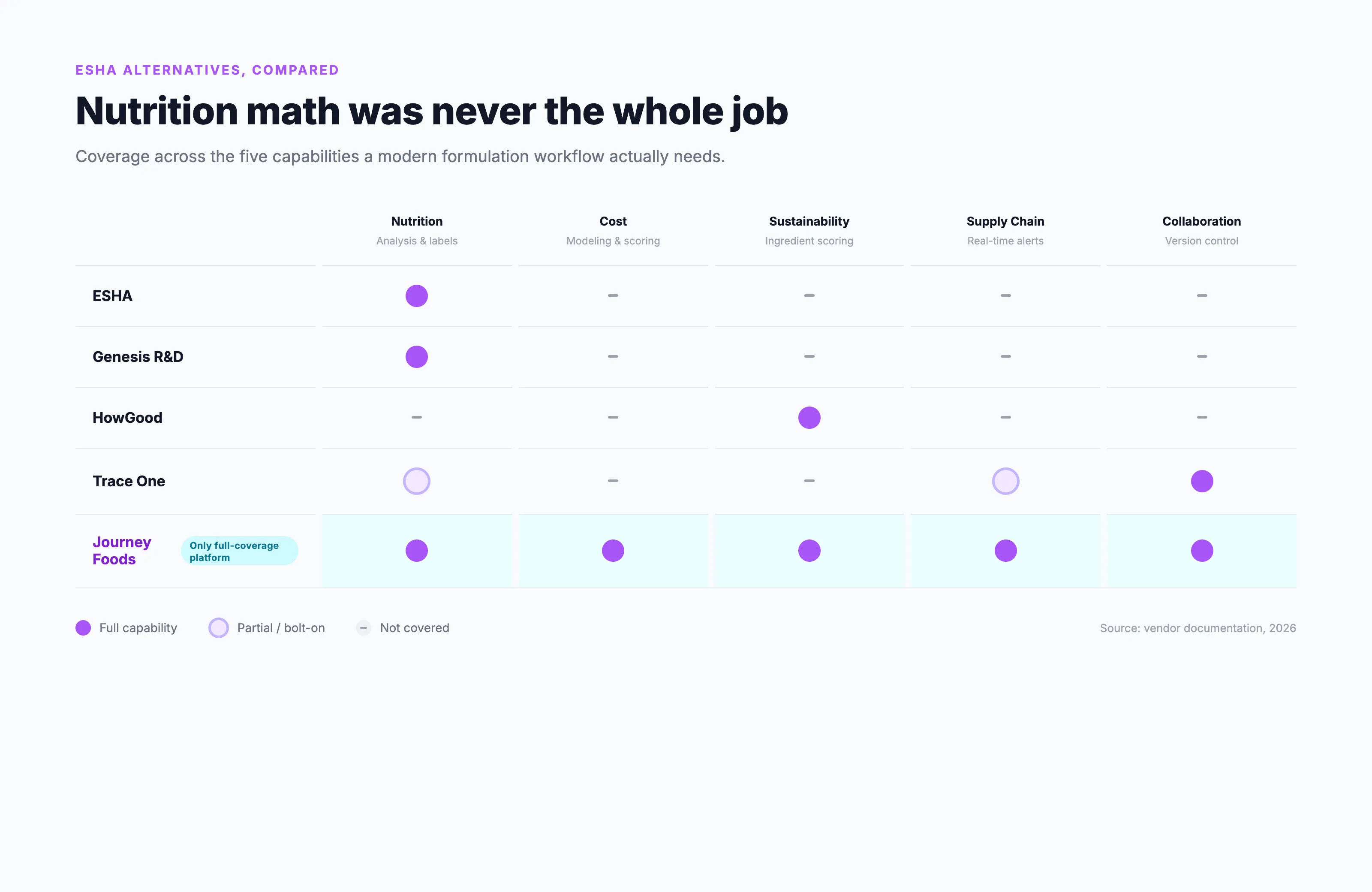
These are the capabilities that separate a nutrition calculator from a full product development platform:
The food product development platform evaluation guide on the Journey Foods blog walks through this framework in more detail if you want a structured comparison methodology.
One scenario where ESHA's gaps become especially costly is clean label reformulation. When you are replacing a synthetic additive, you need to know whether the alternative ingredient performs nutritionally, whether it costs the same or more, and whether it is reliably available from your current supplier network.
A nutrition calculator tells you the first part. It tells you nothing about the second or third. Teams doing active clean label formulation work need a platform that handles all three criteria at once — because an ingredient swap that improves the nutrition panel but blows the cost target or creates a supply risk is not a solution. It is a different problem.
ESHA is a nutrition analysis tool. If that is all you need, it does that job. But CPG product teams in 2026 are not operating in a world where nutrition analysis is the only variable that matters.
The teams launching faster are working from platforms that score ingredients across nutrition, cost, and sustainability simultaneously, surface supply chain risk before it becomes a delay, and keep everyone working from a single source of truth.
If you are evaluating alternatives because your current workflow is slowing you down, the right question is not which tool calculates nutrients better. It is which platform closes the gap between ingredient discovery and a product that ships on time, on cost, and on brief.
See how Journey Foods handles the full workflow. Book a demo at journeyfoods.io/book-a-demo.
What is the main limitation of ESHA for CPG product development?
ESHA handles nutrition calculation and label generation well, but it has no supply chain integration, no cost or sustainability scoring, and no collaborative formulation tools. For teams managing active product pipelines with multiple stakeholders, those gaps create significant friction.
What is the best ESHA alternative for teams that need supply chain monitoring?
Journey Foods is built specifically for this use case. It combines nutrition scoring with cost and sustainability analysis, real-time supply chain alerts, and AI-driven ingredient alternatives in a single platform — designed for mid-market CPG teams and funded food startups that need those capabilities without an enterprise-scale implementation.
Is Genesis R&D a good ESHA alternative?
Genesis R&D is a comparable nutrition calculation tool with a similar scope. If you are doing a direct swap and do not need supply chain integration or multi-criteria ingredient scoring, it is a functional option. If you are trying to solve a broader product development problem, it does not offer meaningful new capability over ESHA.
How does HowGood compare to ESHA as an alternative?
HowGood focuses exclusively on sustainability scoring across a large ingredient database. It is not a nutrition calculator or a formulation tool. It solves a different problem than ESHA and would typically be used alongside a formulation platform, not as a direct replacement.
What should a CPG team look for in an ESHA alternative?
The key capabilities to evaluate: multi-criteria ingredient scoring (nutrition, cost, sustainability), real-time supply chain data and alerts, version-controlled collaborative formulation management, AI-driven ingredient recommendations, and fast implementation without heavy IT requirements.
Can Journey Foods replace ESHA entirely?
Journey Foods covers ingredient scoring across nutrition, cost, and sustainability, formulation management with version control, and supply chain monitoring. Teams that need FDA-compliant nutrition facts panel generation as a primary output should confirm that specific output format is supported for their use case during a demo.
What is the cost difference between ESHA and platforms like Journey Foods?
Journey Foods pricing starts at $199 per month for a single user and scales to $1,999 per month for teams of up to 50, with custom enterprise tiers available. The platform is structured to be accessible to mid-market teams — not just large enterprises — which is a meaningful difference from enterprise-only PLM systems.
Journey Foods Team News