
.svg)
.svg)
.svg)
.svg)


.svg)
Quick Answer: Journey Foods connects with the ERP, PLM, and supply chain systems your team already uses — so ingredient data, formulation records, and supplier alerts flow through one platform instead of living in disconnected tools. The integrations are built for food, beverage, and CPG companies that need real-time data alignment across R&D, procurement, and operations without rebuilding their existing tech stack.
Key Takeaways:
If you're evaluating whether Journey Foods fits your existing tech stack, the integration question is usually the first real blocker. Not because the platform is hard to connect — but because food and CPG companies have deeply entrenched systems, and nobody wants to rebuild workflows from scratch.
Here's what you actually need to know.
Most R&D and procurement teams don't suffer from a lack of tools. They suffer from too many tools that don't talk to each other.
Your ERP holds supplier pricing and purchase orders. Your PLM holds product specs and formulation history. Your quality system holds compliance documentation. And somewhere in the middle, your R&D team is emailing spreadsheets between all three.
That fragmentation isn't just annoying. It slows reformulation cycles, creates version conflicts, and means a supply chain disruption flagged in your ERP takes days to reach the R&D team that needs to act on it.
Journey Foods closes that gap. The platform acts as a connective layer — ingesting data from your existing systems, enriching it with AI-driven ingredient intelligence, and surfacing everything in a unified dashboard where the whole team works from the same source of truth.
ERP systems are the operational backbone of CPG companies. Supplier contracts, purchase order history, inventory levels, cost structures — it all lives there. Journey Foods integrates with leading ERP platforms to pull that data directly into the ingredient management workflow.
When your ERP connects to Journey Foods, cost data becomes part of the ingredient scoring process. The Operations Scientist AI engine evaluates an ingredient on nutrition and sustainability criteria and on real landed cost pulled from your procurement system — not a static estimate from a spec sheet.
That means when an R&D lead is evaluating a protein isolate substitution, they're seeing the actual cost delta. Decisions that used to require a three-week back-and-forth between R&D and procurement compress into a single query.
Supply chain alerts get sharper too. If your ERP flags a supplier as at-risk or shows a lead time extension, Journey Foods surfaces that signal in the formulation dashboard — so R&D and procurement see the same problem at the same time, not two days apart.
PLM systems are where formulation specs live. For most mid-to-large CPG companies, the PLM is the system of record for everything from ingredient declarations to regulatory compliance documentation.
The most common failure mode in food product development isn't a bad formula. It's version drift — where the spec in the PLM doesn't match what R&D is actively developing, because someone updated a formulation in a local file and never pushed the change upstream.
Journey Foods addresses this with version-controlled formulation tracking that syncs with connected PLM systems. When a formulation is updated in Journey Foods — a substitution made, a processing aid removed, a nutrient target revised — that change propagates to the connected spec record. Everyone working in the PLM sees the current version.
This matters most for teams running simultaneous reformulation projects across multiple SKUs. At that scale, version drift isn't just an inconvenience. It's a compliance and quality risk. Integration eliminates that exposure.
If you're comparing how Journey Foods handles formulation management against tools like Genesis R&D, the Genesis R&D vs Journey Foods comparison breaks down where the workflows diverge in practical terms.
Supply chain visibility tools generate a constant stream of signals: supplier risk scores, commodity price movements, lead time changes, geopolitical disruptions, weather events affecting raw material availability. Without integration, those signals sit in one system while the people who need to act on them sit in another.
Journey Foods ingests supply chain alerts and maps them directly to the ingredients and formulations they affect. If a key emulsifier supplier is flagged for capacity constraints, the platform identifies which active formulations use that ingredient, scores alternative suppliers against your cost, nutrition, and sustainability criteria, and surfaces ranked recommendations — without requiring a manual search.
This is where the Operations Scientist AI engine earns its place. It's not just aggregating alerts. It's connecting a supply chain signal to a formulation decision and generating a ranked set of options for your team to evaluate.
For procurement leads managing a broad supplier base, reactive sourcing becomes the exception rather than the default. You're not scrambling when a disruption hits — you're already looking at alternatives.
Beyond ERP and PLM, most food and CPG companies run separate systems for regulatory compliance, nutritional labeling, and quality assurance. These tools hold the documentation that sits between a formulation and a finished product on shelf.
Journey Foods integrates with specification management workflows so that ingredient data in the platform — nutritional profiles, allergen declarations, sustainability certifications — flows into compliance documentation without manual re-entry.
For teams managing products across multiple markets with different regulatory requirements, that's a meaningful time saving. An ingredient change that triggers a label update no longer requires a manual audit of every downstream document. The connected system catches it.
The ESHA vs Journey Foods comparison covers specifically where traditional nutritional compliance tools hit their limits when formulation complexity scales up — worth reading if your team is still running Genesis R&D or ESHA workflows.
Here's a realistic picture of how a mid-size CPG company's integration setup might look with Journey Foods at the center:
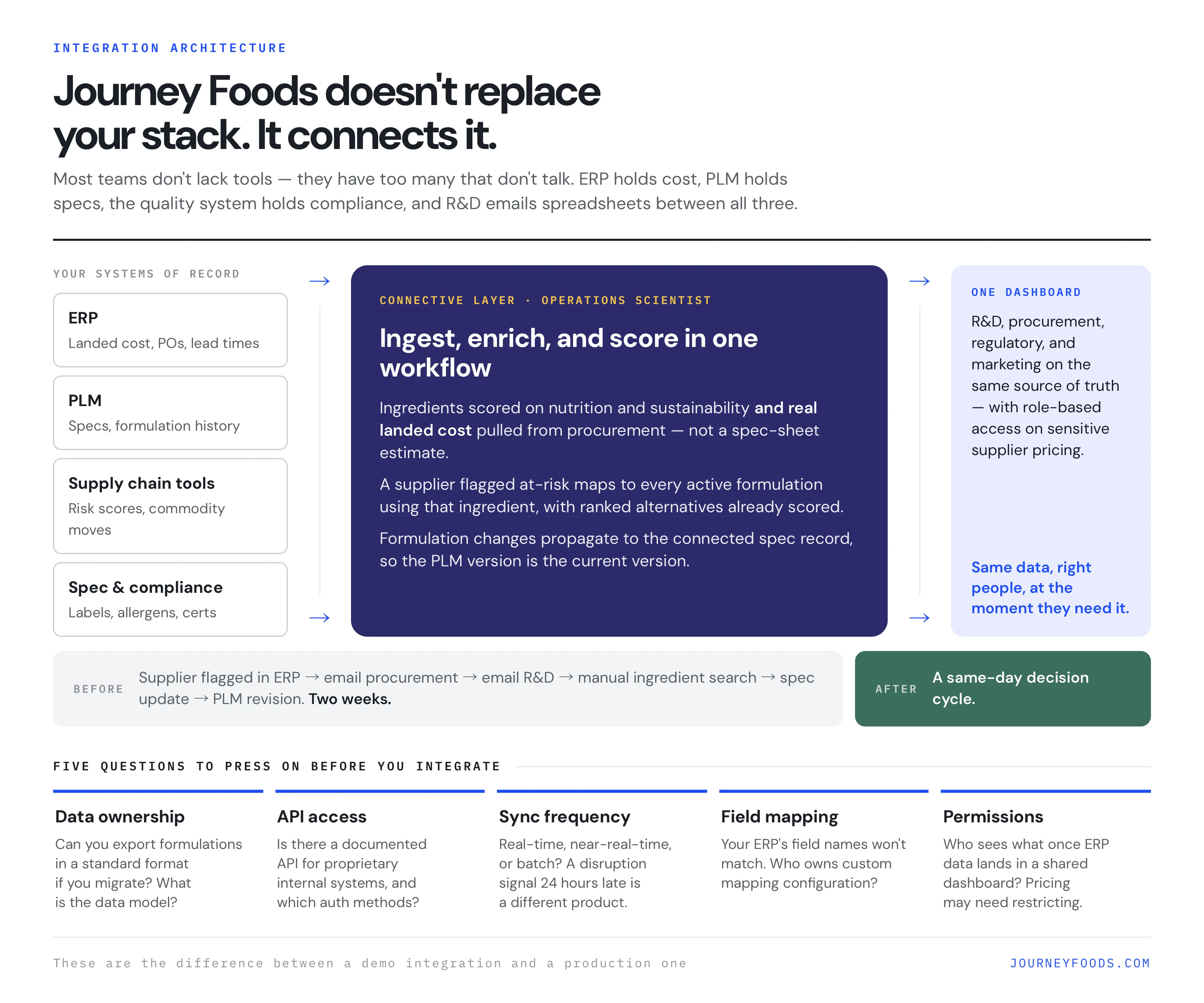
The result: a supply chain disruption that used to take two weeks to resolve — supplier flagged in ERP, email to procurement, email to R&D, manual ingredient search, spec update, PLM revision — compresses into a same-day decision cycle.
For teams evaluating where Journey Foods sits relative to other platforms, the best AI-powered ingredient management platforms for CPG companies in 2026 provides a broader market view.
If you're in a technical evaluation, these are the questions worth pressing on:
Data ownership and export: Can you pull your formulation data out of Journey Foods in a standard format if you ever need to migrate? What does the data model look like?
API access: Does the platform expose a documented API for custom integrations with internal tools or proprietary systems? What authentication methods does it support?
Sync frequency: Are integrations real-time, near-real-time, or batch? For supply chain alerts, latency matters. A disruption signal that arrives 24 hours late is a different thing entirely from one that arrives in minutes.
Field mapping flexibility: Your ERP's ingredient records probably don't use the same field names as Journey Foods' ingredient database. How does the platform handle custom field mapping, and who owns that configuration?
Permissions and access control: When data flows from your ERP into a shared dashboard, who can see what? Supplier pricing data may need to be restricted to procurement roles even within the same team.
These aren't gotcha questions. They're the difference between an integration that works in a demo and one that works in production.
For a broader framework on evaluating food product development platforms — including how to assess integration depth as part of a platform decision — the food product development platform evaluation guide covers the full criteria set.
Journey Foods isn't trying to replace your ERP or your PLM. Those systems hold institutional knowledge your team has spent years building. The platform's value is in connecting them — making the data inside those systems actionable for ingredient decisions instead of locked behind system boundaries.
The integration argument in one sentence: the same data, available to the right people, at the moment they need it.
If that's what your team is missing, the platform is worth a closer look at journeyfoods.io.
Does Journey Foods replace our existing ERP or PLM?
No. Journey Foods connects with your existing ERP and PLM systems — it doesn't replace them. It acts as a data and intelligence layer that pulls information from those systems into a unified ingredient management workflow.
What ERP systems does Journey Foods integrate with?
Journey Foods integrates with major ERP platforms including SAP and Oracle, among others. For a specific list of supported connectors, or to discuss a custom integration with an internal system, the best path is a direct conversation with the Journey Foods team at journeyfoods.io.
How does the platform handle formulation version control across connected systems?
When a formulation is updated in Journey Foods, the change syncs to connected PLM and specification management tools. The version in the PLM always reflects the current development state — which eliminates the drift that typically happens when R&D and systems teams work in separate tools.
Are supply chain alerts in Journey Foods real-time?
Journey Foods surfaces real-time supply chain alerts through its centralized dashboard. The latency of those alerts depends on integration configuration and data source — a direct API connection to a supply chain visibility tool will deliver faster signals than a batch sync.
What does the API look like for custom integrations?
Journey Foods exposes API access for teams that need to connect proprietary internal systems or build custom data pipelines. For documentation and technical specifications, the Journey Foods team can walk developers and engineers through the integration architecture directly.
How does Journey Foods handle sensitive procurement data like supplier pricing?
The platform supports role-based access controls, so supplier cost data and other sensitive procurement information can be restricted to appropriate team members even within a shared dashboard. Field-level permissions are configurable during integration setup.
Can we export our formulation data from Journey Foods?
Yes. Journey Foods supports data export so your formulation records remain accessible in standard formats. For specifics on data model and export options, confirm the details directly during a technical evaluation.
The integration question is really a data question. Where does your ingredient and formulation data live, who can see it, and how fast can it move when a decision needs to be made? Journey Foods is built to answer all three. Book a demo at journeyfoods.io to see how it maps to your specific stack.
Communications and PR leader